
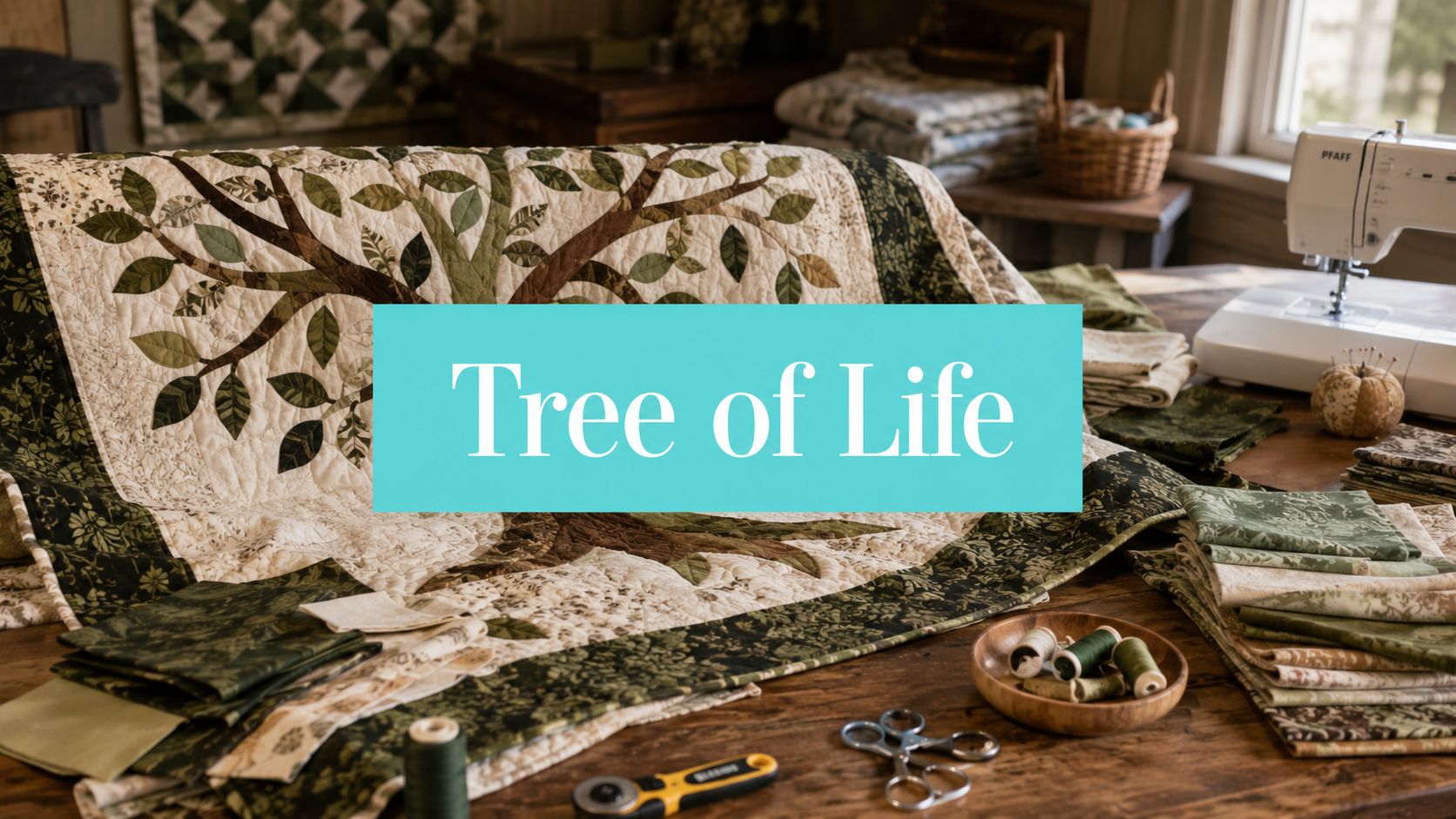
Making a Tree of Life quilt is absolutely achievable when you break it into clear stages. The pieced version can require exactly 73 fabric pieces in a single block, and one common version uses 32 Half Square Triangles and finishes at 20 inches, so success starts with choosing the right method, fabrics, and finishing plan before you cut.
If you're staring at a pattern stack, pulling fabrics, and wondering whether this project is too ambitious, take a breath. A beautiful Tree of Life quilt comes together one decision at a time: pieced or appliqué, cotton top or plush backing, home quilting or professional longarm finishing.
A striking Tree of Life quilt is very doable when you choose a pattern style early, cut accurately, and plan the finish from the start. That last part matters more than most quilters expect, especially if you want a soft backing and a polished result.
Meta description: Tree of Life quilt guide with piecing, appliqué, minky backing, and longarm prep tips. Get 15% off your first order and free shipping over $70!
Suggested URL slug: /blog/tree-of-life-quilt
How Should You Begin Your Tree of Life Quilt Project
The first decision isn't color. It's character.
A Tree of Life quilt carries a long visual history, and that history can help you decide what kind of version you want to make. The appliquéd Tree of Life design has roots in 18th-century Indian luxury textiles called palampores, and surviving examples from 1840 to 1850 are recognized by the Smithsonian's National Museum of American History as fine examples of this enduring design tradition in American quiltmaking (Smithsonian collection record).

That long lineage is part of the appeal. The motif traveled across textiles, fashion, and domestic needlework before becoming a familiar American quilt subject. If you enjoy studying regional style before choosing a project, these heirloom Southwest quilt designs are a useful comparison because they show how strong symbolic motifs change as makers adapt them to local traditions.
Should you choose piecing or appliqué
Appliqué gives you movement. Piecing gives you structure.
If you want branches that feel graceful and organic, appliqué usually fits the Tree of Life better. You can shape curves more freely, place birds or leaves where they balance well, and make the composition feel almost drawn onto the quilt.
Piecing creates a more architectural tree. It has a sharper, more geometric rhythm, and it's a strong choice if you enjoy unit construction, precise seam allowances, and the satisfaction of building an image from many smaller parts.
Practical rule: Choose appliqué if the silhouette matters most. Choose piecing if block construction is what you enjoy.
What makes a good starting plan
Before you buy fabric, settle these three points:
- Project style: Are you making a wall quilt, lap quilt, or larger bed quilt?
- Construction path: Will you use raw-edge appliqué, fused appliqué, or traditional piecing?
- Finish strategy: Will you quilt it yourself or send it out for professional quilting?
That last question affects yardage, backing choice, and how much handling the quilt top needs before it's finished. If you're still sorting out amounts, this post on calculating yardage for quilts helps prevent the most common planning mistake, which is underestimating backing and border needs.
A good Tree of Life quilt starts with restraint. Don't try to solve every design choice at once. Pick the construction method first, then build everything else around it.
What Fabrics and Tools Do You Really Need
Fabric choice determines how hard this quilt will be to make.
A Tree of Life design puts every decision on display. Branches show wobbly cutting. Small leaves expose bulky seam allowances. Busy backgrounds can swallow the trunk shape. Start with materials that behave well under pressing and repeated handling, especially if the quilt will later be packaged and shipped to a longarm service.
For the top, quilting cotton is still the best working fabric. It cuts cleanly, presses flat, and stays stable through piecing or appliqué. If you need a refresher on quality markers, this guide to cotton for quilting explains what separates quilting cotton from lighter craft fabric.
Which fabrics belong in the top
Choose fabric for clarity first, then personality.
Tree quilts often tempt quilters to overmix prints because the subject feels whimsical or symbolic. I get better results by keeping the trunk and branches fairly controlled, then letting the leaves, birds, or borders carry more print and color. The tree needs to read from across the room before the smaller details can shine.
For appliqué, use fabrics with enough body to hold a clean edge after fusing and stitching. For piecing, look for solids, tone on tones, or small scale prints that still read clearly after they are cut into narrow units. If a print loses its identity once it is trimmed to a small patch, save it for borders or backing.
A practical supply list looks like this:
- Top fabric: Quilting cotton for background, trunk, branches, leaves, and accent motifs
- Interfacing or fusible: Helpful for fused appliqué and any motif with tight curves or points
- Thread: Fine piecing thread for construction, plus matching or blending thread for appliqué
- Cutting tools: Rotary cutter, acrylic ruler, sharp scissors, and labels or trays for sorting units
- Pressing setup: Iron, pressing surface, and a pressing cloth if your appliqué fabrics scorch easily
Accuracy tools matter here more than specialty gadgets. A fresh blade and a ruler you trust will do more for this quilt than a drawer full of extras. Before anything goes to quilting, it also helps to review how to square a quilt top before longarm quilting, because a tree design can stretch out of square if the background and motif are handled unevenly.
Why your finishing plan affects what you buy now
Materials for the quilt top should match the finish you want.
If the quilt will be used often, choose top fabrics that can stand up to a softer, heavier backing and denser quilting. If you plan to send it to a professional longarmer, avoid unstable fabrics, loose weaves, or heavily embellished pieces that complicate loading and quilting. Those choices may look charming on the table and become frustrating on the frame.
Backing gets its own section later, but it belongs in your supply planning from the start. Cotton remains a solid choice for a traditional back, especially if you want a pieced look or easy prep. Minky changes the feel of the finished quilt, the drape, and the prep requirements, so it should influence thread, batting, and quilting plans before you ever cut the top.
Good tools make the project smoother. Good fabric makes it look intentional. On a Tree of Life quilt, both matter.
How Do You Cut and Assemble the Quilt Top
The cutting table is where a Tree of Life quilt either settles into order or starts drifting off course. This design asks for patience early, because small cutting errors show up fast in the trunk, branch angles, and background spacing.
A single pieced Tree of Life block can require exactly 73 individual fabric pieces, which is why this design has a reputation for rewarding precision and punishing casual cutting (AccuQuilt Tree of Life article).

How should you approach a pieced block
Start by treating the quilt as a set of parts, not one large top. Cut all like pieces together, stack them in labeled groups, and keep trunk, branches, leaves, and background separate. That sounds simple, but it prevents the most common assembly mistake I see. Similar green pieces get swapped, and the tree loses its shape before the quilter notices.
One advanced Tree of Life method uses 32 Half Square Triangles, often from 5-inch squares, arranged asymmetrically. Direction matters. A flipped unit can change the lean of a branch or turn the whole tree the wrong way. The same demonstration that shows the clip-and-flip method also covers fused construction options, which makes it a useful reference if you're deciding between piecing and appliqué in the same project (video demonstration of piecing and fusing methods).
A cutting and assembly workflow that holds up well looks like this:
- Cut all units before sewing. Batch cutting helps you compare pieces and catch size errors early.
- Lay out one full block or section. Check branch direction before stitching anything permanent.
- Sew subunits first. Small sections are easier to correct and press accurately.
- Press after every stage. Flat seams keep the tree outline crisp and reduce bulk where branches intersect.
- Check squareness before adding borders. A tree design can pull off grain if one side gets handled more than the other.
Use a layout surface if you have one. If not, even a clean floor works better than guessing from a stack beside the machine.
If the top starts to skew during assembly, fix that before you add the last rows. This guide on squaring a quilt top before longarm quilting is especially helpful for Tree of Life layouts, where uneven background sections can twist the whole quilt.
What works best for appliqué construction
Appliqué shifts the challenge from seam accuracy to placement accuracy. The shapes may be simpler to cut, but the composition has to stay balanced, or the tree looks awkward even if every edge is fused cleanly.
Some Tree of Life patterns use a Lop & Fuse method with 2.5-inch squares fused to marked iron-on interfacing using 4 yards of Lite Steam-A-Seam 2, producing a block that finishes at 20 inches. That approach keeps the tree elements stable during construction and can save time on a detailed motif.
For raw-edge appliqué versions, clear cellophane wrap helps hold branches and smaller shapes in place before final fusing and stitching, as described in a Tree of Life pattern overview (pattern details).
Start with the trunk, then build outward. If the trunk sits right, the branches and leaves are much easier to place well.
This is also the point to think ahead about quilting and backing. Dense seams, heavy fusibles, and bulky layered motifs can all affect how the quilt loads and stitches later, especially if you're planning a plush backing and a mail-in longarm finish. A top that goes together cleanly is easier to baste, easier to square, and far easier to quilt well.
Why Should You Choose Minky for Your Quilt Back
A Tree of Life quilt often starts as a showpiece. I like to finish it as something people will reach for on the sofa, drape across a bed, and use through winter. A good minky backing helps the quilt make that jump from decorative to thoroughly usable.

Cotton backing still has its place, especially on heirloom pieces or very crisp traditional quilts. But for a Tree of Life design with strong visual impact on the front, a plush back gives you comfort without asking the back of the quilt to compete for attention.
What makes minky a practical choice
Minky earns its spot because it changes how the finished quilt feels in daily use. It adds warmth, a soft hand, and enough body to make the quilt feel substantial without piecing an elaborate backing.
It also solves a problem many quilters run into on larger projects. Extra-wide minky can reduce or eliminate the need for a center backing seam, which means less matching, less bulk in the middle of the quilt, and less chance of that seam showing as a stiff line after quilting.
There is a trade-off. Minky stretches more than quilting cotton, and the pile can shift if it is cut or packed carelessly. That does not make it difficult. It means preparation matters more. If you want a clear overview of how plush backings behave, this guide on what cuddle minky fabric is explains the differences well.
My rule: If the backing is softer and stretchier, the prep needs to be more deliberate.
Which textures work best for winter quilts
Texture matters almost as much as color on a Tree of Life quilt. The front already carries the story. The backing should support that mood.
For winter quilts, I usually steer quilters toward embossed Luxe Cuddle options with a natural or understated texture. Luxe Cuddle Fawn is a strong choice when the quilt top uses earthy greens, browns, creams, or deep autumn tones because the texture feels organic without pulling focus from the piecing.
Other embossed textures can work well too, depending on the top:
- Fawn: warm, natural, and easy to pair with woodland or neutral palettes
- Snowy Owl: bright and cozy for winter color stories
- Hide: rustic texture with a richer look
- Marble: subtle movement without a strong directional effect
- Seal: deeper and moodier for saturated fabrics
If the top has a lot of appliqué, dense branch work, or heavily pieced background sections, I usually recommend keeping the backing simple and letting the quilting design do the rest. That balance reads better on the finished quilt, and it is easier to manage if you plan to send the project to a mail-in longarm service.
New to OPN Quilting? Enjoy 15% off your first order. Plus, all U.S. orders over $70 ship for free.
This short video gives a helpful sense of machine handling and plush fabric behavior in quilting.
A Tree of Life quilt already has beauty on the front. Minky on the back gives it the warmth and comfort that make people keep using it.
How Do You Prepare Your Quilt for a Longarm Service
The quilt is pieced, the backing is chosen, and the last thing you want is to lose accuracy in the final mile because the box was packed in a hurry.
Good longarm results start before the quilt ever reaches the frame. A Tree of Life design shows skew and drag quickly, especially through trunks, branches, and any strong vertical lines. If the top is stretched, the borders wave, or the backing is cut unevenly, the quilting can only do so much to correct it.

What should you do before packing the quilt
I treat prep as part of the quilting, not a separate chore. The cleaner the setup, the better the finish.
Before you pack your Tree of Life quilt, check these basics:
- Square and press the top. Flat seams and straight edges help the quilt load evenly.
- Trim loose threads. Dark thread tails can shadow behind light fabrics after quilting.
- Mark the top edge. Direction matters on tree motifs, borders, and any asymmetrical layout.
- Send each layer separately. Do not baste, pin, or fuse the sandwich together.
- Check the backing size and condition. The backing needs enough extra fabric for loading, and the edges should be straight.
If you want a full packing checklist, follow this guide on how to prep a quilt for mail-in longarm services before you tape the box shut.
What matters most with minky backings
Minky is worth the extra care. It gives a Tree of Life quilt real comfort and drape, but it also shows every shortcut in prep.
The biggest trade-off is stretch. Woven cotton backing forgives a little more. Plush backing does not. If the minky is skewed, cut off grain, or folded with tension on one side, that distortion can show up during loading and affect how the quilting lays across the full width of the quilt.
A few habits prevent most problems:
- Keep the quilt top smooth and fully pressed. Small ripples can get stitched in permanently.
- Make sure the outer edges are straight. Wavy borders are harder to balance on the frame.
- Leave the layers unattached. Longarm loading works best when the top, batting, and backing are separate.
- Label the top clearly. A simple safety pin note or painter's tape note prevents orientation mistakes.
The best prep is plain, accurate, and boring. That is what a longarmer wants to see.
For a Tree of Life quilt, that matters even more because the design has structure. If branches pull to one side or the trunk reads slightly off, the eye catches it right away. Good preparation protects all the work you already put into the quilt top.
What Are the Final Steps to Finish Your Quilt
When the quilting is done, the project starts looking finished. It isn't finished yet.
Binding is the first place many quilters rush, and it's where good quilts lose polish. A Tree of Life quilt usually has enough visual movement already, so the binding should frame the design instead of fighting it. I prefer a binding choice that supports the trunk and branch colors or echoes the background.
How do you bind a quilt with a soft back
A plush backing changes the feel of the edge. It can also make corners a little bulkier if you don't manage the layers carefully.
Keep your binding strips consistent, miter the corners with intention, and check the back often as you stitch. If minky is new territory for you, this tutorial on how to bind a minky quilt for beginners is a practical place to start.
A few finishing habits make a big difference:
- Block the quilt if needed. This helps the quilt hang flatter and drape better.
- Inspect the edge all the way around. Tiny misses are easier to fix now than later.
- Add a label. Include your name, date, and why you made it.
Why does a label matter on a Tree of Life quilt
This pattern carries story well.
A labeled Tree of Life quilt tells the next person more than fabric and thread can say on their own. Was it made for a wedding, a new baby, a winter gift, or because you loved the design? Years from now, that note will matter.
Quilts become heirlooms faster than we expect. Sign your work.
The final check is simple. Lay the quilt out flat. Look for balance, not perfection. If the binding is secure, the quilt hangs well, and the design reads clearly, it's done.
A good Tree of Life quilt doesn't need to be flawless. It needs to be finished with care.
If you're ready to pair your quilt top with premium backing or send it out for a polished finish, On Pins & Needles Quilting Co. is the place to go. Browse the Luxe Cuddle Fawn collection, explore mail-in longarm quilting services, read about cuddle minky fabric, review quilt prep instructions, and use the first-order savings offer while orders over $70 qualify for free shipping. Book Your Longarm Service Today