
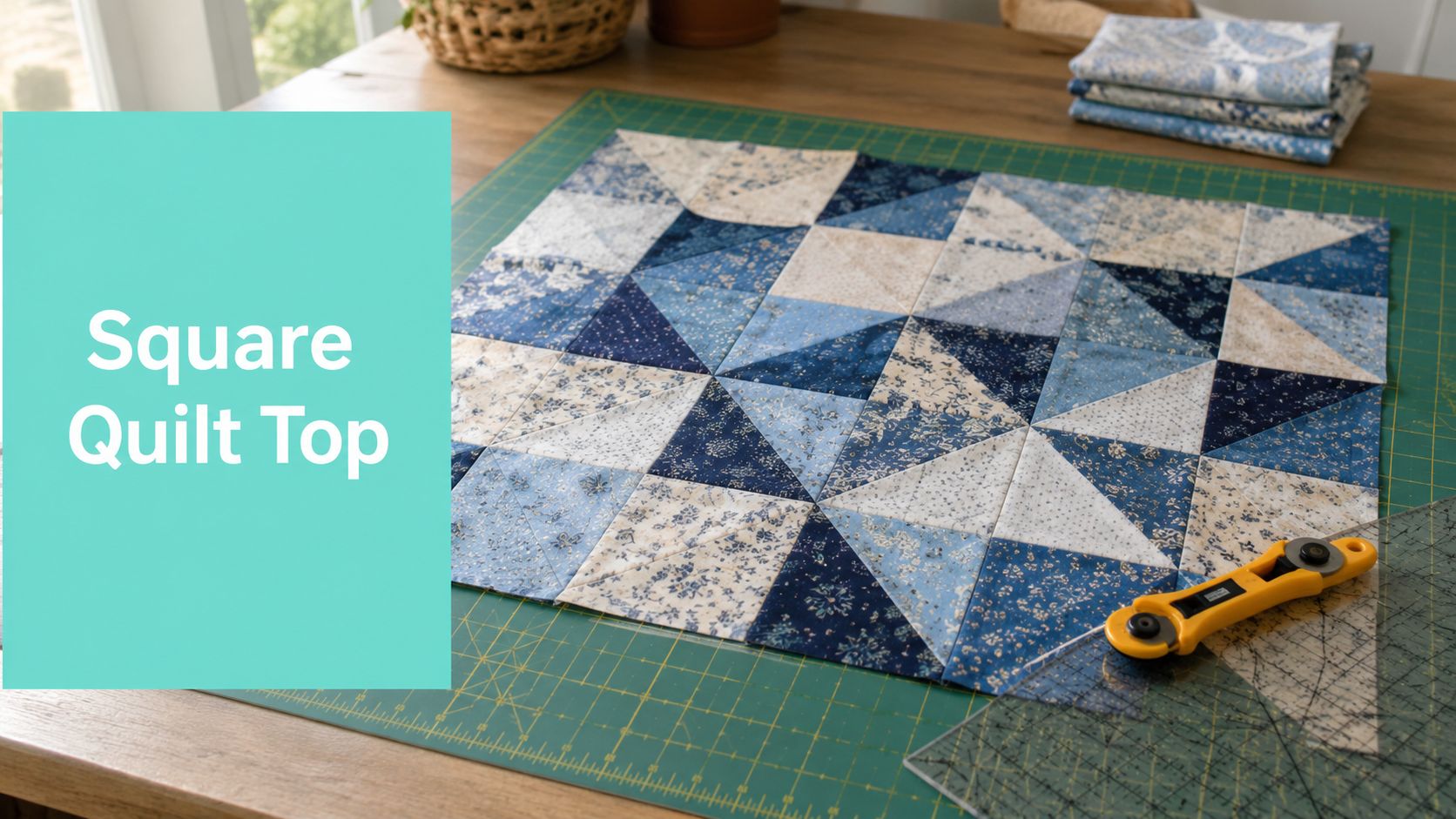
Press the quilt top thoroughly, then use a large square ruler to create one true 90-degree corner, and trim each side in sequence from that corner. For larger quilts, many quilters use a 12 1/2-inch square ruler for corners and a 24-inch ruler for side trimming, because the first cut sets the reference for every cut that follows.
If you're staring at a quilt top that looked fine on the design wall but suddenly seems wavy, slanted, or just a little off on the table, you're in good company. Squaring is one of those finishing steps that feels fussy until you see how much easier it makes quilting, loading, and binding.
The short version is simple: one flat press, one true corner, then careful sequential trimming. What doesn't work is hopping from edge to edge, trimming whatever looks uneven, and hoping it all comes together at the end.
Why Is My Quilt Top Not Square in the First Place
A quilt top can look straight until you spread the whole thing out. Then the top edge waves, one side leans, and the corners don't quite behave.
That usually isn't a sign that you've done anything wrong. It's just what fabric does when piecing, pressing, and handling start to add up across the full quilt.

What usually throws a quilt top off
Bias edges stretch more easily than straight grain edges. If you've worked with triangles, setting pieces, or borders cut in a stretchy direction, small movement during piecing can show up as a larger wobble by the time the top is assembled.
Seam allowance inconsistency does the same thing. A tiny difference repeated across rows can leave one section longer than the one next to it, even when every block looked close enough on its own.
Pressing can also introduce distortion. If the iron pushes rather than lifts and presses, fabric can shift and create ripples that weren't obvious at the machine.
Practical rule: A quilt top doesn't need to come off the machine perfectly square. It does need a final geometry check before quilting.
Why the problem gets bigger on larger quilts
Small tops hide small issues. Larger quilts magnify them.
Once a quilt grows to bed size, a slight lean at one corner can travel across the whole width. That's one reason longarm prep often includes checking multiple points across the quilt rather than trusting a single glance. If you're also sorting out batting choices, this overview of what quilt batting is helps clarify how the layers work together during finishing.
A square top isn't about perfection for its own sake. It's about helping the quilt lie flatter, trim cleaner, and bind without surprise fullness at the end.
What Tools Do You Need to Square Your Quilt
You don't need a fancy studio setup, but you do need a dependable squaring station. The difference between a frustrating trim session and a clean one usually comes down to ruler size, surface space, and whether the quilt is fully supported while you cut.
For accurate results, quilters are commonly advised to use a 12 1/2-inch square ruler for corners and a 24-inch long ruler for the sides on larger quilts, as shown in this quilt squaring tutorial.
Essential Squaring Tool Checklist
| Tool | Why It's Important |
|---|---|
| Large square ruler | Establishes the first true corner and gives you a visible right angle to trust |
| Long ruler | Helps keep longer edge trims straight once the corner is set |
| Rotary cutter | Makes clean, controlled cuts without lifting the quilt |
| Cutting mat | Supports accurate trimming and gives you grid references |
| Iron and pressing surface | Lets you flatten the top before measuring or cutting |
| Measuring tape | Useful for checking consistency across the quilt |
| Large table or clean floor | Keeps the quilt supported so it doesn't hang and distort while you trim |
What matters most in practice
If I had to narrow it down, the essential items are the press, the large square ruler, and enough flat space. A too-small ruler encourages guesswork, and guesswork is where crooked corners start.
If you're building out your sewing setup in general, this guide to sewing accessories is a useful refresher on the basic notions that make projects easier to handle.
For newer quilters, a grounded overview like quilting for beginners can also help put this step in context. Squaring isn't some advanced extra. It's part of finishing a quilt well.
Bigger rulers usually make this job easier. More ruler surface gives you a clearer read on whether the corner and edge are actually behaving.
How Do You Square a Quilt Top Step by Step
A reliable method starts before the rotary cutter comes out. The quilt has to be flat enough to tell the truth.

A commonly taught expert approach is to fully press the quilt first, then start at one corner with the largest square ruler available, create a true 90° angle, and trim outward from there, as described in this corner-first squaring method.
Follow this order
- Press the entire quilt top flat. Don't skim over this. Seams should be settled and the surface should lie smooth before you try to judge any edge.
- Choose one corner to start with. Pick the corner that looks the most stable, not the one that looks the worst.
- Place your large square ruler on that corner. Align both sides of the ruler so you're creating one true right angle.
- Trim only what you need. Remove the uneven overhang without getting aggressive. Taking too much can force the quilt into a shape it wasn't meant to be.
- Trim along the first adjacent edge. Once the corner is true, extend that cut carefully down the side.
- Trim the second adjacent edge. You're still working from the same newly established corner.
- Rotate the quilt and continue around it. Each new cut should reference the cuts you've already made, not a random outside wobble somewhere else.
- Pause and recheck alignment often. It's easier to correct a slight drift early than after all four sides are cut.
If the first corner is off, every later edge inherits that error. That's why corner-first trimming works better than chasing the waviest edge first.
For mail-in projects, these quilt prep instructions are worth reviewing before you pack your top.
What works and what doesn't
What works is a measured sequence. Press, square one corner, trim the connected edges, rotate, repeat.
What doesn't work is trimming one long side because it looks messy, then hopping to the opposite side, then trying to fix the corners afterward. That usually creates a quilt that's technically neater but still not square.
Offer for new customers: If you're prepping supplies for your next quilt, keep an eye on the first-order 15% discount and the free U.S. shipping on orders over $70 available through the shop.
How Do You Handle Large Quilts or Seamless Backings
Large quilts change the mechanics of the job. You can know exactly how to square a quilt top and still struggle if half the quilt is hanging off the table.
For quilts that are too large to spread out fully, quilters are often advised to fold one side over while keeping the surface flat, then move the cutting mat and repeat the trim in sections. That approach is especially useful on very large quilts that can exceed 100 inches on a side, as explained in this large-quilt squaring tutorial.

How to trim a quilt that's bigger than your mat
The key is support. Keep the area you're measuring and cutting flat, and fold the rest so it isn't dragging or pulling.
A few habits help:
- Work in sections. Trim one supported area at a time instead of forcing the whole quilt onto the mat.
- Move the mat, not the standard. Keep your established edge true and shift your tools as needed.
- Smooth without stretching. Lay the quilt into place. Don't tug it into alignment.
- Reconfirm the ruler position each time. Section trimming only works if every new placement follows the same established line.
What to do with seamless backings and extra-wide plush fabric
At this stage, many tutorials offer little guidance. Pieced backings provide seam or block lines to help with alignment. However, a continuous backing fabric offers no such cues.
That matters with extra-wide plush backings, especially the kinds quilters choose to avoid a center seam. If you're using a continuous piece of wide backing, use the grid lines on your ruler and mat to create your own straight reference. Don't wait for the fabric to give you one.
Texture can also distract your eye. Fabrics with pile, loft, or directional nap may look uneven before they are, so rely on ruler alignment more than visual impression. If you're choosing wide backing for a larger project, this article on extra-wide quilt backing is a helpful companion read.
Seamless backing saves you from one problem, but it removes the seam line that many quilters use as a trimming guide. On wide plush fabrics, the ruler grid becomes the guide.
Why Is a Square Top Critical for Longarm Quilting
A square top loads better. That's the practical answer.
Longarm quilting works best when the layers start with clean edges and stable corners. If the top is wavy, skewed, or fuller on one side, the machine can't magically turn that into a perfectly balanced finish.
What an unsquared top tends to cause
When a top isn't square, fullness has to go somewhere. Sometimes it shows up as a soft ripple near the border. Sometimes it becomes harder to keep the top looking even across the quilting path.
The issue isn't that every imperfect top fails. It's that an unsquared top gives the quilter less control over how the finished quilt will lie.
Why prep affects the finish
Square edges help the quilt stay aligned through quilting and finishing. They also make the final trim and binding more straightforward.
For larger projects, some longarm guidance recommends checking the top, middle, and bottom of the quilt with a 120-inch measuring tape to confirm consistency across the width, as noted in this quilting prep reference. That multi-point check reflects a simple truth. Big quilts can drift.
If you're sending a quilt out, good prep is part of getting the result you want. This roundup of longarm quilting top prep tips is worth reviewing before packaging your project.
A longarm can stitch beautifully on a top that isn't perfect. It can't erase geometry that was never corrected before loading.
Can You Square a Quilt After It Has Been Quilted
Yes, sometimes you can. You just need a gentler approach.
A common question from quilters using longarm services is how to fix lettuce leafing or puffy corners after quilting, issues linked to tension differences that many tutorials don't address directly, as discussed in this post-quilting troubleshooting video.
How to re-square a quilted piece safely
Start by laying the quilted project flat and letting it relax naturally. Don't pull the corners into shape.
Then work carefully:
- Check the quilting near the edge. Make sure you won't cut into stitches that need to remain secure.
- Use a large ruler to define a cleaner edge. You're creating a controlled trim line across all layers now, not just the top.
- Trim conservatively. Small corrections are safer than trying to force the quilt into a new shape.
- Watch the corners closely. Puffy corners often need restraint and accuracy, not a dramatic cut.
- Bind promptly after trimming. A fresh, clean edge is best stabilized without delay.
When to stop trimming
If the distortion is deep into the body of the quilt rather than limited to the edge, trimming may not solve the underlying problem. In that case, the smarter move is to improve the binding finish and accept a little character rather than overcutting the quilt.
Quilted projects are less forgiving because the batting and backing are already locked in place. That's why pre-quilting squaring is always easier than post-quilting repair.
If you'd rather skip the stress and send your project to a team that handles quilt finishing every day, On Pins & Needles Quilting Co. offers Mail-in Longarm Service support, premium wide backings, and trusted help for big quilts. We carry plush favorites like Shannon Luxe Cuddle textures including Hide, Snowy Owl, and Fawn, and customers shop with confidence thanks to hundreds of verified reviews, a 15% first-order coupon, and free U.S. shipping on orders over $70. If your next step is finishing, Book Your Longarm Service Today.