
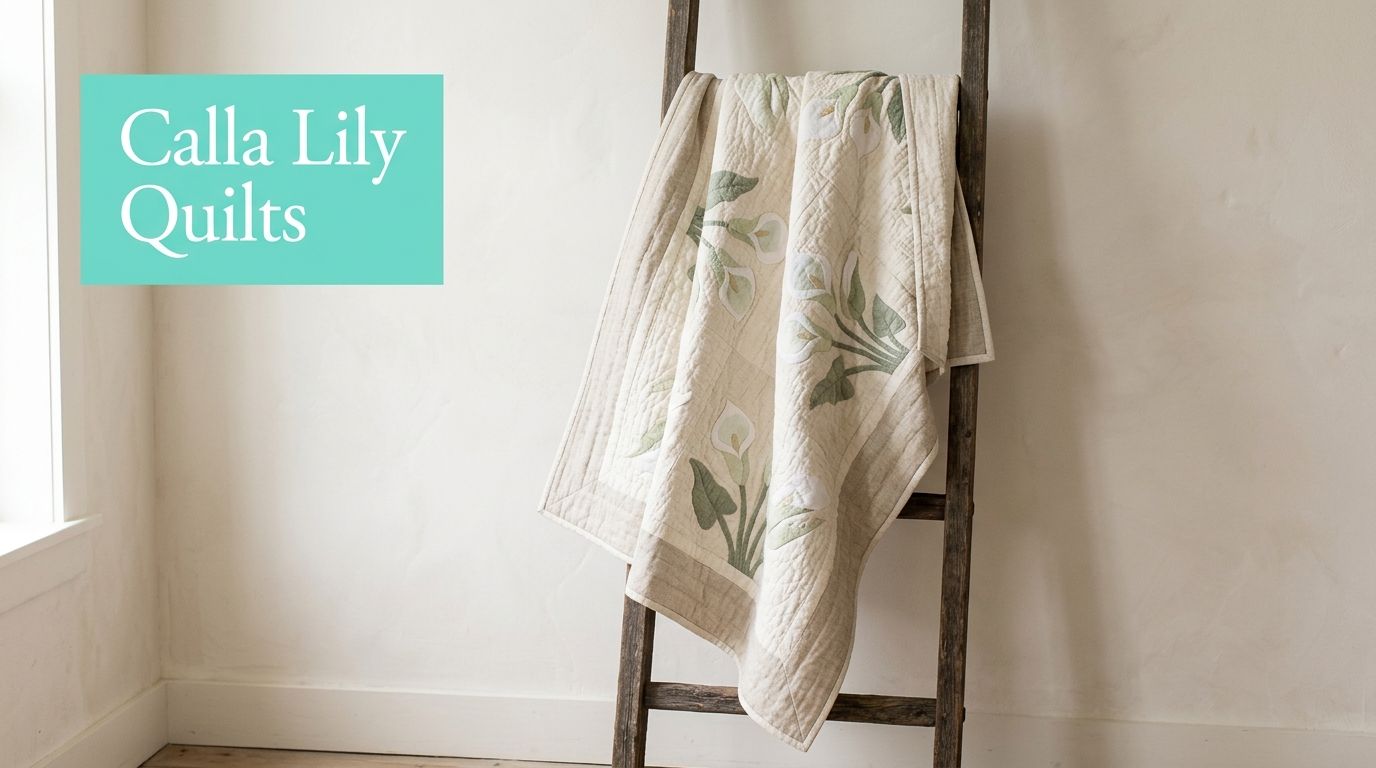
Calla lily quilts work best when you treat the flower as a dimensional appliqué motif and pair it with modern, touchable materials that support the curves instead of fighting them. If you want a quilt that feels current rather than museum-like, build the lilies with structure, keep the background quiet, and choose a backing that gives the finished piece real drape.
If you're here because you love the look of lilies but don't want your quilt to end up stiff, flat, or overly traditional, that's the right instinct. Calla lily quilts sit in a sweet spot. They have historic roots, but they respond beautifully to modern fabrics, plush backings, and thoughtful longarm finishing.
URL Slug: calla-lily-quilts
Meta Description: Calla lily quilts made modern with appliqué tips, minky backing ideas, and finishing advice. Get 15% off your first order and free shipping over $70.
What Defines a Calla Lily Quilt Design?
A calla lily quilt usually centers on a floral motif with a trumpet-shaped bloom, most often created with appliqué so the curves stay graceful. That shape is what makes the design recognizable. If the petal looks blunt or the center collapses, it stops reading as a calla lily.
Historically, quilters often connect this motif to the older Carolina Lily pattern. The earliest dated examples of the Carolina Lily quilt pattern, often seen as the historical predecessor to the Calla Lily, are from 1841, and that sparked a wider fad in the 1840s in American quilting history, as documented in the Encyclopedia of Quilt Patterns history note.

How is Calla Lily different from Carolina Lily?
Carolina Lily is the historical reference point. Modern calla lily quilts are usually less about strict historical reproduction and more about silhouette, softness, and depth.
That distinction matters because many quilters search for “calla lily quilts” expecting one fixed antique block. In practice, you're usually working with one of these approaches:
- Appliqué-centered floral layouts where one bloom becomes the focal point
- Multiple lily blocks arranged as repeats across the top
- Art quilt interpretations with shading, layered petals, and stems
- Mixed-technique quilts that combine piecing in the background with appliqué flowers
What makes the design succeed visually?
The bloom has to feel elegant. That means the background shouldn't compete, the stem should support the composition, and the petals need visible shape.
A few principles consistently work:
- Use contrast carefully. White or pale petals against deeper green, charcoal, taupe, or soft floral grounds keep the bloom crisp.
- Give the flower room. Crowded sashing or overly busy prints make the lily disappear.
- Let the petal curl. A calla lily should look like it wraps inward, not like a flat oval.
A calla lily quilt looks best when the flower gets to breathe. Empty space is not wasted space in this design.
For layout inspiration, a floral-focused reference like the Floral and Paisley pattern gallery is useful because it shows how quilting movement can support botanical shapes without overpowering them.
Is there one “correct” style for calla lily quilts?
No, and that's part of the appeal. Some quilters want a traditional top in cotton with restrained color. Others want a contemporary heirloom with soft fabric, richer texture, and a more sculptural flower.
Both can work. What doesn't work is mixing too many competing ideas at once. If the flower is romantic and organic, keep the quilting and fabric choices aligned with that mood. If you want a modern version, lean into cleaner backgrounds, stronger negative space, and tactile finishes.
Which Fabrics Should You Choose for a Modern Calla Lily Quilt?
If your first thought is “I should probably use quilting cotton for everything,” pause there. Cotton is reliable, but it isn't automatically the best choice for modern calla lily quilts, especially if you want the finished quilt to feel as luxurious as it looks.
There has been a 34% global surge in the last year for searches like “Calla Lily print minky fabric,” which points to real interest in softer, more current interpretations of the motif, according to this search-trend reference. That lines up with what many makers are already noticing. People still love floral quilts, but they increasingly want them in fabrics that feel giftable, cozy, and high-end.
When should you choose cotton and when should you choose minky?
Cotton still earns its place on the quilt top, especially for appliqué backgrounds. It presses sharply, marks easily, and behaves well under detailed stitching.
Minky changes the experience of the finished quilt. It adds drape, softness, and visual richness that standard cotton backing can't replicate.
Here's the practical split:
- Choose cotton for the top if you want precision in the block and cleaner appliqué placement.
- Choose minky for the back if you want warmth, softness, and a more contemporary hand.
- Use minky selectively on the front only if you're comfortable managing stretch and pile around appliqué.
For a fuller explanation of how these fabrics behave, the article on what cuddle minky fabric is is worth reading before you commit yardage.
Shannon Cuddle vs. Luxe Cuddle for your Calla Lily quilt
| Feature | Cuddle® 3 | Luxe Cuddle® |
|---|---|---|
| Surface feel | Smooth and soft | Plusher and more textured |
| Best use | Everyday backing, simpler projects | Heirloom-style backing, gift quilts, statement texture |
| Visual effect | Clean and understated | More dramatic depth and loft |
| Sewing behavior | Easier for newer minky users | Slightly more demanding because of pile and texture |
| Good match for calla lily quilts | Great when you want the flower top to lead | Excellent when you want the whole quilt to feel elevated |
Which textures suit a floral quilt best?
Not every minky texture supports a floral design the same way.
Hide adds organic movement. It works well if you want the backing to feel natural and a little richer.
Snowy Owl has a soft, plush look that pairs nicely with pale lily palettes and winter-white quilts.
Fawn is a strong choice when you want warmth, softness, and visible texture without a loud pattern. Luxe Cuddle® Fawn Cappuccino has a 10mm pile height and is made from 100% polyester, which gives it that lofted plush feel while staying machine-washable, as listed in the Luxe Cuddle Fawn Cappuccino product details and the Shannon Fabrics material specification.
Practical rule: If your quilt top is delicate and floral, the backing should feel rich, not busy.
What usually goes wrong with fabric selection?
Three mistakes show up over and over:
- A backing that overpowers the top. Loud prints steal attention from the flower.
- Petal fabric with no body. Thin or limp fabric can make the lily collapse visually.
- Too much texture on the face of the quilt. One plush element is usually enough.
When in doubt, keep the lily block crisp and let the softness happen through the backing, binding choice, and overall finish.
How Do You Construct an Appliqué Calla Lily Block?
The cleanest calla lily blocks are built as appliqué, not forced through piecing that breaks the curve. You can piece backgrounds and stems if you like, but the bloom itself benefits from a more controlled approach.
The modern Calla Lily appliqué motif is often standardized with a 10-inch by 10-inch flower block and uses a two-layer petal structure to create depth instead of a flat silhouette, as described in this Calla Lily appliqué reference.

What order should you build the block in?
Don't start by stitching everything down at once. Build the flower in layers so you can control shape.
- Cut the background block first. Start with a square slightly larger than needed if you want room to trim accurately later.
- Prepare the petal pieces. The outer petal defines the bloom. The inner layer creates the sense of curl.
- Shape the curves before stitching. English paper piecing can help with the petals, especially if you want a smooth rolled edge.
- Add the stem and leaf after the flower is placed. That order lets you adjust the bloom angle before committing.
Why does the two-layer petal matter?
A single appliqué petal often reads flat, especially on a larger block. The second layer creates a shadow line and suggests the natural trumpet shape of the flower.
That doesn't mean the block should become bulky. Keep the fabrics light enough to layer cleanly. The depth should come from structure, not thickness.
A working construction method
Use this sequence if you want a dependable result:
- Trace accurately. Transfer the petal templates cleanly. A wobbly cut edge will show.
- Turn the edge with intention. Smooth curves matter more than speed here.
- Test placement before stitching. Step back and check the angle of the bloom.
- Secure the inner petal first if needed. Then place the full flower on the background.
- Machine appliqué slowly. Short, controlled stitching around the curve prevents jagged edges.
- Press from the back when possible. That protects the shape on the front.
The best calla lily blocks don't look overworked. They look calm, smooth, and slightly sculpted.
Should you use fusible, EPP, or needle-turn?
That depends on your priorities.
| Method | Best for | Trade-off |
|---|---|---|
| Fusible machine appliqué | Speed and stability | Can look a bit stiffer |
| EPP-assisted petals | Precise curves | Slower prep |
| Needle-turn | Soft hand and subtle finish | Demands more control |
For most quilters, machine appliqué with careful prep hits the best balance of beauty and practicality.
What changes when you use soft fabrics?
If any part of your flower or background includes Cuddle or another plush fabric, stabilize it first. Soft fabrics can shift under the foot and swallow the line of stitching.
Use a stabilizer that supports the fabric without making the block board-stiff. Test your stitch length before committing to the final block. On plush surfaces, clean lines come from slower handling, not from forcing the machine to move faster.
Why Is Extra-Wide Minky Perfect for Your Quilt Back?
The biggest advantage of extra-wide minky is simple. It lets the backing do its job without introducing a seam right where you want uninterrupted softness.
If you've ever finished a large floral quilt and then had the back broken by a center seam, you already know the problem. The front may feel elegant, but the back can start to look pieced together in the wrong way.

Why does width matter so much on larger quilts?
A calla lily quilt often has open space and graceful movement. A bulky backing seam interrupts both the look and the drape.
Extra-wide backing solves several issues at once:
- Fewer seams means less bulk
- Better drape because the back moves as one surface
- Cleaner longarm loading with less distortion risk from joined backing panels
- A more polished gift finish on queen and king projects
For a detailed look at sizing options, the guide to extra-wide 110-inch minky fabric explains why wider backing changes the entire finishing process.
Is 90-inch or 110-inch better?
That depends on the quilt size and how much extra backing your finisher wants around the top. For throws and many bed quilts, 90-inch can work beautifully. For larger tops, 110-inch gives more breathing room and often avoids piecing entirely.
What matters most is that you choose width early, not after the top is done. Backing decisions affect your border choices, final dimensions, and mailing prep if you're sending the quilt out to be finished.
A quick demonstration helps if you're comparing the feel and handling of plush backing options:
What about care and durability?
Care matters with plush backing. Luxe Cuddle Fawn care instructions specify machine wash cold with like colors, no fabric softener, and tumble dry low without dryer sheets to protect the 10mm pile, according to this care reference for Luxe Cuddle Fawn.
That's not fussy care. It's just the difference between a backing that stays plush and one that gets coated down over time.
A seamless minky back doesn't just feel better in use. It also makes the whole quilt hang and fold better.
How Should You Prepare Your Quilt for Mail-In Longarm Service?
A beautiful top can still quilt badly if it arrives unprepared. Most finishing problems start long before the machine. They begin with fullness, loose threads, uneven borders, or a backing that's too small.
Good prep isn't glamorous, but it saves the project.
What should you do before packing the quilt?
Use a short checklist and don't skip steps because the quilt “looks close enough.”
- Square the top as well as you can. Longarm quilting can't fix major shape problems.
- Press the top and backing. Deep wrinkles and folded seam allowances create avoidable issues.
- Clip loose threads. Dark threads behind light fabric can shadow through after quilting.
- Check seams along the borders. Weak seams can split when the quilt is loaded.
If you want a fuller pre-shipping reference, keep a preparation checklist like this mail-in longarm prep guide nearby while you work.
How large should the backing be?
Your backing should extend beyond the quilt top on all sides so the quilt can be loaded properly. If you're uncertain about how much extra to allow, ask your longarmer before cutting. Guessing is where many backing problems begin.
This is also why extra-wide minky is so helpful. You can cut with confidence instead of piecing under pressure at the end.
What should you not do?
Some mistakes create more work for the finisher and less control for the final result.
- Don't pin the layers together
- Don't baste the quilt sandwich
- Don't trim the backing to match the top exactly
- Don't leave selvages attached on pieced backing seams
The “don't pin or baste” rule matters more than many quilters realize. A longarmer needs separate layers for proper loading. Pre-basted layers slow the process and can distort tension across the quilt.
If you're sending a quilt out, your job is to deliver clean, flat, separate layers. That gives the machine the best chance to do its work well.
What helps calla lily quilts quilt well?
Calla lily tops benefit from restraint. If the appliqué is detailed, don't overload the borders with fullness or highly directional piecing that refuses to stay flat.
Before mailing, do one final review:
- Lay the top out completely.
- Look for ripples near borders.
- Confirm the appliqué edges are secure.
- Fold neatly, not tightly.
- Label the top edge if the orientation matters.
That last step saves confusion on asymmetrical floral layouts.
What Quilting Patterns Complement a Calla Lily Top?
The right quilting pattern should support the flower, not argue with it. That's especially true on calla lily quilts because the design already contains a strong focal shape with curved petals, a stem line, and often a lot of negative space.
A poor quilting choice can make the quilt feel crowded. A smart one adds movement and polish.
Should you choose floral quilting or contrast with modern geometry?
Both can work, but they create different outcomes.
Flowing floral or leaf motifs echo the organic shape of the lily. They're a safe choice when you want harmony and softness.
Modern geometric patterns can be striking if the quilt top is simple and spacious. The contrast between a sculptural flower and a controlled geometric field can make the design feel current instead of sweet.
Here's the key difference:
| Quilting style | Best effect on a calla lily top | Watch out for |
|---|---|---|
| Floral scrolls or leaves | Reinforces botanical movement | Can feel too busy if the top already has printed florals |
| Gentle curves | Softens the whole quilt | May disappear visually on high-loft backing |
| Geometric edge-to-edge | Adds modern structure | Can look harsh against romantic appliqué if scaled too tightly |
| Point-to-point motifs | Adds crisp control | Needs careful scale so it doesn't chop up the flower visually |
When do point-to-point designs help?
Digitized motifs can be useful when you need clean stabilization around appliqué. For example, a digitized “Small Triangle Point-to-Point” design for longarm use is engineered at 2.9 by 6 inches, helping secure appliqué edges with dense, controlled stitching while avoiding distortion, according to this digitized quilting design reference.
That doesn't mean every calla lily quilt should get a rigid point-to-point field. It means this type of design can solve a technical problem when the appliqué needs anchoring.
How do you choose the right scale?
Scale is where many otherwise good quilting patterns fail.
Choose smaller-scale quilting when:
- the appliqué has lots of edge detail
- the quilt will be handled often
- the background is plain and needs more texture
Choose a larger-scale pattern when:
- the lily block is oversized
- negative space is part of the design
- you want the quilt to stay visually calm
For more examples of how modern tops pair with edge-to-edge choices, the article on the best longarm patterns for modern quilts gives a useful comparison framework.
The quilting should be visible on a calla lily quilt, but it shouldn't be the first thing anyone notices.
What usually works best?
For most calla lily quilts, the strongest finish is one of these:
- A soft botanical edge-to-edge for harmony
- A restrained geometric for contrast on minimalist tops
- A supportive allover texture that holds the appliqué down without competing
If you're unsure, choose the option that preserves the flower as the star. That's almost always the right answer.
Where Can You Find Calla Lily Quilt Kits and Inspiration?
Not everyone wants to draft a full quilt from scratch. Some quilters want a smaller project first. Others want the look of calla lily quilts translated into softer, quicker, more gift-friendly makes.
That's a smart approach, especially now. There has been a 28% rise in searches for “floral minky kit” in 2025-2026, highlighting a gap between traditional quilt content and what many beginners and gift-makers are actively looking for, according to this floral minky kit trend reference.
What kinds of projects fit the calla lily look?
The calla lily motif adapts especially well to projects that emphasize softness and giftability.
Good options include:
- Infinity scarves in floral-inspired palettes
- Pillow projects that feature a single dramatic bloom
- Baby blankets with soft backing and simple flower accents
- Lap quilts that keep one large lily as the focal point
Many makers often get stuck. They can picture the aesthetic, but they don't want to source multiple fabrics, trims, backing, and finishing details one by one.
What should beginners look for in a kit?
A useful kit removes decision fatigue. It should simplify selection, not create more of it.
Look for:
- Curated fabric combinations that already work together
- Appropriate scale for the project, especially with floral motifs
- A fabric type suited to the project, such as plush textures for gifting
- Clear finishing expectations, so the project doesn't stall halfway through
If you're making a gift, don't underestimate the value of choosing a smaller project that you'll finish. A polished pillow or scarf often gets more use than an ambitious quilt top left in a bin.
Where does inspiration usually come from?
Inspiration tends to come from three places with this style:
- Historic lily quilts, which give you shape language
- Modern floral home décor, which sharpens your color sense
- Texture-led fabric choices, which make the project feel current
That last piece is what often turns a floral project from “pretty” into memorable. Soft texture changes how people use and keep the finished piece. A calla lily theme doesn't have to live only in a bed quilt. It can become a throw, nursery gift, reading blanket, or accent pillow that gets handled every day.
A good floral project doesn't need to be large to feel special. It needs strong shape, clear color, and the right hand.
If your goal is inspiration first, start small and let the motif teach you what scale, fabric, and finish you prefer. If your goal is a keepsake, plan the backing and quilting style as early as the flower block itself.
If you're ready to turn the look of calla lily quilts into a finished project, On Pins & Needles Quilting Co. is a practical place to start. Browse the Shannon Cuddle collection, compare extra-wide minky backing options, explore mail-in longarm quilting services, and pick up a beginner-friendly project from the kits collection or a giftable finish from the ready-made blankets collection. We're known for minky expertise, responsive help, and hundreds of verified reviews, and first-time shoppers can get 15% off your first order while qualifying orders receive free shipping over $70. Book Your Longarm Service Today.