
You're standing at the fabric wall with a bundle of Winnie the Pooh fat quarters in your hands, already picturing a baby quilt, but one question keeps nagging: will the set be enough? An 18-piece bundle can provide a strong starting point for a small quilt, but the finished size depends on your cutting plan, borders, background fabric, and whether the prints are doing all the work.
What a Winnie the Pooh Fat Quarter Bundle Actually Is
You pick up an 18-piece Winnie the Pooh fat quarter bundle and see enough color for a crib quilt. The label tells you how many pieces are included, not whether those pieces will cover the finished quilt. To judge the bundle, start with the cut size, then compare each piece with the pattern's largest shapes.
A fat quarter is half of a half-yard of quilting cotton, cut across the fabric's width. A standard American fat quarter measures about 18 by 22 inches, though the exact dimensions depend on the bolt width. Quilting cotton commonly ranges from 41 to 45 inches wide, so a piece may be closer to 18 by 20 inches or reach 18 by 22 inches. Missouri Star Quilt Co. explains the standard fat-quarter cut, and Designed to Quilt discusses why dimensions vary.
The shape works well for patchwork because it gives you a broad rectangle rather than a narrow quarter-yard strip. Four fat quarters cover roughly the fabric area of one yard of 44-inch-wide cotton, while each individual piece can supply squares, rectangles, appliqué shapes, or a character-centered block. Bundles may hold a small coordinated group or more than 20 pieces. Stitchin' Heaven breaks down the practical advantages of fat quarters.
What appears in a Pooh bundle
A Pooh bundle uses the same precut format, with prints drawn from the Hundred Acre Wood. Depending on the collection, the stack may include Pooh, Piglet, Tigger, Eeyore, Christopher Robin, honey pots, bees, leaves, maps, lettering, and quieter coordinating prints.
Those prints are the ingredients, not the whole meal. A themed bundle may provide the characters and color scheme while leaving you to buy background, border, binding, and backing fabric. An 18-piece set might begin a small quilt, yet large blocks or generous borders can use the fabric faster than expected.
Before buying, check three details:
- Finished quilt size: Crib, lap, and queen patterns require different amounts of fabric.
- Block size: Large character artwork needs larger cuts if you want Pooh or another figure to remain recognizable.
- Cutting yield: One fat quarter can produce several small pieces, but trimming and seam allowances reduce the number of large squares.
A useful test is to place the bundle beside the pattern's cutting chart. If the pattern calls for large blocks, count usable rectangles rather than assuming every inch will be available. For color planning, this guide to fat-quarter bundles explains how coordinated prints, duplicate fabrics, and solids can work together.
Who Makes Licensed Pooh Fabric and Why It Matters
A bolt of Pooh quilting cotton passes through more than one business before it reaches a quilt shop. Disney controls the character licensing, an approved textile company develops the artwork and collection, a fabric manufacturer prints the cotton, and a retailer sells the finished yardage or precut bundle.
That's why a Riley Blake Designs, Springs Creative, or Camelot Fabrics Pooh line can feel different from an older Disney-branded bolt. These are separate licensed products, produced during different collection periods and potentially printed by different manufacturing partners. Vintage fabric from the 1990s or 2000s may have a completely different hand, color palette, scale, and available coordinates from a newer quilting-cotton range.
Why the Cath Kidston collaboration is useful context
The Disney x Cath Kidston Winnie the Pooh collection, announced in July 2016 and scheduled to launch on September 26, 2016, placed Pooh imagery across womenswear, children's clothing, bags, accessories, and home goods. FashionUnited reported on that collaboration.
That collaboration matters to fabric shoppers because it shows how a character can move between media, fashion, and home décor. Pooh fabric isn't limited to children's bedding or novelty craft projects. The licensing ecosystem has remained active into 2026, with new Disney-branded home and fashion tie-ins still appearing, which points to long commercial relevance rather than a single nostalgia release.
For quilters, licensing affects practical choices:
- Artwork control: Authorized collections are produced under brand requirements, so recognizable characters and colors are handled as part of an approved design.
- Collection planning: A licensed line may include feature prints, small coordinates, panels, and blenders that are designed to work together.
- Availability: Once a collection leaves regular production, matching fabric can become difficult to locate.
- Dye-lot planning: A later purchase may not match the original fabric exactly, even when the print name looks familiar.
The safest buying habit is to inspect the selvedge, collection name, manufacturer, and seller description. If you're unsure how to evaluate a bolt or online listing, this fabric-buying guide for quilts offers a useful general approach.
Comparing Pooh Precuts, Squares, and Yardage Formats
Retailers may offer the same Pooh collection in several cuts. A current Riley Blake listing, for example, shows an 18-piece fat-quarter bundle alongside yardage, 10-inch squares, 5-inch squares, and 2.5-inch strips. Shabby Fabrics displays that multi-format Winnie the Pooh release.
Each format solves a different cutting problem. Yardage gives you coverage and control, while precuts reduce sorting and make coordinated patchwork faster.
Pooh Fabric Formats at a Glance
| Format | Cut Size (inches) | Typical Bundle Count | Best Project Fit |
|---|---|---|---|
| Full yard | 36 by 44 | Sold by the yard or in cuts | Backing, borders, large panels |
| Fat quarter | About 18 by 22 | Small sets to 20 or more | Patchwork blocks and mixed-print quilts |
| Half-yard cut | About 18 by 44 before folding | Sold as individual cuts | Larger blocks, borders, small backings |
| 10-inch square | 10 by 10 | Layer-cake style bundles | Quick block quilts and large patchwork |
| 5-inch charm square | 5 by 5 | Charm-pack style bundles | Small patchwork and postage-stamp designs |
| 2.5-inch strip | About 2.5 by 44 | Jelly-roll style bundles | Strip piecing, sashing, and log-cabin units |
A fat quarter and a half-yard cut aren't interchangeable, even if the half-yard is folded when you receive it. The fat quarter is wider and shorter, while a half-yard cut runs along the full width of the bolt. That difference changes what you can cut without piecing.
Use yardage when you need broad, uninterrupted coverage. A Pooh map print may work beautifully for a border or backing, while a character fat quarter is easier to distribute through blocks. Use 10-inch squares when your pattern is built around large uniform units, 5-inch squares for small patchwork, and 2.5-inch strips when the design depends on long strips rather than individual motifs.
For a clearer look at how pre-cut squares fit into quilt planning, this guide to precut fabric squares is a helpful companion. Put the format that matches your pattern in the cart, not the format with the cutest packaging.
How Many Pooh Fat Quarters You Need for a Real Quilt
Standing at the Pooh fabric wall with an 18-piece bundle, you may wonder whether it will finish a crib quilt or leave you short. The answer depends on the usable area left after squaring the fabric, trimming edges, and allowing for seams.
A standard fat quarter measures about 18 by 22 inches, or approximately 396 square inches before trimming. For a practical estimate, plan on about 16 by 20 inches of usable fabric, or roughly 320 square inches, after preparation. The fat-quarter size guide provides a helpful measurement reference.
A simple planning formula
Start with this calculation:
Finished quilt area ÷ 320 usable square inches per fat quarter = starting fat-quarter count.
Add 10 percent for trimming to create a planning allowance. This shortcut helps with early shopping, but a pattern's cutting chart remains the final check. Borders, sashing, directional Pooh motifs, and large feature blocks can change how efficiently each piece cuts.
Use these layouts as practical reference points:
- A 36 by 52-inch crib quilt with a 5-inch border can be planned around 16 fat quarters, depending on the block design and cutting efficiency.
- A 54 by 75-inch lap quilt can be planned around 30 fat quarters, plus 2.5 yards of sashing.
- An 80 by 88-inch queen quilt can be planned around 48 fat quarters, plus 4 yards of background fabric.
An 18-piece Pooh set may cover a small crib project comfortably, yet fall far short for a queen quilt. One queen-quilt guide may call for about 32 to 42 fat quarters, while another scrappy-quilt guide suggests 36 to 50, depending on the pattern. Suzy Quilts explains why fat-quarter preparation must follow the cutting plan.
Pooh Fat Quarter Bundles Mapped to Finished Quilt Sizes
| Bundle Size | Finished Crib | Finished Lap | Finished Queen |
|---|---|---|---|
| 12 pieces | Small crib or accent project | Not usually enough alone | Not enough alone |
| 18 pieces | Many simple crib layouts | Usually needs added fabric | Not enough alone |
| 24 pieces | Comfortable crib planning range | May support a compact lap design | Not enough alone |
| 42 pieces | More than enough for many crib layouts | Strong starting point for many lap designs | May still need background, borders, or pattern-specific additions |
Use the table as a buying guide, not a promise of exact finished dimensions. A bundle with small blenders usually cuts efficiently. Large character scenes may need to stay intact, leaving less fabric for ordinary blocks and creating a need for extra coordinating prints.
Check the retailer's piece count against the pattern's required cuts before buying. Directional prints also need attention because turning a Pooh motif the wrong way can waste fabric.
Three Project Plans Built Around a Pooh Bundle
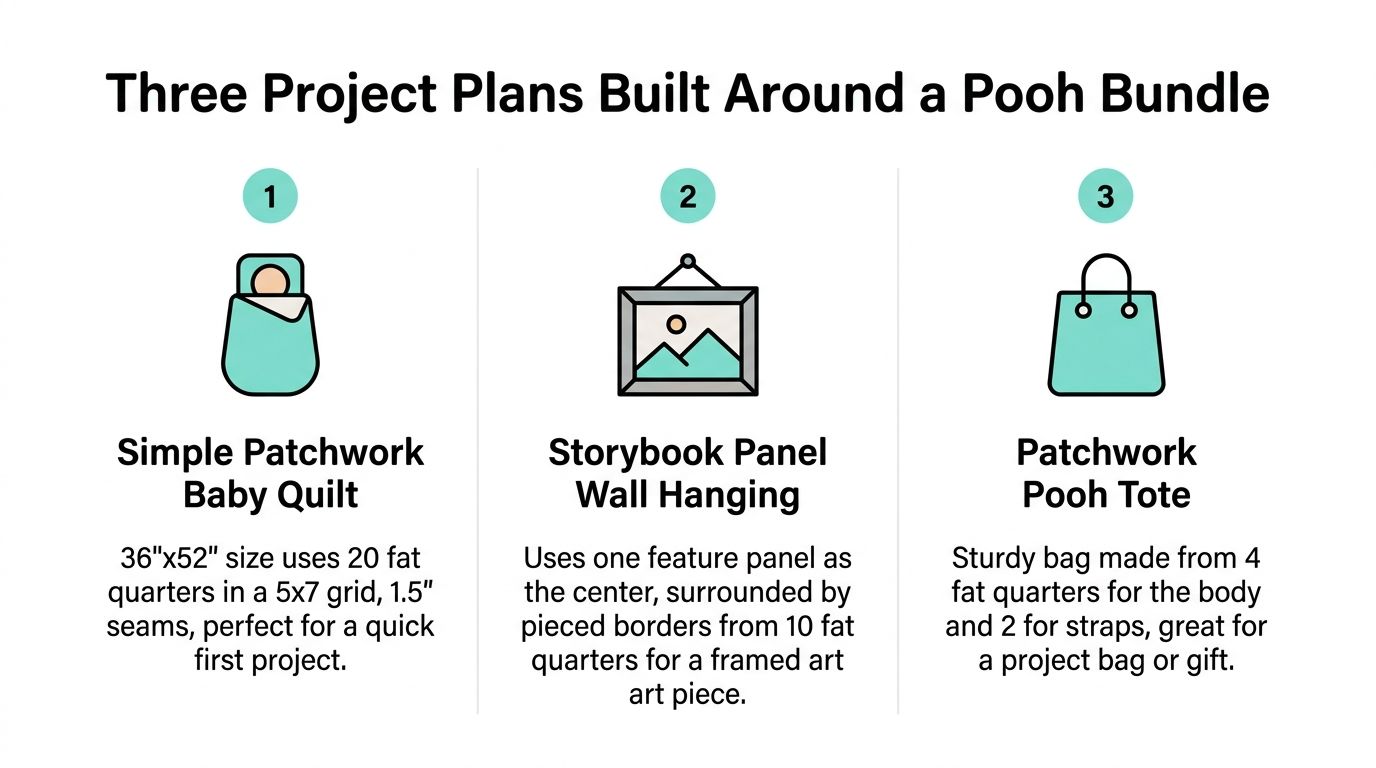
A Pooh bundle becomes much easier to shop for when you assign every piece a job. The following plans use the bundle math in practical ways, but you should still check your pattern and measure each cut before sewing.
Project one is a simple patchwork baby quilt
For a 36 by 52-inch baby quilt, plan on 20 fat quarters in a simple patchwork arrangement. Reserve 1.5 yards for backing and half a yard for binding.
A straightforward cut list looks like this:
- Top: Cut the blocks according to your selected pattern, keeping the largest Pooh motifs in larger units.
- Seam allowance: Use the allowance specified by the pattern. If you're drafting your own layout, maintain one consistent allowance throughout.
- Pressing: Press seams toward the darker fabric, unless your block design calls for nesting seams or pressed-open construction.
- Finishing: A home machine can handle a baby quilt if you divide the layers carefully. A longarm finish gives the top a more even stitched texture and saves wrestling with the bulk.
This is the plan that makes the most sense for a first bundle buyer. Twenty pieces give you room to mix character prints, blenders, and a few calmer fabrics without forcing every block to look identical.
Project two is a patchwork pillow
A 20 by 20-inch patchwork pillow uses 6 fat quarters, one charm pack, and one yard of solid fabric for an envelope back.
Cut the front pieces from the Pooh fat quarters, using the charm squares as small accents or corner units. Keep the character faces away from seam lines, and arrange the prints on the floor before sewing so the strongest motifs don't collect in one corner.
Press each row in alternating directions to help seams nest. A home machine is the right tool for this project, and quilting the pillow front with straight lines or a simple grid keeps the finish manageable. Add a pillow form after the cover is assembled, and use the solid yardage to create a clean back that doesn't compete with the front.
Project three is a charm-square tote
For a 14 by 16-inch charm-square tote, use a 42-piece charm pack, half a yard for the lining, and a yard of strapping.
Arrange the charm squares into front and back panels, then reinforce the patchwork with an interfacing or stabilizer appropriate for your pattern. Press the seams consistently, and topstitch the panel edges before attaching the lining so the bag keeps its shape.
The tote doesn't need a longarm finish. A home machine gives you better control around the handles, lining, and boxed corners. A longarm service is most helpful for the baby quilt, especially if you want the stitching to become part of the finished design rather than holding the layers together.
For additional project ideas that use manageable precut shapes, this fat-quarter project collection can help you choose a plan before cutting into a collectible Pooh set.
The video below can also be useful if you learn best by watching fabric move through a project.
Licensing, Stock, and Smart Buying Considerations
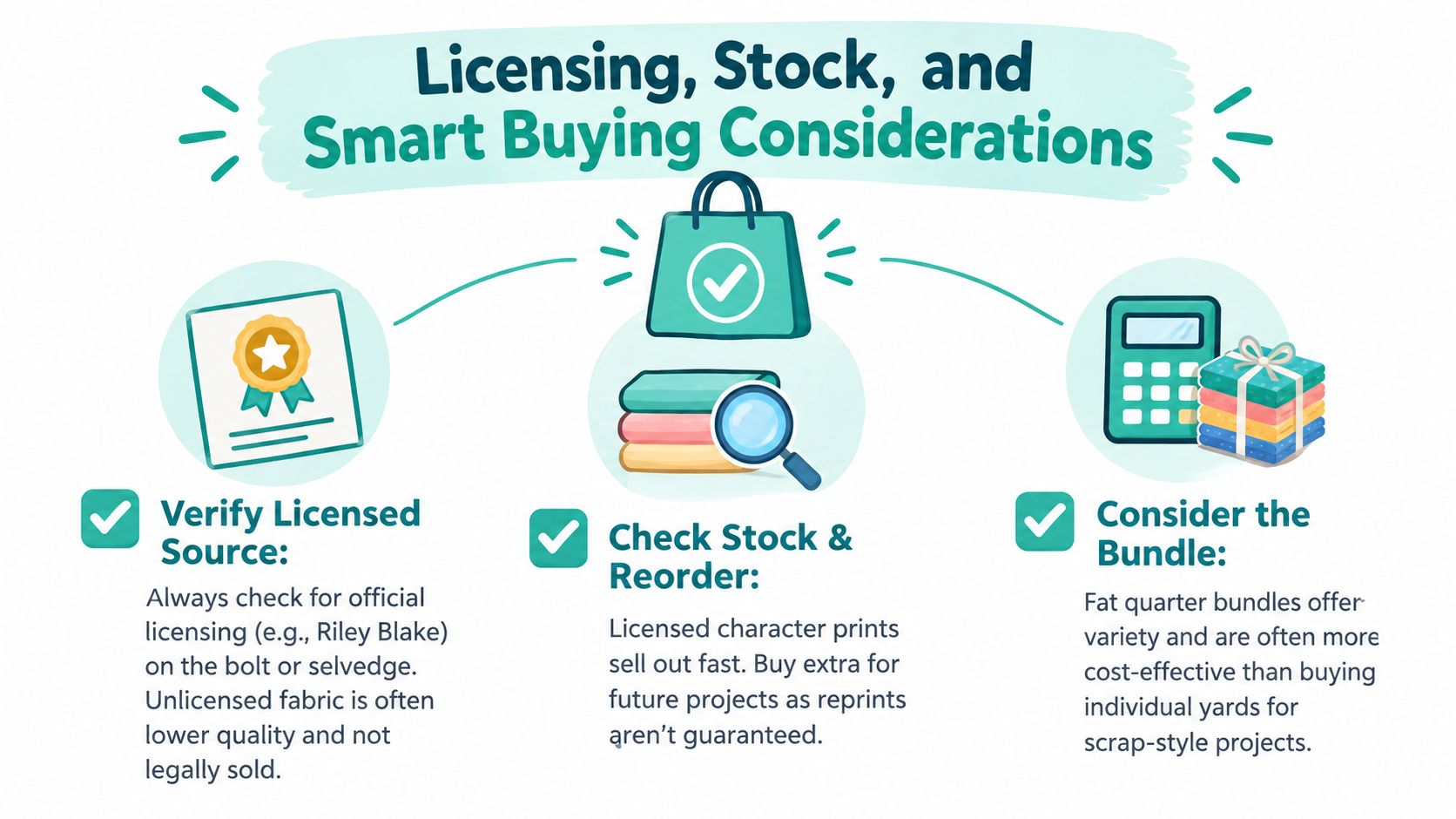
The licensing label doesn't tell you whether a fabric will suit your pattern, but it does tell you to slow down before buying a random marketplace listing. Winnie the Pooh fabric can come from a current authorized collection, an older Disney-branded release, or an item with unclear provenance. Those categories shouldn't be treated as interchangeable.
A recurring trap is assuming that every Pooh print will be restocked. Character collections can disappear from regular retail, and a later search may turn up only isolated fat quarters, mismatched dye lots, or vintage fabric with unknown storage history. If your design depends on coordinated colors, buying the complete bundle at once is safer than planning to assemble it gradually.
What to check before checkout
- Read the selvedge: Look for the manufacturer, collection information, and licensing language when the fabric is sold by the bolt.
- Inspect the listing: A trustworthy product page should identify the collection and describe whether the item is licensed, vintage, or a reproduction.
- Study the scale: Large Pooh artwork may be lost in small blocks, while tiny coordinates can disappear inside wide borders.
- Match the fabric type: Quilting cotton, flannel, minky, and cuddle fabrics behave differently and shouldn't be substituted without checking the pattern.
- Buy coordinating yardage promptly: Backgrounds and blenders can be harder to match after the original collection leaves stock.
A complete bundle isn't automatically a complete quilt. Serious patchwork often needs solids or blender fabrics to separate novelty prints and create visual breathing room.
The same caution applies to finishing. A baby quilt is a reasonable home-machine project, but a larger top can become awkward to quilt without enough workspace. For a Pooh panel or carefully pieced character top, a mail-in longarm service can provide edge-to-edge stitching, batting, and thread while avoiding the strain of pushing a large layered quilt through a domestic machine.
If you choose a soft backing instead of cotton, check the width before ordering. Standard minky is commonly sold around 58 or 60 inches wide, while wide-back options are available in widths such as 88, 90, and 108 inches. Kitchen Table Quilting explains how wider minky can reduce the need for pieced backing.
Choose the bundle after confirming the quilt dimensions, cutting requirements, and supporting fabrics. If your Pooh top is larger than a baby quilt, consider sending it to a specialist finisher rather than risking puckers, skipped stitches, or a damaged feature print.
On Pins & Needles Quilting Co. offers premium minky and Shannon Cuddle backing options alongside convenient Mail-in Longarm finishing, with batting, thread, and free return shipping included in the service. Visit On Pins & Needles Quilting Co. to compare soft quilt textures, review the shop's hundreds of verified reviews, and use the 15% first-order coupon or free U.S. shipping on orders over $70. Get your Winnie the Pooh project ready, then Book Your Longarm Service Today.