
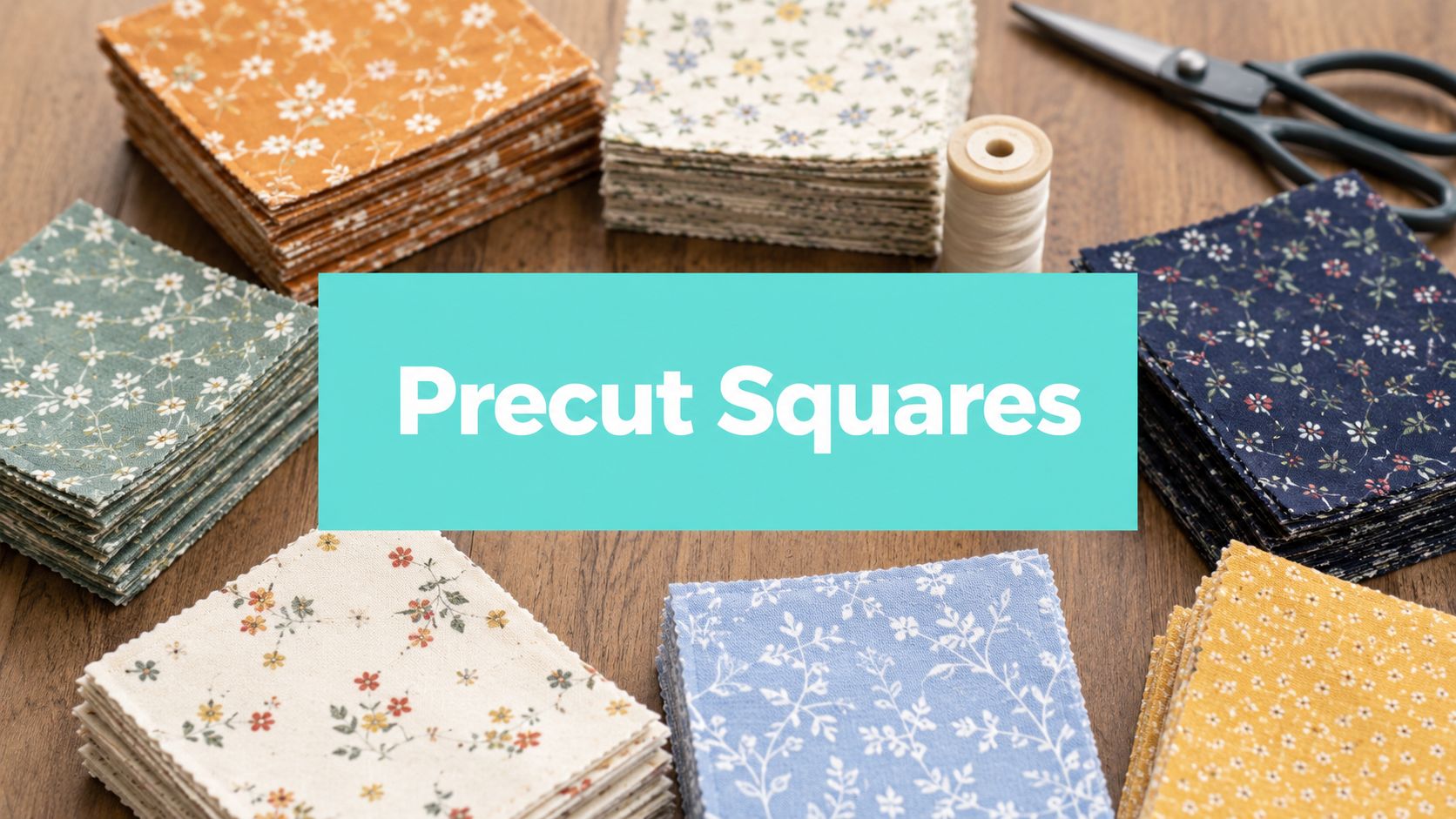
Precut fabric squares are bundles of fabric, most commonly 5-inch Charm Packs or 10-inch Layer Cakes, cut into standardized squares by manufacturers. They save cutting time and give us a coordinated set of prints that work together right out of the package.
If you're standing at your cutting table with a pattern in one hand and a fabric bundle in the other, you're not alone. A lot of quilters understand what precuts are in theory, but still get stuck on the practical questions: which size should I buy, what can I make with it, and how many packs will cover my project?
What Are Precut Fabric Squares Anyway
Precut fabric squares are ready-cut bundles of coordinated quilting cotton that help us skip the first big hurdle of quilting, choosing fabrics and cutting them accurately. For many quilters, that's the difference between starting a quilt tonight and leaving the fabric on the shelf for another week.
The appeal is simple. We open the pack, sort the prints, and start planning blocks instead of trimming yardage into matching units.
Why do quilters use them so often
Precuts solve two problems at once:
- They save prep time because the basic square cutting is already done.
- They simplify fabric selection because the bundle usually comes from one coordinated collection.
- They reduce early mistakes since we aren't measuring and rotary-cutting every starting square ourselves.
That makes them especially friendly for beginners, but experienced quilters use them too. They're useful when we want a fast gift quilt, a scrappy look that still feels cohesive, or a project that doesn't require a full afternoon of cutting first.
Are precuts a modern shortcut or an old quilting tradition
They're much older than many people realize. Historically, 5-inch squares called charms were used in block swaps as far back as the 1870s, which is one reason this format still feels so natural in quilting today (National Quilters Circle on the history of charms).
That bit of history matters. It reminds us that precut fabric squares aren't just a retail trend. They're connected to a long quilting habit of sharing, mixing, and building variety from small units.
If you'd like to see how charm packs fit into modern quilting projects, our guide to Moda charm packs is a helpful next stop.
Precise cutting can feel like the hard part when you're new. Precuts let us practice piecing and pressing first, which is often where confidence really grows.
How Do I Choose Between Common Precut Sizes
The most common confusion isn't what precuts are. It's which size makes sense for the quilt we want to make.
Some square bundles are better for tiny patchwork. Others are better when we want larger blocks, fewer seams, or more flexibility for recutting. The quickest way to compare them is side by side.

Precut square sizes at a glance
| Precut Name | Size | Typical Piece Count | Best For |
|---|---|---|---|
| Mini Charms | 2.5" x 2.5" | 42 | Small patchwork, accents, miniature piecing |
| Charm Packs | 5" x 5" | 42 | Baby quilts, simple blocks, bags, runners |
| Layer Cakes | 10" x 10" | 42 | Larger blocks, fast quilt tops, projects that need recutting |
A Layer Cake is especially useful when we want room to adapt. A standard Layer Cake typically contains 42 squares cut to 10" x 10", and that amount is often enough for a small quilt top (Missouri Star Quilt Company on Layer Cakes).
When should I pick each one
Choose by project behavior, not just by size.
- Mini Charms work well when the squares are decorative details rather than the whole show. They shine in tiny patchwork, corner accents, and very small accessories.
- Charm Packs are a comfortable middle ground. They're easy to handle, large enough to show a print, and small enough to create movement across a quilt.
- Layer Cakes make sense when we want fewer seams or more design options. We can leave them whole, cut them into smaller squares, or use them for larger patchwork units.
What do beginners usually find easiest
Most beginners do well with either charm packs or layer cakes.
Charm packs feel less intimidating because the pieces are already small and manageable. Layer cakes are forgiving for quilters who want to cut sub-units from a larger square and avoid handling lots of tiny pieces right away.
If you're comparing bundle styles beyond squares, our article on fat quarter bundles helps clarify where those fit into the decision.
Practical rule: If your pattern depends on lots of little units, start smaller. If your pattern asks you to subcut and mix shapes, start larger.
Are Precut Squares Better Than Buying Yardage
Sometimes yes. Sometimes not.
The better question is this: what problem are we trying to solve in this quilt? If the problem is time, coordination, or ease, precut fabric squares usually help. If the problem is exact control over scale, repeats, or quantity, yardage may be the smarter choice.
When precut fabric squares make more sense
Precuts are strong when convenience matters most.
- Fast starts. We can get to piecing sooner because much of the cutting is already done.
- Coordinated prints. The bundle gives us a ready-made palette without pulling bolts and matching fabrics one by one.
- Good variety. Small cuts let us sample many prints from one collection.
- Beginner-friendly workflow. We spend less time on measuring and more time learning seam allowance, pressing, and block assembly.
When yardage gives us more freedom
Yardage wins when flexibility matters more than speed.
- Custom cutting. We choose the exact size and shape each piece needs.
- More control over print placement. That's helpful if a print is directional or has a large motif.
- Easier scaling. If we need more background, borders, binding, or repeated shapes, yardage can be simpler to plan around.
- Better fit for some patterns. Some quilts are written around strips, rectangles, or specialty cuts rather than square bundles.
What usually confuses shoppers
A larger square doesn't always mean a better buy. Efficiency depends on the pattern, how much recutting it requires, and whether we can use leftovers in another project.
That becomes clearer when we compare our project plan first:
- Look at the block size. Large-block quilts often work well with larger squares.
- Check how much subcutting is required. Heavy recutting can create leftovers that may or may not be useful.
- Notice the role of background fabric. A square bundle rarely replaces every fabric in the quilt.
- Decide whether speed or control matters more. That's the key tradeoff.
If you're trying to compare that tradeoff against traditional fabric planning, our post on calculating yardage for quilts can help you think through the other side of the equation.
Yardage gives us freedom. Precuts give us momentum. Most quilters end up using both, depending on the job.
What Projects Can I Make With Precut Squares
Precuts get fun. Once we stop thinking of them as just packaged fabric and start seeing them as starting points, project planning gets much easier.

A charm pack baby quilt
A charm pack is a comfortable choice for a baby quilt because the pieces are already small enough to feel manageable, but still large enough to show off playful prints. We can sew the squares into simple rows, turn them into half-square triangle units, or frame them with sashing for a cleaner look.
For the back, many quilters like to shift from quilting cotton to a soft fabric that makes the finished quilt feel more gift-ready. If you're planning a cuddly finish, browse the Shannon Cuddle and Luxe Cuddle collection for backing options that pair well with cotton tops.
A layer cake patchwork throw
Layer cakes are useful when we want a quilt top to move quickly. The squares can stay large for a clean, modern layout, or we can cut them down into smaller units for more movement without starting from yardage.
A plush backing changes the feel of this kind of quilt immediately. Textures like Hide, Snowy Owl, and Fawn are popular with quilters who want a more luxurious finish, and the Luxe Cuddle collection is where those textures usually fit into the planning stage.
A quick table runner or topper
Not every precut project has to be a full quilt. Charm packs and mini charms both work nicely for table runners, toppers, and seasonal decor because we can test a color palette without committing to a larger project.
If you need block ideas before choosing the bundle, our roundup of easy quilt blocks and patterns can help narrow the options.
A short demo can also make the possibilities easier to picture:
What backing should I pair with a precut top
This depends on the quilt's purpose.
- Baby and gift quilts often benefit from softer backings that feel cozy right away.
- Display pieces and table projects may work fine with quilting cotton if you want a flatter finish.
- Throws and comfort quilts are good candidates for plusher backing fabrics, especially if comfort matters as much as appearance.
If your goal is a continuous backing for a larger project, take a look at extra-wide Cuddle fabric, which is often easier to work with than piecing a backing from narrower widths.
How Do I Calculate How Many Precuts I Need
This is the question most guides skip. They define the pack, show a pretty bundle, and leave us to do the math.
That gap is real. One quilting guide notes that a major challenge with precut fabric squares is figuring out whether they're the most efficient choice for a specific project, since most sizing guides don't really solve project-specific yield and waste decisions (Bear Creek Quilting on precut planning challenges).
Start with the finished layout
The easiest way to estimate is to plan in rows and columns.
- Pick your finished block or square size. That's the size after sewing, not the cut size.
- Sketch the quilt in a simple grid. Count how many blocks fit across and down.
- Multiply the rows by the columns. That gives the number of units you need.
- Compare that number to your bundle. If your chosen precut makes one unit per square, you can estimate pack needs from there.
If your pattern chops each square into several units, count the output per square before buying. That's where many miscalculations happen.
Think in terms of yield, not just pack count
A bundle can feel generous until the pattern starts asking us to trim, snowball corners, or make specialty units. That's why the raw square count isn't the whole story.
Ask these questions before you buy:
- Will I use the squares whole, or cut them down?
- Does the pattern need matching pairs, contrast pieces, or background fabric too?
- Will the leftovers be useful in borders, pieced backs, or scrappy blocks?
- Am I trying to avoid extra cutting, or am I comfortable recutting for precision?
The right amount of precut fabric squares depends on the block math inside the pattern. The package label alone won't answer that for us.
A simple way to avoid underbuying
Keep a short checklist beside the pattern.
- Count feature units first. These are the printed squares or subcuts from the precut bundle.
- Count supporting fabric separately. Background, sashing, borders, and binding often come from yardage.
- Allow for trimming and mistakes qualitatively. If a pattern includes precise piecing, it helps to have a little breathing room in the plan.
- Match the bundle to the block style. Larger squares suit patterns with more cutting options. Smaller squares suit direct patchwork.
Worth remembering: If the math starts feeling messy, that's often a sign to compare the project against fat quarters or yardage instead of forcing a square bundle to fit.
If you need a quick refresher on how one common alternative is measured, our guide to what size a fat quarter is can make that comparison easier.
Shop note: If you're gathering supplies for a new project, OPN Quilting offers a 15% first-order coupon and free U.S. shipping on orders over $70. That can be useful when you're pairing precuts with backing, batting, or finishing supplies in one order.
What Are The Best Tips For Sewing and Backing My Quilt
You finish piecing the top, spread it out, and realize the last decisions still shape how the quilt looks and feels. Careful sewing keeps the top square. A smart backing choice makes quilting easier and changes the finished quilt from crisp and classic to soft and cuddly.

How do I sew precut squares accurately
Precuts save us from a lot of cutting, but they do not remove the need for accuracy. Quilting with precuts works a lot like baking with pre-measured ingredients. The prep is faster, but the final result still depends on how carefully we handle each step.
A few habits help right away:
- Check a few squares before sewing. Precuts are cut to standard sizes, but measuring a small sample helps us catch any slight variation before it affects a whole row.
- Keep the seam allowance consistent. Even a small wobble can add up across many seams and change the size of the finished top.
- Press consistently. When we press the same way each time, matching points and nesting seams gets much easier.
- Sort prints before stitching. Grouping darks, lights, directional prints, or busier fabrics helps the layout feel balanced before everything is sewn together.
If points stop matching, pause and check the seam allowance first. That is usually the quiet culprit.
What backing works well with a precut quilt top
Backing fabric does more than cover the back. It affects drape, warmth, weight, and even how easy the quilting step feels on our machine.
Cotton backing gives a quilt a flatter, more traditional finish. Minky backing gives it a softer, loftier feel that works especially well for baby quilts, throw quilts, and gift projects. If we already chose precut squares to save time on the front, pairing them with the right backing can save frustration on the finish too.
The width of the backing fabric also matters. Piecing a backing is completely workable, but larger quilts often go together more cleanly with extra-wide backing fabric because we avoid adding unnecessary seams across the back.
For quilters who want that option, On Pins & Needles Quilting Co. carries 90-inch and 110-inch extra-wide Cuddle backings in textures such as Hide, Snowy Owl, and Fawn. Those wider cuts can reduce or eliminate backing seams, which is especially helpful when our precut quilt top grows into a full throw or larger project.
A quilt top made from simple squares can still feel very different in the end. The backing often decides whether the project feels structured, plush, lightweight, or extra cozy.
If your sewing space is getting crowded while you plan tops, batting, and backing at the same time, a quick read on decluttering your crafting materials can make the finishing stage easier to manage.
When should I send the quilt out for longarming
Some quilt tops are pleasant to finish at home. Others become awkward fast, especially once we add a larger size or a plush backing.
If the quilt sandwich feels bulky, the backing is slippery, or the project is too large for comfortable home quilting, sending it out can be the simpler choice. That often applies to throw-size and larger quilts backed in minky, since the extra softness we love can also make the layers harder to control under a domestic machine.
If you'd rather have the quilting finished professionally, mail-in longarm quilting service is one route to consider, especially when you want edge-to-edge quilting without setting up the whole finishing process yourself.
Another helpful step is choosing backing before the top is fully finished. Looking through quilt backing fabric options early can help us match the backing width to the quilt size, which answers a very practical question before it turns into a last-minute scramble.
How Should I Buy and Organize My Precuts
Buying precuts gets easier when we stop treating every bundle like a one-time decision. The better approach is to match the purchase to the kind of quilting we do.
What should beginners buy first
Beginners usually do best with one manageable bundle and one clear project.
- Start with a single charm pack if you want to practice piecing, layout, and pressing without handling very large cuts.
- Choose a simple project such as a baby quilt, pillow front, or runner so the bundle doesn't sit untouched.
- Pair it with a backing plan right away so the project feels complete from the beginning.
If you also sew with plush fabrics, beginner-friendly cuts can help keep the project approachable. A browse through minky fabric by the yard and curated cuts can help you plan the backing at the same time.
What works better for small business owners
Small business makers often need repeatable workflow more than novelty.
A larger square bundle can be useful if you cut multiple product sizes from the same collection, while yardage may be better if you make the same item over and over. Reliable inventory and accurate cuts matter because delays affect your own customer orders.
How do I store precut fabric squares neatly
Storage doesn't need to be fancy. It needs to make the bundles easy to see and easy to use.

Try these habits:
- Keep bundles flat so the edges stay tidy.
- Label by size instead of only by collection name.
- Separate project-ready precuts from stash-only precuts so you know what you've already assigned.
- Store related notes with them if you've already picked a pattern or backing.
If your sewing room is due for a reset, this guide to decluttering your crafting materials offers practical ideas for sorting supplies without overcomplicating the process.
Precuts are supposed to remove friction, not create another pile we forget about. When we buy with a project in mind and store by size and purpose, the bundle is much more likely to become a finished quilt.
If you're ready to turn precut fabric squares into a finished quilt with a soft, polished backing, browse the fabric and finishing options at On Pins & Needles Quilting Co.. For your next step, Get 15% Off Your First Order.