

You're staring at a stack of holiday quilting patterns, a half-finished quilt top, and a deadline for a gift that needs to feel special. The best approach is to pair a versatile motif with a carefully chosen minky backing, then match the quilting density to the fabric's thickness and drape. That combination gives classic holiday character without creating a stiff, bulky project.
Planning Your Perfect Holiday Quilt
A holiday quilt usually starts with one strong image. Maybe you've saved a star block, pictured a snowy throw across the back of a sofa, or found a festive fabric bundle that would make a thoughtful gift. The hard part isn't finding inspiration. It's deciding which idea will still look good after the wrapping paper is gone and whether the finished quilt will be practical to sew, quilt, and use.
Start by making four decisions:
- Choose the role: Decide whether the quilt is a wall hanging, table runner, lap quilt, baby quilt, sofa throw, or bed quilt.
- Select the mood: Traditional reds and greens feel unmistakably seasonal, while stars, cabins, cream backgrounds, and muted neutrals can work throughout winter.
- Match the substrate: A cotton pieced top behaves differently from a plush minky backing. Stretch, pile, and loft affect handling and quilting.
- Plan the finish: Decide early whether you'll quilt it on a domestic machine, use a local longarm operator, or prepare it for a mail-in service.
A traditional cotton top with a plush backing is one of the most reliable ways to modernize holiday quilting patterns. The pieced side carries the geometry and color story, while the minky side adds warmth and a softer hand. That contrast works especially well for gifts because the quilt looks finished and decorative on one side, then feels immediately comforting when it's used.
Practical rule: Let the pieced top carry the visual complexity. If the backing has a strong texture, choose a simpler quilting design so the finished quilt doesn't feel overworked.
Fabric planning also deserves attention before you cut. A small seasonal project may tolerate a detailed block, while a large quilt rewards repeatable construction and a backing wide enough to avoid an unnecessary seam. For seasonal fabric ideas, the guide to Christmas fabric bundles for 2026 can help you build a coordinated palette before committing to a pattern.
Classic and Modern Holiday Quilting Motifs
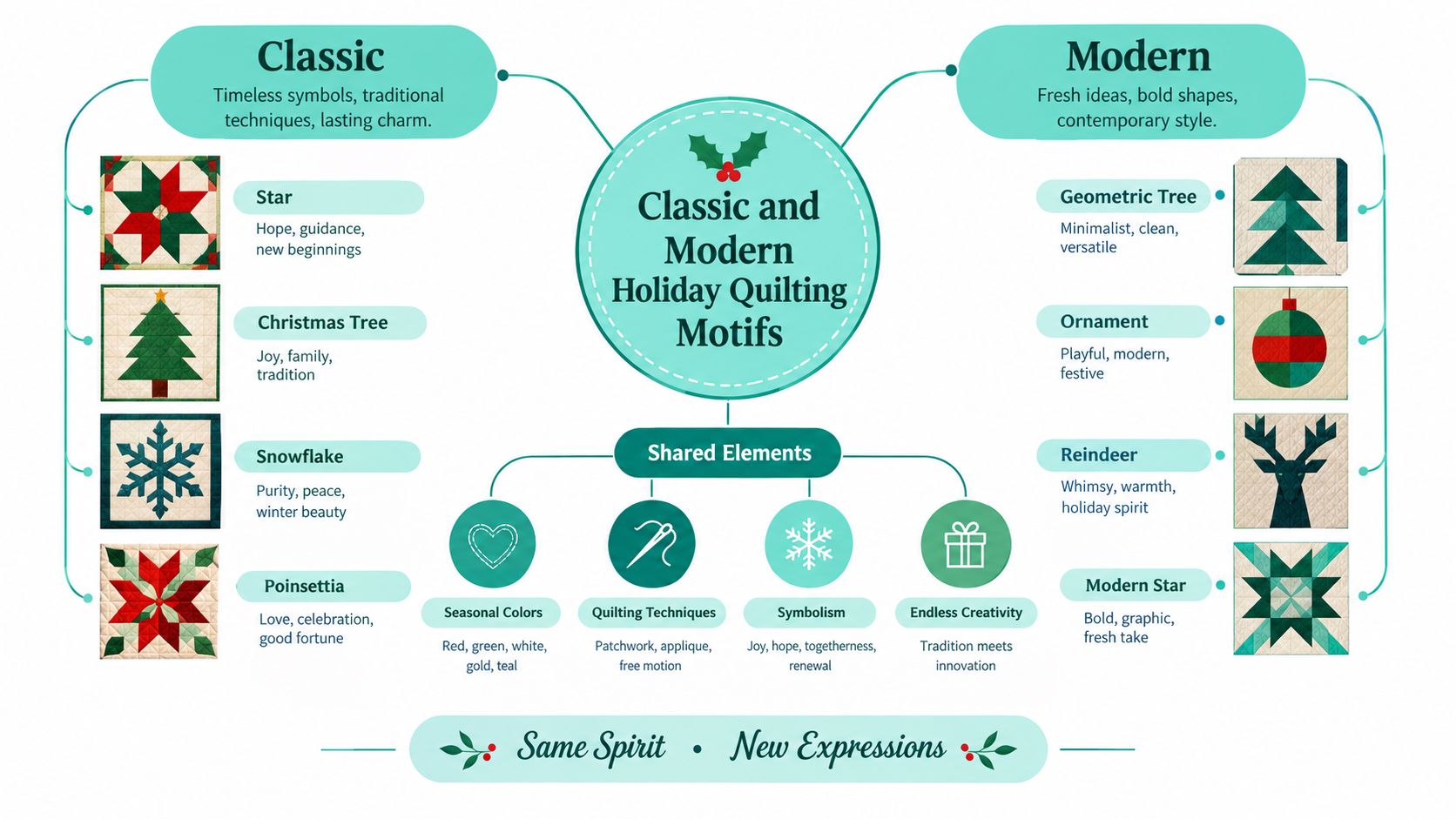
Stars remain the safest starting point for holiday quilting patterns because they carry both historical depth and visual flexibility. The National Park Service describes the star as “probably the most common motif used on quilts,” and connects its popularity with symbolism and practical design. Homesteaders used stars for navigation, while quiltmakers developed hundreds of variations, including the eight-pointed star, often described as the simplest and most popular version. Read the historical overview of Christmas quilt motifs for the broader context.
The names of established blocks also show that seasonal imagery has deep roots in quilt history. Bethlehem Star, Crown of Thorns, Eastern Star, and Star of Eden all became recognized pattern names, so holiday and religious associations weren't added later as a retail theme. A star block can therefore feel traditional without looking dated, especially when you change the background fabric or simplify the quilting.
Which motifs feel traditional?
Traditional motifs tend to rely on repeating geometry and clear symbolic shapes:
- Eight-pointed stars: Efficient, recognizable, and easy to recolor.
- Bethlehem Star: Strong for a faith-centered or classic Christmas design.
- Log Cabin: Warm, structured, and adaptable to red, cream, green, or neutral fabrics.
- Rose-of-Sharon: Floral and sentimental, with a softer decorative character.
- Album quilts: Suitable for personal messages, signatures, or gift-making with emotional meaning.
The Clio history project also lists Rose-of-Sharon, Log Cabin, Trip Around the World, and album quilts within the wider American quilt tradition. These patterns matter because holiday quilting has always borrowed from a broad vocabulary of repeating shapes, florals, and domestic gift-making rather than relying only on trees and snowmen.
Which modern motifs last beyond December?
Contemporary patterns often use snowflakes, candy canes, stockings, gingerbread, bells, trees, and snowmen. These motifs make a quilt immediately festive, but they can limit how long the quilt feels appropriate in the home.
For a longer decorating season, choose stars, log cabins, simple trees, or red-and-white geometry. A neutral background can soften an overtly Christmas-focused print, while a winter palette of cream, gray, icy blue, or warm brown can keep the quilt useful after the holiday itself. A free Christmas table runner pattern is a good place to test that balance on a smaller project.
Choosing Patterns by Skill Level
The best holiday quilting patterns are the ones you can finish cleanly with the materials you've chosen. A complicated snowflake block may look excellent in quilting cotton, but its tiny pieces and bias edges can become frustrating when paired with a stretchy or plush backing. A simpler pattern often produces a more polished gift because you have enough time to press, square, and finish it properly.
Which patterns suit beginners?
Beginner-friendly projects usually have repeatable units, straight seams, and clear visual structure. Strip-based designs, uncomplicated patchwork, and large star blocks let you practice accurate cutting without forcing you to manage many tiny intersections.
Use this progression:
- Start with a strip or patchwork design if you're still learning seam consistency.
- Move to a large star block when you're comfortable matching points.
- Add borders carefully and measure the quilt top before attaching them.
- Reserve intricate appliqué or curved piecing until you understand how the fabric behaves.
A beginner pattern doesn't have to look plain. Strong fabric placement can make a straightforward block feel deliberate, especially when you combine a seasonal print with solids or low-volume backgrounds. The beginner quilt patterns and free printable resources can help you choose a manageable construction style.
How should advanced quilters adapt detailed designs?
Experienced makers can take on dense snowflakes, foundation paper piecing, curved seams, or layered appliqué. The practical question is whether the finished top will remain stable when it's paired with minky.
Minky can stretch, shift, and hide seam detail under its pile. Keep the pieced side as stable as possible with accurate pressing and careful pinning, then simplify any block that depends on delicate points or numerous narrow sections. You may also want to enlarge a tiny block so the motif remains legible and the quilt doesn't become visually crowded.
For plush-backed gifts, avoid letting complexity accumulate everywhere. An intricate top, highly textured backing, and dense edge-to-edge quilting can each look attractive alone, but together they may create excessive weight, stiffness, or handling difficulty. Choose one primary feature and let the other elements support it.
Pairing Patterns with Shannon Minky Fabrics
Minky backing changes the character of a holiday quilt more than many makers expect. A traditional star top can feel crisp and graphic with a smooth backing, while a plush texture turns the same pattern into a winter throw with a more relaxed, luxurious finish.
Shannon Fabrics options such as Hide, Snowy Owl, and Fawn offer distinct surface effects. Hide creates a bold, fur-like look, Snowy Owl supports a wintry mood, and Fawn brings a warm, natural softness. The right choice depends on whether the backing should support the top or become part of the quilt's visual identity.
Width matters just as much as texture. Standard quilting minky is commonly available around 44 to 45 inches, while wider options include 80-inch Mirage, 90-inch, and 110-inch fabrics through specialty quilting suppliers. A 110-inch backing can prevent the bulky center seam that often appears when a large quilt requires joined backing pieces.
How do Cuddle and Luxe Cuddle compare?
| Fabric Type | Texture Examples | Available Widths | Best For |
|---|---|---|---|
| Cuddle | Smooth, dimples, prints, panels | Around 44 to 45 inches, with wider options depending on the collection | Everyday quilt backs, baby quilts, simple throws |
| Luxe Cuddle | Hide, Snowy Owl, Fawn, and other plush textures | Collection-dependent, including extra-wide options through specialty suppliers | Luxury throws, winter gifts, tactile statement backs |
The trade-off is straightforward. A smoother Cuddle backing is easier to handle and lets the pieced top dominate, while Luxe Cuddle adds more texture and softness but demands greater care during cutting, pinning, and quilting.
A plush backing should enhance the pattern, not compete with it. Pair a detailed star or snowflake top with a calmer texture, and reserve the most dramatic pile for simpler piecing.
Before choosing a texture, review the holiday minky fabric prints for Christmas and consider how the pile direction, color, and motif scale will read from across the room. If you want a tactile finish with a more refined look, shop the Luxe Cuddle collection.
Calculating Yardage and Exploring Kits
Yardage planning becomes easier when you separate the quilt top, backing, batting, and binding instead of treating the project as one fabric calculation. Begin with the finished dimensions of the top, then account for the pattern's cutting requirements, border additions, directional prints, and any fabric needed for mistakes or matching.
For the backing, compare the quilt width with the fabric width before ordering. A standard-width fabric may require a joined backing, while an extra-wide minky can cover the quilt in one continuous piece. That continuous construction reduces bulk and eliminates a center seam that can interrupt the softness of a plush backing.
What should you calculate before ordering?
- Quilt-top fabric: Follow the pattern's requirements, then check whether the design uses large directional prints or unusually narrow cuts.
- Backing fabric: Add enough around every edge for quilting and securing the layers. Extra-wide fabric may reduce the amount of yardage needed because it covers more of the quilt in one direction.
- Binding: Match the pattern's recommendation to your preferred binding width and the quilt's perimeter.
- Nap and direction: Plush fabrics may look different when brushed in opposite directions, so plan the orientation before cutting.
- Kit contents: Confirm whether a kit includes fabric only, or whether it also includes a pillow form, backing, binding, or pattern.
A useful planning method is to sketch the quilt dimensions and write the fabric width beside them. This quickly shows whether you're buying a single piece or planning a seam. For a detailed walkthrough, use this guide to calculate yardage for quilts.
Curated cuts can simplify gift projects. Two-yard, 2.5-yard, and 3-yard cuts, strip bundles, pillow kits with forms, and infinity scarf kits give makers a defined starting point without requiring a full fabric collection. They're especially helpful when the project needs to move from idea to finished gift quickly.
Shop curated minky cuts and kits when you already know the approximate project size, and check the backing width before adding fabric to your cart.
Elevating Your Quilt with Longarm Finishing
A well-pieced holiday quilt can still look unfinished if the quilting pattern doesn't support the top. Professional edge-to-edge longarm quilting adds a consistent stitched texture across the entire quilt, which is difficult to reproduce evenly on a domestic machine, particularly when the backing is plush or the quilt is large.
Holiday pantographs are usually continuous-line digital motifs. Common Christmas choices include snowflakes, stockings, candy canes, holly, bells, stars, snowmen, and Christmas trees. Choose a motif that reinforces the top's structure. Stars pair naturally with winter geometry, while holly or swirls can soften a simple patchwork design.
How does density affect the finish?
Denser quilting patterns place more stitching into the same area, increasing production time, thread use, and equipment wear. That's why longarm services commonly price denser designs at a higher rate per square inch, as explained in this longarm quilting pattern and density guide.
Density also affects how the quilt feels. Technical quilting guidance associates decorative quilting with roughly 3 to 5 stitches per centimeter, while more structural applications are kept at 3 stitches per centimeter or less. Those figures come from the technical guidance on stitch density, and they're a useful reminder that tightly packed snowflakes or holly swirls shouldn't be selected without considering batting loft and backing texture.
Professional machine-quilting guidance reports an average stitch length of 10 to 11 stitches per inch, with 8 to 9 stitches per inch suggested for heavier cotton thread and around 13 stitches per inch for very fine heirloom-style detail. The stitch-length guidance from APQS explains the practical relationship between stitch length, thread weight, and the intended finish.
For computerized longarm work, placement can matter as much as the motif. One winter star design calls for alternating rows to be staggered or offset by 50%, then closing the gap between rows. That specific mechanic helps the design repeat evenly across the quilt rather than leaving visible spacing.
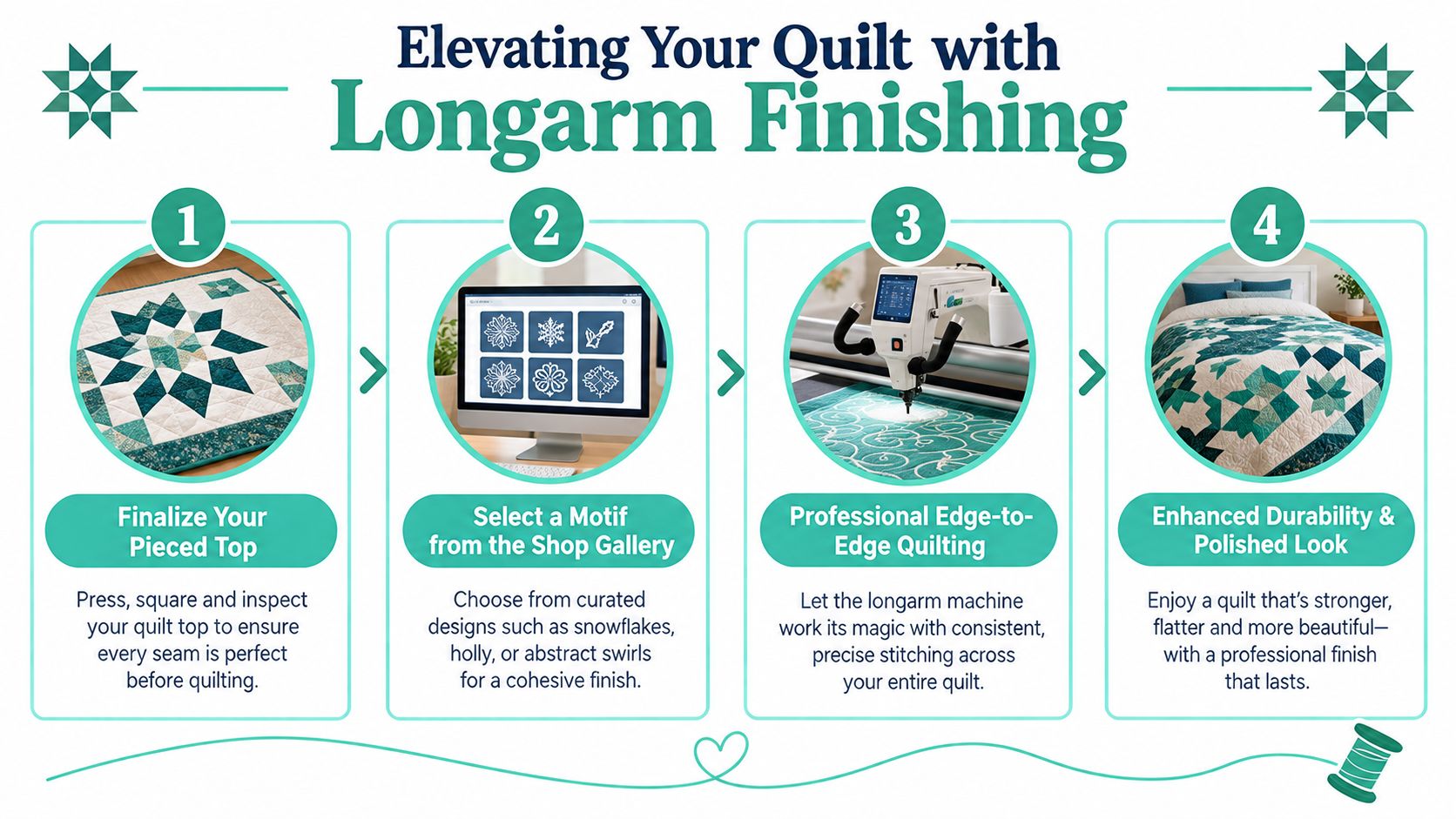
A mail-in longarm service can remove the equipment barrier while giving the project a coordinated finish. OPN's Mail-in Longarm service includes batting, thread, and free return shipping, with a gallery of holiday, modern, floral, juvenile, and nature motifs. Customer confidence matters when shipping a handmade quilt, and OPN is backed by hundreds of verified reviews.
If you're sending a quilt top to a longarm provider, prepare the backing generously. Mail-in preparation guidance recommends that the backing be at least 4 inches larger than the quilt top on all four sides. For example, a 60 by 70 inch quilt top would need a 68 by 78 inch backing, as shown in this mail-in longarm preparation checklist.
Mail-in finishing works best when the top is square, the backing is oversized, and the fabric choices are made with quilting density in mind.
Here's a closer look at the finishing process and motif selection:
Book a Mail-in Longarm service when the goal is a polished, gift-ready quilt without managing a large machine at home. New customers can also use the 15% first-order coupon, subject to the shop's current terms.
Your Next Steps for a Cozy Holiday Quilt
Choose the motif before buying the backing, but let the backing influence the quilting plan. Stars, log cabins, and restrained red-and-white palettes can remain useful after December, while plush textures such as Hide, Snowy Owl, and Fawn add warmth and a giftable finish.
For a practical workflow:
- Pick the project size and decide whether it's for display, gifting, or everyday use.
- Select a block style that matches your skill level and the stability of the fabrics.
- Compare backing widths before ordering, especially for large quilts.
- Calculate yardage for the top, backing, batting, and binding.
- Choose quilting density that suits the thread, batting, and minky pile.
- Prepare early for finishing if you're using a Mail-in Longarm service.
You can shop Shannon Cuddle and Luxe Cuddle fabrics, explore quilt backing fabrics, or select a coordinated kit for a smaller seasonal gift. OPN offers a 15% first-order discount and free U.S. shipping on orders over $70, so check the current offer before placing your order.
On Pins & Needles Quilting Co. offers premium Shannon Cuddle and Luxe Cuddle fabrics, extra-wide minky backings, curated kits, and Mail-in Longarm finishing for holiday quilts. Choose your soft backing, send in your prepared quilt top, and visit On Pins & Needles Quilting Co. to start your cozy project today.