
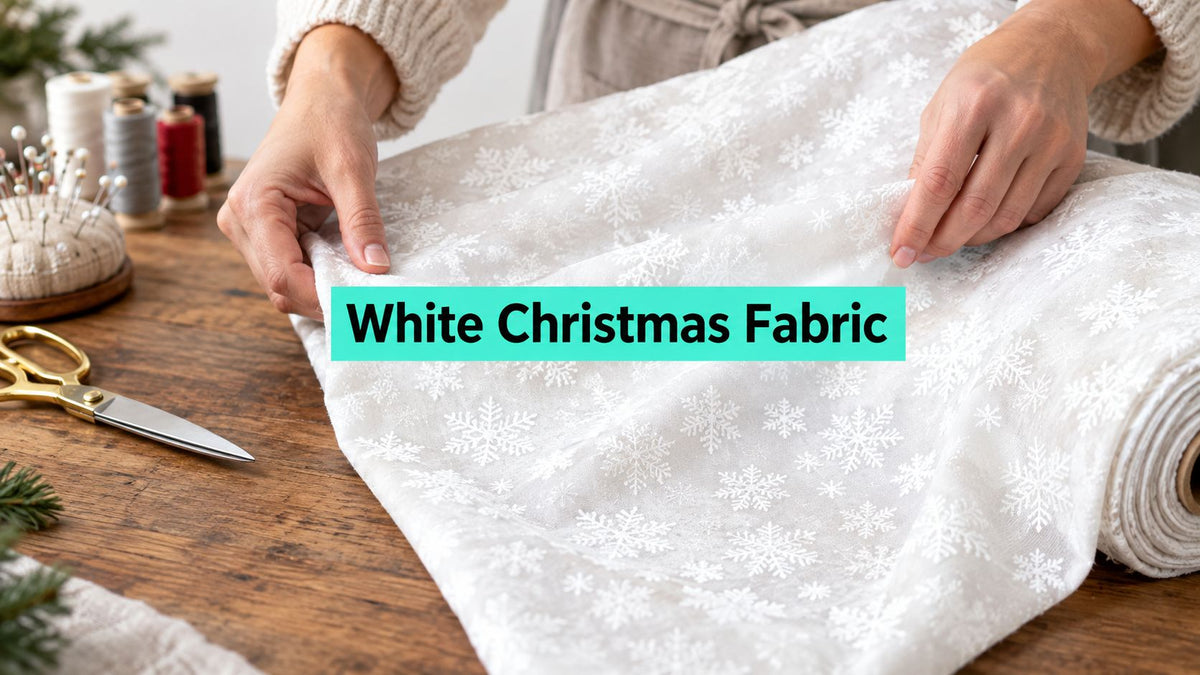
You're standing in the fabric aisle holding a bolt that looks completely blank, wondering if you picked up plain white by mistake. Tilt it toward the light and snowflakes suddenly appear. White on white Christmas fabric is white quilting cotton with a white tonal motif on a white ground, and its pattern shows through texture and sheen, not color contrast.
What Is White on White Christmas Fabric
That hold it to the light moment confuses almost every quilter the first time. You're not imagining the pattern, and you haven't grabbed the wrong bolt. The design is there, it just doesn't shout.
White on white Christmas fabric means a white design on a white ground, like writing with a white crayon on white paper, then discovering the drawing when you angle the page. It's different from plain white cotton, which has no motif at all, and different from a printed holiday fabric where red poinsettias or green trees sit in clear contrast.
What Makes the Motif Appear
The pattern doesn't come from color. It comes from texture, weave, quilting, raised motifs, or subtle differences in sheen. A snowflake might catch light because it's printed with a slightly glossier finish, while a swirl might sit a fraction higher than the base cloth.
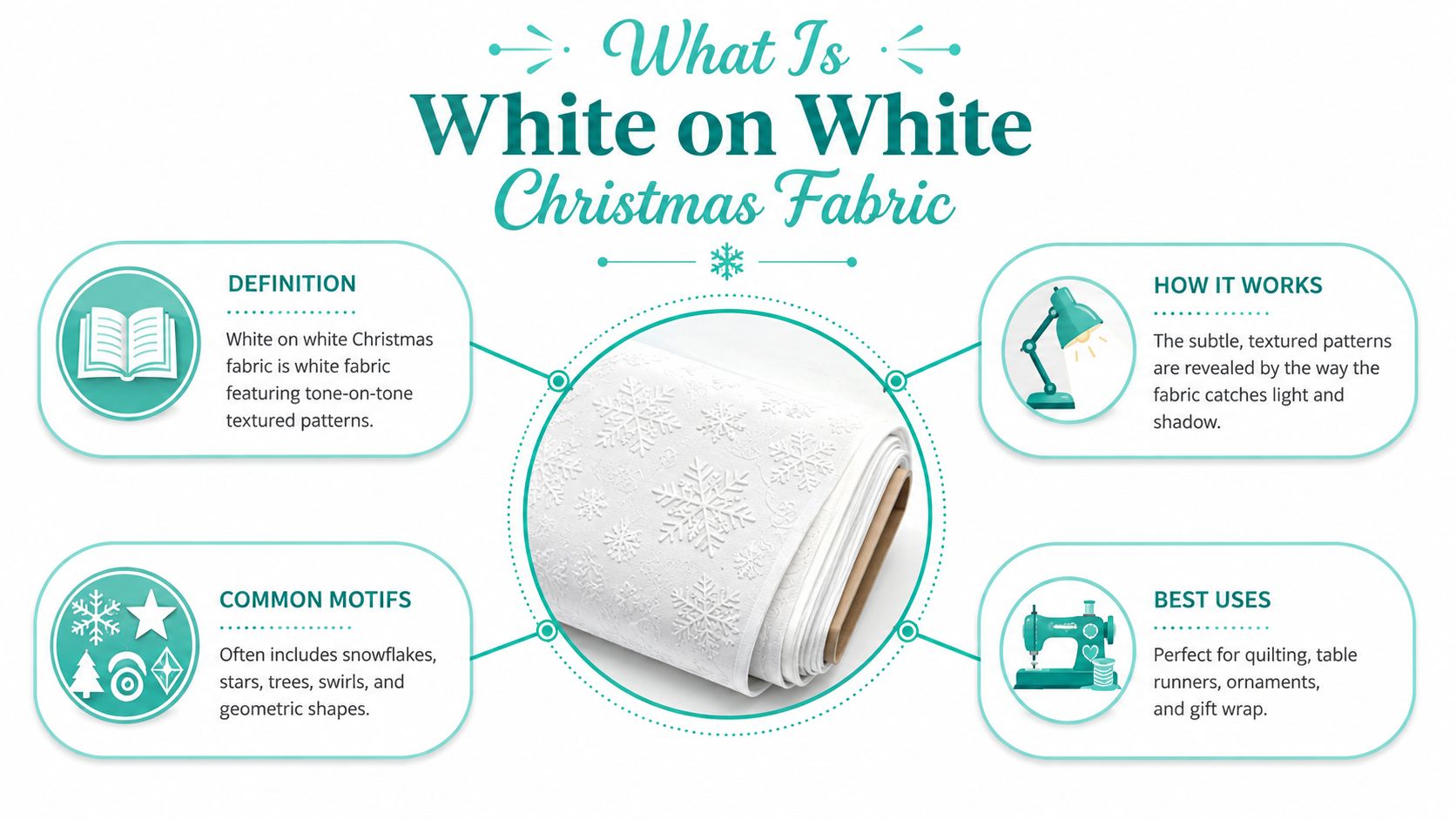
That's why product photos can mislead you. A fabric that looks solid in a flat image can reveal its pattern under angled light or once it's quilted and the surface gains depth. If you're shopping online, zoom in, look for a close crop, and read the motif description rather than trusting the thumbnail alone.
Where This Fabric Earns Its Place
Because the detail stays quiet, this fabric works in two jobs at once. It can be your background, giving colorful blocks room to breathe without looking empty. It can also be the whole palette for a calm, wintry piece.
- Christmas quilts where you want holiday detail without busy color
- Tree skirts and stockings that need to sit beside colorful ornaments
- Table runners and seasonal pillows that shouldn't fight your centerpiece
- Borders and sashing that add interest up close and rest the eye from a distance
A useful test in the shop is simple. Drape the fabric over your hand and turn it slowly. If snowflakes, stars, or trees appear and fade as the angle changes, you're looking at white on white, not plain white.
Once you train your eye to look for sheen instead of color, you'll spot it instantly. You're choosing the pattern you want people to discover when they get close, not the one they see across the room.
The History Behind White-on-White Holiday Textiles
White on white didn't start as a Christmas idea. It started as a practical way to get the look of lace without paying for handmade lace. That history explains why the fabric still reads as refined and handmade today.
European and American whitework became especially popular during the eighteenth century, when tone-on-tone embroidery offered a less expensive alternative to handmade lace. Cotton was the principal ground fabric, though linen was also used. The work relied on stitch and texture, so light and shadow did what color usually does.
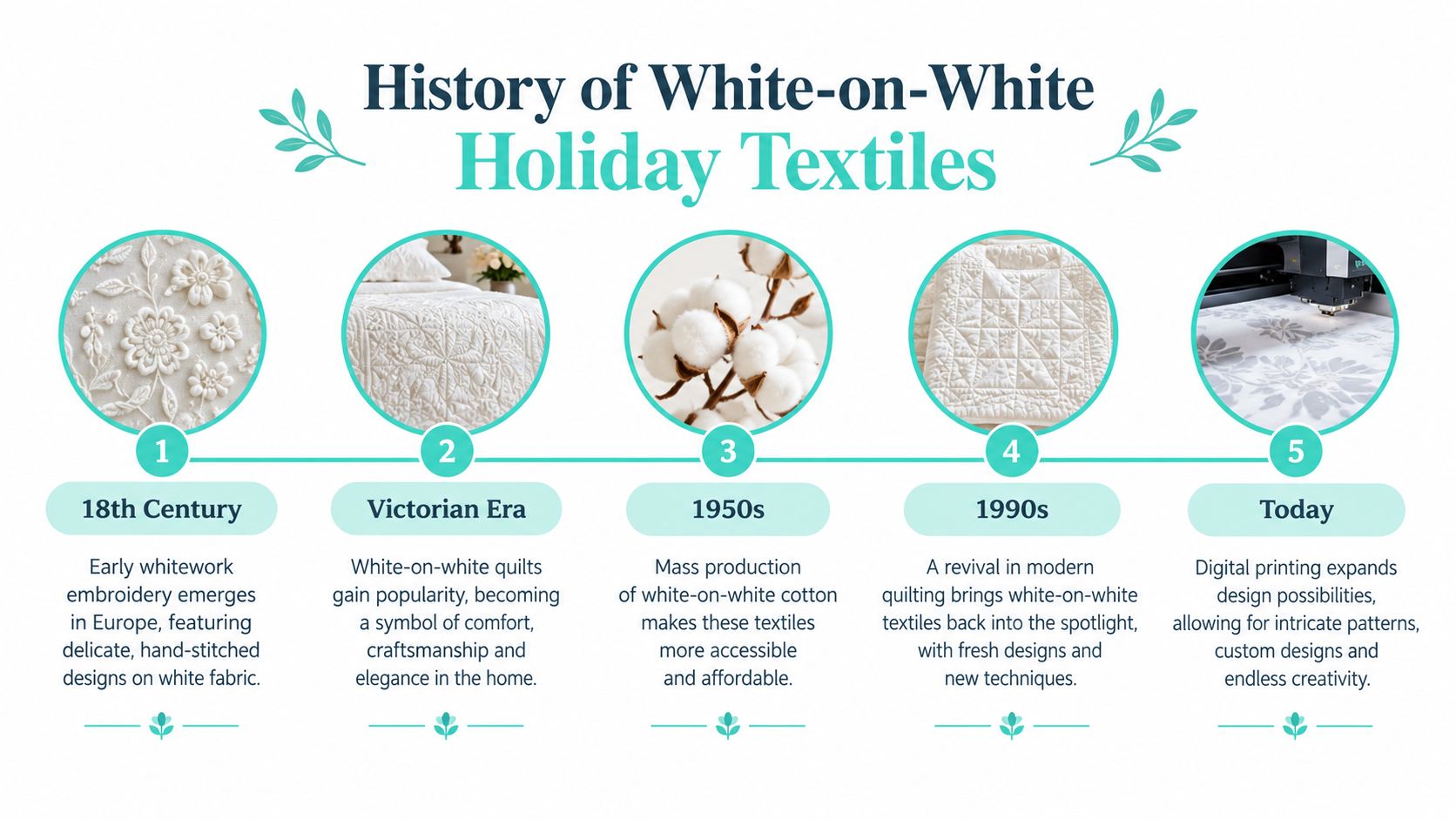
The scale of that tradition surprises many. By the mid-nineteenth century, more than 200,000 embroiderers, including children as young as eight, were employed in Ayrshire whitework production in Scotland and Ireland. This wasn't a small cottage trend. It was a major textile industry built on subtle white decoration.
A Tradition That Crossed Continents
The same idea developed in many places at once. Whitework traditions grew across England, Scotland, Ireland, continental Europe, India, Bangladesh, Guatemala, and Mexico. Techniques varied from surface embroidery, such as Indian chikan, to woven supplementary-weft decoration, such as jamdani from Bengal.
That spread matters for how you read modern fabric. White-on-white decoration is a globally recurring practice, not a narrow regional style. When you see a tonal snowflake today, you're seeing a printed descendant of stitched and woven work that makers refined for centuries.
How White Became a Christmas Palette
The link to Christmas came through decorating, not quilting alone. Christmas-tree celebrations in Britain became recognizable in the nineteenth century, and Victorian decorators used handmade textile elements including silk, lace, tassels, doilies, cotton wool, and small fabric figures. After 1960, synthetic yarns, sequins, plastics, and imported decorations made coordinated color themes more accessible.
Historical decoration accounts identify all-white trees with frosty white ornaments and silver, blue, pink, or mauve accents as an established icy winter style. That's the vocabulary your fabric belongs to, snow, frost, purity, lace, and restrained luxury. You're not using a blank fabric. You're borrowing a documented winter language that your guests already understand instinctively.
Design and Texture Considerations for Holiday Projects
The question quilters ask most is honest, will anyone see the pattern, or will my quilt look blank? The answer depends on motif scale, lighting, and what sits next to the fabric. Once you understand those three levers, you can predict the result before you cut.
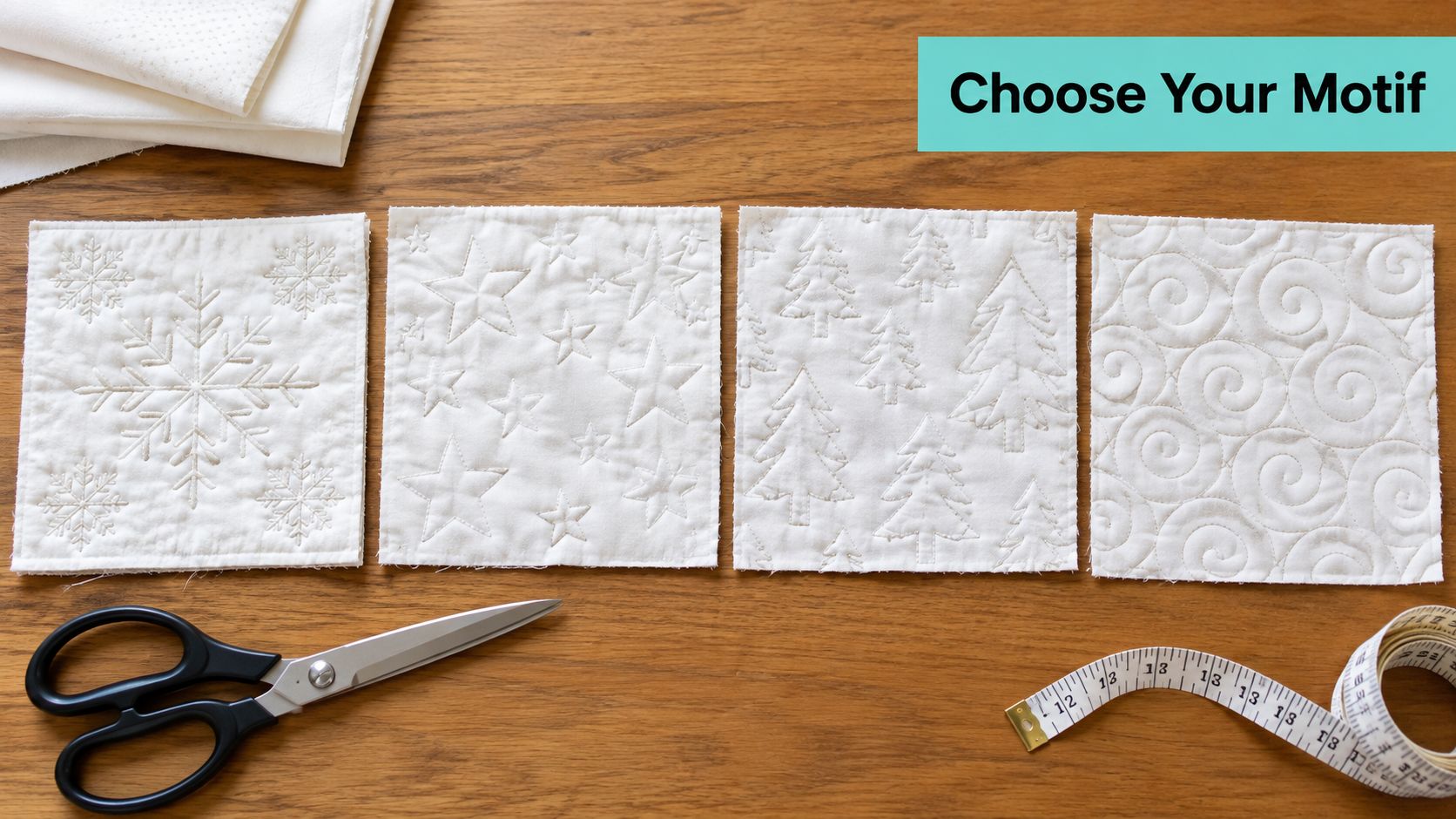
Start with the motif itself. Snowflakes and stars read as clearly seasonal even at low contrast, because your eye recognizes the shape. Swirls and geometric textures behave more like a blender, adding movement without announcing a theme. Trees and script need larger cuts to make sense, so they suit borders, large squares, and whole-cloth panels better than small piecing.
Will the Motif Disappear in Your Room
Lighting changes everything with this fabric. Under flat overhead light, a tonal print can look almost solid. Under angled lamplight, window light, or tree lights, the sheen difference wakes up and the motif appears.
Viewing distance works the same way. From across the room, your quilt reads as a clean white field. Up close on a lap, the snowflakes show. For many gift quilts, that reveal is the point.
Practical rule: Judge the fabric where the finished piece will live. Take a swatch to the room, lay it beside the sofa or table, and check it morning and evening before you decide it's too subtle.
Don't assume more visible is better. A low-contrast fabric can provide holiday detail without competing with appliqué, embroidery, or colorful blocks. If your appliqué trees are the stars, a quiet background lets them perform. If you want the background itself to carry the holiday theme, choose a larger, shinier motif.
Bright White, Ivory, and Off-White Are Not Interchangeable
Bright white looks crisp and snowy beside true red and green. Ivory and off-white look warm and vintage, but they can look dingy when pieced directly against bright white. Under warm indoor lighting, even a true white can read cream, so compare all your whites together in one light source. Projects go wrong here.
Value does the heavy lifting here. Perceived transparency and depth can be created by value relationships rather than literal transparency, while thread that matches the background can make quilting lines nearly invisible. In plain terms, a slightly deeper white thread or a denser quilting pattern can make your surface look layered even though every element is white.
Batting changes the picture too. A higher-loft batting pushes the surface up between quilting lines, which makes texture easier to see. A thin batting keeps the piece flatter and subtler.
Watch how tonal fabric behaves once it's cut, pressed, and stitched into real blocks.
If you're building a full seasonal palette around your choice, our guide to coordinating Christmas quilt fabric for balanced holiday projects walks through pairing tonal neutrals with saturated prints. Pick your white first, then let the reds and greens audition against it, not the other way around.
Pairing White-on-White Tops with Minky Backs
A delicate white top and a plush back sound like opposites, but they're a natural match. The top brings the refined, snowy look. The back brings the softness people curl up in. Your job is choosing a pile that supports the top instead of overwhelming it.
Shannon Fabrics Cuddle is the smoother, lighter option, while Luxe Cuddle has a longer, plusher pile and more weight. Textures like Hide give you an embossed, low-profile surface, Snowy Owl brings a luxe, feathery look that echoes a winter theme, and Fawn offers a soft, tonal pattern with visual warmth. With a white-on-white top, a textured back adds interest without introducing a competing print.
Shannon Cuddle vs Luxe Cuddle for White-on-White Quilts
| Texture | Pile Height | Best For | Care Notes |
|---|---|---|---|
| Cuddle, including Hide | Short and smooth | Baby quilts, table pieces, lighter throws | Easier to handle, less bulk in seams |
| Luxe Cuddle Snowy Owl | Longer and plush | Gift throws and winter lap quilts | Handle gently, cut carefully to limit shedding |
| Luxe Cuddle Fawn | Longer with tonal pattern | Statement backs for plain tonal tops | Check pattern direction before cutting |
Neither choice is better in the abstract. A short pile keeps a small quilt drapey and easy to wash and fold. A long pile turns the same top into a heavy, luxurious gift that feels substantial the moment someone picks it up.
Stop struggling with bulky seams in your quilt backs when you can plan the backing width around the finished size from the start. Our walkthrough on how to choose quilt backing that fits your top and your quilting plan helps you match width, drape, and texture before you order. That's especially helpful if you're shoppping soft fabric and quilt textures online without a bolt in your hands.
What Minky Asks of You in Return
Minky stretches, sheds when cut, adds weight and drag, and doesn't grip batting the way cotton does. Those aren't flaws, they're mechanics you plan around. Cut it square, handle it gently, and don't expect it to behave like quilting cotton on the frame.
For longarm work, our published preparation guidance specifies a sharp 18/110 needle, careful tension management, and 4 to 6 extra inches of backing on all four sides. That extra perimeter gives the operator material to load, clamp, and advance without pulling the edges. Press your white top flat first and trim every loose thread, because dark threads can shadow through light fabric and show as gray squiggles you can't remove later.
- Cut the backing square and mark the top edge clearly
- Remove pins, clips, and embellishments before it goes on a frame
- Correct ripples and lifted seams now, since quilting doesn't reliably remove fullness
If you'd rather not wrestle a plush backing under a domestic machine, that's exactly the problem a Mail-in Longarm service solves. You send a clean, pressed top and a square, generously sized back, and the quilting adds the texture that makes your tonal motif come alive.
How to Wash and Sew White-on-White Fabric Safely
Most white-on-white disasters happen before the first seam. The fabric shrinks after piecing, a red print bleeds into the white field, or a dark thread shadows through a seam. A short testing routine prevents all three, and it costs you one small swatch.
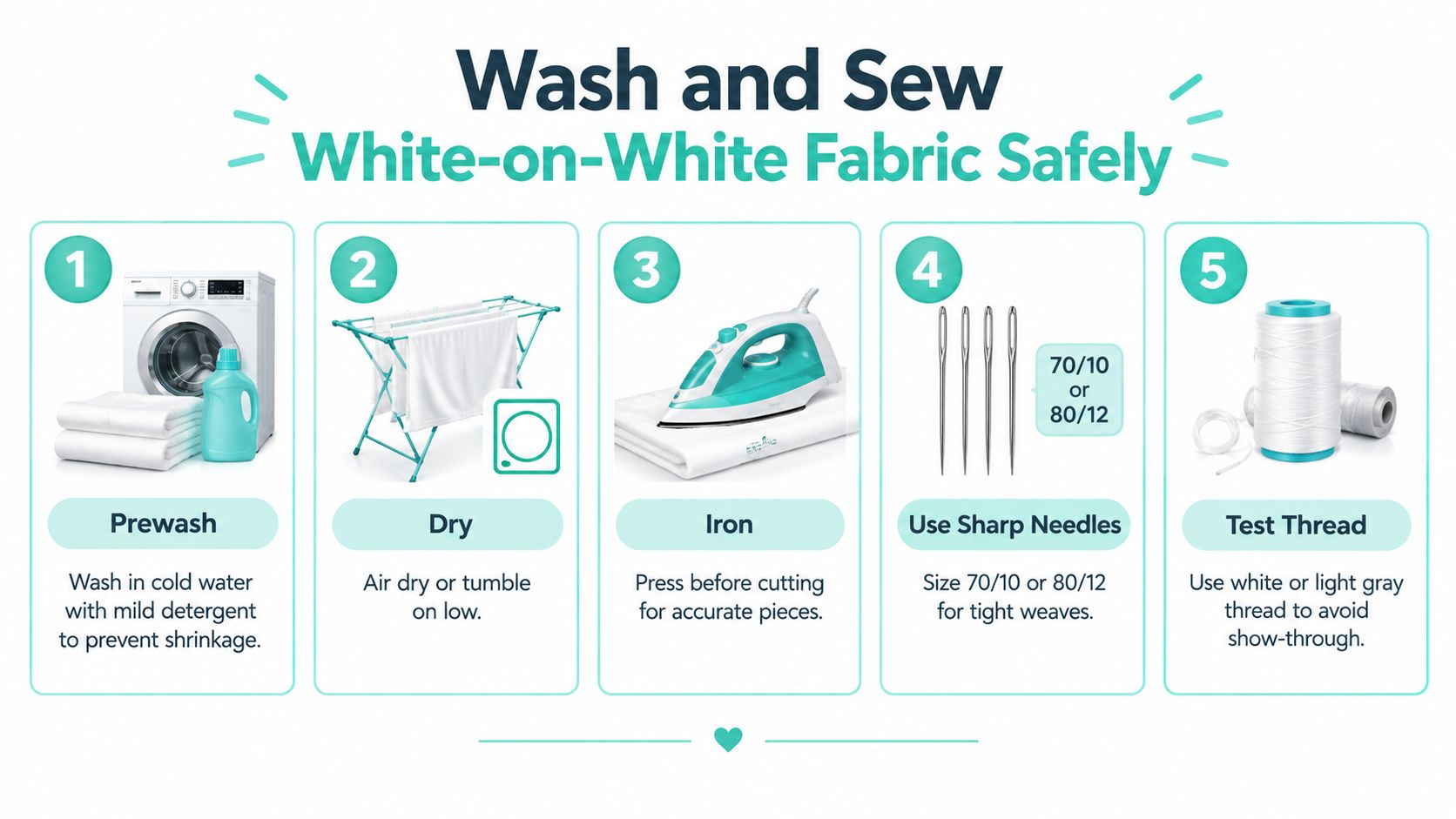
Start with shrinkage, because cotton moves. Cotton quilting fabric commonly requires prewashing because post-quilt shrinkage can distort pieced-block alignment, while residual sizing can affect needle penetration and thread tension. If one fabric shrinks and its neighbor doesn't, your points stop meeting and your borders wave.
A Simple Shrinkage Test You Can Measure
- Cut a 6-inch square and mark the warp and weft directions
- Wash and dry it using the exact care cycle you plan for the finished quilt
- Measure both directions again and calculate change with ((prewash dimension minus postwash dimension) divided by prewash dimension) multiplied by 100
- Decide from the result whether to preshrink all your fabrics the same way before rotary cutting
Preshrinking also helps grain. Washable fabrics can often be returned closer to correct grain simply by washing and drying them, and most fabrics should be preshrunk even when no other corrective processing is required. You're moving the dimensional change to before precise piecing, which is where you can still control it.
Test for Bleeding Before White Meets Red
White fabric reveals even slight dye transfer, so test every saturated partner fabric. Nebraska Extension recommends placing several drops of plain water on an inconspicuous area, letting it soak in, then blotting with white blotter paper or cloth, and repeating with your planned detergent solution. If color appears on the blotter, that fabric isn't safe to wet-clean beside your white field.
Use cold or warm water, mild detergent, and gentle agitation, and wash suspect accents separately. Our detailed guide to color fastness testing before you piece a high-contrast quilt shows how to record results bolt by bolt. That record matters because a tonal motif may be printed, finished, pearlized, or textured, and each surface can respond differently to laundering and ironing.
Don't skip the mini quilt sandwich. Wash a small sample with your actual batting, backing, thread, and stitch pattern. It's the only test that shows you shrinkage, thread contrast, and seam shadows together.
For thread, evaluate by value, not by the spool label. White thread can disappear into a white ground, which is lovely for background quilting and frustrating if you wanted definition. A pale gray often reads as shadow and shows your quilting without looking dirty. Press with care, check seams against light, and trim dark seam allowances or press them toward the darker fabric so they don't ghost through your beautiful white field.
Where to Find Reliable White-on-White Christmas Stock
Ordering white fabric online works like buying paint from a swatch card. You can't tilt a screen image toward the light, so what you're really purchasing is the shop's judgment, cutting accuracy, and willingness to answer questions. The yardage itself is almost the easy part.
Read each listing the way you'd read a recipe. A trustworthy page tells you whether a white is bright or ivory, whether a motif is matte or pearlized, and shows close photos of the tonal pattern. A listing that just says "white Christmas fabric" leaves you guessing on the two details that decide whether your quilt reads as crisp winter white or dingy cream.
What a Trustworthy Stockist Shows You
- Accurate, generous cutting so your planned borders still fit
- Consistent inventory when you need one more yard of the same white
- Reachable phone and email support for matching a white from a past order
- Secure checkout and clear shipping terms before you commit
Then check the shop's claims against its reviews. Before ordering, skim the review section for comments about true color, cut accuracy, and how a Shannon Cuddle texture held up after washing. Those specifics tell you more than a star rating, and they appear again and again when a stockist cuts carefully and describes its whites.
Our current offer for new customers: Get 15% off your first order and free shipping on orders over $70. If you're pairing a white-on-white top with a plush backing, that threshold is easy to plan around.
A specialist also helps you think in complete projects. Sourcing your tonal cotton, minky backing, and finishing supplies in one place keeps a refined top from ending up with a backing that fights it. Our guide to where to buy material for quilts from reliable, well-stocked sources walks through what to check before trusting any supplier with a gift deadline.
Ask one question before you order for a coordinated set: can the shop confirm the white and lot if you reorder? Lot-to-lot variation is normal in textiles, and a careful stockist will help you buy enough at once for blocks, borders, and binding. That single conversation protects the clean, even white field your whole design depends on.
A Step-by-Step Holiday Quilt Project Walkthrough
Let's put the pieces together in one realistic gift quilt. You'll make a white-on-white lap quilt with red accents and a plush back. The sequence matters more than speed, because each step protects the next one.
First, choose your white and prove it. Pick a snowflake motif in the white that matches your other fabrics, then run the shrinkage square and the blotter test on your red accent. Only after both tests pass do you wash, dry, and press your yardage for cutting.
From Cutting Table to Pieced Top
- Cut after preshrinking so block sizes stay honest
- Piece with a thread you've tested against the white ground
- Press seam allowances toward the darker fabric where you can, and trim loose threads as you go
- Check the top against light to catch shadows before layering
Hold finished blocks up in the room where the quilt will be photographed and gifted. If the motif vanishes under that lighting and you wanted it visible, denser quilting or a higher-loft batting can add the surface depth you need. If it looks perfect already, keep the quilting simple and let the fabric do the work.
Our collection of holiday quilting patterns suited to tonal and low-contrast fabrics is a good place to choose a layout with pieces large enough to show your motif. Small, fussy piecing can chop a snowflake into unrecognizable fragments. Generous squares, sashing, and borders let the pattern breathe.
Layering, Quilting, and Finishing
Choose your backing by feel and by finish. A smooth Cuddle keeps the quilt lighter for everyday use, while a Luxe Cuddle in Hide, Snowy Owl, or Fawn makes it a heavier gift piece. Cut the back square with the extra margin your quilting method needs, and mark the top edge so directional textures stay oriented correctly.
If you're sending the top out, follow the prep checklist exactly, pressed top, trimmed threads, square backing, no pins or embellishments. Book Your Longarm Service Today once your top passes the light test, rather than rushing a top with ripples you hope quilting will hide. It won't, and on white fabric, fullness shows.
Finish with a binding you've also tested for bleeding if it's red or green. Wash the completed quilt the way you tested at the start, then fold it once to check that the white field stayed clean. You've now used history, design judgment, testing, and backing mechanics in one project, and the result looks deceptively simple. That's the charm working exactly as intended.
Frequently Asked Questions About White-on-White Fabric
Can I Fussy Cut White on White Christmas Fabric
Yes, if the motif reads clearly at the size you need. Choose a snowflake, star, or tree with enough contrast to survive the seam allowance, then cut pieces large enough to hold the whole shape. Mark on the wrong side or use a clear template, because a tonal outline can vanish under bright cutting-table light.
Is White on White the Same as Tone on Tone
White on white is one kind of tone on tone. Tone on tone means print and ground sit in the same color family, such as red on red or navy on navy. White on white is the strict version: both layers read as white, and sheen or weave does the separating.
Will Minky Hide the Subtle Pattern
A plush back can soften the front visually if the quilting is too dense. Use a low-loft batting and an open design so light still crosses the surface. For a heavier gift, Luxe Cuddle works, but test a small sandwich near a window and under evening lamps.
Can I Machine Wash the Finished Quilt
If your test pieces, thread, and backing stayed colorfast, a gentle cycle with mild detergent suits an everyday cotton and minky quilt. Heirloom pieces deserve hand washing. Repeat the method your mini sandwich survived.
How Do I Store Leftover Pieces
Label each scrap with the exact white name and purchase source, then keep whites away from saturated reds and greens in damp storage. Two whites that match in a bin can drift apart in daylight.
Ready to start your own snowy project with white on white Christmas fabric, a plush Shannon Cuddle backing, and finishing help you can trust? Shop the Luxe Cuddle Collection, get 15% off your first order with free shipping over $70, and explore fabrics, kits, and mail-in longarm quilting at On Pins & Needles Quilting Co. today.