
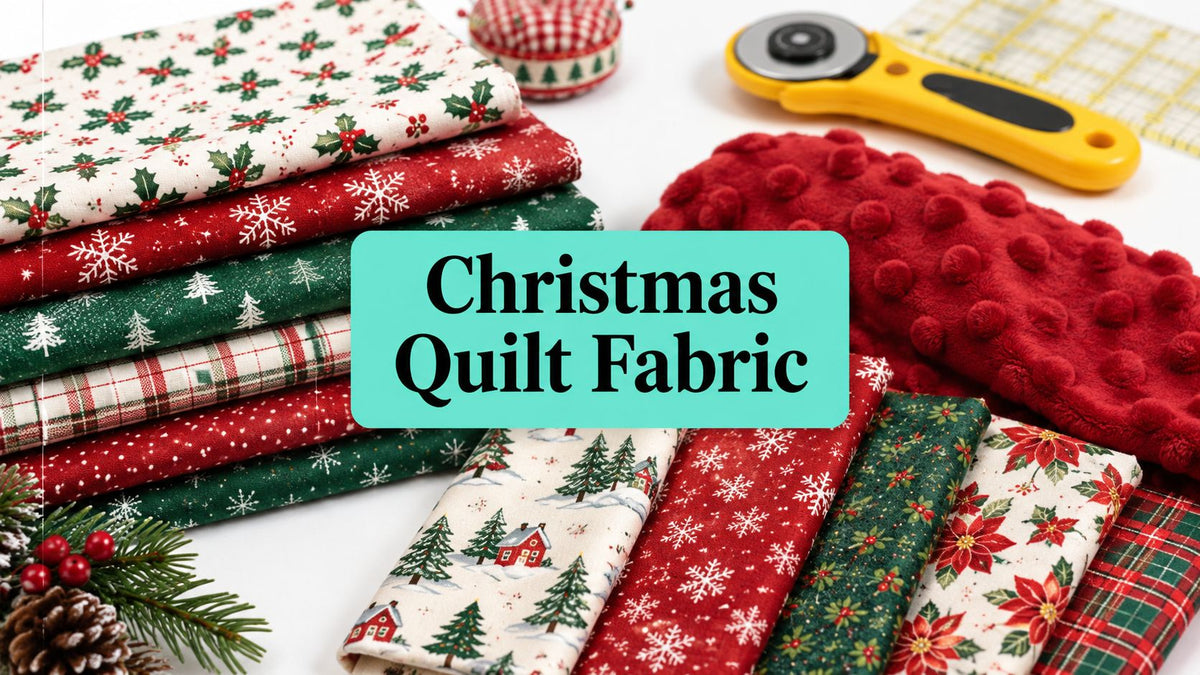
You've found the perfect red-and-green print, but the finished quilt can still disappoint if the backing sheds, the colors bleed, or the fabric width forces a bulky seam. The best Christmas quilt fabric plan matches four choices from the beginning: print, texture, width, and care. That approach produces a quilt that looks festive, sews accurately, and remains comfortable after washing.
Start With the Right Fabric Combination
Every holiday quilt begins with a practical decision: will the top carry the design, or will softness carry the project? Cotton quilting prints suit precise piecing, while plush fabrics such as Shannon Cuddle and Luxe Cuddle create a warmer, simpler construction. The strongest results come from choosing both as a coordinated system rather than shopping for them separately.
Start with the mood you want. Traditional Christmas quilt fabric often combines red, green, cream, white, and gold, while winter designs can move toward blue and silver. Contemporary palettes may include pink, aqua, soft neutrals, or brighter colors, so a seasonal quilt doesn't have to follow one formula. Shabby Fabrics' Christmas fabric collection offers a useful visual reference for these traditional and modern directions.
How should you match a cotton top with a plush backing?
Use the top to establish the pattern and the backing to control the tactile experience. A red-and-green tree or star top pairs naturally with a solid cream, deep green, or winter-toned Cuddle backing. If the top already contains several novelty prints, a quieter backing prevents the finished quilt from feeling visually crowded.
For a faster project, an all-minky construction can work well. It removes detailed piecing from the equation, but plush fabrics require careful handling because pile can shift and obscure seam lines. Cotton prints remain the better choice for small stars, ornaments, log cabins, and paper-pieced designs where accurate geometry matters.
Practical rule: Choose the top for visual structure and the backing for comfort. Don't ask one fabric to perform both jobs if that compromises either result.
What should you buy first?
Build a small plan before ordering yardage:
- Choose the focal print: Decide whether Santa figures, trees, snowflakes, plaid, or a quieter winter motif will lead the design.
- Add support fabrics: Select solids, small-scale prints, or low-contrast coordinates that give the eye somewhere to rest.
- Select the texture: Compare smooth Quilting Cuddle with more dimensional textures such as Hide, Snowy Owl, or Fawn.
- Confirm the width: A backing that avoids piecing can matter more than a slightly cheaper cut.
- Plan the use: A decorative wall quilt can tolerate different choices than a frequently washed child's blanket.
Quilting has always adapted to available materials and household needs. Printed textiles became more accessible during the nineteenth century, and quilts gradually moved beyond utility into decorative, seasonal, family-centered objects. That same flexibility makes it reasonable to combine a traditional cotton top with a modern plush backing. For broader seasonal planning, Christmas fabric bundles can help keep color and motif choices coordinated.
Makers who are also decorating shirts or family gifts may find holiday apparel with DTF transfers useful for carrying the same seasonal palette beyond the quilt. Keep the visual language consistent, but don't force apparel prints and quilt fabrics to serve the same construction purpose.
Cotton Prints vs Plush Textures
Cotton and plush polyester solve different problems. Woven quilting cotton gives you controlled cutting, crisp seams, and dependable pattern definition, while Shannon Cuddle and Luxe Cuddle bring softness, warmth, and a quick path to a finished gift. Neither is automatically the right answer.
A technically useful benchmark for woven quilting cotton is approximately 4.3 to 4.5 ounces per square yard, or about 145 to 152 grams per square meter, with roughly 60 to 75 threads per inch in both directions. This construction balances sewability, opacity, dimensional stability, and resistance to distortion during piecing. The figures and related buying guidance are discussed in this quilting cotton construction guide.
| Feature | Cotton Prints | Plush Textures |
|---|---|---|
| Best use | Detailed pieced tops, appliqué, and paper piecing | Backings, simple blankets, and soft gift projects |
| Main strength | Sharp prints and stable seam geometry | Warmth, drape, and tactile comfort |
| Cutting behavior | Easy to mark, rotary cut, and align | Pile can hide edges and shift during handling |
| Sewing consideration | Pressing and seam matching are straightforward | Walking-foot control and careful pinning help |
| Visual effect | Crisp motifs and clear value contrast | Dimensional surface with a softer appearance |
| Main trade-off | Requires more piecing and finishing time | Can create bulk or obscure precise seam lines |
When does cotton make more sense?
Choose cotton for a design with many small pieces. A tighter, balanced plain weave helps preserve the shape of stars, trees, and geometric blocks, particularly when bias edges are involved. A light starch or sizing finish can temporarily improve rotary-cut accuracy, though that support may disappear after laundering.
Cotton also gives you more control over value. A cream background can make red ornaments readable, while a dark green border can frame the composition without adding another competing novelty print. For additional backing guidance, our notes on the best fabric for quilt backing address how weight and construction affect the finished quilt.
When is plush the better route?
Plush textures are practical when the recipient values softness more than intricate piecing, or when you need a manageable gift project. Shannon Cuddle and Luxe Cuddle are 100% polyester and can be machine washed, but they need low-stress preparation and drying. Higher pile also changes how you inspect seams, trim edges, and attach the quilt to a longarm frame.
OPN Quilting carries Shannon Fabrics options including Hide, Snowy Owl, and Fawn, along with prints and seasonal panels. A specific holiday print such as Snowmies Digital Cuddle Scarlet can provide the festive surface, while a quieter texture can serve as the reverse.
A plush backing should support the quilt top, not compete with it. If both sides demand attention, reduce the number of novelty prints before adding more texture.
Pick the Best Width for Your Quilt Size
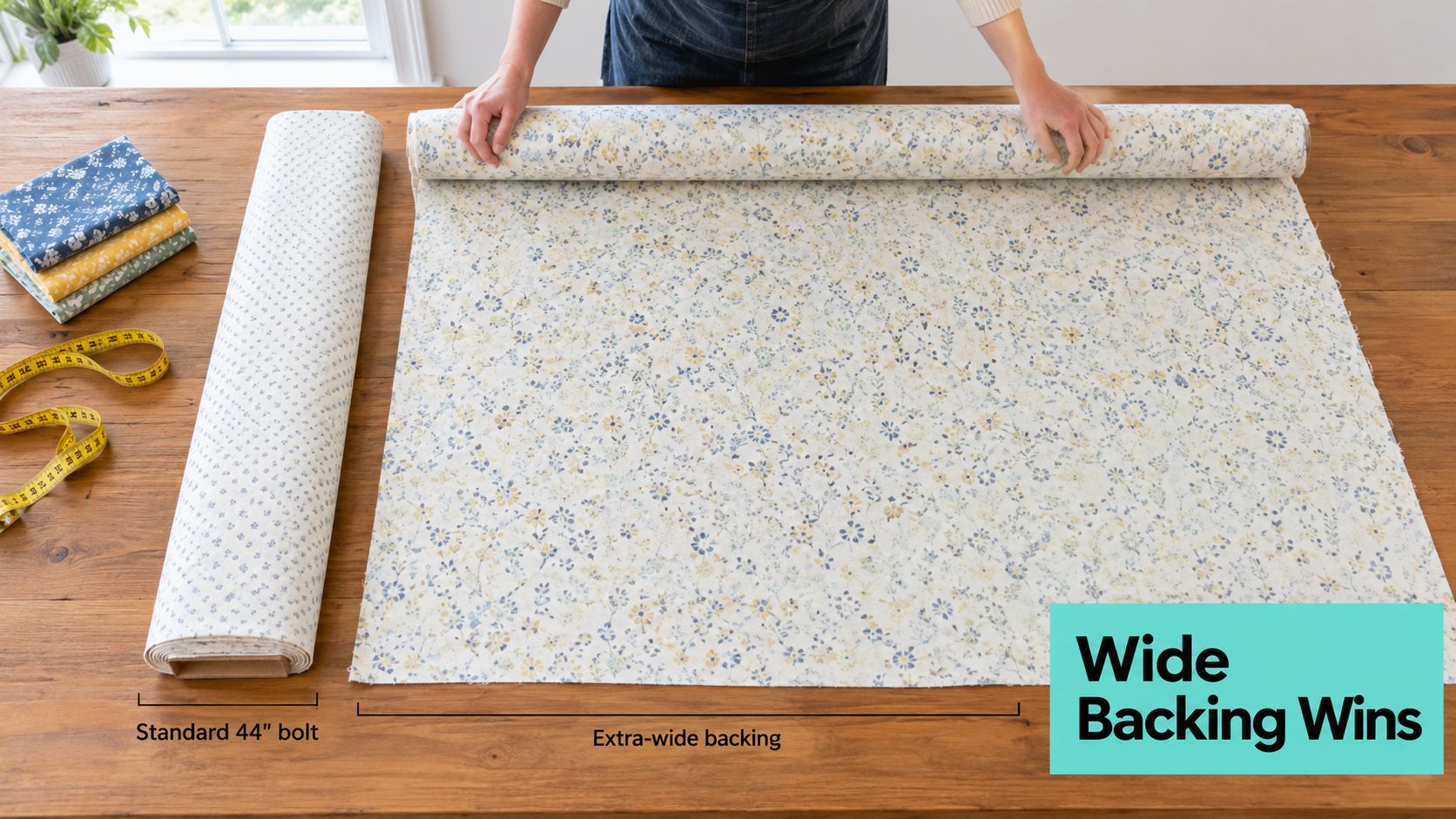
Backing width often determines whether a Christmas quilt has a smooth drape or a noticeable ridge. Standard quilting cotton is commonly about 44 inches wide, so larger quilts usually require a joined backing. That seam isn't always a problem, but it adds bulk and creates another line that must be pressed, aligned, and quilted.
Extra-wide minky changes the calculation. OPN Quilting stocks 44 to 45 inch Quilting Cuddle, 80 inch Mirage, and extra-wide 90 and 110 inch options. For a large holiday blanket, 110-inch Luxe Cuddle can eliminate a center backing seam when the quilt dimensions fit within the usable width.
How do you choose a backing width?
Measure the finished quilt top, then compare that measurement with the fabric's usable width. Remember that longarm preparation requires extra fabric beyond the top, so a width that looks sufficient on paper may not be enough once attachment and quilting allowances are considered.
Use this decision pattern:
- Small projects: A 44-inch cut may work for a narrow wall hanging, table runner, or baby quilt.
- Medium projects: An 80-inch width can remove a seam from many throws and lap quilts.
- Large projects: A 90-inch or 110-inch backing can simplify queen and king-size planning.
- Directional fabrics: Check whether the print needs to run a particular way before ordering.
- Textured fabrics: Allow for careful handling, because pile direction can change the appearance of the finished surface.
The advantage of extra-wide backing isn't merely appearance. A uniform reverse reduces seam bulk, avoids matching two pieces of plush fabric, and gives the quilt a more continuous drape. Our guide to extra-wide backing fabric shows why width should be considered before you finalize the top.
A wider cut may require more deliberate yardage planning, especially if the fabric has a directional design or a large repeat. Measure first, sketch the backing layout, and verify the supplier's cut dimensions rather than assuming every wide fabric behaves identically.
Watch the handling difference between standard and extra-wide materials before you commit to a large cut.
Wash and Care for Holiday Fabrics
Holiday colors deserve testing before cutting. Red, green, and deep blue dyes can migrate into cream, white, or pale snowflake areas during the first wash, and a red-and-white quilt makes even modest bleeding obvious.
ISO 105-C06 evaluates domestic and commercial washing by agitating a fabric specimen with adjacent multifiber material in detergent solution, then rating color change and staining with gray scales. The technical discussion of laundering and colorfastness also notes that water hardness strongly influences color change, while higher temperatures can intensify changes, particularly in hard water.
How should you test cotton Christmas quilt fabric?
Use a small swatch and reproduce the care conditions you expect for the finished quilt.
- Cut a representative sample: Include the strongest red, darkest green, or deepest blue in the collection.
- Wash it with a pale companion: A white or cream swatch makes dye transfer easy to see.
- Use the intended detergent and temperature: Don't test gently if the finished gift will receive a stronger wash.
- Inspect after drying: Check both color change and staining, not just whether the original print still looks bright.
- Separate dark prints initially: Keep high-risk fabrics away from pale yardage during the first laundering.
Prewashing can also reveal shrinkage and surface changes before your pieces are cut. If a supplier provides wash-fastness documentation, keep it with your project notes rather than relying only on labels such as “premium” or “colorfast.”
How should you wash Shannon Cuddle?
Shannon Fabrics recommends cool water, gentle detergent, no fabric softener, and no dryer sheets for Quilting Cuddle. Its preparation guidance calls for tumbling the fabric in a no-heat dryer for approximately 10 minutes, then hanging it to dry so loose fibers are reduced without damaging the plush texture.
Cuddle and Luxe Cuddle are machine washable, but finished items should be dried on low or cool heat and should not receive liquid fabric softener. For cut pieces, a 5-to-10-minute tumble on a low or cool setting can help remove loose fibers. Follow the manufacturer's Quilting Cuddle care guidance and broader Cuddle preparation instructions.
If you're caring for several soft household textiles, the principles behind how to wash a sheepskin rug are a useful reminder to use gentle cleaning and controlled drying. For finished blankets, our Luxe Cuddle washing guide keeps the focus on preserving pile and softness.
Prepare Your Quilt Top for Longarm Quilting
A carefully selected Christmas quilt fabric still needs a prepared top before it reaches a longarm machine. Poorly pressed seams, loose threads, and an uneven edge can affect how the quilt feeds through the frame and how the finished stitching appears on the surface.
Mail-in longarm work is easier when the top arrives in its final finished dimensions. Press seams open or consistently to one side, trim stray threads, and remove embellishments that could catch on the machine or show through pale fabric. The top should lie flat without rippled borders or wavy edges.
What should you check before mailing a quilt top?
Use a final inspection that connects fabric care with machine preparation:
- Confirm dimensions: Measure the top after pressing, not while it is folded.
- Inspect seams: Look for open joins, skipped stitches, and bulky intersections.
- Trim loose threads: Dark threads can shadow beneath cream or white fabric.
- Check the borders: Borders should lie flat rather than flare or pull inward.
- Mark the orientation: Note the top edge if the design is directional.
- Prepare the backing separately: Fold it neatly and label it if the service requests identification.
The backing must extend 5 inches beyond the quilt top on every side for longarm attachment and edge-to-edge stitching. For example, a 60-by-60-inch quilt top needs backing measuring at least 70 by 70 inches, according to longarm quilt preparation guidance.
Why does backing selection affect the finished quilting?
A stable cotton backing gives clear tension feedback, while plush backing requires attention to nap, stretch, and edge handling. Extra-wide backing can remove a bulky join, but it doesn't eliminate the need to inspect the cut for straightness or verify that the fabric is large enough after accounting for the required overhang.
OPN Quilting's Mail-in Longarm service is designed for makers who have completed the top but don't own a longarm machine. The service includes batting, thread, and free return shipping, while the shop's pattern gallery includes holiday, floral, modern, juvenile, and nature motifs. Preparation details are also summarized in these quilt prep tips for longarm quilting.
Hundreds of verified reviews provide additional reassurance for makers sending a meaningful holiday project away for finishing. Still, preparation remains your responsibility. A well-trimmed top and correctly sized backing give the quilter a far better starting point than an expensive fabric choice alone.
Finish Your Christmas Quilt Project
A successful holiday quilt is the result of connected decisions. The print establishes the story, the texture controls comfort, the width affects seams and drape, washing protects the color, and longarm preparation determines how smoothly the project reaches its final stage.
For a quick gift, choose a coordinated seasonal print with a soft backing and a straightforward quilting design. For a more detailed heirloom-style top, use stable cotton for the piecing, test the strongest dyes, and reserve plush texture for the reverse. Shannon Fabrics options such as Hide, Snowy Owl, and Fawn let you change the tactile finish without abandoning a carefully planned color palette.
OPN Quilting also offers curated 2, 2.5, and 3 yard cuts, strip bundles, pillow kits with forms, infinity scarf kits, ready-made minky blankets, and scarves. If you're ordering fabric or a kit for the first time, the shop offers a 15% first-order coupon and free U.S. shipping on orders over $70. Confirm current terms at checkout, since promotions and availability can change.
Use this final workflow:
- Select the palette and focal print.
- Match the top with a compatible plush or cotton backing.
- Verify width before purchasing yardage.
- Test colorfastness and prepare plush fabric carefully.
- Press, trim, inspect, and send the finished top for quilting.
On Pins & Needles Quilting Co. offers Shannon Cuddle and Luxe Cuddle fabrics, extra-wide backing, seasonal kits, ready-made gifts, and Mail-in Longarm finishing for Christmas quilt projects. Visit On Pins & Needles Quilting Co. to choose your Christmas quilt fabric, use the available first-order offer, and Book Your Longarm Service Today.