
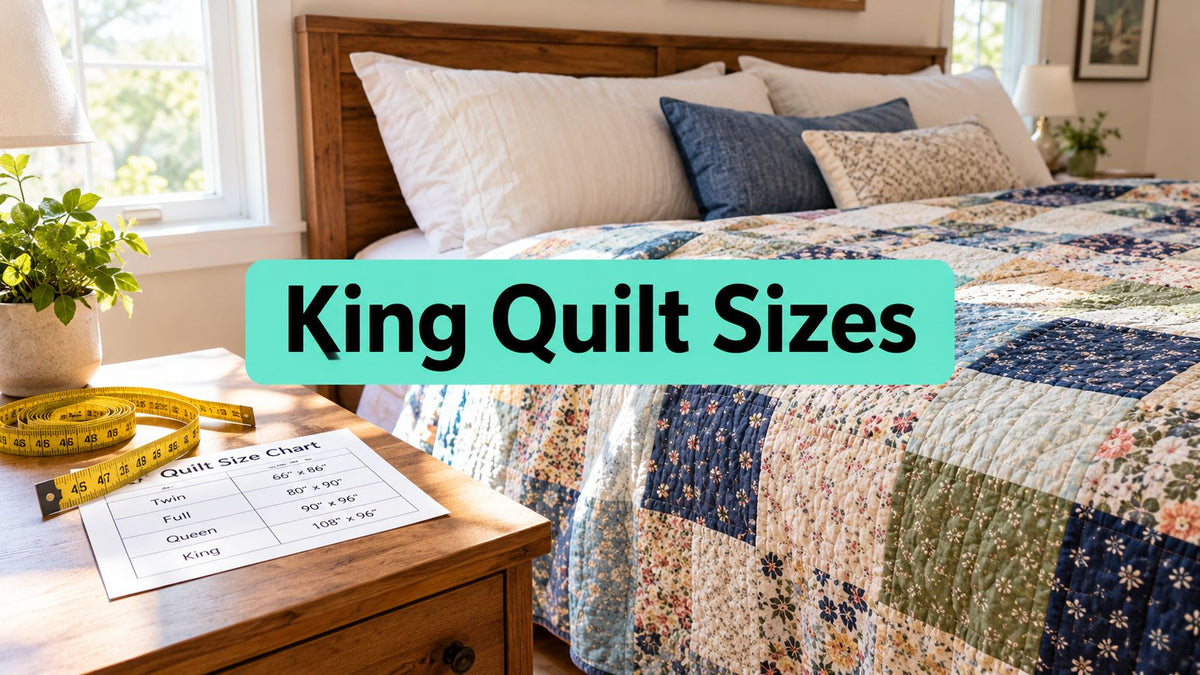
You've finished a king quilt top, and now you're standing at the cutting table wondering whether the backing you planned will cover it. Don't trust the word "king" on a chart alone. For many U.S. king beds, a practical finished quilt is about 100–110 inches wide and 95–105 inches long, but the right size depends on your mattress, desired drop, and bed style. Measure first, then choose the backing and longarm plan to match.
What Size Quilt Fits a King Bed
A king quilt should match the mattress and the drop you want, not a chart label. Before you cut backing or send a finished top to OPN Quilting's mail-in longarm service, measure the quilt top and the bed. If you're still choosing a mattress, use Lott's Furniture's find the right mattress size guide first.
A standard U.S. king mattress measures 76 inches wide by 80 inches long, or about 193 by 203 centimeters, according to Pillows.com.au's bed-size guide. Those numbers describe the mattress, not the quilt. A quilt cut to mattress-top dimensions will leave little or no coverage at the sides and foot.
Measure the mattress width, length, and depth. Then choose the side and foot drop you want, and calculate the finished size before settling on a pattern or backing.
For example, adding a 12-inch drop on each side and a 15-inch drop at the foot gives a finished quilt of about 100 by 95 inches, based on the mattress dimensions in Pillows.com.au's bed-size guide. A 15-inch side drop with the same foot drop gives roughly 106 by 95 inches, using the same measurements. These are examples, not universal king sizes. Mattress depth, box-spring height, frame style, and whether you tuck the quilt all affect the fit.
Backing needs room beyond the finished top on every edge so the longarm quilter can load, tension, and trim the layers. Extra-wide backing can avoid a seam, but choose a width that suits your top and the service's preparation rules.
At the cutting table: Set the finished quilt dimensions before ordering backing. Extra width can simplify quilting, but it won't correct a top measured for the wrong bed.
Eastern King vs California King vs Split King
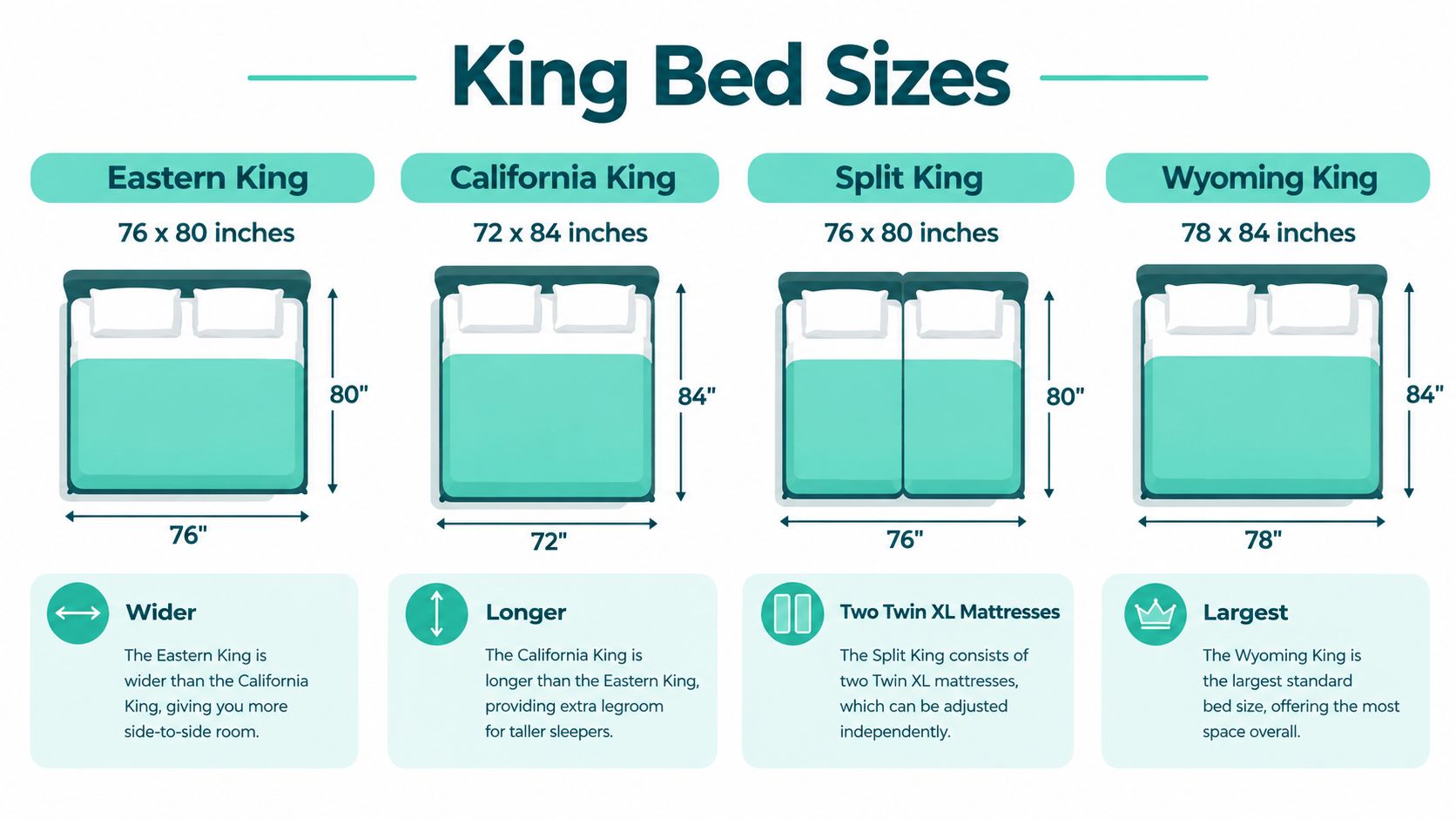
“King” doesn't mean the same mattress dimensions everywhere, and even U.S. king beds aren't all shaped alike. Eastern King is wider; California King is longer. A single quilt size can therefore leave one bed with extra width and another short on length.
| King Mattress Variants at a Glance | Width (in) | Length (in) | Width (cm) | Length (cm) |
|---|---|---|---|---|
| Eastern King | 76 | 80 | 193 | 203 |
| California King | 72 | 84 | 183 | 213 |
| Split King | 76 | 80 overall | 193 | 203 overall |
| UK King | 59 | 79 | 150 | 200 |
| Australian or New Zealand King | 72 | 80 | 183 | 203 |
A split king typically uses two Twin XL mattresses on an adjustable base. Although the combined surface matches an Eastern King footprint, a one-piece quilt may bunch or pull when the two sides move independently. Measure the setup with the base in the position you use most, and decide whether a single quilt or separate covers will work better.
The California King's extra length changes the calculation at the foot, while its narrower width changes the side-drop math. Don't take an Eastern King pattern and assume it will drape the same way. If you're checking which style of king bed you have, Guynn Furniture & Mattress's king bed sizing guide is a helpful reference.
The label also changes across markets. A UK king is about 59 by 79 inches, while the larger UK super king is about 71 by 79 inches. The name alone can't tell you which dimensions to use, so identify the actual mattress before cutting.
If you're shopping for a backing that can accommodate a longer footprint without a center seam, compare OPN's extra-wide minky collection. Start with the quilt's finished dimensions, then check whether the fabric width is sufficient for the top and the extra allowance your longarm quilter requires.
How to Calculate Finished Quilt Dimensions
Measure the bed where the quilt will hang. Don't use the mattress label as a substitute for checking its real width, length, and depth.
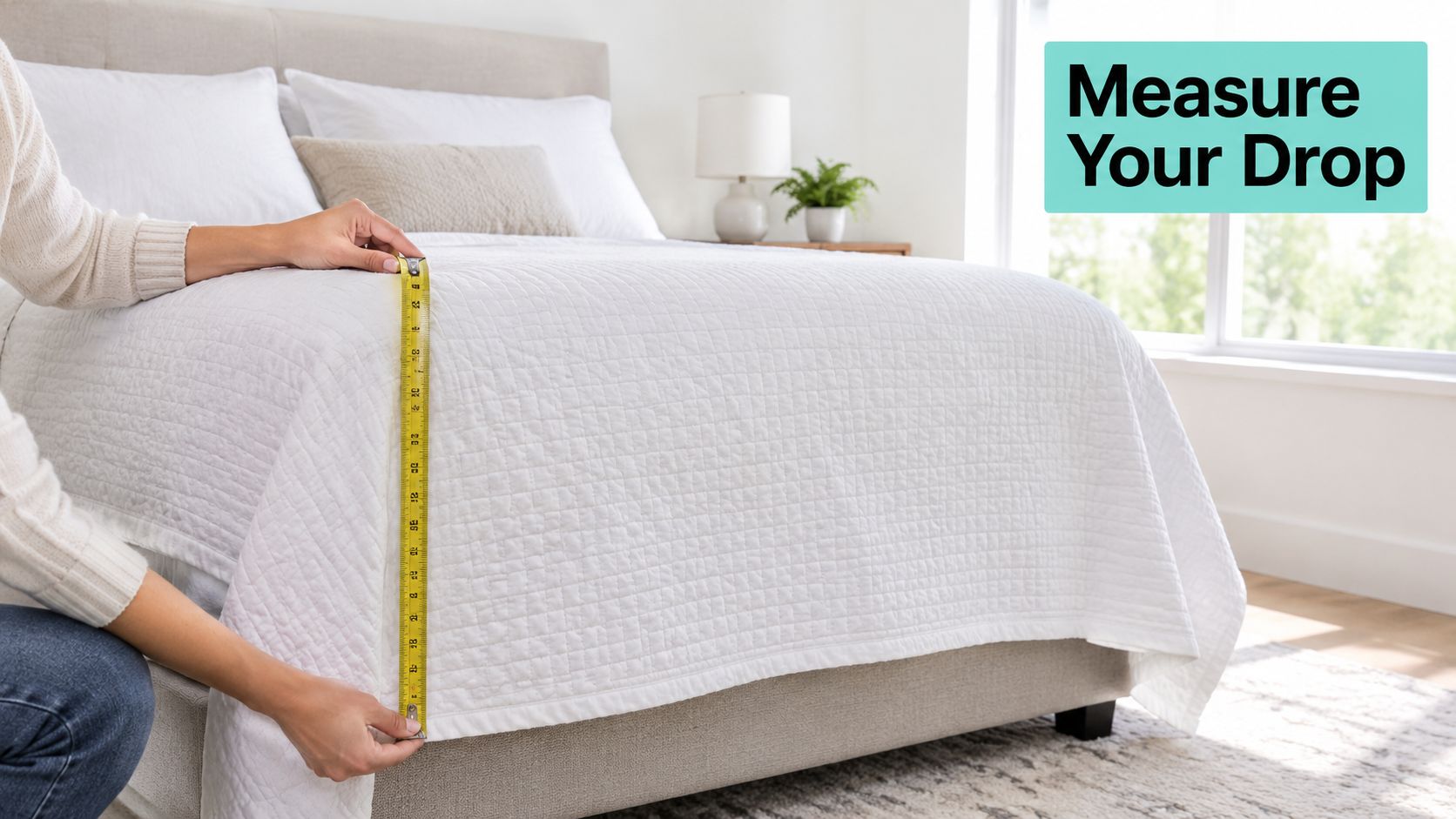
The basic formulas are straightforward:
- Finished width = mattress width + both side drops
- Finished length = mattress length + foot drop + optional pillow tuck
For an Eastern King mattress measuring 76 by 80 inches, a 14-inch side drop gives you a finished width of 104 inches. Add a 15-inch foot drop, and the finished size is about 104 by 95 inches, before any pillow tuck.
If you want a deeper side hang, use a 17-inch drop on each side. That gives you a finished width of about 110 inches; with the same foot drop, the quilt is about 110 by 95 inches. Measure the vertical distance from the mattress top to the lower edge you want, and repeat on both sides if your frame or floor isn't even. The side drop can also be checked by subtracting the mattress width from the finished quilt width and dividing the difference by two. (The Duvet Advisor's drop-length guide shows this calculation with king-bed examples.)
Depth matters just as much as width. A modern pillow-top mattress can be about 15 inches deep, enough to use up the drop a generic chart assumes. Measure the mattress from its top surface to its lower edge, including any topper that stays on the bed.
For planning fabric, keep your target top size separate from your cutting requirements. If you're estimating how much fabric the quilt design needs, OPN's guide to calculating yardage for quilts can help you plan the top before you purchase the backing.
The video below offers another visual reference for measuring and planning quilt dimensions.
Coverlet Drop vs Comforter Drop vs Bedspread Drop
The quilt's purpose should decide its dimensions. A neat coverlet, a conventional sleep quilt, and a near-floor bedspread don't need the same drop.
For a 76-inch-wide Eastern King, use the table to see how the side-drop choice changes the finished width. Length depends on your desired foot drop, plus any pillow tuck. The length examples below use a 15-inch foot drop and no pillow tuck, so you can compare the width choices clearly.
| Finished King Quilt Dimensions by Drop Style | Side Drop | Foot Drop | Finished Width | Finished Length |
|---|---|---|---|---|
| Coverlet | 8–12 in | 8–12 in | 92–100 in | 88–92 in |
| Comforter-style quilt | 12–16 in | 12–16 in | 100–108 in | 92–96 in |
| Bedspread | 18–22 in | 18–22 in | 112–120 in | 98–102 in |
These are planning ranges, not a promise that every bed will look the same at those measurements. A tall mattress or thick topper reduces the visible drop, while a box spring or bed frame can change where the quilt edge lands. For a tucked look, add the length you want at the head of the bed.
A larger quilt isn't automatically better. Extra width can bunch on an adjustable base, crowd bedside furniture, or add weight you don't want. A modest drop may suit a platform bed where you want the frame visible, while a taller mattress may need more fabric to cover the sides.
If you're comparing quilt and blanket dimensions for a different kind of project, OPN's guide to minky couture blanket sizes offers another sizing reference. For this bed, choose the style first, then calculate the dimensions from your own mattress.
Why Extra Wide Minky Backing Solves King Quilt Seams
A king-size backing pieced from standard-width fabric can leave a long seam running through the back. With minky, that seam adds bulk, can be harder to press flat, and may create an awkward ridge for longarm quilting. If your quilt's dimensions allow it, a single wide backing is the cleaner solution.
OPN stocks 80-inch Mirage, 90-inch Extra Wide Cuddle 3, and 110-inch Cuddle options. The fabric width determines which tops they can back without a seam. A 90-inch backing may suit a narrower finished quilt or a top planned with less drape; a 110-inch backing gives more room for a generous king top. Neither width should be selected by the bed label alone. Check the top dimensions and add the longarm allowance before ordering.
If you want plush backing, OPN carries Shannon Fabrics textures including Hide, Snowy Owl, and Fawn. Choose the texture and color that suit the quilt, then confirm the backing's usable width against the top and the service's required overhang. OPN's wide backing fabric guide can help you compare the available options.
First order offer: OPN offers 15% off a first order and free U.S. shipping on orders over $70. Check the current shop terms before placing your order.
A seam-free back won't eliminate the need to prepare the fabric properly. It does remove one construction step, and it gives the longarm quilter a flatter backing to load.
How Much Backing to Order for a King Quilt
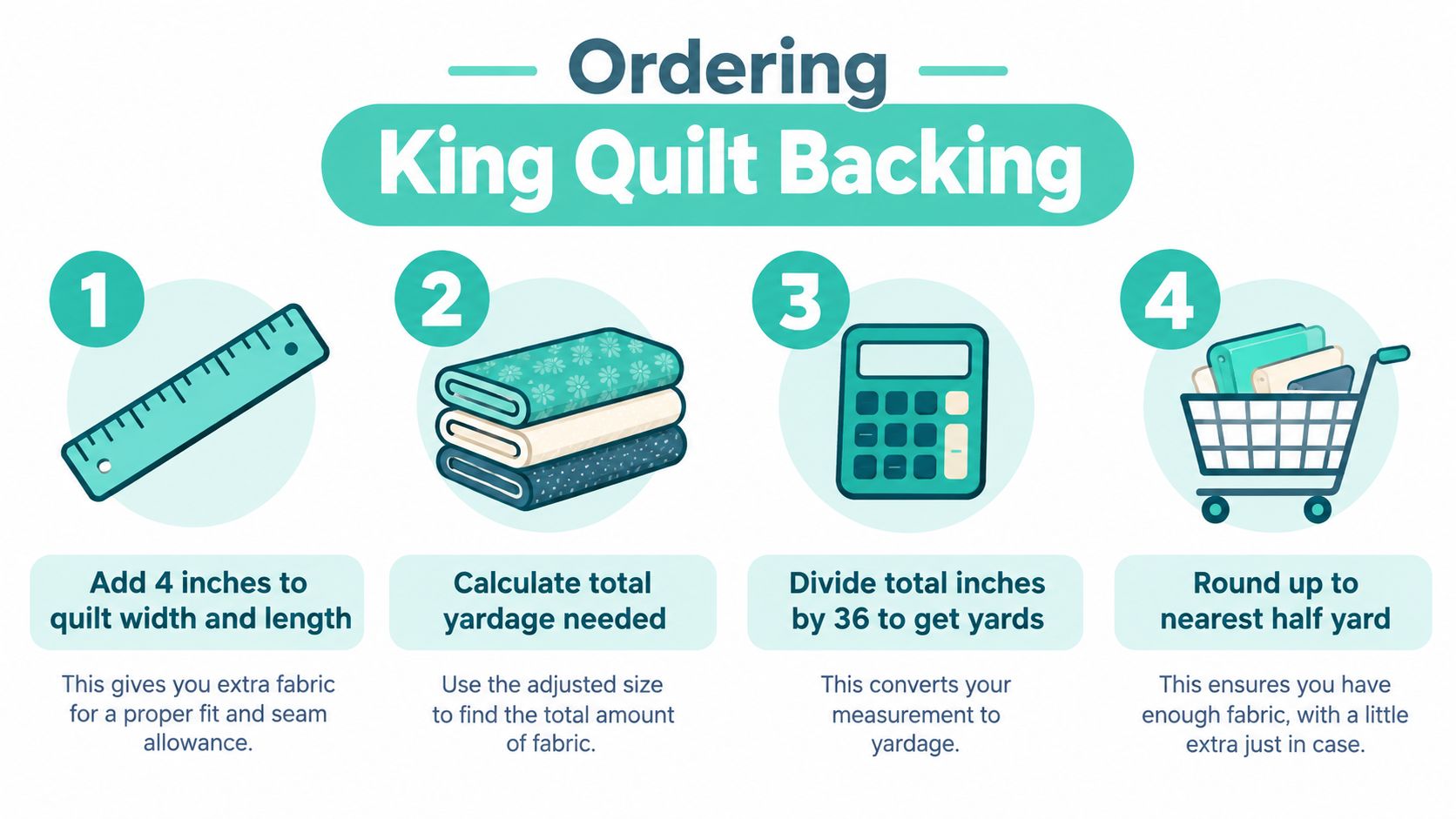
Backing needs to extend beyond the quilt top on every edge. One public-library longarm guide calls for backing and batting that are 12 inches larger overall, which means 6 inches beyond each edge; the receiving quilter's own requirement takes priority. (Harris County Public Library's longarm guide gives that preparation allowance.)
For a 110 by 95-inch top, adding 6 inches on every side means backing and batting should be at least 122 by 107 inches. A single lengthwise cut from 110-inch-wide fabric can provide the required dimensions when oriented appropriately, with enough fabric length to cover the other measurement. Check the fabric's usable width and any required orientation before ordering.
| Backing Yardage by Finished King Quilt Size | Min Backing (6 in/side) | OPN Cut Recommendation |
|---|---|---|
| 100 × 95 in | 112 × 107 in | Choose a cut long enough to provide the required backing dimensions |
| 104 × 95 in | 116 × 107 in | Choose a cut long enough to provide the required backing dimensions |
| 110 × 95 in | 122 × 107 in | Choose a cut long enough to provide the required backing dimensions |
The exact cut depends on fabric width and the dimensions of the finished top. OPN offers curated 2-, 2.5-, and 3-yard cuts, but don't assume one cut works for every king quilt. Lay out the required backing rectangle against the usable fabric width before placing an order. Narrower 80-inch or 90-inch backings may need extra length and seams to cover a wide top.
Before sending the quilt, trim the backing and batting only after confirming the longarm service's exact allowance. If you're reviewing how the layers go together, B-Sew Inn's quilt layering steps provide a useful overview. For fabric selection, OPN's quilt backing guide covers practical choices for backing material.
Prepping a King Quilt for Mail In Longarm Quilting
A large quilt top can be beautifully pieced and still cause problems on the machine if its layers aren't ready to load. Follow the service's directions before packing anything. OPN's mail-in longarm preparation tips cover the workflow, but these basics are worth checking at the cutting table.
- Oversize the backing and batting: For the longarm allowance described above, extend each beyond the top by at least 6 inches on every edge. Confirm OPN's current requirements before shipping.
- Press the layers flat: Press the top and backing, repair open seams, and trim or square uneven edges.
- Secure a heavily pieced top: Stay-stitching near the edge can help keep seams from opening during handling.
- Clip loose threads: Threads caught between layers can show through the finished quilt.
- Leave the sandwich unassembled: Don't pin or baste the top, batting, and backing unless the service specifically asks you to.
- Prepare minky seams carefully: Press bulky minky seams open when appropriate, and remove tight selvages if the preparation instructions call for it.
- Fold layers as directed: Some services ask you to fold the top, batting, and backing separately. Follow the receiving quilter's packing instructions.
Longarm prep rules aren't identical from one service to another. Some providers require a different allowance, or ask customers to prepare the layers in a specific way. Check the instructions before mailing, not after the quilt is packed.
OPN offers edge-to-edge mail-in longarm quilting with batting, thread, and free return shipping included in its service. You can review the longarm service details and browse the Luxe Cuddle backing collection when you're ready to choose the backing.
Your King Quilt Size Checklist and Next Steps
Before you order fabric or book quilting, make three decisions. They determine whether the quilt fits the bed and whether the backing is practical to load on a longarm.
- Measure the actual mattress. Record the width, length, and depth, and identify whether it's Eastern King, California King, split king, or another regional size.
- Choose the drop style. Decide whether you want a neat coverlet, a conventional comforter-style hang, or a deeper bedspread. Include a pillow tuck if you plan to use one.
- Match the backing to the finished top. Compare the top's dimensions with the usable width of the backing and the longarm service's overhang requirement.
A seam-free backing can simplify a large project, but only when its width is sufficient for the top and the required allowance. Pick the finished quilt size first, then compare the 90- or 110-inch backing options. If you prefer a plush finish, look at textures such as Hide, Snowy Owl, and Fawn in the Luxe Cuddle range.
When you're ready to shop, compare OPN's Luxe Cuddle backing options, review the mail-in longarm service, or check the first-order offer. OPN's hundreds of verified reviews give you another way to assess the shop while you plan a king quilt around your actual bed, preferred drop, and backing needs.
Book Your Longarm Service Today.
On Pins & Needles Quilting Co. offers extra-wide minky backing and mail-in edge-to-edge longarm quilting for projects like your king quilt. Visit On Pins & Needles Quilting Co. to compare backing options and prepare your quilt for finishing.