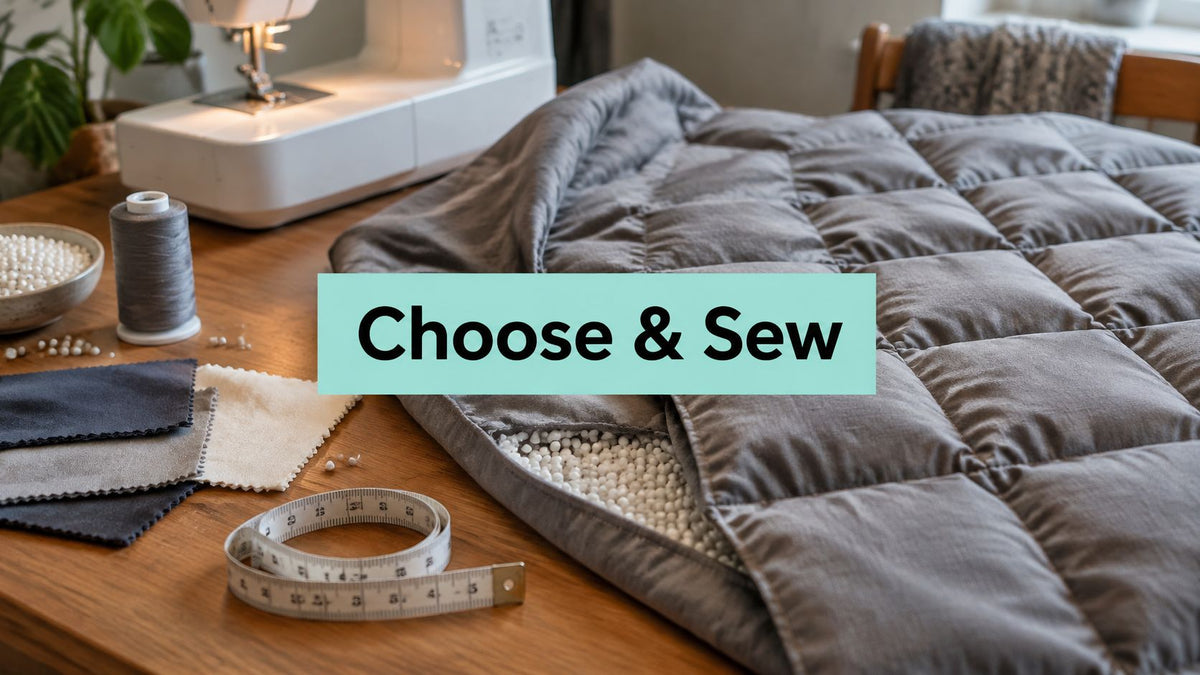
A weighted blanket's softest fabric sample is usually the one that fails first. The best shell for most blankets is a tightly woven cotton or a cotton-polyester blend over a small, evenly stitched pocket grid, because that combination holds the fill, spreads the load and survives washing, while plush pile hides loose construction until it pills. Softness still matters, and the fabrics that deliver it get their turn below. The point is that the shell, the fill and the pocket grid work as one system, and judging that system by hand-feel alone is how buyers end up with beads pooled in two corners by spring.
Compare Weighted Blanket Fabric at a Glance
A weighted blanket succeeds or fails as a layered system: the shell must hold the fill, the pocket grid must keep it evenly distributed, and the finished blanket must tolerate washing. Cotton and cotton-polyester blends suit many everyday blankets; plush minky offers a softer, warmer feel, with trade-offs in bulk and heat.
A weighted blanket's shell does more than provide a surface to touch. It contains the fill and supports the stitched compartments, so fabric choice matters alongside pocket construction. Research on weighted blankets likewise considers the outer fabric, compartmentalized construction and evenly distributed weight as parts of the same system, rather than treating softness as the only measure.
In a comparative textile study, 100% cotton measured thermal conductivity of 22.7 mW/m·K and thermal resistance of 31.98 mm²·K/W. A 65% polyester/35% cotton blend measured 21.4 mW/m·K and 34.44 mm²·K/W, while 100% polyester measured 19.3 mW/m·K and 27.74 mm²·K/W.
| Fabric | Durability | Hand-feel | Thermal data (conductivity; resistance) | Best for |
|---|---|---|---|---|
| 100% cotton | Good with a tight weave | Soft and natural | 22.7 mW/m·K; 31.98 mm²·K/W | Year-round use and sensitive skin |
| 65% polyester / 35% cotton blend | Strong, holds its shape | Smooth with light drape | 21.4 mW/m·K; 34.44 mm²·K/W | Everyday use in mixed climates |
| 100% polyester | High abrasion resistance | Silky to plush | 19.3 mW/m·K; 27.74 mm²·K/W | Low-maintenance blankets |
| Plush minky (Cuddle, Luxe Cuddle) | Good; pile can mat with heavy use | Very soft; dense pile feels warmer | No published value for the finished pile face; thickness and backing set it | Gift blankets and winter throws |
| Fleece or flannel | Fair; the brushed face pills and mats first | Soft, brushed surface | No published value; a brushed surface traps more warm air than a flat weave | Cold sleepers only |
| Bamboo or Tencel (rayon) | Lower wet strength than cotton, so wash cold and line dry | Smooth and cool to the touch | No published value; smooth, low-loft yarns move moisture faster | Hot sleepers and humid climates |
What the Numbers Change in Practice
The cotton and blend samples are close on conductivity, while the blend recorded the higher thermal resistance. The polyester sample measured lower on both, but the figures describe the tested materials, not every blanket: fabric thickness and construction affect the result. These values alone cannot predict how a completed weighted blanket will feel after its shell, fill and pocket layout are combined.
Choose cotton for a familiar everyday feel, a polyester-heavy shell when abrasion resistance matters, or minky when a plush finish is worth a warmer, denser blanket. On Pins & Needles Quilting Co. specializes in Shannon Fabrics Cuddle and Luxe Cuddle, including extra-wide options for quilt backing.
Shortlist a smooth woven fabric and a plush option, then compare their feel and construction before cutting. For a broader overview of soft blanket fabric choices, consider how each surface balances softness with practical use.
How Do You Test Hand-Feel and Durability?
A photograph can't show three things that decide whether a blanket lasts a year: how the fabric feels after washing, whether it holds together under stress, and whether it keeps its fill where you put it. First-touch softness is a poor proxy for all three. Plenty of shells feel wonderful on the bolt and pill after three washes.
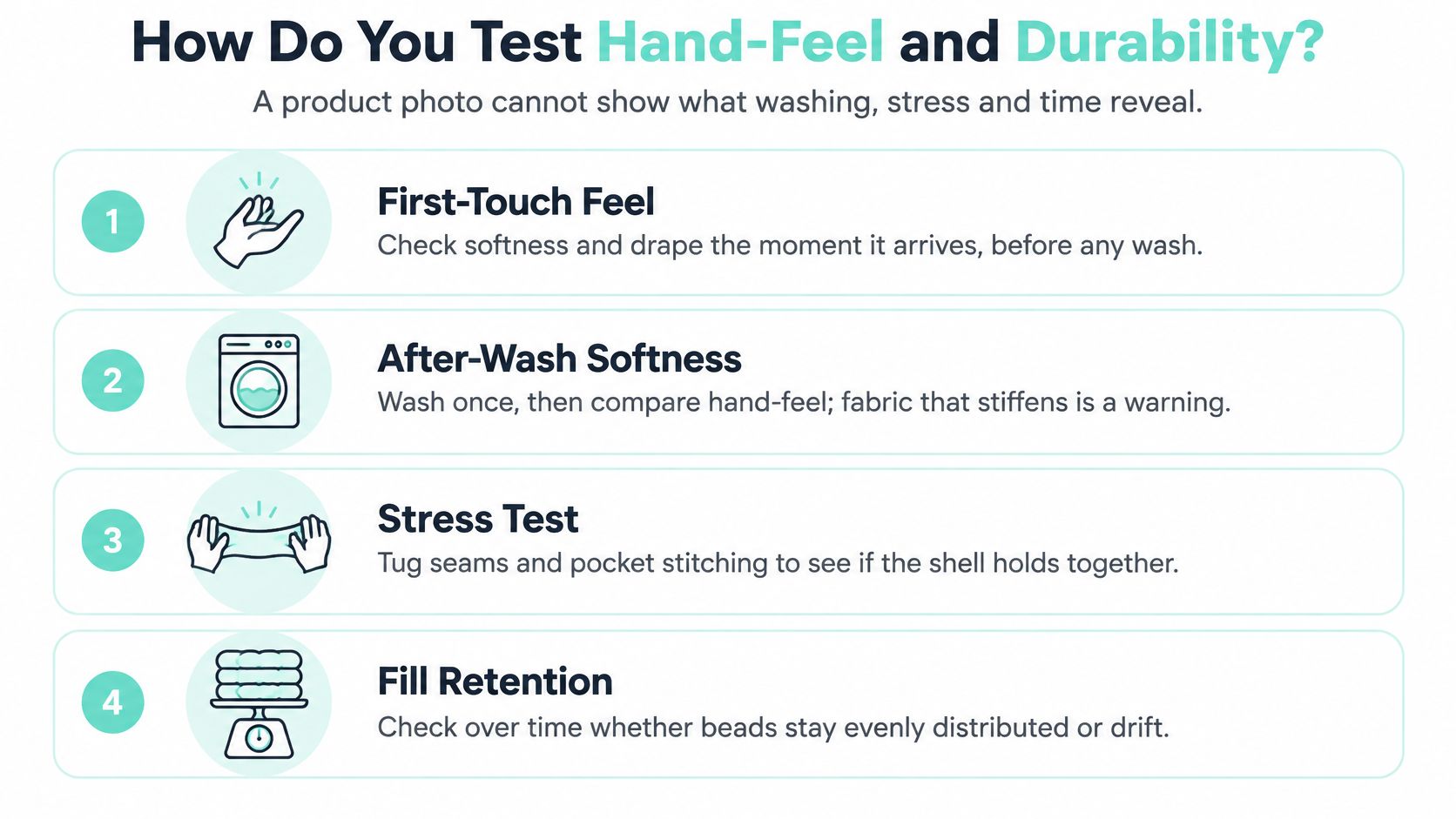
Work through six checks on a 4-inch swatch. Each one has a pass sign and a fail sign, so you can decide without guessing.
- Rub test. Rub the swatch with a dry cotton cloth 20 times. Loose fuzz or pills mean the surface will look tired within a season; a clean surface passes.
- Stretch and release. Pull 10 to 15 percent in each direction. The fabric should spring back flat, because a swatch that stays distorted will bow your pocket grid out of square.
- Seam stress. Sew a 4-inch seam with the stitch you'll use, then tug hard. If it gaps or the thread snaps now, it won't hold 15 pounds of beads later.
- Pile crush. Press a minky sample flat, release it, and watch. Pile that stays matted signals a dense face that traps warmth and flattens along every seam line.
- Needle holes. Stitch a pocket line through both layers and inspect the perforations. Holes that stay open are holes the fill will find.
- Wash and dry. Wash the swatch with the method you plan to use for the finished blanket, dry it flat, then compare hand-feel. Fabric that stiffens is a warning, not a quirk.
Smaller compartments do restrict how far fill can travel, but no construction label on its own promises even pressure or durability, as the Sleep Foundation's weighted blanket methodology notes point out. Our acceptance criteria are the engineering kind: zero visible leakage, no enlarged empty pockets, stable dimensions after repeated washes. If pilling is the problem you're trying to avoid on a finished quilt, our guide to preventing fabric pilling covers the surface fixes.
Run Hide, Snowy Owl and Fawn side by side, because the same brand can behave differently across textures.
A swatch that passes all six checks is ready to cut. One that fails two is a blanket you'll remake.
Which Fill and Pocket Layout Suits Your Fabric?
The 10% body-weight rule is a starting point, not a medical prescription. Northwestern Medicine's guidance illustrates it with a 150-pound person choosing a 15-pound blanket. The rule was adapted from weighted-vest guidance, and evidence specific to weighted blankets is limited. A practical range of roughly 5% to 12% may suit some users, but comfort and ease of handling matter more than hitting a target.
| Body weight | 5% (low end) | 10% (starting point) | 12% (high end) |
|---|---|---|---|
| 100 lb | 5 lb | 10 lb | 12 lb |
| 150 lb | 7.5 lb | 15 lb | 18 lb |
| 180 lb | 9 lb | 18 lb | 21.6 lb |
| 200 lb | 10 lb | 20 lb | 24 lb |
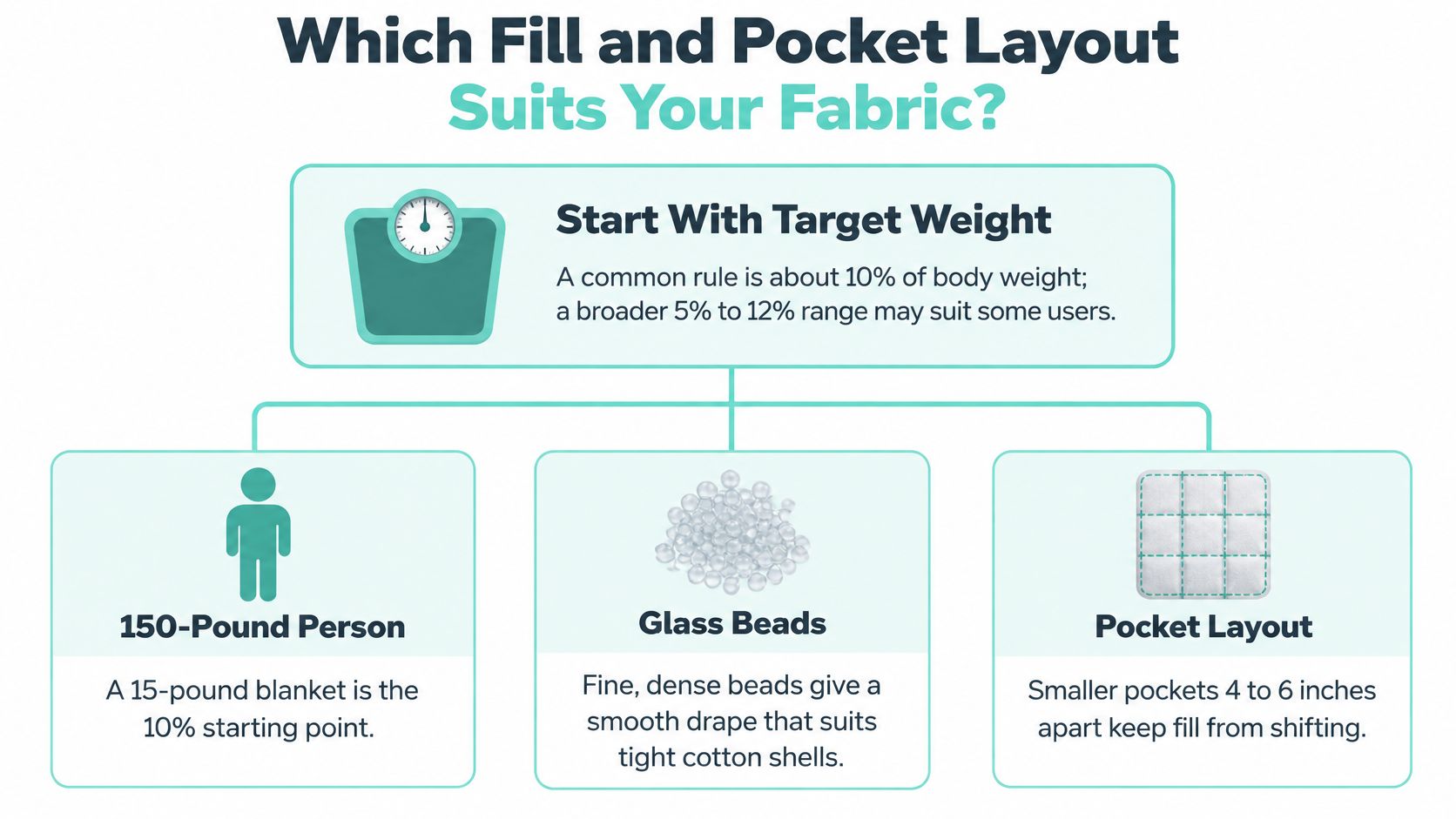
Fill choice changes both the blanket's drape and the strain on its seams. Plastic pellets are common, but can make noise when they shift in a loose grid. Glass or micro-glass beads flow into a thinner, smoother layer. Steel shot is compact and heavy, which can suit a smaller blanket but puts more load on its seams. Corn, rice and beans absorb moisture, making them poor choices for bedding.
Match the shell and pocket construction to the fill. A tightly woven shell is better suited to fine micro-glass; an open weave can let small beads work through. Pockets around 4 to 6 inches square help limit fill movement, though smaller cells mean more stitching and more seams that must hold under the blanket's weight.
First-order offer: New customers get 15% off their first order, and U.S. orders over $70 ship free.
Choose a shell that can contain the fill without making the blanket harder to handle or wash. Micro-glass calls for a tight weave; steel shot needs a sturdy shell and reinforced seams. Plastic pellets work with a compact pocket grid, but that grid adds sewing time.
Does a Cooling Fabric Actually Prevent Overheating?
A cool-feeling shell does not guarantee a cool night. Fibre labels such as bamboo, Tencel and cotton tell only part of the story. The Sleep Foundation's guide to whether weighted blankets run hot points to the blanket's weight, layers, weave or knit, fill, pocket density and room climate as factors that affect warmth. Fleece, flannel and wool tend to feel too warm for hot sleepers.
Two blankets can have the same cotton shell and total weight but sleep differently. Small, densely packed pockets and batting add insulation; wider pockets and no batting leave less material to hold warmth. The second construction may feel cooler, even with the same shell.
Fill changes the build, too. Glass beads can fit into a thinner blanket than larger plastic pellets, so two blankets with the same total weight may feel different across the chest.
A cover or shell can feel noticeably cooler to the touch than the blanket underneath. That explains a cool first touch, not how warm you may feel later in the night. A plush face can also feel warmer than a smooth woven shell, even if both fabrics allow airflow.
Judge the whole system: hand-feel, insulation, moisture handling and airflow. A removable cover lets you change the surface layer without changing the blanket's weight. For more on how fabric structure affects airflow, read about minky fabric breathability for baby quilts.
If the mattress feels warm beneath you, the blanket may not be the only factor. Protect-A-Bed's breathability guide explains how a mattress protector can affect airflow beneath the sheets.
How to Sew Weight Pockets Into the Shell, Step by Step
The shell has two jobs at once: it keeps the skin comfortable and it contains the filling. A Consumer Reports weighted blanket review makes the same point about construction, describing a soft textile exterior over micro-glass or steel beads that the stitching has to distribute. Sew accordingly.
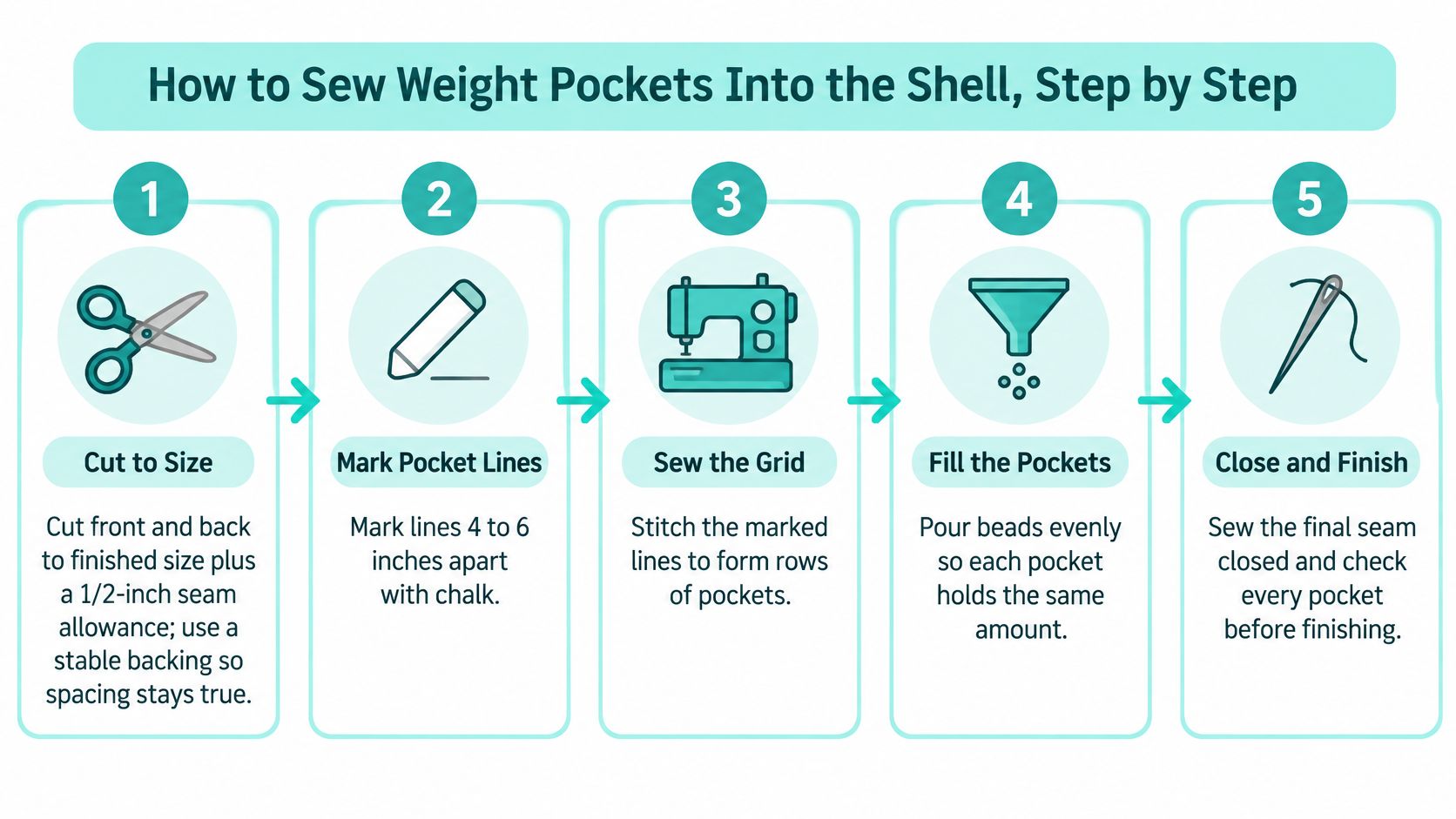
- Cut to finished size plus a 1/2-inch seam allowance. Use a shell with a stable backing so pocket spacing stays true, because a stretchy face will creep as you sew.
- Mark the grid from the centre outward. Chalk lines 4 to 6 inches apart, working from the middle. Starting at one edge is the classic mistake: it leaves a narrow sliver at the far side while the centre pockets run fat.
- Clip instead of pinning inside the seam allowance. Pins leave permanent holes in minky pile. If you must pin, keep every pin outside the seam line.
- Stitch the grid with a walking foot. Backstitch at the start and finish of each line and double the stitch at the corners, where the weight concentrates. If your layers slide, our guide to sewing with minky without it sliding covers tension and foot pressure.
The walkthrough below shows the order of work if you'd rather watch the grid come together before you cut.
- Leave one long side open. Fill through the widest opening you can manage, and finish the short edges first so beads can't escape while you work.
- Weigh every portion. Divide your target weight by the pocket count, portion each one on a kitchen scale, and funnel it in. Keep every pocket within a few grams of the others or the blanket will hang heavy at one end.
- Close with a straight seam plus a second row. Two rows of stitching are what stop beads from working through a single line of perforations.
- Lift, shake and label. Shake the finished blanket to check for pooling, then attach a label with the weight and the care method.
Where blankets fail: the corner pockets, not the middle. Corners take the most handling and the least attention.
For large throws, a 110-inch extra-wide Cuddle backing in our extra-wide Cuddle range removes the centre seam altogether, which is one less line of needle holes for beads to find.
How Do You Wash Weighted Blanket Fabric Safely?
The shell does not determine the whole wash routine. Fill type, blanket weight and the washer's load limit matter just as much. Care guidance summarized by Martha Stewart's weighted blanket washing guide varies by filling:
| Filler | Washing method | Drying |
|---|---|---|
| Plastic pellets | Cold, gentle cycle or hand-wash | Air-dry |
| Steel shot | Hand-wash or gentle machine wash | Air-dry |
| Smooth pebbles or micro-glass beads | Hand-wash only | Air-dry |
| Organic fill (corn, beans, rice) | Do not machine-wash; spot-clean | Air-dry flat, away from heat; never tumble |
Check the washer's load rating before putting a weighted blanket in the drum. A blanket's dry weight increases as it absorbs water, so a heavy blanket may need a commercial machine or laundromat, as Southern Living's weighted blanket washing guide explains.
For washable blankets, cold water, a gentle cycle, mild detergent and air-drying are safer defaults unless the care label gives different instructions. High dryer heat can damage synthetic shells and distort plastic filling. Spot-cleaning between washes also reduces wear on the shell and limits microfibre shedding from polyester and fleece faces during domestic laundering.
A removable cover lets you wash the face while leaving the weighted insert undisturbed. That avoids repeatedly washing the filling and helps it stay distributed. For pile care, follow the guidance on how to wash mink blankets.
Buy Your Fabric and Start Today
Choose the shell, fill and pocket layout as one system. Before buying, settle these five specifications:
- Target weight. Start at 10% of body weight and stay within the 5% to 12% range.
- Finished size. For a large blanket, 90-inch or 110-inch extra-wide Cuddle fabric can keep the back free of a centre seam.
- Shell. Use the texture that passed your swatch test, such as Shannon Cuddle in Hide, Snowy Owl or Fawn, or tightly woven cotton.
- Fill and pocket size. Match micro-glass beads, plastic pellets or steel shot to pockets measuring 4 to 6 inches square.
- Batting. For quilting services, On Pins & Needles Quilting Co. uses Winline Comfort Blend 80/20 cotton-polyester batting unless the customer requests otherwise. This is a quilting-service detail, not batting included with a fabric purchase.
Browse the Luxe Cuddle collection for a blanket face, or the Minky Fabric category for other textures and widths. The shop also offers finished minky blankets, kits and precuts. Get 15% Off Your First Order and choose fabric for a swatch test before committing to the full shell.
On Pins & Needles Quilting Co. specializes in Shannon Fabrics Cuddle and Luxe Cuddle, including 44-45-inch Quilting Cuddle and 90-inch and 110-inch extra-wide options. Free U.S. shipping is available on orders over $70. Compare the feel and care needs of your chosen fabric before you build the rest of the blanket. Shop On Pins & Needles Quilting Co.