Online retail took an estimated $300.2 billion in the first quarter of 2025, or 16.2% of all U.S. retail sales, according to the Census Bureau's quarterly e-commerce series. Quilt fabric sells inside that channel now, so the judgement you used to make with your hands has to happen on a product page.
A reliable online quilt shop tells you the usable width rather than just the nominal one, shows shipping before payment, publishes its defect policy, and puts longarm prep rules where you can read them before you mail anything.
Photos don't carry that information. A listing can show the softest pile in the world and still ship a short cut, hide the freight until the payment screen, and go quiet when the backing arrives with a crushed nap.
How Do You Know an Online Quilt Shop Is Reliable?
A reliable shop makes the after-checkout outcome predictable before you pay: the usable width you will receive, the cut accuracy it will honor, and the help available if the order arrives wrong. In the 2024 Quilting Trends Survey, 25% of quilters said they most frequently bought fabric online, according to the Craft Industry Alliance's survey results. That share makes verification a normal buying skill rather than a special caution.
The strongest shops put the answers in writing. These seven checks show where product photography stops and operating standards begin.
| Criterion | What good looks like | Red flag |
|---|---|---|
| Inventory width | Nominal and usable width stated for every backing | Only the word wide, with no measurement |
| Shannon Cuddle stock | Named textures and collections shown in close-up | Generic minky photos with no texture names |
| Shipping transparency | Shipping cost and free-shipping threshold visible before checkout | Extra costs appear only at payment |
| Cutting accuracy | Cut increments and tolerance stated, with a re-cut or refund route | No tolerance or remedy given |
| Returns and defects | Written reporting window, photo requirements and remedy | Policy missing or vague |
| Customer support | Email, phone and chat reachable, with a named contact | Contact form only |
| Longarm services | Pricing, prep instructions and a pattern gallery published | No prep rules or pattern guidance |
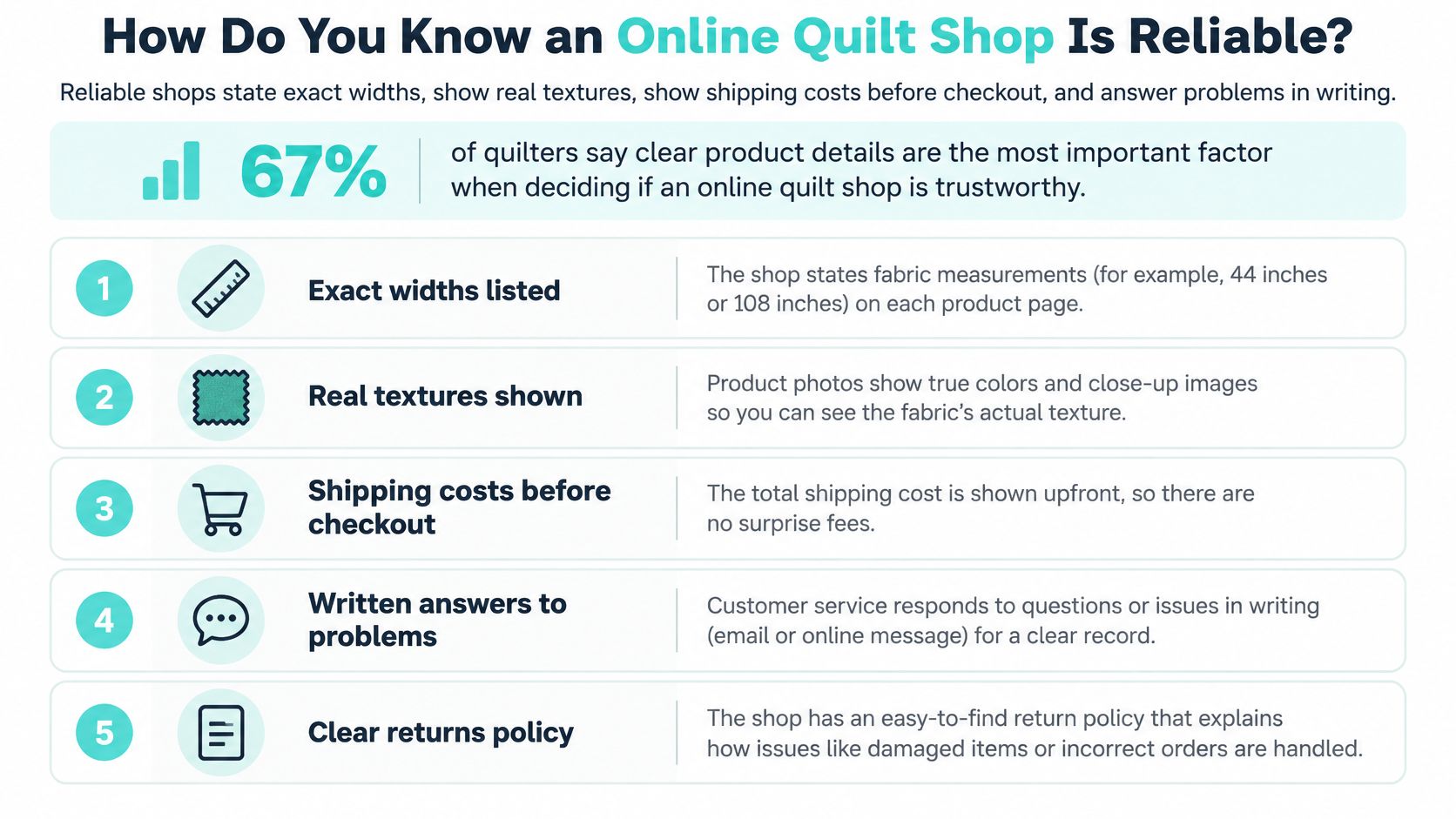
The infographic below compresses the five checks that matter most on a first visit.
Start with width because it decides layout and yardage before anything else does. A backing listed at 110 inches can still lose usable inches to selvage, edge damage or trimming. A reliable listing prints both the nominal and usable width and says whether the roll ships folded or rolled, because that answer changes your pressing plan before you cut.
Then test the shop's remedies. Cutting tolerance matters only when it comes with a stated re-cut, refund or replacement route. A defect policy should give a reporting window, request photos and identify who pays return freight. If those details are vague, the shop has left the expensive part of the transaction undefined.
Texture naming separates a specialist from a general fabric seller. "Soft minky" tells you nothing about pile, stretch or how the surface will sit against piecing. We specialize in Shannon Fabrics Cuddle and Luxe Cuddle, and our Snowy Owl stockist notes show the level of texture identification buyers should expect. Named stock and close-up photography let you compare materials before yardage leaves the shelf.
Support and quilting documentation reveal the same discipline. We publish a call and text number, (801) 390-0642, an email address at info@opnquilting.com and a website chat option. Our quilting pages also list services and pricing, quilt prep instructions and a pattern gallery. Shops without longarm services can still be reliable, but a shop that offers quilting should publish its prep rules before the quilt is mailed.
Run the checks in order. Width and shipping failures affect cost immediately, while cutting and defect terms determine who absorbs a mistake. A shop that is specific in all seven places gives you a clearer prediction of the order you will receive than any styled product photo can.
Which Widths and Shannon Textures Should a Shop Stock?
Nominally wide fabric is easy to find. Usable width is the number that decides whether your backing arrives as one piece or three, so settle width first and choose texture second.
| Width | Typical use | Queen back (90 by 108 in) |
|---|---|---|
| 44-45 inch Quilting Cuddle | Pillows, scarves and small projects | Not suited to a queen back |
| 58-60 inch standard minky | Throws and baby blankets | About 8 to 8.5 yards with two seams |
| 80 inch Mirage | Lap quilts and mid-size backs | Requires seams for a queen back |
| 90 inch extra-wide | Many queen backs after loading margin check | One piece if the margin check passes |
| 108-110 inch extra-wide | King-size and single-piece backs | About 3.25 yards in one piece |
Read the queen column against the numbers you hold. A 90 by 108 inch queen back takes roughly 8 to 8.5 yards of standard-width fabric plus two seams to join, while 108 to 110 inch backing needs only about 3.25 yards laid whole (our guide to wide quilt backing). A 90-inch roll can serve many queens, but only after you confirm the loading margin the longarm needs. It falls short on a king at about 108 by 108 inches, where 108 or 110 inch goods cover the width in one pass, provided you check the finished top size and overhang first.
Cuddle and Luxe Cuddle Are Not the Same Animal
The difference is pile height and how much the fabric resists you. Cuddle behaves as a low, dense plush that presses and seams with less argument. Luxe Cuddle carries a longer pile, deeper color and more movement under the needle, and each texture photographs differently in daylight. A single styled shot tells you almost nothing about what arrives.
Match the texture to the job. A high-pile Luxe backing gives a bed quilt warmth and weight; the same fabric on a baby blanket is often more than the project needs.
A shop worth buying from stocks across widths rather than one crowd-pleasing bolt. That means 44-45 inch Quilting Cuddle for pillows and scarves, standard 58-60 inch for throws, 80 inch Mirage for lap quilts and mid-size backs, and the 90 and 108-110 inch rolls behind them for backs.
Here is the product page we hold ourselves to.
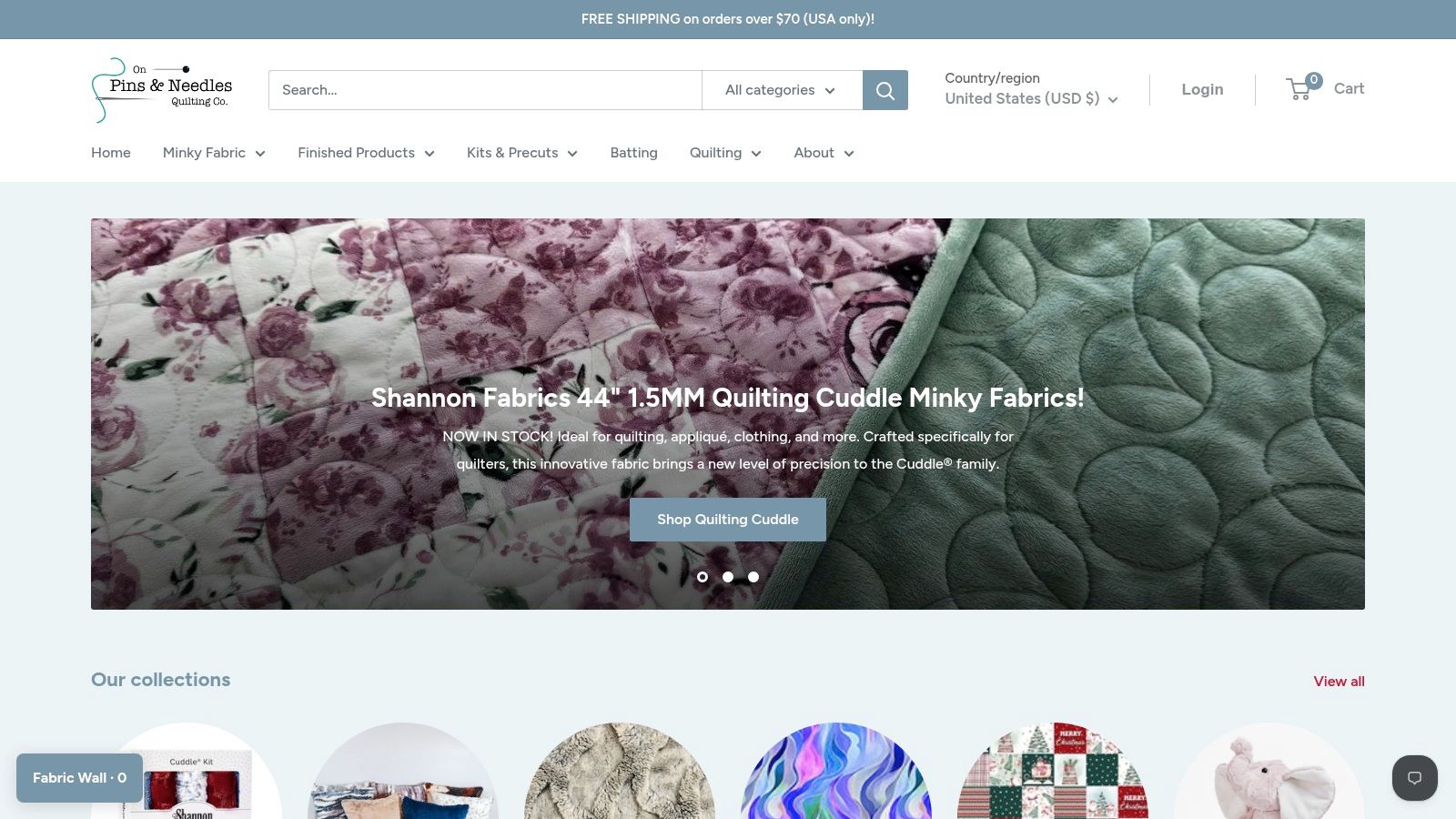
Pile height in numbers rather than adjectives. Color shot in daylight. Nap direction noted. Whether the texture is a one-time buy or a line that gets restocked. Those four details do more selling than any lifestyle photo, and they are the first thing missing when a shop is flipping closeout goods.
Confirm these three numbers before you buy
- Nominal width: the advertised figure, 90 or 110 inches.
- Usable width: what remains after selvage and edge distortion, which is the number your backing plan needs.
- Yardage on hand: whether the shop can cut the full length in one piece, or whether it will splice two bolts without telling you.
That last point is the one buyers skip, and it is where cut accuracy gets tested before the fabric even leaves the shop. A listing can promise continuous yardage and still ship two joined lengths when stock runs thin.
Small projects deserve their own check, since a pillow or scarf does not need wide goods at all. Most of those cuts come off a fat quarter or a half yard, and if you are unsure how much ground a fat quarter covers, this explanation of how big a fat quarter is settles it before you order.
Pick the width from your quilt size, then pick the texture. Browse the Shannon Cuddle and Luxe Cuddle range once both are decided, and if you are matching solids across dye lots, our notes on Cuddle 3 solid colors will save you a second order.
How Much Does Shipping Really Add to Your Order?
Shipping on a minky order rarely matches the buyer's expectation, because plush pile consumes volume and carriers bill for volume. A three-yard cut of high-pile fabric can cost more to move than its own price suggests, and extra-wide rolls create their own handling expectations at the counter.
Late disclosure is where that goes wrong. Baymard's checkout benchmark reports an average cart-abandonment rate of about 70.19%, and 40% of surveyed users abandon because of unexpected extra costs such as shipping, taxes or fees (Baymard Institute).
Check five things before you add to cart:
- Cost on the product page: the shipping figure appears on the listing, not only at payment.
- Threshold beside the subtotal: the free-shipping line sits next to the running cart total, so you can see the gap.
- Delivery estimate: an arrival window is stated, not implied.
- Packing method: the listing says whether the cut ships folded or rolled, because rolls change the parcel dimensions.
- Standard cut lengths: curated 2, 2.5 and 3 yard cuts are offered, which makes package size predictable and rate estimation honest.
Say you have $58 of fabric in the cart and the page shows a $70 threshold. You see the gap before checkout, add a half yard for binding, and land on free U.S. shipping on orders over $70 with no surprise at the payment screen. That is the entire purpose of publishing the number early.
Get 15% off your first order at On Pins & Needles Quilting Co., plus free U.S. shipping on orders over $70.
Our own free shipping threshold breakdown explains how the $70 line interacts with bulky cuts, so you can plan a single order instead of three.
Build one habit and the problem disappears. Ask for the total landed cost before you add the last yard, then compare your cart total against the threshold rather than the fabric price alone. Get 15% Off Your First Order and the freight math gets easier from the first cart.
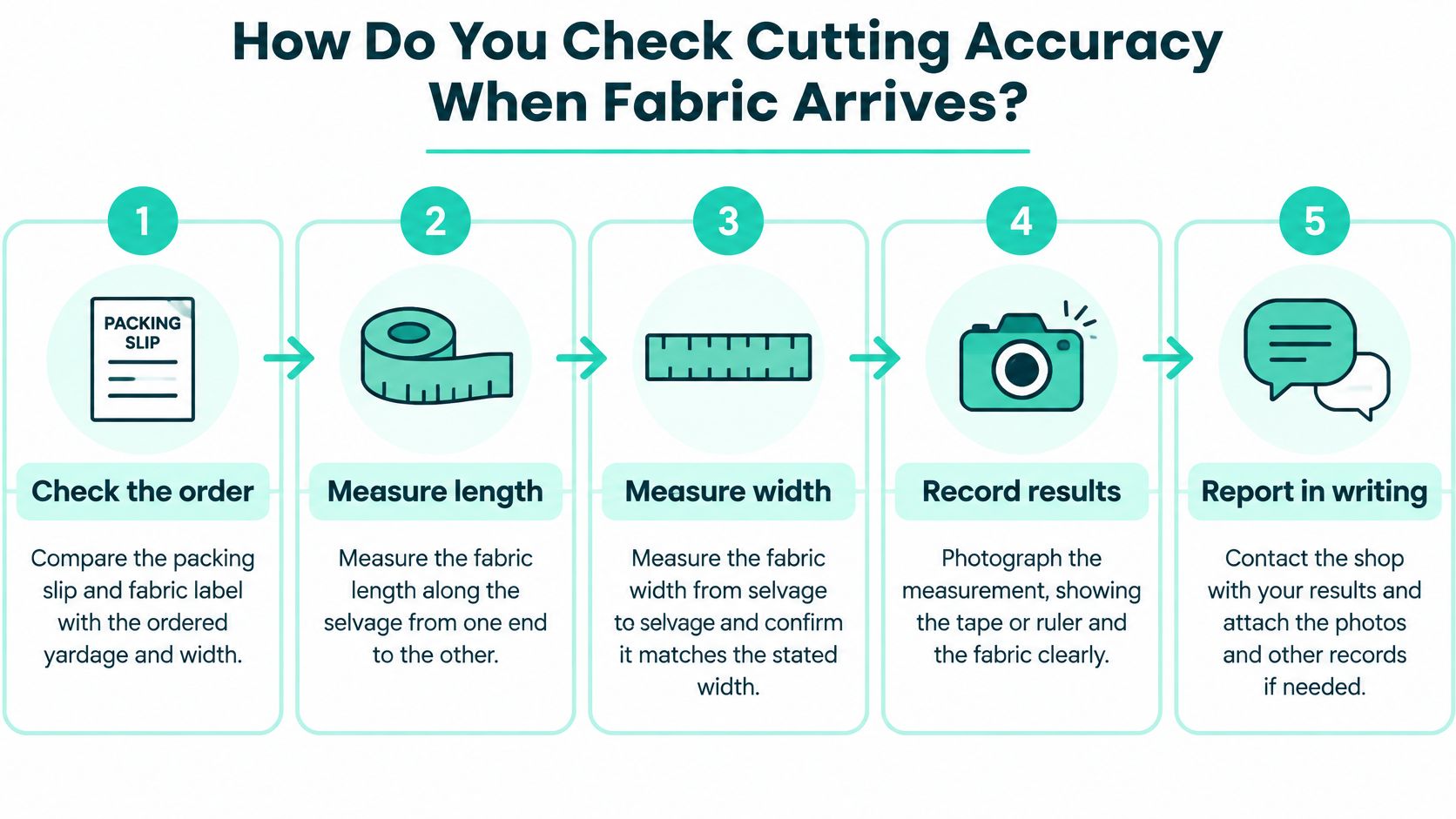
How Do You Check Cutting Accuracy When Fabric Arrives?
Open the parcel with a tape measure on the table, not a pair of scissors. Run these six steps in order and you'll know within ten minutes whether the cut is right, while the packaging is still intact and the claim window is wide open.
- Check the order against the slip. Compare yardage and width on the packing slip with what you bought. The slip is your only proof of what the shop intended to send.
- Measure the length along the selvage. Plush knits stretch, so a cut measured by tugging can read long. Lay it flat, smooth it without pulling, and record the number. The common slip is measuring across the fold without letting the goods relax first.
- Measure width edge to edge at three points. Minky is typically a 100% polyester microfiber knit with a dense cut-pile face and a flat knit backing, and that knit can pull out of square (HC Quilts notes on minky). Three readings tell you if the cut is skewed.
- Work out usable width. Subtract the selvage and any distorted edge from the nominal figure. That result, not the advertised number, is what your backing plan uses.
- Find the stretch and mark the nap. Identify the stretch direction, then mark nap direction on the wrong side with a removable pen. The pile has direction and will look different under different lights if you flip pieces.
- Wash a ten-inch sample the way you'll wash the quilt. Use the same temperature, agitation, detergent and drying method you plan for the finished project, then re-measure and record the change. Skipping the sample wash is how a quilt back ends up two inches short after its first laundering.
Once the cut checks out, set up the machine for the material rather than for cotton. A 90/14 stretch needle is the right choice for Cuddle-type goods; the backing is a knit, and an unsuitable needle produces skipped stitches or drags the fabric (Cuddle Studio guidance). Test a longer stitch length on scraps and use a walking foot when the minky is layered with batting.
If a cut lands short, photograph it with the tape measure in frame before you cut into the main piece. That shot is the evidence any shop needs to correct the order, and without it you're describing a problem instead of showing one. Replacements and additional yardage come from the Luxe Cuddle Collection, and our notes on improving cutting accuracy explain how we check lengths before a parcel leaves.
What Happens If Fabric Arrives Defective or Wrong?
Post-purchase policy is now a purchase criterion in its own right. DHL's 2025 survey of 24,000 shoppers across 24 markets found that 71% would leave if the return process did not meet expectations, while 76% of U.S. consumers would abandon a purchase if their preferred delivery option was unavailable (DHL e-commerce trends report 2025).
Minky needs a closer read than most categories, because cut-to-length fabric is usually treated differently from finished goods. Confirm four things before you order:
- The defect-claim window: how many days you have, counted from delivery rather than order date.
- Who pays return postage: on a defect, it shouldn't be you.
- Whether cut fabric can be returned at all: many shops exclude it, and the honest ones say so on the listing.
- What photos are needed: pile, selvage, tape measure in frame, plus the packing slip.
| Problem | Likely cause | Request to make |
|---|---|---|
| Cut is short | Measured before the selvage trim | Re-cut or credit, with a photo of the tape measure |
| Texture or color differs from listing | Lighting in photos or dye variation | Swatch comparison and a return option |
| Pile crushed or damaged | Rolled tightly or stored in heat | Replacement with packing photos |
| Wrong width shipped | Order picking error | Exchange at the shop's cost |
Reviews are more useful than the star average here. We've built up hundreds of verified reviews, and the ones worth reading are the specific ones about cut accuracy, packaging and how a problem was handled. A five-star average with no detail tells you nothing.
How to reach us: email angela@opnquilting.com, call or text (801) 390-0642, or open the chat widget at the bottom of the website and describe the project. A written answer beats a phone call you can't forward later.
Keep the order confirmation, the photographs you took on arrival, and the product tag until the fabric is cut. Then contact support inside the policy window, with the measurements already in hand. You can reach our team and see replacement options in the same place at On Pins & Needles Quilting Co.
How Do You Prep a Quilt for Mail-In Longarm Quilting?
A 60 by 70 inch quilt top typically ships with a backing around 68 by 78 inches. Adding roughly eight inches in each direction is a common longarm guideline, which leaves about four inches of loading margin per side so the frame can grip and advance the fabric. Exact allowances vary by machine and shop, so treat the figures below as typical values and confirm the requirement with whoever finishes your top.
| Quilt top (in) | Typical backing (in) | Loading margin per side (in) |
|---|---|---|
| 36 by 36 | 44 by 44 | 4 |
| 60 by 70 | 68 by 78 | 4 |
| 90 by 108 | 98 by 116 | 4 |
| 108 by 108 | 116 by 116 | 4 |
If the backing is pieced, join and press it before the box ships. A seam that isn't fully secured can pull apart under frame tension during quilting.
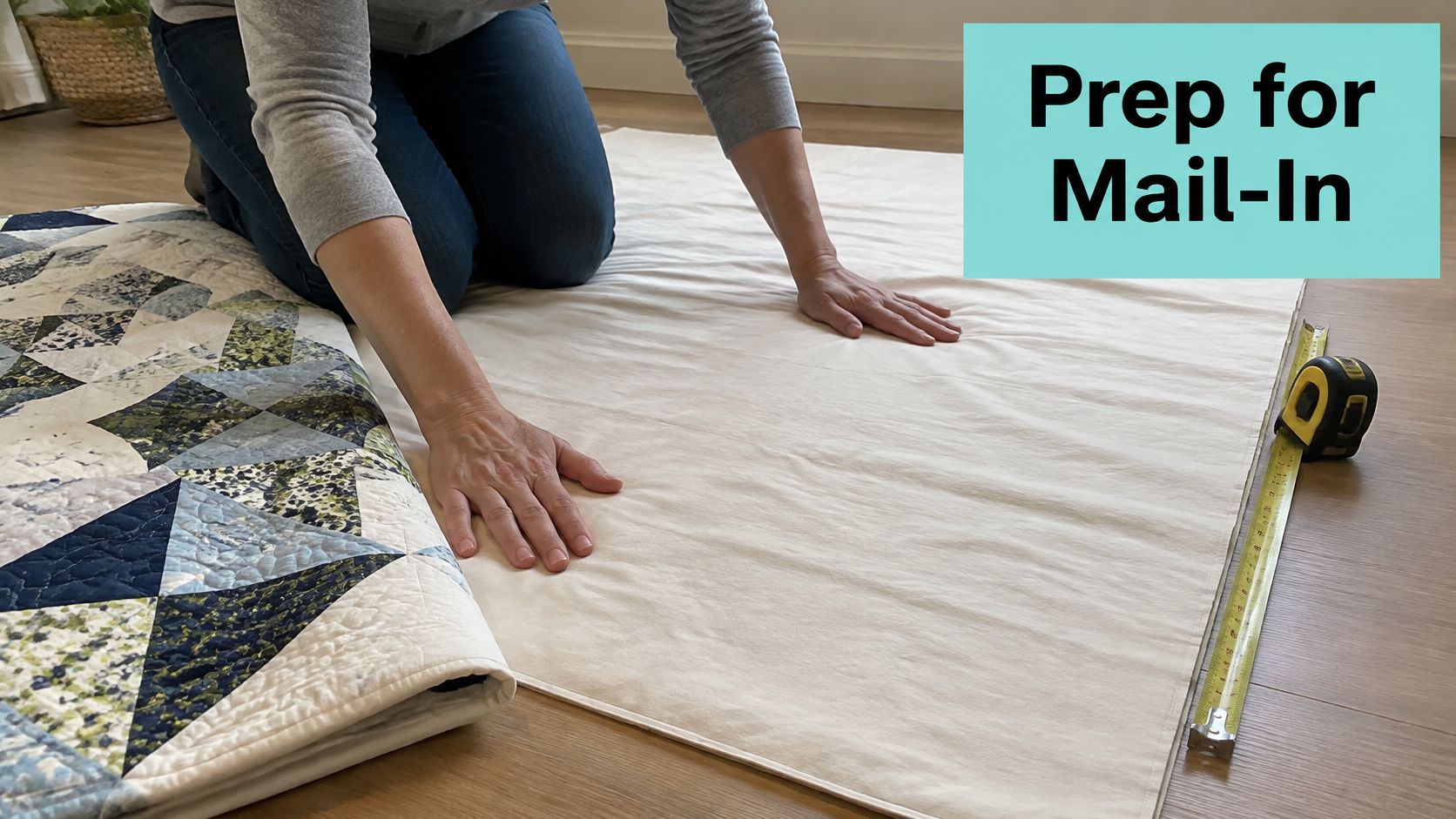
Our Quilt Prep Instructions carry the full checklist, and these are the items that cause the most delay:
- Trim every loose thread. Dark threads behind a light fabric show through as shadows once quilted.
- Secure seams and fix popped stitches. An open seam travels under the needle and keeps opening during quilting.
- Press the top and the backing, then keep them flat. Folded creases quilt in permanently.
- Don't baste or pin the layers. A longarm loads the top and backing separately, and pins or basting spray interfere with the frame.
- Ship the top and backing as two items. Never pre-sandwich them for mail-in work.
Prep rule: the top and backing travel separately, unpinned, unbasted and pressed. Everything else is a convenience that costs you time.
We include a Pattern Gallery with edge-to-edge designs across modern, floral, juvenile, holiday and nature motifs, and you can book your longarm service once you've picked one. If you'd rather not choose, Quilter's Choice lets us match a favorite pattern to your top. Talk through the design with us before the quilt ships so the finished work matches what you pictured. We may share finished quilts on Facebook and Instagram, so if you'd rather yours stay private, say so in the order notes.
The video below shows the loading side of the process, which makes the margin guideline easier to picture.
Mail your quilt top and backing to On Pins & Needles Quilting Co. at 747 North 750 West, West Bountiful, UT 84087. Additional services and prep work can change cost and turnaround, so check the top against the table before you pack the box.
How Do You Wash and Care for Shannon Cuddle?
Wash finished Cuddle and Luxe Cuddle items in cool water on a gentle cycle with reduced agitation, then air dry them away from heat. High heat is what flattens and deforms a cut pile, and once the pile is crushed the softness doesn't come back.
The pile has direction and the backing is a knit, which is why care starts at the cutting table rather than the laundry room.
- Confirm the nap direction you marked on the wrong side during your arrival check. Pieces cut in different directions can look like different colors in raking light.
- Wash cool with reduced agitation, using the same detergent and cycle as your shrinkage sample. Staying consistent is what makes your sample measurement mean anything.
- Air dry the item, away from radiators, dryers and direct sun. Heat does the damage that no amount of fabric softener repairs.
- Inspect the pile after drying and compare it with your sample. If the sample shrank or the pile matted, you know what the finished quilt will do on its next wash.
The sample wash earns its ten minutes here. It tells you how the fabric behaves while the consequences are still small, instead of after a queen-size back has been quilted.
Texture choice affects how much care a piece needs. Test Hide, Snowy Owl and Fawn first if you're building something that will be washed often, because pile depth varies across the range and the deeper textures need gentler handling. Compare the full Shannon Cuddle stock and choose a texture whose care profile matches how the quilt will live.
What Should You Confirm Before Your First Order?
Before you pay, confirm the usable width against your quilt top plus its loading margin, and get the cut and defect terms in writing. Confirm what the shop does with your quilt afterward, too. We post finished quilts on Facebook and Instagram, so if you'd rather yours stayed private, say so in the order notes.
We publish widths, cut policies and prep rules because they're the parts of an order you can't inspect through a screen. Our stock covers Shannon Fabrics Cuddle and Luxe Cuddle, extra-wide quilt backing and mail-in edge-to-edge quilting, and those listings are backed by hundreds of verified reviews.
If a question comes up before you order, ask it. Email angela@opnquilting.com, call or text (801) 390-0642, or use the chat widget at the bottom of the site with your quilt dimensions. A two-line message about a 90-inch back and a king top saves a return.
Mail-in quilting already includes standard thread, patterns, Quilter's Dream 80/20 batting and standard return shipping to the lower 48, so spend your questions on the upgrades: extra services, a Cuddle minky back, priority rush.
On Pins & Needles Quilting Co. is a family-owned minky fabric and longarm quilting shop in Utah. Orders run on measured widths, cuts checked before they ship, a written route for defects, and prep instructions you read before you pack a box. If you're weighing a backing width or a texture for a specific quilt, send us the top dimensions and we'll tell you what fits. Visit On Pins & Needles Quilting Co. to compare Shannon Cuddle and Luxe Cuddle, book mail-in longarm quilting, and take 15% off your first order with free U.S. shipping over $70.