
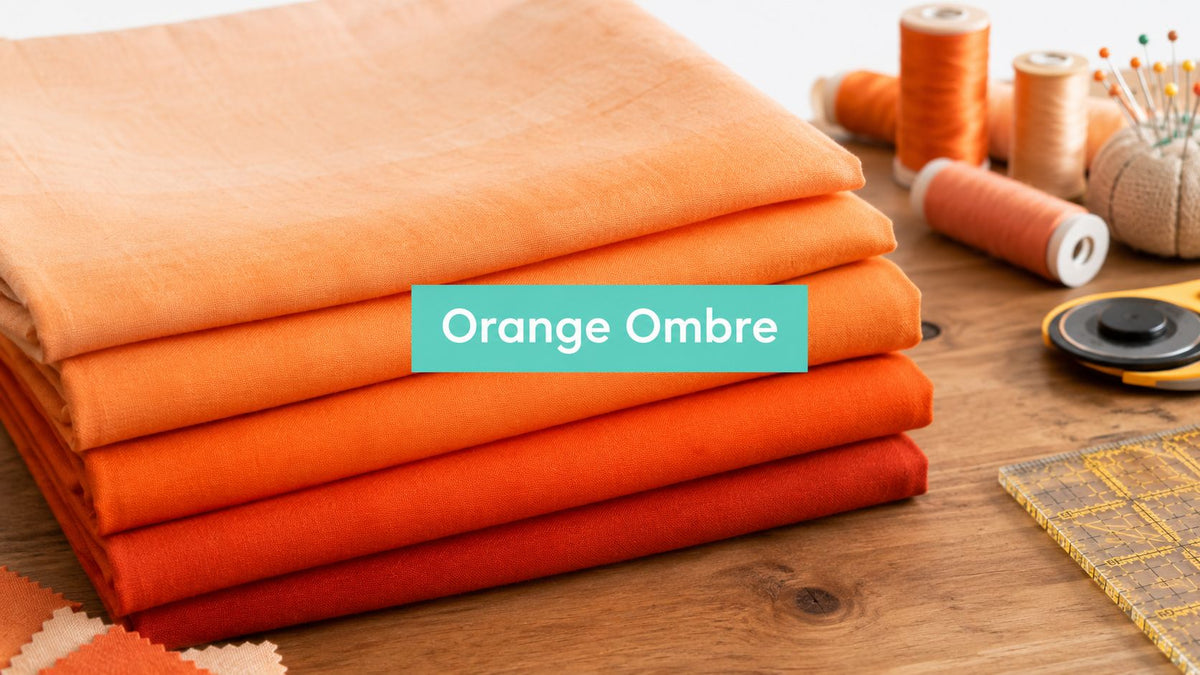
You're standing in front of a fabric display when one bolt catches your eye. It moves from pale apricot to vivid tangerine and then into deep pumpkin without a hard stripe. Orange ombre fabric is a directional gradient cloth, and it can turn one cut of yardage into a complete color plan for a quilt, pillow, or room accent.
The trick is learning how that color shift behaves before you cut. At On Pins & Needles Quilting Co., we look at ombre through a maker's eyes, including the fiber, the direction of the fade, the cut size, and how the finished piece will be washed or quilted.
What Orange Ombre Fabric Actually Is
Orange ombre fabric is cloth with a gradual transition from a light orange shade to a deeper orange shade. The fade can move through peach, apricot, marigold, tangerine, pumpkin, rust, or another warm neighboring tone, depending on the dye process and the fabric base.
That makes ombre different from several fabrics that may look similar on a website:
- Tone-on-tone fabric uses one dominant color with a printed or woven motif in a related shade.
- Gradient print places the color transition on the surface with digital or rotary printing.
- Color-blended yarn fabric creates variation through threads that change color before weaving.
- Dye-dyed ombre builds the transition through changing dye exposure across the cloth.
The difference matters because the gradient may run along the length of the bolt, across its width, or through a particular repeat. Before buying, check the product photographs, selvedge direction, fabric width, and cut policy.
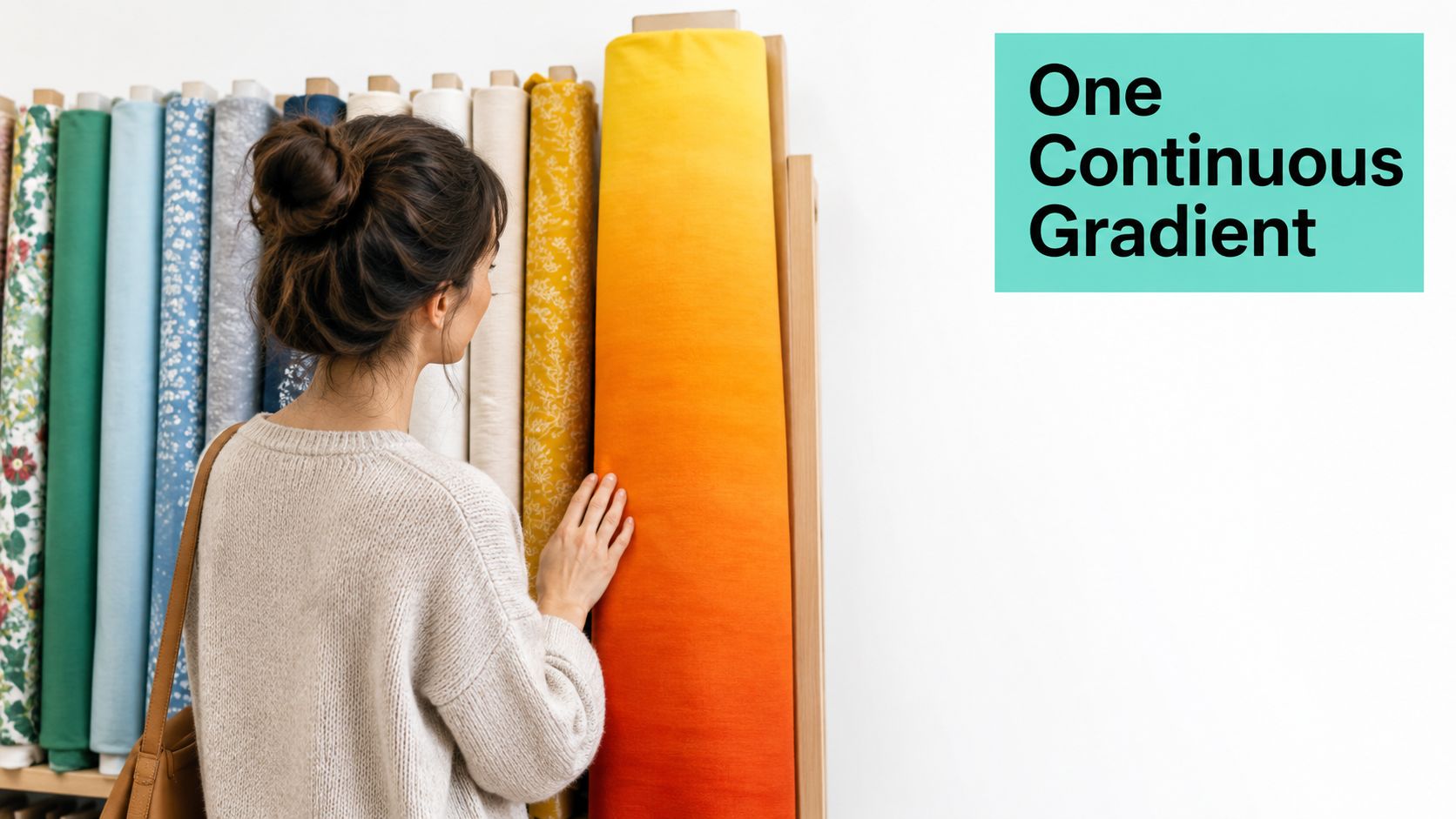
Which fabric bases show the fade best?
Quilter's cotton gives you a flat, readable gradient. Cotton sateen adds a subtle sheen, while voile makes the transition look lighter and more translucent. Minky plush changes the visual depth because the pile catches light in different directions. Its deepest orange can appear warmer or richer than the same dye on smooth cotton.
That softness is useful for backing, baby quilts, blankets, and pillows, but it also means you should brush the pile consistently before judging the shade. Shannon Fabrics textures such as Hide, Snowy Owl, and Fawn have different surface heights and reflections, so the same orange family won't look identical across each texture.
For another example of how a gradient can guide a quilt layout, compare the approach in this guide to grey ombre fabric.
Cutting rule: Treat ombre as directional fabric. Mark the light and dark ends before cutting, or you may place an unexpected orange tone in the center of a block.
A Short History of Ombre in Textiles
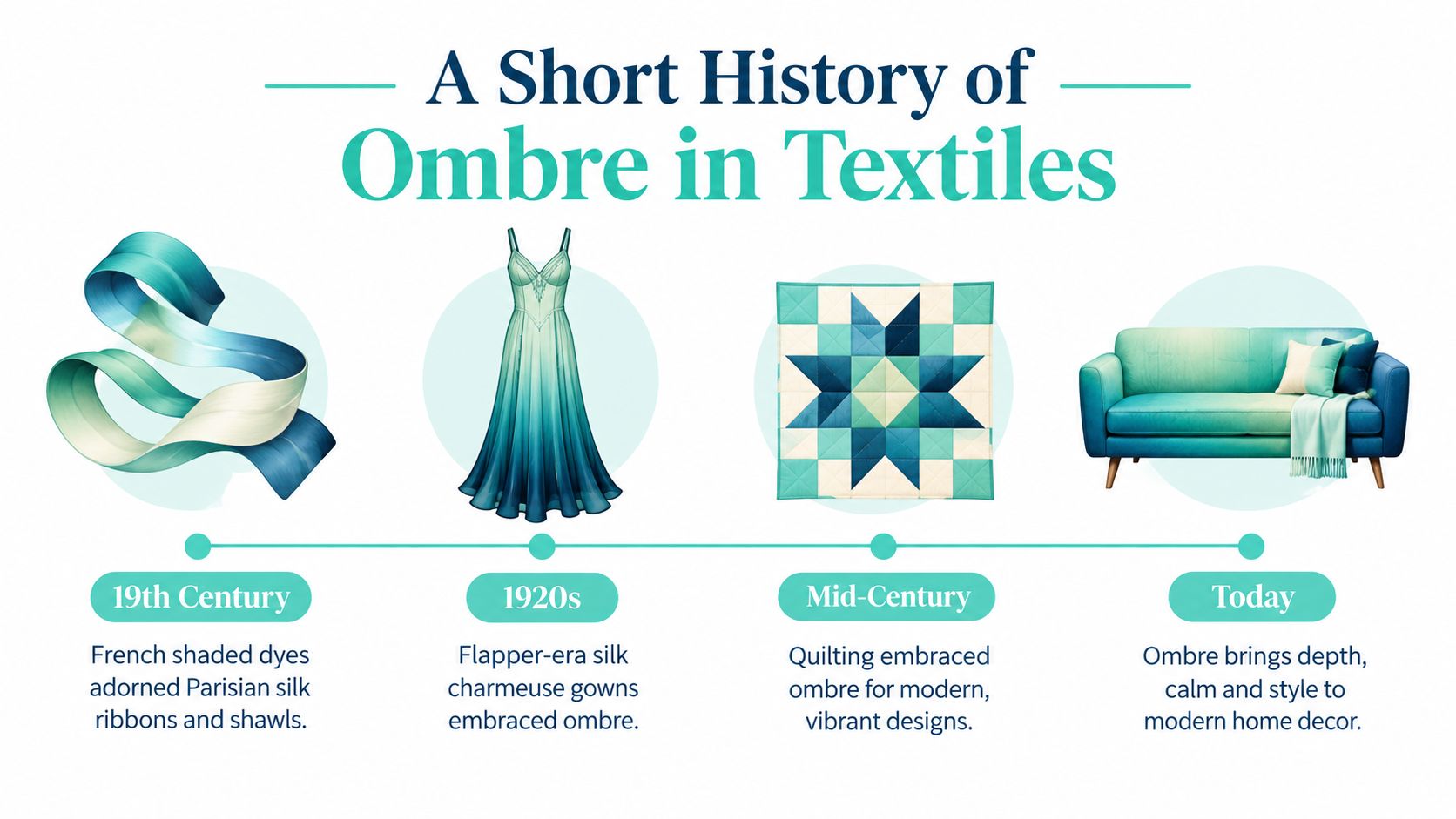
Ombre has a longer textile history than its current social-media presence suggests. Historical records describe a special printing block called a “rainbowed” block in the early 19th century, used to create textiles with graduated color designs. Sources also note that ombré returned to fashion around 1840 and continued through the 19th century. (Historical overview of ombré textiles)
By the 1820s to 1850s, French ombré wallpapers and textiles appeared in vivid layered palettes described as rainbow patterns. Makers used block printing, roller printing, and brush application to build those shifts. On June 21, 1849, British engineer Charles Augustus Holm received a patent for machinery designed to shade or print paper, silk, and other fabrics with multiple colors. (Documented ombré history and patent milestone)
Why does the effect keep returning?
The visual idea has remained consistent for more than 180 years, moving from historical textile production into later tie-dye culture and contemporary fashion and interiors. (Definition and history of ombré) Orange works especially well because a light-to-dark progression can resemble a sunset, glowing ember, autumn leaf, or vintage color wash.
Contemporary design coverage places ombré prominently in interiors between 2018 and 2020, while later design writing describes vibrant gradients as standalone statements rather than background decoration. (Interior ombré trend context) A 2023 Paris Haute Couture Week recap also described soft ombré looks from designers including Julien Fournié, Fendi, and Schiaparelli. (Couture ombré context)
Most modern shop bolts arrive already shaded by a dye house, so home sewists can buy the effect rather than reproduce every stage themselves. That makes orange ombre practical for quilt blocks, nursery accents, garments, and soft furnishings.
How Orange Ombre Is Made
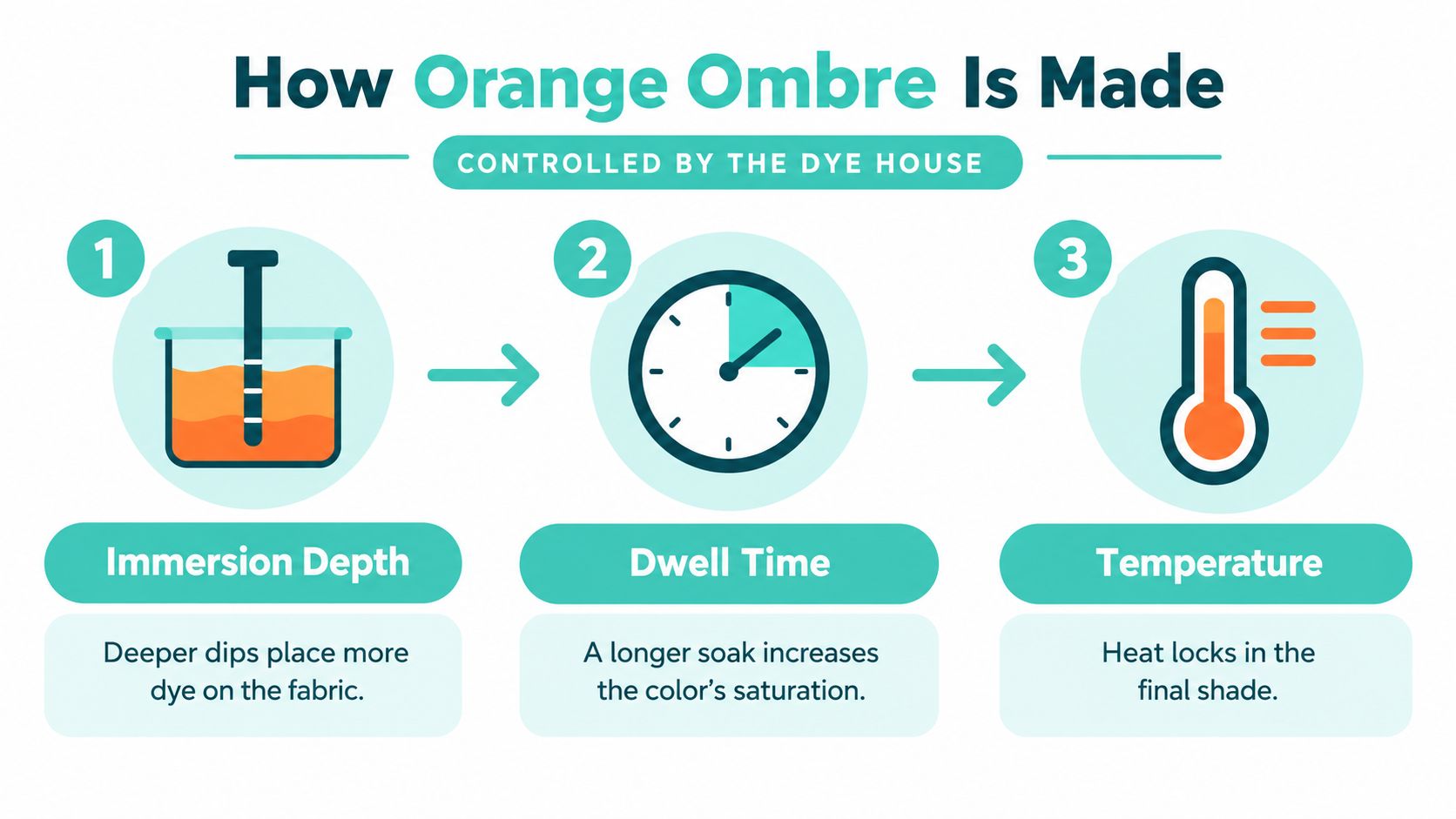
The production method is called gradation dyeing, often described as dip-dyeing or gradient dyeing. The cloth moves through dye exposure in stages, so one region absorbs less color and another region absorbs more. The deepest shade usually appears where the fabric remains submerged longest. (How ombre and gradient patterns are formed)
Three controls shape the finished ramp:
- Immersion depth determines how far the fabric enters the dye bath. A deeper dip exposes more cloth to the dye.
- Dwell time controls how long each zone stays in the bath. Longer exposure generally intensifies saturation.
- Dye concentration affects the relationship between the pale and deep ends, such as a shift from soft peach into tangerine or rust.
Orange requires careful control because its red and yellow components can develop at different rates. If the timing or concentration changes unevenly, the middle of the bolt may look blotchy rather than smoothly shaded.
What should you inspect on the bolt?
Unroll enough fabric to see the entire transition. A well-controlled gradient should move gradually, without a sudden horizontal band, muddy interruption, or abrupt jump from yellow-orange to red-orange.
Fiber type also changes the result. Cotton, rayon, silk, polyester, and nylon require different dye systems, so a listing that shows “orange ombre” without identifying the fiber leaves an important buying question unanswered. Marketplace examples include quilting fabric, silk satin, polyester-spandex mesh, wallpaper, and home-decor yardage, all under related search terms. (Orange ombre product range)
The following video gives a visual reference for ombre dyeing and helps you see why even movement matters.
For makers who want to understand the broader safety conversation around fabric colorants, this OPN guide to non-toxic fabric dyes offers a useful starting point.
Color Pairings That Make Orange Ombre Shine
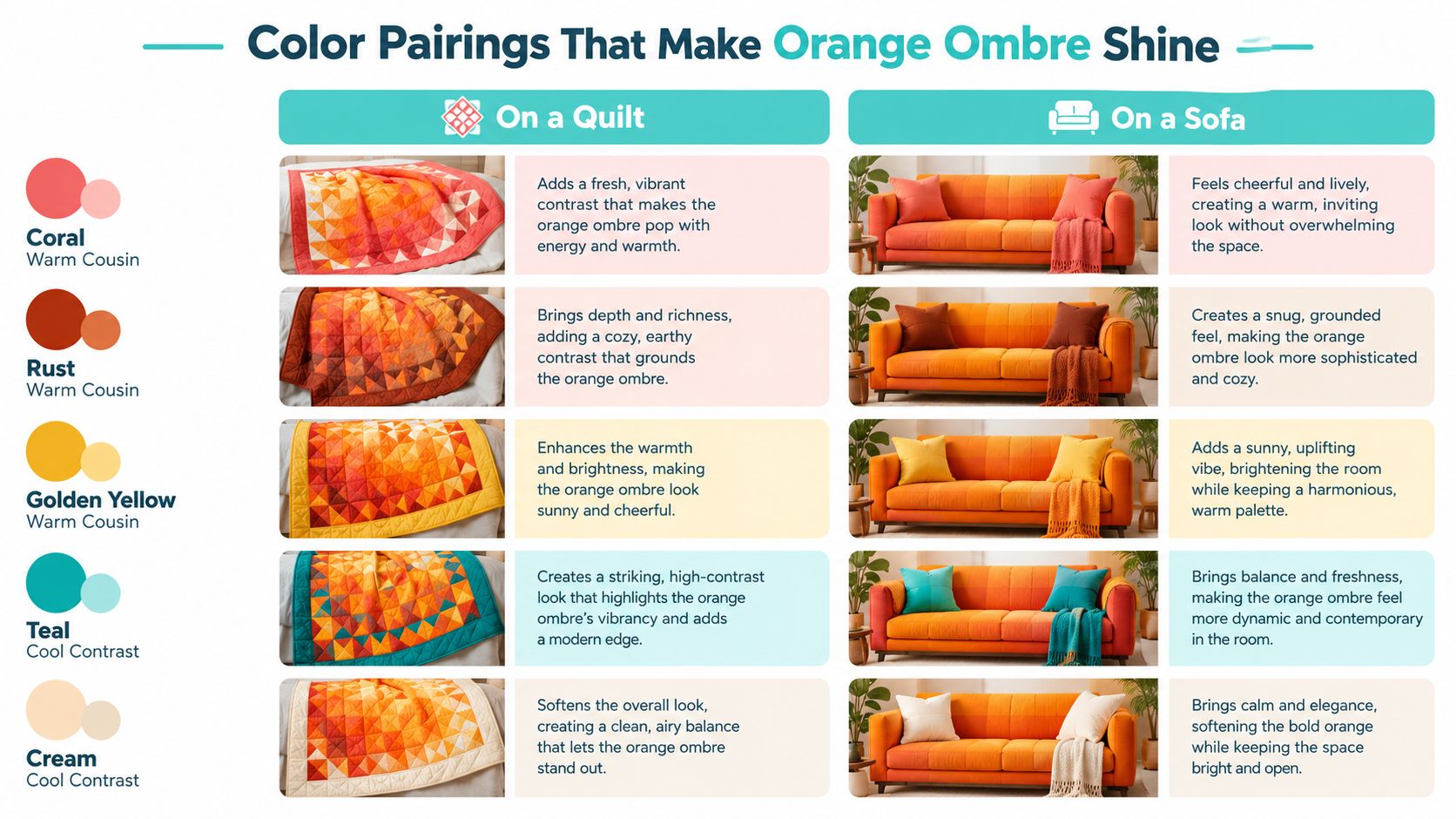
Orange can dominate a palette, but the right companion colors tell the gradient where to sit. Warm neighbors make the fade feel continuous. Neutrals give the deepest orange more authority. Cool contrasts make the whole piece look sharper.
Which warm colors blend naturally?
Coral, rust, and golden yellow sit close to orange on a warm palette. In a baby quilt, those neighbors create a cheerful flow without making each block feel isolated. In a wall hanging, they can produce a sunlit effect that reads intentionally layered.
Chocolate brown and oatmeal create a quieter result. Brown anchors pumpkin and rust, while oatmeal keeps pale apricot from disappearing into stark white.
Cool pairings behave differently:
| Partner color | On a quilt | In a room |
|---|---|---|
| Teal | Creates crisp contrast around orange blocks | Adds energy to pillows, throws, or a chair |
| Dusty blue | Softens the warmth without flattening it | Feels calmer beside orange upholstery |
| Soft sage | Gives a natural, muted balance | Works well with wood and neutral walls |
| Warm white | Keeps the gradient open and luminous | Makes orange the clear accent |
| Charcoal | Frames the strongest orange values | Adds a modern, graphic edge |
For a deeper explanation of how color relationships affect visual impact, this guide to color theory for image enhancement is useful even when you're planning fabric rather than editing a photograph.
How do metallic details fit?
Brushed copper thread and gold piping echo orange's warmth without interrupting the gradient. Use them as a fine border, binding detail, or restrained quilting accent rather than covering the transition with heavy decoration.
For more palette ideas, OPN's modern quilt color schemes guide can help you test orange against neutrals and cooler contrasts before ordering yardage.
A strong orange ombre palette usually needs one main gradient, one quiet anchor, and one deliberate contrast.
Yardage and Cut Options for Your Project
The cut you order affects more than the amount of fabric in your package. It determines how much of the fade you can place across a block, border, pillow front, or quilt back.
A fat quarter is useful for small blocks and appliqué, but it may show only part of a lengthwise gradient. A half yard gives you more room for coordinated pieces. A full yard offers greater control over the direction, while a 3-yard cut can support a larger backing or a long, uninterrupted fade.
For standard quilting fabric, the usable width is commonly around 42 to 44 inches. Wide minky may measure 58 to 60 inches, giving you more room across the quilt and reducing the need to piece a backing. Always confirm the listing width before calculating.
How much fabric should you plan for?
These are planning examples, not substitutes for the pattern's cutting instructions. Add your preferred seam allowance, binding, shrinkage allowance, and directional margin before ordering.
| Project | Finished Size | Yardage (42-44 in) | Yardage (58-60 in minky) |
|---|---|---|---|
| Baby quilt | 36 by 50 inches | Plan for a running cut sized to the pattern, with extra for directional placement | A wide cut may cover the project with fewer joins |
| Throw quilt | 50 by 60 inches | Expect piecing or a layout that uses the gradient in panels | Wide minky can offer more continuous coverage |
| Pillow cover | 18-inch square | A half yard can provide flexibility for front, back, and placement | A smaller cut may work, depending on the pattern and nap direction |
The finished dimensions above describe the project, not a guaranteed purchase amount. Your pattern may require more fabric for borders, matching, directional repeats, or pattern-specific cutting.
Before cutting, mark the selvedges and draw an arrow toward the deepest orange. Keep that arrow visible while you lay out pieces. A running yardage cut usually gives more control than pre-cut strips when you want the fade to travel across the quilt rather than stop at each strip.
For a fuller planning method, use this guide to calculating fabric yardage before placing your order.
Care and Durability of Orange Ombre Fabric
A beautiful gradient isn't automatically a durable one. Lighter orange areas can show fading or contrast loss sooner than deeper areas when the fabric faces frequent washing, harsh detergent, or strong sunlight. (Washfastness and lightfastness considerations for ombre textiles)
Washfastness matters because the gradient depends on contrast. If the pale end fades unevenly, the transition can look flatter. If the deep end loses saturation, the whole piece may read more like a muted solid.
Which care habits protect the fade?
- Wash gently: Use cold water and a pH-neutral detergent when the fabric manufacturer permits machine washing.
- Skip chlorine bleach: Bleach can damage color and fiber, especially in warm orange shades.
- Dry carefully: Choose low tumble heat or lay the piece flat when practical.
- Limit direct sun: Rotate finished pieces away from strong windows, particularly south-facing exposure.
- Prewash thoughtfully: Test a swatch first if you don't know how the dye will react.
One fabric product listing reports a wash test result of 5-7 on the EN ISO 105-C06 scale, showing that some high-performing ombre textiles can maintain acceptable appearance after repeated washing. (Ombre wash test listing)
What should you ask before cutting?
Request a swatch when possible and wash it using the care method you expect for the finished project. Inspect the selvedge for even dye penetration, and compare the front and reverse sides to see whether the color is embedded through the cloth or mainly sitting on the surface.
Dye-dyed gradients generally age differently from printed gradients. Printed color may show wear at fold lines or high-contact areas, while a properly dyed gradient can change more evenly through laundering and use.
OPN's color-fastness testing guide offers additional questions to consider before committing a bright fabric to a frequently washed quilt.
Choosing the Right Construction for Your Project
The gradient is only half the decision. Construction controls how orange ombre fabric sews, drapes, stretches, and responds to quilting.
Dye-dyed gradient cloth gets its color through staged dye exposure after the textile is formed. That can produce a soft transition within the fiber and works well when you want a continuous visual movement across a quilt.
Printed gradient cloth begins with a base fabric and receives the gradient on its surface. It can be a practical choice for craft pieces, especially when you want a specific artwork or a smaller production run, but inspect the hand, reverse side, and fold areas before buying.
Yarn-dyed ombre uses threads that shift hue before weaving. The result can look more dimensional or heathered, which suits cushions, throws, and room accents where texture matters as much as a perfectly smooth fade.
| Construction | How the Gradient Is Made | Feel and Drape | Best For |
|---|---|---|---|
| Dye-dyed gradient | Finished cloth receives changing dye exposure | Soft, integrated color movement | Heirloom quilts, baby quilts, washable projects |
| Printed gradient | Digital or rotary printing places color on a base cloth | Depends on the base fabric, often flatter at the surface | Tote bags, panels, craft projects |
| Yarn-dyed ombre | Threads change hue before weaving | Dimensional, textured, sometimes heathered | Cushions, throws, home décor |
How does construction affect the longarm frame?
Smooth cotton usually feeds predictably under the needle. Minky adds stretch, nap, and bulk, so you'll want to stabilize the sandwich carefully and keep the pile oriented consistently. Plush textures such as Shannon Cuddle Hide, Snowy Owl, and Fawn also change how quilting lines appear because the texture can soften small details.
For a quilt top that needs professional finishing, OPN's Mail-in Longarm service includes batting, thread, and free return shipping. The service is designed for makers who have a finished top but don't want to manage longarm equipment at home.
Putting It All Together and Where to Buy
Choosing orange ombre becomes straightforward when you make three decisions in order.
First, select the shade family. Pale peach into tangerine feels lighter and fresher, while marigold into pumpkin creates a stronger harvest character. Red-orange blends can look dramatic, but they need more neutral space if you want the gradient to remain readable.
Second, match construction to the project. Use a smooth gradient when the fade itself is the focal point, a plush minky surface when softness and warmth matter, and a textured weave when the room needs visual depth.
Third, choose a cut that preserves the direction. OPN Quilting offers orange-relevant fabric options such as Bumbleberries Brazilian Orange BB020, along with minky fabrics and coordinated cuts for quilt and home projects.
What should you order?
On Pins & Needles Quilting Co. sells fabric by the yard in 0.25-yard increments, half-yard cuts, and curated 1-yard bundles, according to the provided shop information. These options help when a pattern needs a specific amount or when you want several coordinated gradients without buying large unused pieces.
The shop also carries premium Shannon Fabrics Cuddle and Luxe Cuddle, including 44-45 inch Quilting Cuddle, 80 inch Mirage, and extra-wide 90 and 110 inch options. For plush texture, browse Luxe Cuddle Hide, Luxe Cuddle Snowy Owl, and Luxe Cuddle Fawn.
Budget note: OPN lists a 15% first-order coupon and free U.S. shipping on orders over $70. Check the homepage or current shop terms before checkout because offers can change.
A quarter-yard cut can work for a small accent, while a longer cut gives you control over a fade across a bargello layout, pillow front, or quilt backing. OPN also offers curated 2, 2.5, and 3-yard cuts, strip bundles, pillow kits with forms, and ready-made minky items. Its mail-in finishing option can help when the top is complete but the quilting remains.
The shop is supported by hundreds of verified reviews, along with phone and email support. That combination is useful when you need to confirm width, texture, direction, or the right cut before ordering.
On Pins & Needles Quilting Co. offers orange-relevant quilting fabric, premium Shannon Cuddle and Luxe Cuddle textures, curated cuts, kits, and Mail-in Longarm finishing for projects that need a soft professional finish. Visit On Pins & Needles Quilting Co. to choose your gradient, use the 15% first-order offer when available, and plan your order around free shipping on U.S. purchases over $70.