
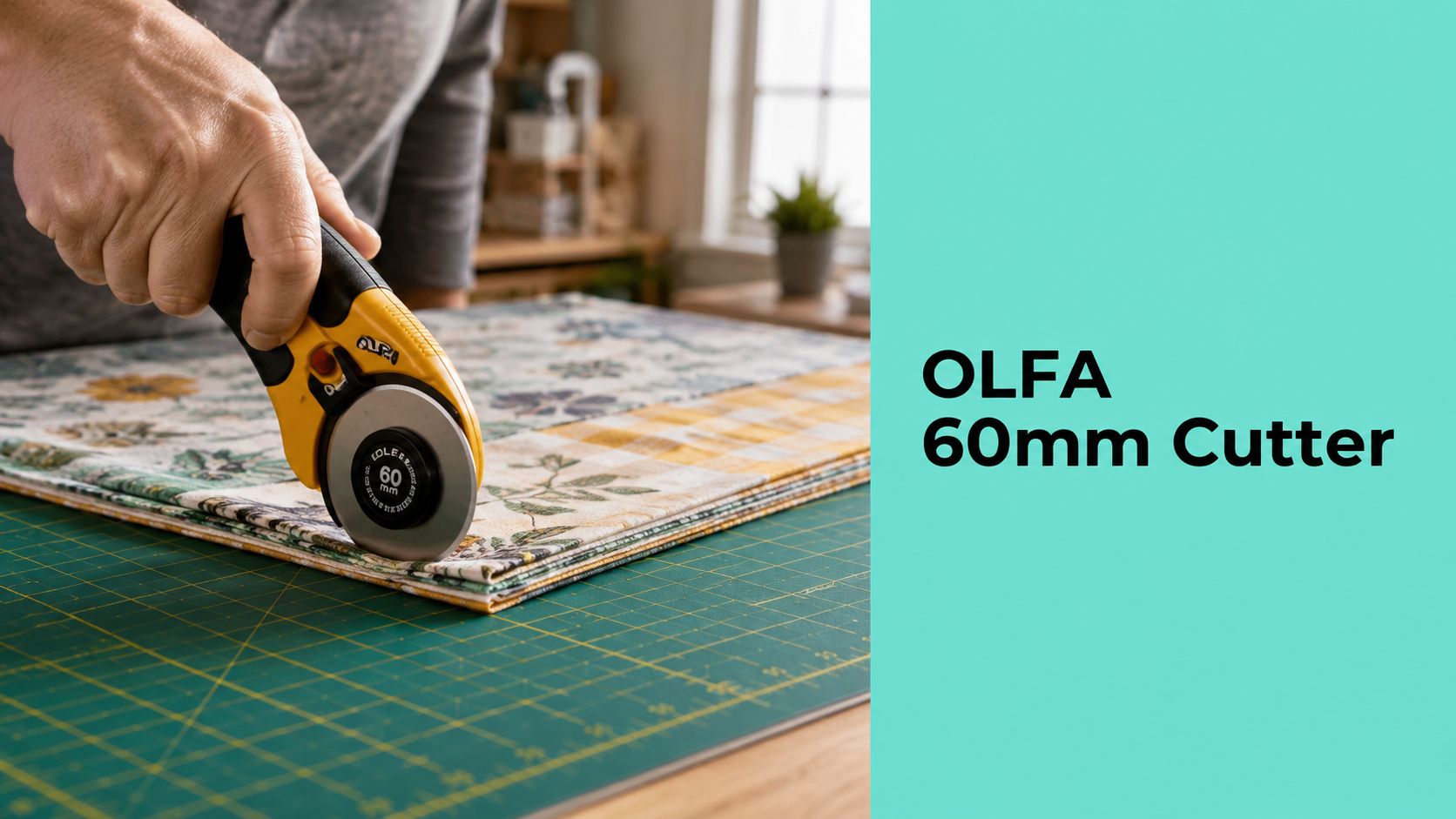
The surprising part of the OLFA 60mm rotary cutter is that its value isn't limited to thick fabric. It earns its place when a smaller blade makes you repeat long cuts, especially while preparing plush minky backings and batting. OLFA says the 60 mm model is its largest rotary blade size and can cut up to 12 layers of cotton fabric in one pass (OLFA product specifications). For everyday piecing, a 45mm may still be the more comfortable choice, but wide, bulky work is where the larger cutter makes sense.
Why the OLFA 60mm Rotary Cutter Exists
The 60mm cutter has a specific job: move through wide or bulky material with fewer passes. OLFA identifies it as the company's largest rotary blade size, designed for medium-to-large cutting work (OLFA's 60mm cutter page). That makes it particularly useful for minky, batting, denim, upholstery-weight cotton, and stacked quilting fabric.
OLFA's rotary cutter history helps explain the design. The company dates its first snap-off blade cutter to 1956 and the rotary cutter to 1979, a 23-year gap between the two inventions (OLFA craft catalogue). Rotary cutters changed quilting because a rolling blade could replace traced templates and scissors for many straight and gently curved cuts.
What the larger blade handles well
Use the 60mm when the material is broad, thick, or awkward to hold flat.
- Wide strips: Long backing cuts benefit from a blade that can maintain contact through the stack.
- Minky and plush fabric: The larger blade is useful when pile and stretch make repeated passes frustrating.
- Batting stacks: A deep blade profile helps keep the cut moving through bulky layers.
- Long straight edges: The cutter works naturally with a ruler and a properly supported mat.
- Gentle curves: Broad arcs are easier than tight templates because the blade doesn't need constant directional changes.
Practical rule: If you're pressing hard enough to distort the fabric or returning to the same line repeatedly, the cutter may be undersized for the job.
The 60mm isn't automatically the right answer for every quilt. It's heavier and less nimble than a smaller cutter, so fine appliqué, small scraps, and tight curves still favor a more compact blade. Quilters comparing sizes can also review this practical rotary cutter selection guide before adding another handle to the sewing room.
Key Features of the 60mm Rotary Cutter
The RTY-3/G and RTY-3/DX versions focus on control during demanding cuts. The straight-handle model is a direct, workmanlike option, while the deluxe RTY-3/DX adds a squeeze-handle mechanism, self-retracting blade action, and a dual-action safety lock (OLFA RTY-3/DX details).
The practical difference is how the tool behaves between cuts. With the deluxe model, squeezing engages the blade, and the safety lock can secure it for use or keep it inside the handle when stored. That arrangement can reduce unnecessary hand and wrist strain during repeated work while also limiting accidental blade exposure.

Which features matter at the cutting table
- Large circular blade: OLFA states that the 60mm cutter can cut up to 12 layers of cotton fabric in one pass (OLFA product information). That capacity is most useful when the stack is stable and the mat supports the full stroke.
- Squeeze handle on the RTY-3/DX: The grip gives the operator a positive way to engage the blade instead of relying on a continuously exposed cutting edge.
- Dual-action lock: The blade can be locked during use or secured inside the handle when the cutter is not in use (RTY-3/DX safety information).
- Replacement-blade compatibility: The handle accepts OLFA 60mm replacement blades, including the RB60H Endurance blade.
- Endurance option: OLFA says the RB60H provides about 2x the cutting life of a standard blade for demanding cutting workloads (OLFA RTY-3/DX product page).
A flat, stable cutting mat still matters as much as the handle. If your studio also manages online orders, the help centre for e-commerce teams from Carti is a useful separate resource for keeping shop operations organized while production work stays focused.
60mm vs 45mm Rotary Cutter
The 60mm and 45mm serve different jobs. The larger blade earns its space during longarm-quilting prep, especially when wide minky backings or thick batting stacks make repeated passes slow and uneven. The 45mm remains the more precise choice for ordinary piecing and detail work.
| Comparison | 60mm RTY-3/DX | 45mm RTY-2/DX |
|---|---|---|
| Primary role | Thick stacks, wide cuts, heavy fabric | Everyday piecing and general quilting |
| Handling | Larger and heavier in the hand | Easier to maneuver |
| Best cut type | Long straight edges and gentle curves | Small pieces, tighter curves, and templates |
| Fabric workload | Bulky and multiple-layer work | Common quilting layers |
| Typical blade demand | Handles long prep cuts with fewer passes | May need extra passes through thick stacks |
| Learning curve | Needs a lighter, steadier touch | Familiar for routine cutting |
| Ideal shop position | Specialist heavy-duty cutter | Everyday workhorse |
The practical difference appears on broad backing panels. A smaller blade can still finish the cut, but plush fabric and thick batting often require more passes, increasing opportunities for shifting or an uneven edge. The 60mm reduces that repetition and feels steadier across long straight sections. Its specifications are noted earlier in the article, so the choice should rest on the work rather than another capacity claim.
When the 45mm is smarter
Choose the 45mm when control matters more than cutting depth.
- Appliqué templates: Tight turns are easier with a smaller blade.
- Small scraps: A compact cutter feels less cumbersome around short edges.
- Block trimming: The lighter tool pairs naturally with acrylic rulers.
- Routine piecing: Strips and squares in ordinary quilting cotton rarely need the 60mm's reach.
- Fine curves: The smaller circular path follows detailed shapes with less handle interference.
Keep both sizes available if your work moves between bulk preparation and detailed piecing. Use the 60mm for wide minky backings, thick batting, and long cuts. Switch to the 45mm for small blocks, tight curves, and template work.
Cutting Wide Strips and Curves with the 60mm
A large minky backing exposes the difference between blade sizes quickly. For a queen quilt, the challenge usually isn't making one attractive cut. It's keeping a broad, plush panel square while trimming enough material for a clean longarm preparation.
Start by controlling the fabric rather than forcing the cutter.
- Lay the backing pile-side down on a fully supported self-healing mat.
- Bring the selvedges toward the center so the fabric folds without twisting.
- Fold the fabric again to create a manageable multi-layer stack.
- Align the fold with a ruler before rolling the cutter.
- Use a light, continuous pass instead of pressing down aggressively.
With a four-layer stack roughly 27 inches wide, the 60mm blade can trim across the folded material cleanly when the fabric is positioned squarely. The larger wheel also feels steadier on long edges, especially when plush fabric catches slightly under the ruler.
Handling curves without stretching plush fabric
Gentle curves are another area where the 60mm earns its place. A broad blade arc glides through shallow S-curves and long binding shapes without the constant wrist corrections required by a smaller tool. Keep the wrist relaxed, let the blade roll, and avoid dragging the cutter sideways across the pile.
The tool still has limits. A 45mm remains the better choice for tight appliqué curves, small block corners, and short detail cuts where the larger grip can feel intrusive. For more reliable straightness, the fabric must be supported from edge to edge, and the ruler needs to remain stable throughout the pass.

Minky preparation rewards patience. The accuracy guide for fabric cutting is useful when a wide backing needs to arrive square and ready for quilting rather than needing extensive correction at the longarm.
Changing 60mm Blades Safely
Blade replacement deserves more attention on a 60mm cutter because the tool is intended for substantial cutting work. OLFA's safety information emphasizes cleaning the handle and blade, checking that stacked blades aren't stuck together, and replacing the blade with the lock engaged (OLFA FAQ).
Follow the manufacturer's instructions for your exact model, then use this handling sequence as a practical checklist:
- Retract the blade fully. On the RTY-3/DX, release the squeeze handle so the blade returns inside the housing.
- Engage the dual-action safety lock. Confirm that the blade can't move before touching the central fastener.
- Remove the central bolt. Use the supplied tool or a suitable coin, keeping the cutter on a stable surface.
- Lift the old blade straight out. Hold the blade by its center or protective cradle, never by the sharpened edge.
- Install the replacement blade. The RB60H Endurance blade is supplied in a plastic case, which gives you a safer place to hold it during installation.
- Retighten without forcing the mechanism. The blade should sit securely without wobbling, but excessive force can damage the assembly.
How should the old blade be stored
Never assume a dull blade is harmless. A worn edge can still cut skin, and a damaged edge can catch unexpectedly in fabric.
Slide the protective cradle over the removed blade, keep the cutter locked, and store both in a dry drawer. Avoid leaving the blade near the edge of a cutting mat, where contact with mat corners can chip the edge or create a hazard during cleanup.
If you use decorative edges, review this rotary pinking cutter guide before changing blade styles. The same careful handling applies to any replacement edge.

Care and Maintenance for Long Blade Life
A 60mm cutter earns its place on minky-backed quilts when it stays clean, supported, and sharp. Lint, batting fibers, and plush pile can gather around the housing, restricting smooth blade movement and making thick stacks feel harder to cut.
Run this routine after each substantial project:
- Clean the housing: Wipe away lint and loose fibers with a dry microfiber cloth.
- Inspect the blade: Under a bright lamp, check for chips, nicks, or uneven wear.
- Check the assembly: Confirm that stacked blades have not adhered to one another.
- Watch the cut: Skipping, incomplete cuts, and rising resistance indicate a dull or damaged edge.
- Replace promptly: Pressing harder to compensate for a failing blade increases handling risk and does not restore cutting performance.
Keep the cutter locked during cleaning and inspection. The OLFA maintenance FAQ also covers routine handle and blade care, along with safe replacement practice. On a longarm-prep bench, that routine matters most after cutting wide minky backings or multiple batting layers, where extra passes quickly expose a worn edge.

Match the mat to the stroke
Use a self-healing mat large enough to support the fabric and ruler for the full cut. A mat that is too small encourages overhang, fabric shifting, and awkward wrist angles, especially with bulky minky.
Avoid improvised sharpening methods. Cleaning, inspection, controlled pressure, and timely replacement are more dependable than trying to restore a damaged rotary edge with household materials. Keep the cutter away from damp storage and clear fibers from the work area, much as a regular sewing machine maintenance routine keeps equipment ready for the next project.
Matching the Cutter to Your Next Minky Project
The cutter should match the entire workflow, not just the fabric. A large plush backing needs room to spread, a stable mat for squaring, and a finishing plan that accounts for pile direction and longarm handling.
For wide backing preparation, pair the 60mm with a 36-by-72-inch self-healing mat so the fabric remains supported during long cuts. Keep a 45mm nearby for precise 2.5-inch strip work, small block trimming, and any detail that benefits from a lighter handle.
A practical minky setup
OPN's catalog includes minky fabrics and quilting tools that can be combined with mail-in finishing services. Its selection includes Shannon Fabrics Cuddle and Luxe Cuddle textures such as Hide, Snowy Owl, and Fawn, along with extra-wide backing options and quilting supplies. The shop also has rotary cutters and replacement blades for makers building a dedicated cutting setup.
Use the cutter according to the material:
- Extra-wide backing: Use the 60mm for long trimming passes and bulky folded stacks.
- Textured Luxe Cuddle: Stabilize the fabric first, then cut with a light rolling motion.
- Small kits and accessories: A 45mm offers better control for short pieces.
- Finished quilt preparation: Square the backing and top before using a mail-in longarm quilting service.
The guide to cutting minky without the mess is helpful when loose fibers and shifting pile make preparation harder. OPN Quilting has hundreds of verified reviews, and its mail-in longarm service includes batting, thread, and free return shipping according to the publisher information.
Shop note: The 60mm is a specialist tool. Buy it for wide, thick, repetitive cuts, not because a larger blade sounds better on paper.
For first-time orders, OPN offers a 15% first-order coupon, and orders over $70 qualify for free U.S. shipping. Those offers can make it practical to combine a rotary cutter or replacement blade with backing fabric, a texture such as Hide, Snowy Owl, or Fawn, and the materials needed for a finished quilt project.
On Pins & Needles Quilting Co. offers premium Shannon Cuddle and Luxe Cuddle fabrics, rotary cutting supplies, and mail-in longarm quilting for minky-backed quilts. Visit On Pins & Needles Quilting Co. to choose your backing, prepare it with the right cutter, and book the finishing service when your quilt top is ready.