
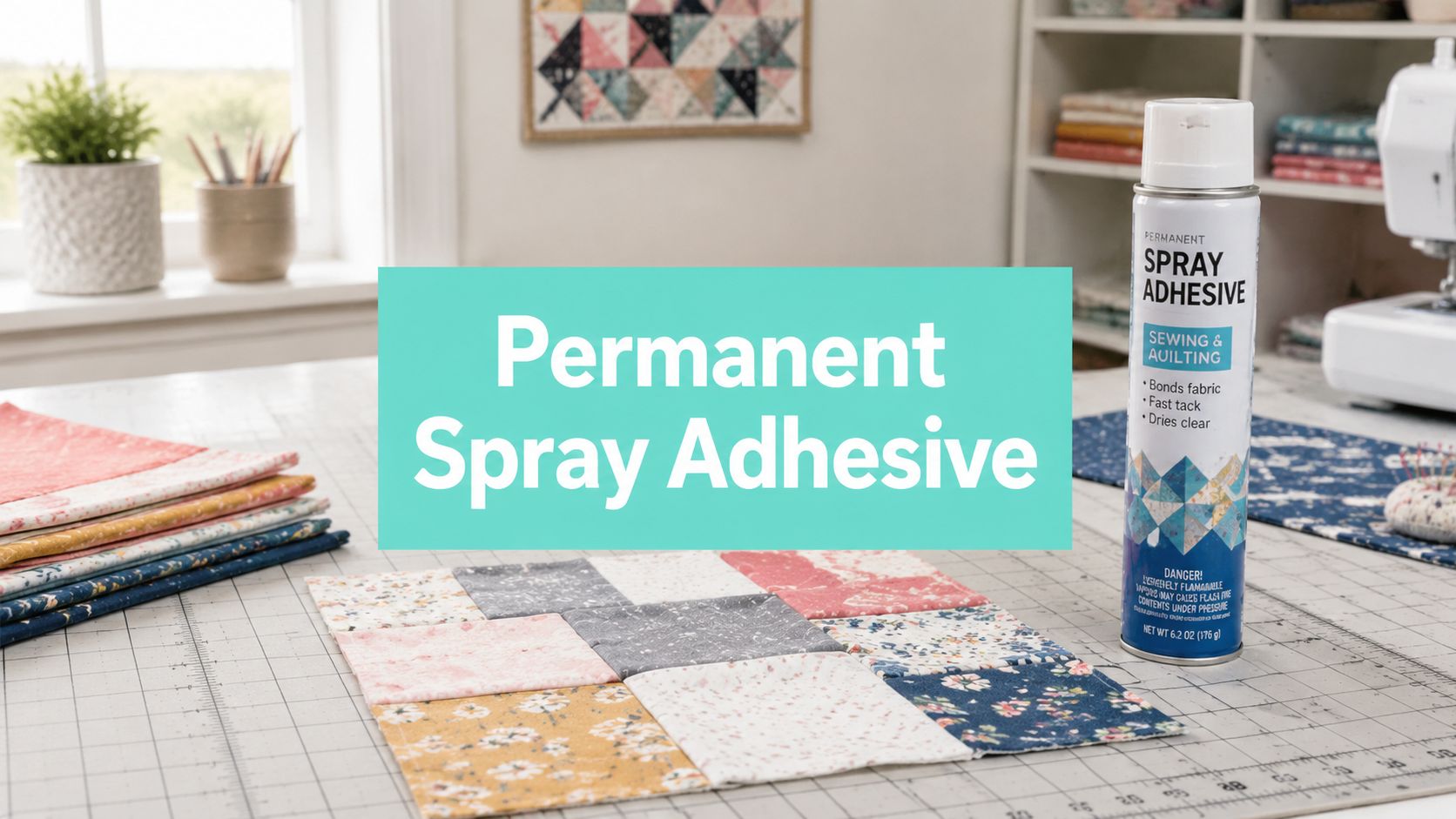
You've finished a beautiful quilt top, reached for spray adhesive, and now you're wondering whether “permanent” means it will survive washing, pressing, and years of handling. Permanent spray fabric adhesive creates a durable bond that isn't designed to wash out, while temporary spray is intended to hold layers only until the next stage of sewing or quilting. Choosing between them matters more than the word on the front of the can.
Understanding Permanent Spray Fabric Adhesive
A quilt can look perfectly basted on the table and still shift during transport. The backing creeps, the batting wrinkles, and the carefully aligned appliqué starts lifting at the edges. That's where the right adhesive can help, but only if you understand what the formula is meant to do.
Permanent spray fabric adhesive is a pressurized bonding mist formulated to create a durable, non-washable attachment between materials such as fabric, paper, and wood. Temporary sprays are generally selected when the layers need to separate or rinse away later. Product guidance distinguishes temporary sprays that wash out from permanent versions that don't, but “permanent” still doesn't mean every fabric, wash setting, or heat exposure is automatically safe. Wawak's spray glue guide describes this broader distinction and the use of spray adhesives across sewing and craft materials.
The adhesive works much like a contact bond. You spray the mating surfaces, allow a short flash-off period for solvents to evaporate and tack to develop, then bring the pieces together. The mist gives you fast positioning, which is useful for appliqué, reinforcement, and projects that need to stay aligned during handling.

Which quilting jobs need a permanent bond?
Permanent adhesive can make sense when the fabric element is intended to remain attached after stitching, such as:
- Appliqué positioning: It can hold an appliqué in place while you stitch around its edge.
- Reinforcement: It can stabilize selected fabric layers where movement would make sewing difficult.
- Decorative attachment: It may suit embellishments that aren't expected to be removed later.
- Transport support: It can reduce shifting when a prepared piece must be carried or mailed.
It isn't the automatic choice for every quilt baste. For a quilt being prepared for professional finishing, the adhesive must be compatible with the next process, the quilting machine, and the care instructions you'll give the finished piece. If you're still sorting out batting choices, our guide to what quilt batting does can help you separate the role of batting from the role of adhesive.
The spray adhesives category has expanded beyond niche industrial bonding. Market estimates place the broader spray adhesives market at about USD 3.45 billion in 2022, with projections ranging from USD 4.37 billion by 2031 at a 4.81% CAGR to USD 7.2 billion by 2032 at a 7.8% CAGR. Textile uses, including fabric bonding, lamination, and reinforcement, are explicitly included in that market analysis of the spray adhesives market.
How to Apply Permanent Spray Fabric Adhesive Correctly
A clean bond starts before you press the nozzle. Test the adhesive on a fabric scrap first, especially with plush surfaces, dark colors, delicate fibers, or a fabric that will later be pressed or laundered.
What should you do before spraying?
Work outdoors or in a well-ventilated workspace. Move away from candles, gas flames, heaters, hot irons, and other ignition sources, because some solvent-based spray adhesives are flammable.
Use this sequence:
- Prepare the workspace: Cover the surrounding surface and keep the fabric flat. Wear gloves and eye protection if the product label recommends them.
- Check the surfaces: Remove lint, dust, loose threads, and moisture. Adhesive can't compensate for a dirty or damp interface.
- Position the can: Hold it approximately 6 to 12 inches from the fabric. Quilting application guidance recommends this working distance and light, sweeping passes.
- Spray lightly: Move the can continuously rather than holding it over one spot. Heavy saturation can create stiffness, overspray, transfer, and a weaker interface.
- Work in sections: For a large quilt panel, handle manageable areas so the coverage stays even and the adhesive doesn't lose tack before you align the layers.
- Allow flash-off: The usable window varies by formula. Technical guidance describes open times from roughly 15 seconds to 15 minutes for one multipurpose spray and up to about 20 minutes for some textile-focused products. This technical application guide explains why joining too early can trap solvent, while waiting too long can reduce tack.
- Align and press: Bring the pieces together carefully, then smooth from the center outward. This helps prevent bubbles and wrinkles.
- Let the bond cure: Full strength is generally reached after 24 to 48 hours, depending on the product and conditions. Don't rush directly from spraying to washing or high heat.
Shop-floor rule: A light, even coat gives you more control than trying to make one heavy pass do all the work.
For quilt preparation, adhesive is only one part of a successful handoff. Before sending a project to a longarm quilter, follow the measurements, squaring, and packaging guidance in how to prep a quilt for mail-in longarm services.
Here's a visual walkthrough of the application sequence:

If you prefer to see the motion and fabric handling, this demonstration provides another way to review the technique:
Permanent Versus Temporary Fabric Adhesive Comparison
The most common mistake is treating “permanent” as a quality ranking. It's a use-case description. A temporary product may be the better choice when you need to baste a quilt, sew through the layers, and later remove the adhesive without leaving a long-term bond.
| Feature | Permanent spray adhesive | Temporary spray adhesive |
|---|---|---|
| Primary purpose | Durable attachment intended to remain | Short-term positioning or basting |
| Wash behavior | Designed not to wash out, but product limits still apply | Intended to wash out or release according to its label |
| Best fit | Appliqué, reinforcement, and lasting fabric attachment | Quilt basting, pattern placement, and temporary alignment |
| Timing | Requires flash-off and a full cure appropriate to the formula | Usually selected for a removable hold |
| Longarm consideration | May leave a lasting adhesive interface | Often preferable when the adhesive should not remain in the finished quilt |
| Main risk | Washing or heating before the bond has cured | Assuming temporary means unlimited handling or instant removal |
A quilt headed to a mail-in longarm service deserves special thought. Permanent adhesive may complicate later handling if it creates stiffness, residue, or a bond where the quilter needs the layers to move naturally. A temporary basting spray can be a more suitable choice for a quilt sandwich that needs to stay aligned only until stitching is complete.
That doesn't mean every temporary spray behaves identically. Read the label, test the fabric, and consider whether the project contains plush minky, loose weave cotton, batting with loft, or embellishments that could catch on a machine.
Washability also needs careful wording. Some products marketed as permanent list machine washing after a stated cure period, such as 24 hours or 48 hours, with wash-temperature limits such as 30°C or 40°C. Those instructions are product-specific, not a universal definition of permanent adhesive, as shown in this permanent spray product documentation.
For thread selection and stitch planning, keep the adhesive decision separate from thread weight. Our thread weight chart can help with that part of the workflow.
The useful question isn't “Is permanent stronger?” It's “Should this bond still be present after the quilt is finished and cared for?”
Safety and Ventilation Guidelines for Indoor Use
A home sewing room can feel harmless because the project is soft and familiar. The spray cloud is different. Solvent-based adhesive enters the air during application, and the exposure concern often comes from the airborne VOC cloud rather than only from the adhesive that lands on the fabric.
Independent exposure research measured airborne VOC concentrations of 240 to 938 mg/m3 without crosswinds and 161 to 522 mg/m3 with crosswinds during spray sealant use. The same research found fluoropolymer constituents near non-detectable levels in breathing-zone samples, which makes the practical takeaway more specific: controlling the solvent and VOC cloud matters. The indoor air quality guidance from Precision Air offers broader context for why airborne contaminants deserve attention indoors.
How can a home sewist improve airflow?
- Open windows: Create a path for fresh air to enter and contaminated air to leave.
- Use fans thoughtfully: Aim airflow away from your breathing zone, not directly across the wet adhesive toward your face.
- Work outdoors when possible: Outdoor application usually gives the spray cloud more room to disperse.
- Wear suitable protection: Follow the product label for mask, glove, and eye-protection recommendations. A basic face covering isn't automatically a VOC-rated respirator.
- Keep ignition sources away: Don't spray near flames, pilot lights, heating elements, or a hot iron.
- Store and discard carefully: Follow local rules for aerosol-can disposal, even when a can feels empty.
The room may still smell after spraying, but smell alone isn't a reliable measure of safety. Continue ventilating according to the product label and avoid settling in for a long sewing session while the air still feels contaminated.

Soft fabric can make the work feel especially pleasant, but plush textures can also encourage over-spraying because the mist disappears into the pile. Test first on a scrap of minky or Cuddle, keep the coat light, and don't assume a hidden wet layer is harmless.
For fabric-focused material choices that avoid unnecessary chemical treatment, you can also review non-toxic fabric dye considerations. Adhesive safety and dye safety are different topics, but both reward careful label reading and good airflow.
Troubleshooting Common Adhesive Mistakes
Most adhesive failures leave clues. The fabric feels board-like, the appliqué edge lifts, the quilt develops a faint mark, or layers slide after washing. Resist the urge to add more spray immediately. First identify whether the problem came from coverage, timing, surface compatibility, heat, or laundering.
Why does the fabric feel stiff?
Stiffness usually points to excessive adhesive or concentrated spraying in one area. Plush fabric can hide oversaturation until the adhesive dries, and a heavy coat may also increase transfer to tools or work surfaces.
Try this approach:
- Stop adding adhesive: Let the area dry fully before deciding whether it needs correction.
- Check a scrap: Compare the treated piece with an untreated sample from the same fabric.
- Use gentle handling: If the product allows it, light steaming may soften a stiff area, but don't apply heat before checking the label and the adhesive's thermal limits.
- Clean your tools: If residue reaches an iron or pressing surface, use a suitable cleaner such as iron soleplate cleaner rather than dragging adhesive across another quilt.
Why is the bond weak?
A weak bond often comes from joining too soon, waiting beyond the tack window, spraying from too far away, or applying too little to one of the mating surfaces. Contact-bond systems work best when both surfaces receive appropriate coverage and the solvent has had time to flash off.
Some technical guidance places full strength after 24 to 48 hours, while individual product sheets can specify different cure times. Don't use a general timetable as a substitute for the can's instructions.
Can adhesive cause discoloration?
It can. A conservation study of adhesive-containing quilting products found that the adhesive compound doesn't disappear over time. The study also warned that a spray that seems water-soluble early on may not retain that property indefinitely, and it identified a discoloration risk when a quilt isn't laundered soon after completion. The conservation study on adhesive-containing quilting products is particularly relevant to heirloom projects.
If the bond fails after laundering, don't assume the adhesive was defective. Heat, detergent, softener, water temperature, fabric texture, and incomplete cure can all affect the result. Record the product, fabric, cure time, and wash conditions for future testing.
Choosing the Right Adhesive for Your Quilting Project
Start with the finished object, not the can. Ask whether the layers need to separate later, whether the item will be washed, whether it will encounter pressing or tumble-dryer heat, and whether a professional longarm machine will handle it.
For a quilt going to our mail-in longarm service, temporary basting spray may be the safer workflow when the goal is alignment during quilting rather than a lasting adhesive layer. For appliqué or a permanent embellishment, a permanent formula may be appropriate, but test the exact fabric and follow the product's cure and laundering instructions.
Heat limits vary sharply between products. One technical sheet reports a SAFT rating of 66°C/150°F for a common multipurpose spray, while a higher-performing variant is rated at 110°C/230°F. Another adhesive spray datasheet lists temperature resistance up to 80°C and final strength after about 24 hours. The 3M technical data sheet shows why pressing and drying temperatures can't be treated as interchangeable across brands.
Fabric choice matters, too. Shannon Fabrics textures such as Hide, Snowy Owl, and Fawn have distinct pile and hand, so a light test application is more useful than assuming a formula will behave like it does on flat cotton. If you're looking for plush yardage, browse the Shannon Cuddle fabric collection and compare it with Luxe Cuddle textures.
On Pins & Needles Quilting Co. carries premium minky fabrics, selected notions, and mail-in edge-to-edge longarm quilting that includes batting, thread, and free return shipping. The shop also offers mail-in longarm quilting services, and its reputation is supported by hundreds of verified reviews. New customers can use the 15% first-order coupon, while U.S. orders over $70 qualify for free shipping.
Choose permanent spray fabric adhesive when you need lasting attachment, choose temporary spray when you need removable basting, and test before committing a full quilt. Then pair the adhesive decision with the right Shannon Cuddle texture and a finishing plan that respects cure time, heat, laundering, and ventilation.
On Pins & Needles Quilting Co. offers premium Shannon Cuddle and Luxe Cuddle fabrics, selected notions, and convenient mail-in longarm quilting for projects that need a polished finish. Visit On Pins & Needles Quilting Co. to choose your fabric, use the 15% first-order offer, or book your longarm service today.