

Simple Square Patchwork, Charm Pack Quilt, and the Minky Cuddle Quilt with Pillowcase Finish are the easiest starting points for confident beginners. The best choice depends on whether you want the simplest piecing, the least cutting, or a soft-fabric finish that feels gift-ready right away.
Quilting has been around since as far back as 3,400 BCE, and modern reference works have cataloged more than 4,000 pieced quilt block patterns, which is a good reminder that easy quilt patterns aren't a shortcut category. They're the foundation the whole craft was built on (quilt pattern history and block cataloging). That matters for beginners because the fastest first finish usually comes from choosing a pattern with fewer decision points, clearer yardage, and fabric that behaves the way you expect.
This roundup keeps the list practical. It matches ten approachable constructions to real beginner needs, including simple piecing, pre-cut convenience, strip work, scrap use, minky handling, backing width choices, and whether it makes sense to finish the project yourself or send it to OPN Quilting's Mail-in Longarm service.
We use easy quilt patterns every day around minky projects, gift sewing, and quilt finishing at OPN Quilting, so this list leans toward what gets completed. You'll also see where Shannon Fabrics textures such as Hide, Snowy Owl, and Fawn help, where they create extra bulk, and when a downloadable tutorial or pattern page is worth checking before you cut into fabric.
For the header image, use a product-only image from OPN's site, such as Luxe Cuddle yardage or a finished minky quilt kit image, with descriptive alt text.
Which Easy Quilt Pattern Gives the Fastest First Finish
1. Simple Square Patchwork
The Simple Square Patchwork is still the best first quilt because it teaches almost everything that matters without adding angled seams or layout stress. If your goal is to finish one project cleanly, I'd start there.
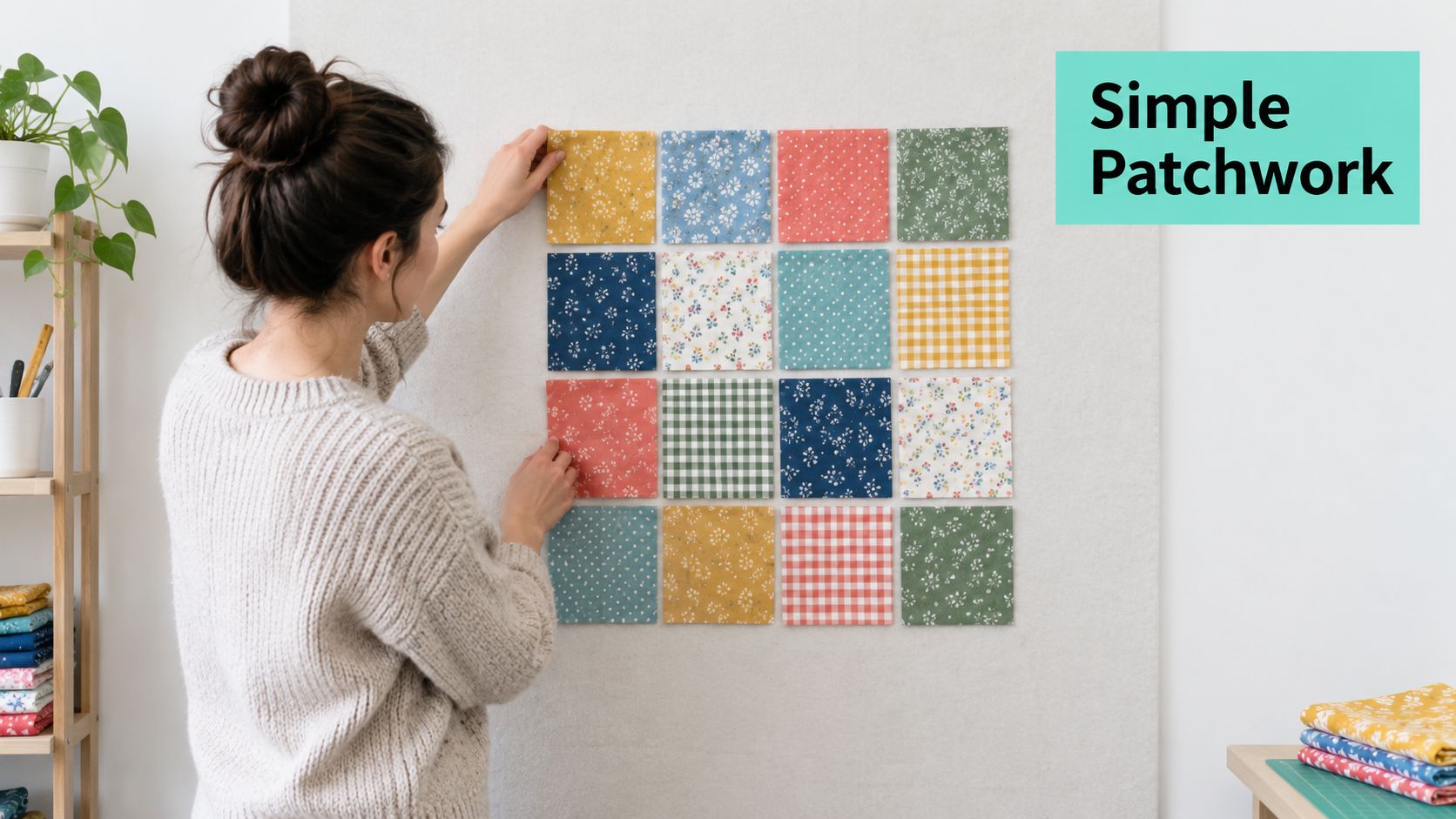 Alt text: A woman arranging colorful patterned fabric squares on a white design wall to create a patchwork quilt.
Squares forgive a lot. A row that's slightly lively usually still presses out well, and if you're pairing a simple top with soft backing like 44-45 inch Quilting Cuddle, the finished quilt still feels polished.
At OPN, we often see beginners pair this pattern with curated minky cuts when they want a crib quilt, throw, or couch blanket that feels plush without complicated piecing. Hide and Snowy Owl textures work especially well when the top itself is visually simple.
What makes square patchwork work so well
- Straight seams only: You're learning cutting, seam allowance, pressing, and row matching.
- Easy color testing: You can move squares around on a wall or floor before sewing.
- Flexible backing choices: Cotton, Quilting Cuddle, or extra-soft minky all work.
The one rule I wouldn't skip is seam allowance. The standard quilting seam allowance is 1/4 inch, and quilting references note that finished dimensions depend on it because cut sizes need to account for the seam line (1/4-inch seam guidance).
Practical rule: If your rows don't line up, check seam consistency before you blame your cutting.
For beginners who want softness without buying excess yardage, curated Cuddle cuts and bundles are a sensible pairing. They keep the fabric plan simple, especially on smaller throws.
Which Easy Quilt Pattern Builds Precision Without Feeling Hard
2. Half-Square Triangles
Half-square triangles are the first pattern I'd recommend after plain squares. They look more advanced than they are, but they do ask for cleaner trimming and more consistent pressing.
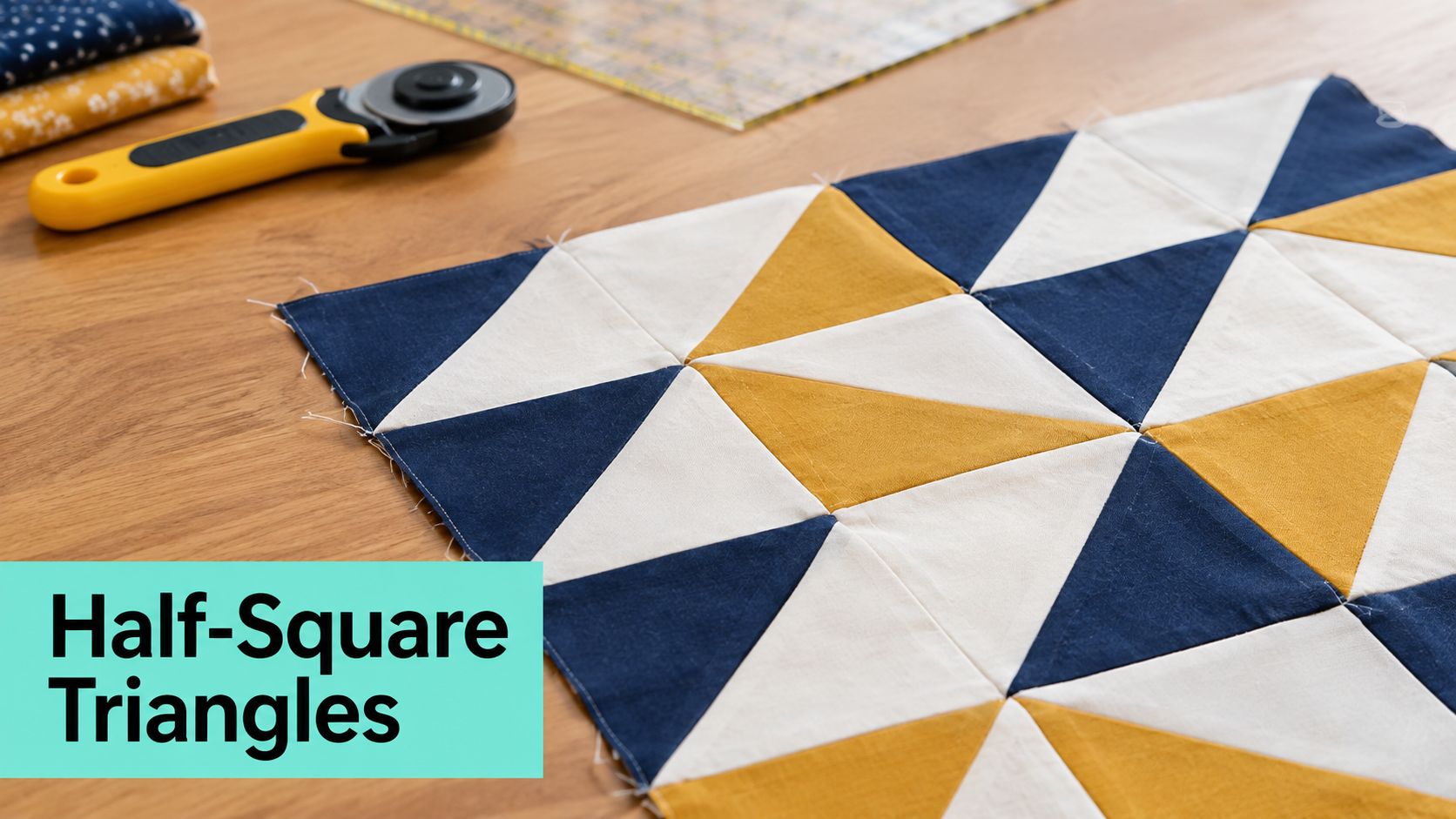 Alt text: A colorful geometric patchwork quilt block made of half-square triangles lying on a wooden table.
What I like about HSTs is that one unit gives you several looks. Pinwheels, zigzags, diamond chains, and hourglass-style effects all come from the same basic construction. That means you can practice one skill and still get a quilt that doesn't look repetitive.
If you're sewing with minky or Luxe Cuddle instead of quilting cotton, trim after sewing instead of trusting pre-cut accuracy. Stretch and nap can shift just enough to throw the block off. A 45-degree ruler guide helps if you're new to diagonal cuts and want cleaner, repeatable trimming.
Where beginners usually struggle
- Bias edges: Triangles can distort if you tug them.
- Bulk: Pressing direction matters more once points meet.
- Texture mix: Plush fabrics need more control at the machine.
HST quilts can be beautiful in Luxe Cuddle Fawn paired with a smoother contrast, but I wouldn't make a dense, tiny-unit HST quilt as a first minky project. Use larger units and fewer seams if softness is the priority.
Which Easy Quilt Pattern Cuts the Most Prep Work
3. Charm Pack Quilt
If cutting is the part you dread most, start with a charm-pack-style layout. This is one of the easiest quilt patterns for people who want momentum more than technical practice.
A charm-style quilt reduces decision fatigue. You spend your energy on arrangement, sewing rows, and pressing instead of measuring stacks of fabric. That's exactly why pre-planned, quick-start formats keep working for beginners.
Historical quilting also supports that preference for simplicity. During the Great Depression, quilting resurged as families reused scraps and worn textiles, and straightforward blocks such as the log cabin and nine-patch stayed practical because they could be taught and assembled quickly. By 1895, the Ladies Art Company had already published a catalog with more than 400 patterns, which shows how long accessible quilt publishing has supported home makers (American patchwork history and pattern publishing).
When a charm-style quilt is the right pick
- You want less measuring: Pre-cut logic keeps the process moving.
- You freeze up over fabric pairing: Coordinated bundles remove that hurdle.
- You want a gift quilt fast: Layout and assembly stay simple.
If you like that approach but want plush fabric, OPN's charm-pack guidance for quilts is a useful bridge. We often recommend pairing charm-style tops with Shannon Cuddle and Luxe Cuddle collections when softness matters more than intricate block work.
Which Easy Quilt Pattern Looks Dynamic With Basic Strip Sewing
4. Rail Fence
Rail Fence gives beginners one of the strongest effort-to-impact ratios in quilting. You sew strip sets, cut them into units, rotate the pieces, and the top starts showing motion right away. It feels active on the wall without asking for fussy block construction.
That matters when a first quilt needs to look intentional but still stay manageable at the machine. I recommend Rail Fence often because the construction teaches repeatable habits. Consistent seam allowances, careful pressing, and straight subcuts all matter here, but the pattern does not punish a new quilter the way tiny patchwork does.
It also suits fabric with visible texture. At OPN, we like Rail Fence for soft throws because color contrast and surface contrast both show up well in this layout. A smooth print beside a plush solid can carry plenty of visual interest without adding harder piecing.
The trade-off is bulk.
If you sew Rail Fence with minky or other lofty fabric, strip width matters. Wider strips are usually the better call because they feed more predictably and create fewer thick seam intersections. Very narrow rails can look sharp in cotton, but in plush fabric they tend to shift, stretch, and build up fast under the presser foot.
Why Rail Fence works well with plush fabric
- The piecing stays repetitive: Good for building confidence and chain sewing.
- Unit rotation does the design work: You get movement without learning advanced block assembly.
- The scale is flexible: It works for baby quilts, lap quilts, and larger throws with simple yardage math.
Backing choice deserves attention early with this pattern, especially if you plan to size up from a small throw to a bed quilt. Rail Fence expands so easily that beginners often finish the top first and only then realize the backing plan affects cost, seam placement, and handling. For larger plush quilts, we often guide customers toward 90-inch and 110-inch extra-wide minky backing options because fewer backing seams usually make quilting and finishing easier.
If you want layout help before cutting, Rail Fence quilt pattern ideas can help you compare straight-set, zigzag, and alternating rotations. That small planning step can save yardage mistakes and help you choose a version that fits your fabric texture and finishing plan.
Which Easy Quilt Pattern Introduces Curves Gently
5. Dresden Plate
Dresden Plate is one of the safest ways to try curves without sewing a full curved block. The petals are usually straight-seamed units, and the curve shows up in the overall shape and the applique center. For a beginner, that is a useful trade-off. You get a softer, more decorative look without committing to repeated curved piecing across the whole quilt.
Keep the first version large and simple. One oversized Dresden on a plain background is easier to cut, easier to balance, and much easier to finish than a quilt filled with smaller plates. I recommend that approach often at OPN Quilting, especially when the fabric has pile or stretch. Plush textures add bulk at the center, so a single focal plate avoids the thick buildup that can make pressing and quilting harder.
Yardage planning matters more here than many beginners expect. A large plate can be efficient with fat quarters or a small bundle of coordinated prints, but the background often takes more fabric than the petals. That catches people off guard. If you want to feature a panel, minky print, or a favorite novelty fabric in the center, plan that first, then size the petals around it so the proportions stay calm instead of crowded.
Keep the petals stable, and let the texture carry the visual interest.
A downloadable tutorial or template set helps with this pattern because consistent wedge cutting affects the whole plate. The sewing itself is not difficult. Matching the petal size from start to finish is the part that keeps the circle smooth.
This top also finishes well with edge-to-edge longarm quilting if you do not want to wrestle a larger quilt under a domestic machine. OPN's Mail-in Longarm quilting service is a practical option for that stage, especially when the center motif is clean and the background has enough open space for the quilting to read.
Which Easy Quilt Pattern Feels Like a Magic Trick
6. Disappearing Four Patch
This is the pattern that makes beginners feel clever. You sew a plain four-patch, cut it apart, rotate the pieces, and the result looks far more complex than the starting block.
That transformation is useful because it builds confidence without adding hard sewing. The piecing is still basic. The visual interest comes from cutting and rearranging.
For the best result, exaggerate contrast. Pair a smooth solid-look minky with a deeper texture or a darker shade so the cut lines stay visible after rearranging. Fawn with a more pronounced texture can work nicely here if you don't overcomplicate the palette.
What helps this pattern look crisp
- Label blocks before cutting: It prevents layout confusion.
- Press consistently: Mixed seam directions make the recut units harder to manage.
- Use a design wall: The reveal happens in the arrangement.
This is one of those easy quilt patterns that rewards patience more than speed. Rush the cutting, and the illusion gets muddy.
Which Easy Quilt Pattern Uses Scraps Best
7. Strips and String
If your fabric bin is already full of leftovers, Strips and String quilting is the most forgiving option on this list. It doesn't ask for perfect matching, and that's exactly why it works.
This style suits quilters who enjoy making choices as they go. It also handles mixed texture projects better than many block-based patterns because the visual language is already loose and pieced.
At OPN, we like this pattern for minky leftovers that are too small for a full backing but too nice to waste. Add them to cotton, flannel, or other soft fabric in a controlled scrappy layout and you can get a very tactile result.
Where this pattern shines
- Scrap management: Good for leftovers from bigger quilts.
- Beginner freedom: A crooked strip often just looks intentional.
- Gift projects: Small throws and pillows are especially forgiving.
A foundation helps. Paper or a stabilizing base keeps the block flatter while you're adding strips, which matters more once soft fabric enters the mix.
Which Easy Quilt Pattern Gives the Fastest Weekend Win
8. Jelly Roll Race
When a beginner wants a quick finish and doesn't care much about traditional block structure, Jelly Roll Race is a strong choice. It turns repetitive strip sewing into a fast top with very little layout stress.
This kind of speed-friendly pattern also aligns with how a lot of quilters shop and learn now. A quilting trends survey found that free quilt patterns and learning new tips and techniques were among the main reasons people visit quilting websites, and a separate report noted that 92% of respondents said quilting was taking about the same, a little more, or much more of their time than before the pandemic (quilting website and time-use trends). That points to a familiar reality. People still want to quilt regularly, but they want projects that are easy to understand and easy to start.
Best use cases for a Jelly Roll Race
- Group sewing days
- Quick gift quilts
- Beginners who hate fussy cutting
What a jelly roll is and how it works is worth a quick read if you're not already sewing with strip sets. If you're using plush fabric instead of cotton strips, keep seam bulk in mind and don't force very narrow joins.
Worth grabbing now: New customers can use OPN's first-order 15% coupon, and free U.S. shipping starts at orders over $70. That helps when you're building a beginner bundle with backing, thread, and a few coordinating cuts. OPN also has hundreds of verified reviews, which matters when you're choosing minky online.
Which Easy Quilt Pattern Works Best for Soft, Plush Finishes
9. Minky Cuddle Quilt With Pillowcase Finish
For a soft finish that still feels manageable on a first project, a Minky Cuddle Quilt with Pillowcase Finish is hard to beat. It keeps the construction simple and puts the focus where it belongs: fabric choice, controlled handling, and a clean turn-and-topstitch finish.
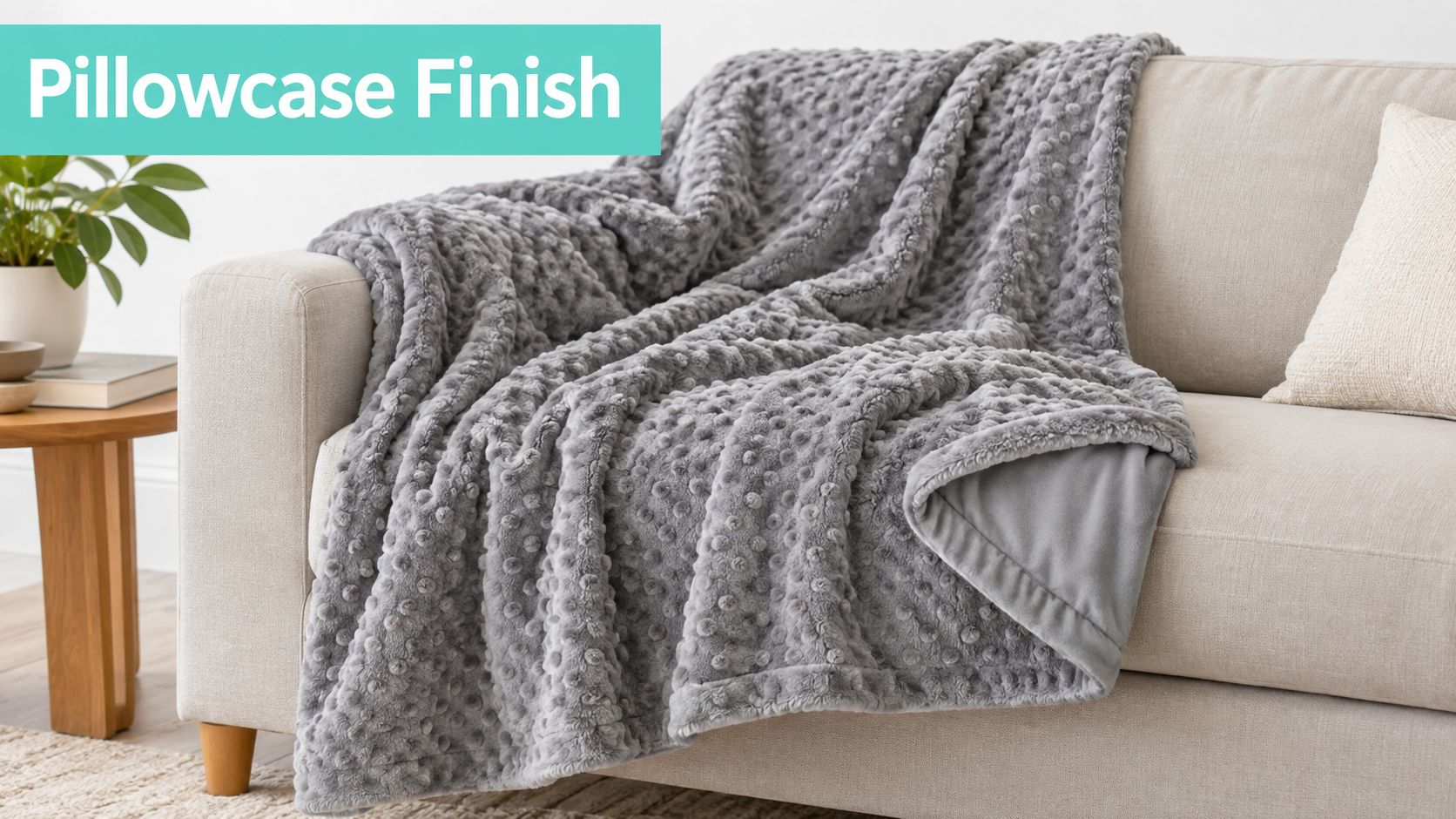 Alt text: A cozy grey plush textured throw blanket draped elegantly over a modern beige sofa in a living room.
With plush fabric, pattern complexity stops being the main issue. Fabric behavior takes over. Minky stretches on the bias, shifts under the presser foot, and builds bulk fast, so the easiest successful version usually uses large squares, wide strips, or a wholecloth or panel front. I steer beginners away from small units here, not because they cannot sew them, but because the seam buildup and nap movement make accuracy harder to hold.
The pillowcase method helps because it removes separate binding, which is often the part that frustrates new quilters working with thick or slippery fabrics. It also suits the drape people usually want from cuddle quilts. The trade-off is that turned edges need careful clipping, pressing by hand or with low heat precautions, and steady topstitching if you want the perimeter to lie flat.
What makes pillowcase finishing beginner-friendly
- No separate binding step: Less measuring, less bulk at the edge, and fewer chances for the minky to shift.
- Soft hand and rounded drape: A good fit for baby quilts, lap quilts, and couch throws.
- Simple construction choices: Texture does a lot of the visual work, so the pattern can stay basic.
If you want beginner guidance specific to this fabric type, how to make a minky baby blanket is a solid reference to check before cutting. We also recommend looking at Luxe Cuddle textures such as Hide, Snowy Owl, and Fawn when you want the top or backing to feel substantial without adding piecing complexity.
Yardage planning matters more than many beginners expect. A wider backing can remove a center seam, which makes the quilt easier to baste and more comfortable against the body. If I am helping someone choose between two beginner projects at OPN Quilting, that point often decides it. Fewer seams usually means less crawling fabric, less lint, and a smoother finish.
This is also one of the easier patterns to pair with downloadable tutorials or shop instructions because the construction steps are short and visual. If the top is simple but the fabric is plush, clear cutting notes and handling tips matter more than fancy diagrams. For quilters who want the softness of minky without wrestling the final quilting step at home, OPN finishing services can also make this pattern a more realistic choice.
Which Easy Quilt Pattern Gives Precision Without Perfect Cutting
10. Foundation Paper Piecing
Foundation Paper Piecing gives beginners a rare advantage. It builds accuracy into the process, even if your cutting is only reasonably straight.
The printed foundation controls shape, seam placement, and point alignment, so the sewing does more of the precision work. That makes FPP a practical choice for quilters who can keep a steady seam allowance but still struggle with corners that drift or pieces that come up a little undersized after trimming. At OPN Quilting, I see this appeal with beginners who want crisp stars or angular motifs without depending on perfect patch-to-patch matching.
It does come with trade-offs. You spend more time preparing templates, shortening stitch length, and removing paper at the end. Yardage planning also needs more care because many FPP patterns call for oversized fabric pieces, and that extra cutting margin adds up faster than beginners expect.
Fabric texture matters here more than in simple patchwork. Stable quilting cotton behaves well because it folds cleanly over the paper and stays flat while you stitch. Plush fabrics such as minky can work for a small accent, but the loft makes folding, pressing, and trimming less predictable. I would keep minky out of a first full FPP quilt and save it for the backing or for a mixed-technique project where the pieced area stays in cotton.
A planned visual can help clarify the process before the first seam:
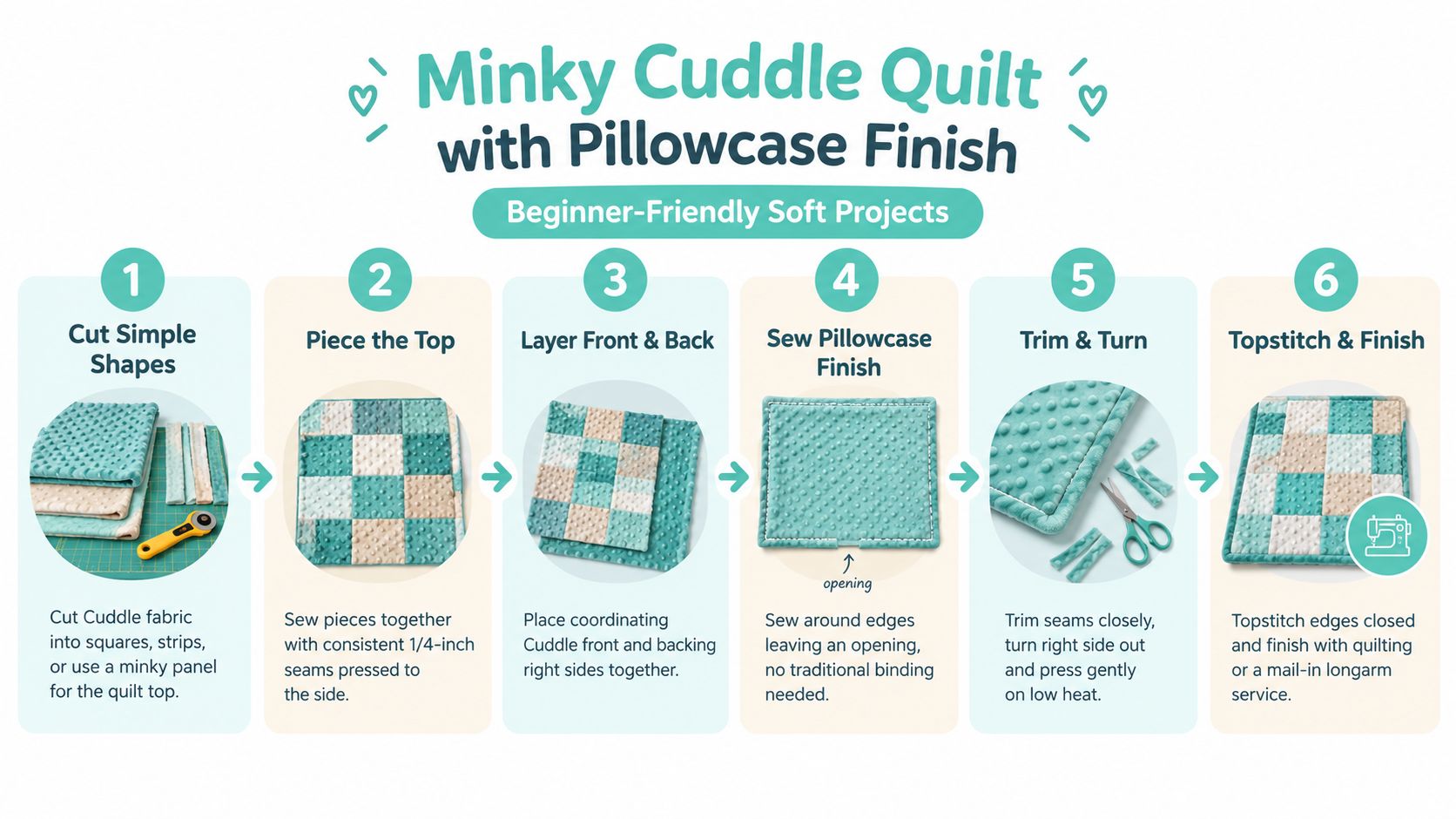 Alt text: A six-step infographic guide explaining how to make a minky cuddle quilt with a pillowcase finish.
Downloadable tutorials are especially useful with FPP because placement order matters more than in basic block construction. Clear diagrams, numbered sections, and trimming lines remove a lot of beginner frustration. If the goal is sharp results without mastering rotary accuracy first, this pattern type earns its place.
10 Easy Quilt Patterns, Quick Comparison
| Pattern | 🔄 Implementation Complexity | 📦 Resource Requirements | ⚡ Speed / Efficiency | 📊 Expected Outcomes (⭐) | 💡 Ideal Use Cases / Key Advantage |
|---|---|---|---|---|---|
| Simple Square Patchwork: The Foundation Pattern | Low, straight cuts & basic seams | Minimal: yardage, rotary cutter, 1/4" presser foot, machine | ⚡ Fast (8–12 hrs) | Clean, forgiving grid; ⭐⭐⭐⭐ | Great for absolute beginners, practice quilts, scalable projects |
| Half-Square Triangles (HSTs) | Medium, diagonal seams, bias handling | Standard tools + HST ruler, trim ruler, accurate cutting mat | ⚡ Moderate (12–16 hrs) | Dynamic, versatile blocks; ⭐⭐⭐⭐ | Builds precision skills, scrap use, many design variations |
| Charm Pack Quilt | Low, pre-cut, pre-coordinated squares | Charm packs (pre-cuts), backing & batting | ⚡ Very fast (6–10 hrs, no cutting) | Professional coordinated look; ⭐⭐⭐⭐ | Time-pressed beginners, reduces decision fatigue, gift-making |
| Rail Fence | Medium, strip-piecing + angled rotation | Strips/jelly rolls, strip-piecing ruler, rotary tools | ⚡ Moderate (10–14 hrs) | Strong geometric movement; ⭐⭐⭐⭐ | Geometric designs, ombre/gradient effects, strip-piecing practice |
| Dresden Plate | Medium–High, wedges/curves or paper templates | Templates or paper-piecing supplies, tearaway paper | ⚡ Slower (12–18 hrs) | Sophisticated, showy blocks; ⭐⭐⭐⭐ | Statement blocks, panel centers, beginners ready for curves |
| Disappearing Four Patch | Low–Medium, sew, cut, rearrange | Basic tools, careful labeling and cutting tools | ⚡ Moderate (8–12 hrs) | Complex-looking from simple start; ⭐⭐⭐⭐ | Confidence-building, creative rearrangement, two-color impact |
| Strips and String (Improv) | Low–Medium, foundation piecing, improvisational | Fabric scraps, foundation/tearaway paper, basic tools | ⚡ Moderate (10–14 hrs) | Unique, zero-waste aesthetic; ⭐⭐⭐ | Scrap-busting, eco-conscious, improvisational art quilts |
| Jelly Roll Race | Low, pre-cut strips, long-seam sewing | Jelly roll/pre-cut strips, long sewing allowances | ⚡ Very fast (6–8 hrs) | Bold diagonal movement quickly; ⭐⭐⭐⭐ | Group events, charity quilting, speed-piecing projects |
| Minky Cuddle Quilt with Pillowcase Finish | Low, simple piecing + pillowcase binding | Minky Cuddle cuts front/back, gentle pressing tools | ⚡ Fast (6–10 hrs) | Ultra-soft, luxurious feel; ⭐⭐⭐⭐ | Minky enthusiasts, baby gifts, beginners avoiding traditional binding |
| Foundation Paper Piecing (FPP) | Medium, follows numbered paper templates | Printer & paper, printed patterns, careful sewing | ⚡ Moderate (variable; paper removal adds time) | Extremely precise, intricate blocks; ⭐⭐⭐⭐⭐ | Achieving complex geometric/star designs with beginner-friendly accuracy |
Which Easy Quilt Pattern Will You Finish First
If you want the safest first finish, choose Simple Square Patchwork. If cutting is what slows you down, choose a Charm Pack Quilt or Jelly Roll Race. If you want visual movement with manageable sewing, Rail Fence and Half-Square Triangles are better picks.
If you're drawn to projects that feel more creative than technical, Disappearing Four Patch and Strips and String are hard to beat. They leave room for experimentation without demanding flawless precision at every seam. Dresden Plate works best when you want one decorative focal block rather than a whole quilt full of repeated complexity.
For soft-fabric sewing, the Minky Cuddle Quilt with Pillowcase Finish is the most practical beginner project in this list. It solves a real problem. Traditional beginner quilt guides often explain the top but not the finish, not the backing width, and not how plush fabric changes seam bulk and drape. With minky, those details matter just as much as block choice.
Before you cut, check three things every time:
- Finished size and yardage: Make sure the pattern's fabric plan matches the quilt size you want.
- Fabric width: Backing width affects whether you'll piece the back or use a one-piece option.
- Tutorial quality: Verify that any tutorial or downloadable pattern link is real, current, and complete before you rely on it.
That last point saves a lot of frustration. Beginners do best with instructions that show the full build, including piecing, pressing, backing, and finishing, not just a photo of the top.
If you're making a larger quilt top and plan to send it out, prep matters too. Longarm prep guidance says the quilt top, backing, and batting should be prepared separately rather than basted together, with loose threads clipped, the top squared, and backing left larger than the top. One source advises about 4 to 6 inches larger, while another recommends at least 6 to 8 inches extra in both directions (longarm prep guidance). That's especially helpful to know before you order backing.
At OPN Quilting, we connect that planning step to the finish every day. If you've pieced the top but don't want to wrestle with home quilting, Mail-in Longarm service includes batting, thread, and free return shipping, which makes the final stage much more manageable for beginner and big-project quilters alike. You can also shop fabric and finishing supplies in one place, from extra-wide backing to plush textures and pattern-friendly cuts, with the first-order 15% offer and free U.S. shipping on orders over $70 helping stretch the project budget.
The best easy quilt patterns aren't the ones that look simplest in a photo. They're the ones you'll finish because the piecing, yardage, texture, and backing plan all fit the way you want to sew. If that's your goal, start simple, verify the pattern details, and choose fabric widths that make the finish easier, not harder.
Book Your Longarm Service Today
If you're ready to turn one of these easy quilt patterns into a finished project, On Pins & Needles Quilting Co. offers Luxe Cuddle, Quilting Cuddle, extra-wide minky backing, curated cuts, and mail-in longarm quilting in one place. Visit On Pins & Needles Quilting Co. to pick your fabric, plan your backing, and get your quilt finished with less guesswork.