
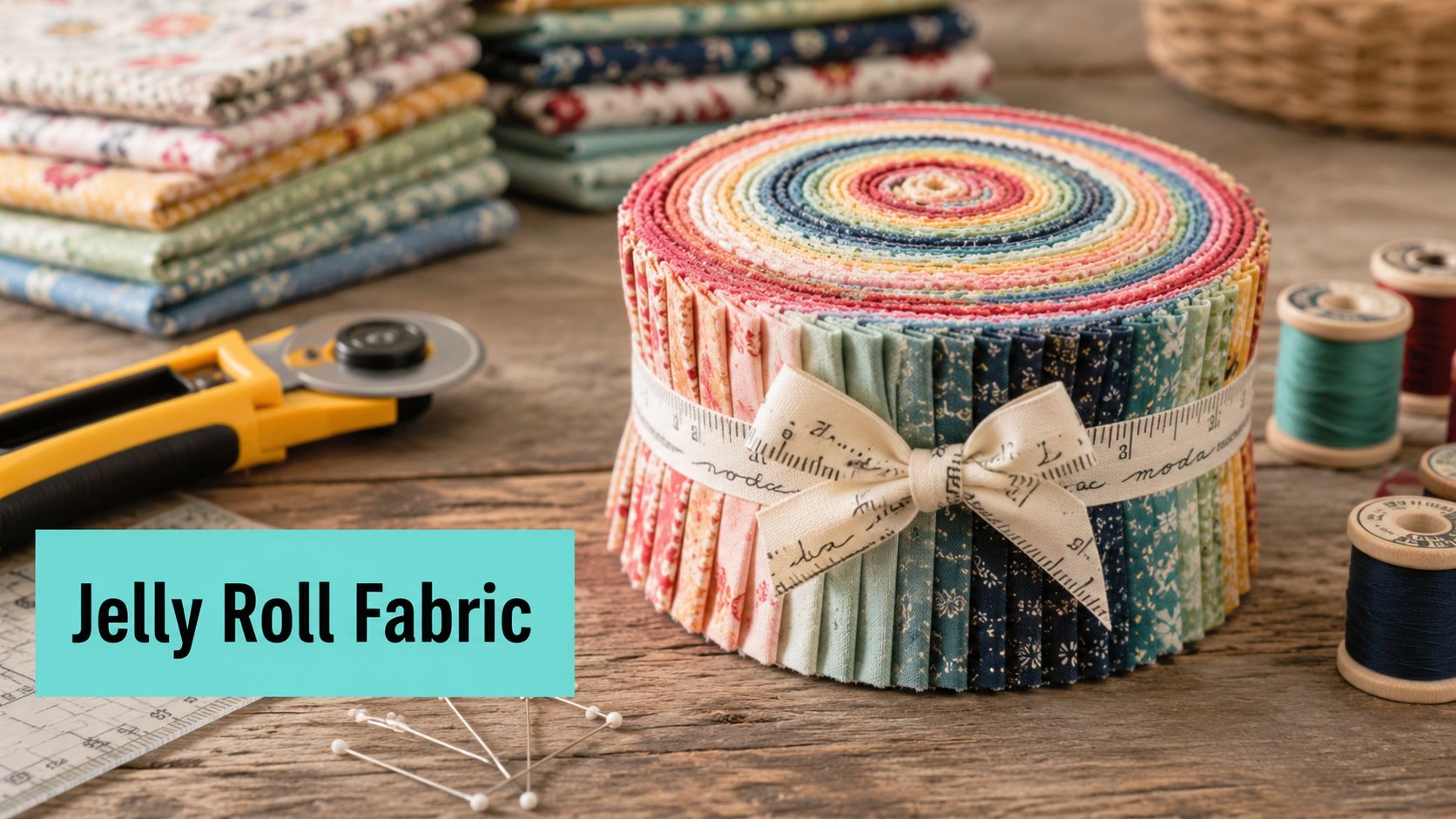
A jelly roll of fabric is a curated bundle of 2.5-inch-wide fabric strips, usually cut to about 42 to 45 inches across the width of fabric. A standard roll typically includes 40 to 42 strips, which is why quilters love it for fast, coordinated projects.
Most beginners hear that definition and still wonder what it means in real sewing terms. The useful question isn't only what is a jelly roll of fabric, but when it helps, when it limits you, and how it fits with soft finishes like Cuddle® and minky.
What Exactly Is a Jelly Roll of Fabric
Have you ever picked up a fabric bundle that looks like a bakery treat and wondered what you would do with it?
A jelly roll is a bundle of pre-cut fabric strips, rolled together and ready for strip-based quilting projects. Each strip is 2.5 inches wide and usually cut across the usable width of the fabric, so the length is often around 42 to 45 inches, as explained in The Quilt Show's jelly roll definition.

The name comes from the shape. Once those strips are wound into a coil, the bundle resembles a rolled pastry, so quilters started calling it a jelly roll and the name stuck.
At the shop, I usually explain jelly rolls as a head start. Instead of pulling yardage, measuring strip after strip, and hoping your prints play nicely together, you begin with a coordinated stack that is already cut for you. That is the main appeal. It saves time, but it also removes a lot of beginner guesswork.
A standard bundle often includes enough strips to give you a useful amount of fabric for repeated units, borders, and strip sets. The exact count can vary by manufacturer, which is why I always tell customers to check the label before choosing a pattern.
One point causes confusion fast. A jelly roll is not a specific fiber or finish. It is a cut size and bundle format. Most are quilting cotton, but the idea matters far beyond cotton quilting, especially if you love soft texture.
That matters here at OPN, because many quilters eventually ask a smart follow-up question: can this idea work with minky or Cuddle® fabrics? Sometimes yes, but not in exactly the same way. Plush fabrics have stretch, pile, and thickness, so they do not behave like crisp cotton strips. You can absolutely borrow jelly-roll-style design ideas for minky projects, but you need to plan for bulk, shifting, and the fact that very soft fabrics are usually better as accents, backs, or selected strip panels than as a full tightly pieced strip quilt.
If you are still learning the language of precuts, our guide to what a charm pack is in quilting helps clarify how these bundles differ and why size changes the kind of project you can make.
Here is the practical way to read a jelly roll pattern before you buy the bundle:
- Good fit: repeated strip units, simple patchwork, borders, jelly-roll-race layouts
- Less ideal: patterns that need large shapes, exact fussy cutting, or big uninterrupted fabric areas
- Extra caution with minky or Cuddle®: fewer seams usually work better, because plush fabric gets bulky fast
So if you want the clearest definition, a jelly roll is a pre-cut strip bundle. If you want the useful definition, it is a shortcut that works best when your project is built around long, repeated pieces, and it needs a little more thought when you want to bring premium plush fabrics into the mix.
How Does a Jelly Roll Compare to Other Fabric Precuts
A jelly roll makes sense once you compare it to the other precuts sitting beside it. The main difference is simple. Jelly rolls give you strips, while the others give you squares or larger rectangles.

Jelly Roll vs. Other Common Precuts
| Precut Name | Dimensions | Typical Use |
|---|---|---|
| Jelly Roll | 2.5 inches x width of fabric | Strip-pieced blocks, borders, binding-style applications |
| Charm Pack | 5 inches x 5 inches | Small patchwork, accents, quick scrappy layouts |
| Layer Cake | 10 inches x 10 inches | Larger blocks, simpler cutting, fast quilt tops |
| Fat Quarter Bundle | About 18 inches x 22 inches | Flexible cutting for mixed shapes, bags, appliqué |
The biggest strength of a jelly roll is speed in any design built around repeated strip units. You don't spend your cutting session measuring, trimming, and stacking. You start sewing.
When another precut is a better fit
A charm pack is handier when your pattern needs little squares and visual variety. A layer cake works better when you'd rather cut larger block pieces yourself and preserve more of the print.
Fat quarters are the most flexible of the group. They aren't as fast as a jelly roll for strip sewing, but they let you cut a much wider range of shapes.
- Choose a jelly roll if you want rhythm, speed, and a coordinated strip set.
- Choose charm packs if your project depends on small square patchwork.
- Choose a layer cake if you want fewer seams in larger pieced units.
- Choose fat quarters if you need versatility more than convenience.
If you're still fuzzy on square precuts, this overview of charm packs and Moda precuts is a useful companion read because it helps sort out where strip bundles stop being the best choice.
A lot of buying mistakes happen before the first stitch. Quilters don't pick the wrong fabric. They pick the wrong fabric format.
One more practical point. A jelly roll naturally pushes your design toward linear piecing. That's not bad at all, but it does shape the look of the finished quilt more than many beginners expect.
What Can You Make with a Jelly Roll
What turns a jelly roll from a pretty bundle into a useful one? The answer is simple. It shines in projects built around repeated strips, where the fabric is doing part of the planning for you before you sew the first seam.

The most natural jelly roll projects are quilts with strong strip structure. A jelly roll race quilt is the well-known starting point, but it is far from the only option. Rail fence blocks, stepped layouts, bargello-style movement, piano key borders, and simple strip-set patchwork all make good use of those long coordinated pieces. If you want a pattern that lets the strips do the heavy lifting, these rail fence quilt pattern ideas are a smart place to start.
Smaller projects work well too, especially when you want color variety without pulling yardage for every piece. Jelly rolls are useful for:
- Table runners with repeated strip sets or borders
- Pillow covers with offset, woven, or diagonal strip layouts
- Tote bags with pieced panels on the outside
- Baby quilts that need quick assembly and a coordinated look
One thing beginners often miss is that a jelly roll gives you a look as much as it gives you fabric. The finished project usually has a steady rhythm because the strips are all the same width. That can be beautiful, especially for modern quilts and nursery projects, but it also means some patterns will feel more linear than expected.
This is also the point where cotton-only advice usually falls short. A jelly roll can make the quilt top. It does not have to do every job in the project.
For the softest finish, I often suggest a cotton jelly roll top paired with a plush minky or Cuddle® backing. That combination makes practical sense. Cotton strips piece neatly on the front, while the backing brings the warmth, drape, and hand-feel people first notice upon using the quilt. Baby quilts, couch throws, and comfort gifts are where this pairing really earns its keep.
The top gives you the design. The backing gives you the experience.
If you want extra texture, plush fabrics can also appear in borders, binding accents, or simple feature panels, but they are usually easier to manage as backing than as narrow pieced strips. Minky has stretch and pile, so it behaves very differently from quilting cotton. That is one of the practical limitations many jelly roll guides skip, and it matters if you are planning a project with premium Cuddle® fabrics.
For projects that feel personal, custom image panels can also sit nicely inside a strip-pieced frame. A guide on making museum-quality fabric prints can help if you want to combine printed photos with jelly roll borders for memory quilts or gift projects.
If you're a visual learner, this walkthrough style is helpful before you cut into a new bundle:
At OPN, shoppers can get 15% off a first order, plus free U.S. shipping on orders over $70.
One pairing I recommend often is a busy strip-pieced top with a simple, ultra-soft backing. It keeps the front lively and lets the back feel calm and luxurious in use. Quilters who want that plush finish can browse Shannon Cuddle options, try a texture like Luxe Cuddle Hide, or choose extra-wide minky backing when they want softness without piecing the back.
How Much Fabric Is in a Jelly Roll and Can I Substitute It
Here's the part that saves people money and frustration. A jelly roll is convenient, but it isn't unlimited fabric.
Independent quilting guidance notes that a single jelly roll may only be enough for a roughly 45" x 60" quilt top, and larger projects may need more than one bundle, as explained by Quilting Daily. That's one of the most important realities beginners miss.
When a jelly roll is the wrong choice
A jelly roll usually isn't the best answer when your project needs large uninterrupted areas. Quilt backs are the clearest example.
A strip bundle creates a lot of seams, and seams are exactly what most quilters want to avoid on the back of a large quilt. If the goal is a smooth, soft backing with less piecing, wide backing fabric makes more sense than stitching together a stack of narrow strips.
- For large backs, choose wide yardage instead of strip bundles.
- For bags or garments, think about whether long strips match the pattern pieces.
- For highly directional prints, yardage often gives better control than precuts.
If you're planning size and backing together, this guide to calculating yardage for quilts helps you think through the whole project rather than just the top.
Can you substitute a jelly roll with yardage
Yes, and sometimes that's the best move. If you love a collection that doesn't come in strip form, you can cut your own strips from yardage.
The benefit is freedom. You choose exactly which prints to repeat, which ones to leave out, and how many strips to cut from each fabric.
The tradeoff is time and consistency. A commercial precut saves measuring and often gives you instant coordination. Cutting your own lets you customize, but it asks for more setup and more care.
If the pattern depends on strips but the collection you want doesn't come pre-cut, cutting your own is completely reasonable. Just treat accuracy like part of the project, not a prep chore.
This is also the point where backing decisions become clearer. If your top is already seam-heavy, many quilters prefer to keep the back simple with plush yardage such as 90-inch and 110-inch Cuddle backings.
How Should I Store and Prepare My Jelly Roll Strips
Jelly roll strips behave best when you handle them gently and keep them organized. The biggest surprise for beginners is that the strips can move more than expected while you're sewing.
According to Madam Sew's quilting guide, jelly roll strips are cut on the fabric's crosswise grain, so they can stretch more during handling and pressing. That's why careful pressing matters if you want accurate seam alignment and consistent block size.

Smart handling habits
I always tell newer quilters to think "guide, don't tug." If you pull strips through the machine or drag the iron across them aggressively, they can distort before you notice.
A few habits help a lot:
- Keep bundles tidy by leaving strips rolled or loosely grouped until you're ready to sew.
- Press, don't stretch so the strip stays true to shape.
- Work on a flat surface when matching seams in strip sets.
- Stack in sewing order once you've chosen your sequence, especially for repeating units.
Should you prewash jelly roll strips
Most quilters skip prewashing precuts because tiny cut pieces can fray, twist, and lose their crisp edges in the wash. If you're worried about texture or shrinkage, it's usually easier to test similar yardage than to wash the whole bundle.
Storage matters too. Keep strips out of direct sunlight, away from moisture, and in a way that prevents hard fold lines from setting in.
Buy your precuts from a shop that cuts and stores fabric carefully. Good prep starts before the bundle reaches your sewing table.
That same principle applies when the top is finished and ready for quilting. If you're sending it out for machine quilting, these longarm quilt prep tips are worth reading before you box it up. Shops with hundreds of verified reviews usually earn that trust by being consistent on both cutting and finishing.
For soft trims, bindings, and cozy add-ons, quilters also like keeping a few specialty textures on hand. Browsing options like Luxe Cuddle Snowy Owl or Luxe Cuddle Fawn can spark ideas for finishing touches.
Is a Jelly Roll the Right Choice for Your Next Project
If your pattern is built around strips, repeated units, or fast piecing, a jelly roll is often a smart buy. It saves cutting time, keeps fabrics coordinated, and lowers the barrier to getting started.
If your project needs large pieces, fewer seams, or a one-piece quilt back, a jelly roll may not be the best tool. That's especially true when softness is the main goal and you'd rather use plush yardage on the back than piece together narrow strips.
For many quilters, the best answer isn't choosing between precuts and specialty fabrics. It's combining them well. Use a jelly roll where strips help, then choose a soft backing or accent texture where comfort matters most. If you're also comparing options, this look at fat quarter bundles can help clarify when more flexible cuts are the better pick.
A good project starts with matching the fabric format to the job. That's the answer to what is a jelly roll of fabric.
If you're ready to turn a jelly roll idea into a soft, gift-worthy quilt, browse On Pins & Needles Quilting Co. for plush backings, specialty Cuddle®, and finishing support. You can shop the Luxe Cuddle Collection, explore Mail-in Longarm quilting, or get 15% off your first order while also qualifying for free U.S. shipping on orders over $70.