
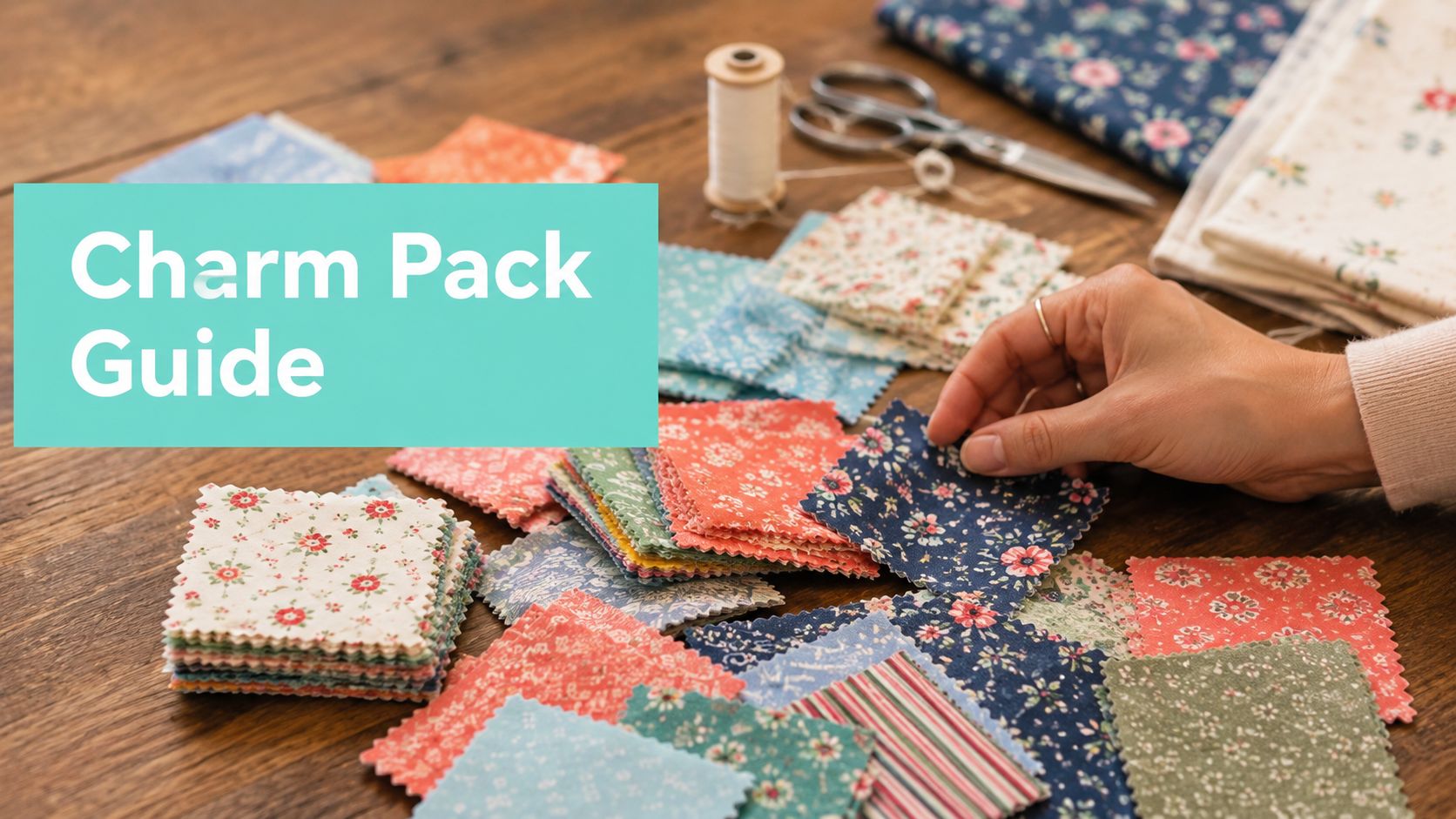
Charm packs for quilts make planning easier because you're buying a pre-cut, grid-ready bundle instead of starting from yardage and guessing at yield. If you want a fast answer, a standard charm pack is 42 squares of 5 inches by 5 inches, and that usually gets you to a small quilt top or a controlled-scrappy start, not a bed-size finish.
Charm Packs for Quilts With Yardage and Backing Guide
A charm pack feels simple in the hand, but the buying decision gets more precise once you know what it really produces. The questions are how many packs you need, how much background fabric you'll add, and whether your top deserves a soft backing like Shannon Cuddle or a full longarm finish.
The History and Allure of Charm Quilts
A charm quilt starts with a simple problem, and that problem is usually variety. Early quilters wanted every scrap to feel distinct, so finished tops often held hundreds of fabrics, and some historic examples reached up to 2,000 different fabrics in a single quilt (Antique Quilt History). That kind of mix gave the work a social side as well as a sewing side, because quilters traded scraps with friends and family to build enough unique pieces, which is why these quilts were also called Beggar Quilts.
The strongest historical runs came in the 1870s through about 1900, then the idea returned in the 1930s when fabric scarcity made scrap-based quilting practical again (Simple Simon and Company). That history still matters now because charm packs keep the same appeal, but they turn the search for variety into something you can buy ready to cut and sew.
Practical rule: charm quilt appeal comes from controlled variety, not random clutter. The best charm quilts still look intentional, even when the prints are all different.
A later revival tied to millennium-themed quilting pushed that same idea further, with makers choosing designs built around 2,000 different fabrics to echo the year 2000. The old goal was novelty through scrap gathering, and that mindset still shapes how many quilters approach charm-pack projects today.

For makers who keep project ideas, inventory, and production notes organized, Readymerce blog articles fit the same mindset as good quilt planning. That organization matters once you move past the history and start checking what a pack can produce, how the top will be laid out, and how the backing and finishing choices will affect the final quilt. You can also read more about precut fabric squares through this guide to charm pack basics, which helps connect the old scrap-driven idea to a modern buying decision.
What Are Charm Packs and How Were They Standardized
A charm pack is usually a bundle of 42 pre-cut squares measuring 5 inches by 5 inches (Simple Simon and Company). That count is practical, not decorative. Fabric lines often do not contain 42 unique prints, so repeats are added when needed. The result is a predictable bundle that still gives quilters enough variety to build a coherent quilt top.
For anyone buying fabric to sew, that standardization matters. You know what you are getting, how much cutting is already done, and how the bundle will behave once it is stitched into blocks.
How the cut changes after sewing
With a typical 1/4-inch seam allowance, each square finishes at 4.5 inches by 4.5 inches (Fibre Calcs). That loss in size is built into the system, which is why charm packs work for quilt planning. You do not size the layout from the cut square. You size it from the finished square.
A standard pack also functions like a yardage reference. One source says 42 charm squares equals roughly 5/8 yard (Modern Moon Quilt Studio), while another treats it as a little under 3/4 yard depending on packing variation (Fat Quarter Shop). Those figures are close enough to show the same thing. When you are comparing bundle pricing to yard cuts, think in 42-square bundles first, then convert only when the comparison is useful.

The fixed size also keeps layout planning straightforward. A 6 x 7 arrangement of finished 4.5-inch squares yields a quilt top of about 27 inches by 31.5 inches, while an 8 x 10 layout reaches about 36 inches by 45 inches. That kind of math is why charm packs are useful before you ever cut a border or choose a backing. A bundle that looks small in your hand can still produce a useful top once the block count is set.
If you want a broader look at precut fabric squares, this guide to precut fabric squares fits the same buying logic. It helps connect the bundle on the shelf to the quilt you can finish.
How Many Charm Packs Do You Need for Your Quilt Size
The fastest way to figure charm-pack needs is to work from the finished square size, not the cut size. For 5-inch charm squares, the finished square is 4.5 inches, so you divide your target quilt dimensions by 4.5 to get the count across and down, then multiply those counts for total squares (Sherri Quilts Alot). That method prevents the common mistake of buying by feel and hoping the math works itself out.
A concrete example shows why this matters. A quilt measuring 45 inches by 63 inches needs 140 charm squares, because that works out to 10 squares across and 14 rows down (Mavanell Studio). If you're using standard 42-square packs, that means you're buying for square count, then converting to pack count after the layout is set.
Pack count versus quilt size
- Small baby or table-size tops: one pack can work if you keep the layout compact and skip heavy borders.
- Crib or lap quilts: one pack is rarely enough unless you add generous background fabric or sashing.
- Longer rectangular quilts: the square count rises quickly, so the border plan matters as much as the block count.
A quilt can look big on paper and still finish small if the layout wastes space in seams, borders, or corner units.
The practical gap many buyers run into is thinking a charm pack equals a finished project. It doesn't. One pack is a fabric starting point, and the final size depends on whether you add sashing, borders, or background yardage. For a more detailed yardage walk-through, the shop's calculating yardage for quilts guide is a smart companion before you add items to cart.
When I price out projects for actual sewing, I always ask one question first, what will the finished edge look like? Straight pieced edges, sashing, and borders all change the math, and the border plan can turn a pack-driven mini into a usable gift.
Layout and Pattern Ideas for Charm Pack Quilts
The easiest charm-pack quilt is a straight grid. It uses every square as-is, keeps cutting to a minimum, and makes the math easy to verify before you sew. That's the layout I recommend when a beginner wants certainty more than design gymnastics.
Simple grid or controlled scrappy
A controlled-scrappy layout still uses variety, but it groups prints intentionally instead of tossing every square in at random. That approach keeps the quilt from looking noisy, and it's especially useful when you want a more polished gift without buying extra yardage.
A four-patch layout gives you more design flexibility because you can cut charm squares down and rebuild them into smaller units. That works well for makers who want a classic patchwork look without committing to a fully random mix. It also helps when you want to stretch one pack into more visual movement.
Which layout fits your skill level
- Straight grid: best for first-time charm pack quilts and quick gifts.
- Sashed layout: useful when you need the quilt to finish larger without adding too many more packs.
- Four-patch or mixed-unit design: better for quilters who want a more curated look and don't mind extra piecing.
The trade-off is waste versus control. Once you start trimming on-point units or cutting charm squares into smaller pieces, the design options increase, but so does the chance of offcuts and mismatched sizes. That's where the rail fence quilt patterns are helpful, because rail-style geometry is one of the simplest ways to build motion without losing the benefits of pre-cuts.
My rule at the cutting table: the more the layout depends on extra trimming, the more important it is to test one block before you commit the whole pack.
If you want the cleanest result with the least waste, choose a layout that lets the charm square stay a charm square. If you want the top to look more layered, plan for small background additions and a little more press-and-trim work.
Pairing Charm Packs with Minky Quilt Backing
A charm-pack top and a minky backing work well together when the scale feels balanced. The top gives you patchwork structure, while the backing brings softness and a cleaner hand on the finished quilt. The key decision is width, because backing width determines whether you can avoid seams entirely or need to piece the back.

Shannon Fabrics gives you several useful width choices, including 44-45 inch Quilting Cuddle, 80 inch Mirage, and extra-wide 90 inch and 110 inch options. A standard-width backing can work for smaller quilts, but wide-back options reduce seam management and make the quilt feel more finished. For queen and king projects, 110-inch minky is the cleanest route when you want to avoid a center seam.
| Backing width | Best use | Practical note |
|---|---|---|
| 44-45 inch Quilting Cuddle | Small quilts, wall pieces, baby projects | Usually needs piecing for anything wider |
| 80 inch Mirage | Mid-size quilts | Gives more coverage with fewer seams |
| 90 inch minky | Larger quilts | Good balance of width and flexibility |
| 110 inch minky | Queen and king backs | Helps eliminate seam lines on big beds |
Texture matters too. Hide, Snowy Owl, and Fawn are useful Luxe Cuddle-style choices when you want the back to feel coordinated instead of random. I like pairing calmer charm-pack tops with a backing texture that has enough visual interest to stand on its own, but not so much that it competes with the piecing.
For cut yardage, the shop's curated 2, 2.5, and 3-yard cuts make it easier to buy just enough for a backing test, pillow kit, or gift project without overcommitting. The how to choose quilt backing guide is the right stop when you're deciding whether to go wide-back or piece a back from yardage.
If you're ordering the top and backing together, check how the colors read in daylight, not just on screen. That simple habit saves a lot of mismatch later, especially when the top uses small prints and the backing is a single plush texture.
Finishing Your Quilt with OPN Longarm Services
A charm-pack quilt can look finished at the top stage, but longarm quilting is what gives it the structure it needs for regular use. Edge-to-edge quilting settles the small blocks, keeps the surface from feeling loose, and adds the stitching density that scrappy tops usually need. With a lot of tiny prints in play, that consistent finish matters more than many new quilters expect.

OPN's mail-in longarm quilting services include batting, thread, and free return shipping, so you are not chasing three separate finish-line supplies after the top is sewn. That is useful when the quilt top is ready and you want it returned as a finished piece instead of sitting around waiting for your machine time.
The pattern gallery covers modern, floral, juvenile, holiday, and nature motifs, which lets the quilting support the mood of the top instead of working against it. A geometric charm-pack quilt usually benefits from a design that adds motion without swallowing the piecing. On a busy scrappy top, the right edge-to-edge pattern can make the quilt read cleaner from a few feet away.
Good longarm prep saves time on both ends. Keep the top square, press the seams flat, and make sure the outer edges are stable before mailing it in.
[!NOTE] New customers can use a 15% first-order coupon, and free U.S. shipping applies on orders over $70. That makes it easier to combine backing fabric, kits, or finishing supplies in one order.
OPN also has hundreds of verified reviews, plus responsive phone and email support, which matters when you are mailing in a quilt you have already invested time in. If you want a closer look at the process before you send anything, the embedded walkthrough below shows how the service works in practice.
If you want to see the next step in more detail, the mail-in longarm quilting services with free shipping page gives a direct look at how the service fits a finished charm-pack top. It works especially well for quilts with lots of small-scale print movement, because the quilting ties all those pieces together into one finished surface.
Practical Tips for Beginners and Small Business Buyers
Beginners usually do best with one charm pack and a layout that keeps trimming to a minimum. That lowers the cost of the first try and makes the project easier to finish, even if the first top has a few uneven edges. If you want more body or dimension, add a curated background fabric instead of asking the pack to carry every part of the design.
For gift sewing, the safer route is a charm pack paired with a small backing order and a compact layout. A clean palette usually reads more polished than a pack scattered into a busy design. Keep the number of fabrics under control, and the finished piece looks intentional instead of crowded.
Small-business buyers have a different job. Inventory consistency matters more than inspiration, so dependable cuts, repeatable textures, and easy reordering matter when you are making minky blankets, scarves, or pillow kits for resale. If you sell those products, the social media roadmap for business owners helps keep product photos, launch timing, and posting habits organized.
A few buying habits pay off quickly.
- Buy with the finish in mind: choose a charm pack only after deciding whether the quilt needs borders, sashing, or a plush backing.
- Use the shipping threshold: if you are near $70, add backing, kits, or another useful cut so the order works harder.
- Take the first-order discount: the 15% coupon is better used on a larger order than wasted on a tiny one.
- Think in finished products: if you sell, do not just buy fabric, buy the pieces that become a finished item.
The strongest charm-pack buyers already know the end use. A baby gift, a table runner, a baby blanket, and a shop-ready sample all call for different backing choices, different quilt density, and different ordering habits. That is what turns charm packs into useful business tools instead of just pretty precuts.
On Pins & Needles Quilting Co. carries charm packs, Shannon Fabrics Cuddle, Luxe Cuddle, and mail-in longarm quilting for quilters who want the whole project handled cleanly from top to finish. If you are ready to turn your next charm packs for quilts project into a finished piece, visit On Pins & Needles Quilting Co. and choose the backing, kit, or longarm service that fits your quilt.