

You've found a dragon panel fabric with a scene too beautiful to cut apart, but you're unsure how to turn it into a finished quilt. A dragon panel is a digitally printed focal section designed to keep dragons, castles, and other fantasy artwork intact, making it a faster starting point for quilts, wall hangings, pillows, and coordinated projects.
What Is Dragon Panel Fabric and Why Quilters Love It
You unfold the fabric on your cutting table and immediately see the problem. The dragon's wings, scales, and surrounding elements already form a complete composition, so cutting randomly could remove the very details that made you buy it.
A dragon panel fabric is different from ordinary yardage because the artwork is printed as a planned, self-contained image. Instead of building a scene from many small pieces, you can frame the panel with borders, add coordinating fabrics, and let the original illustration remain the visual center.
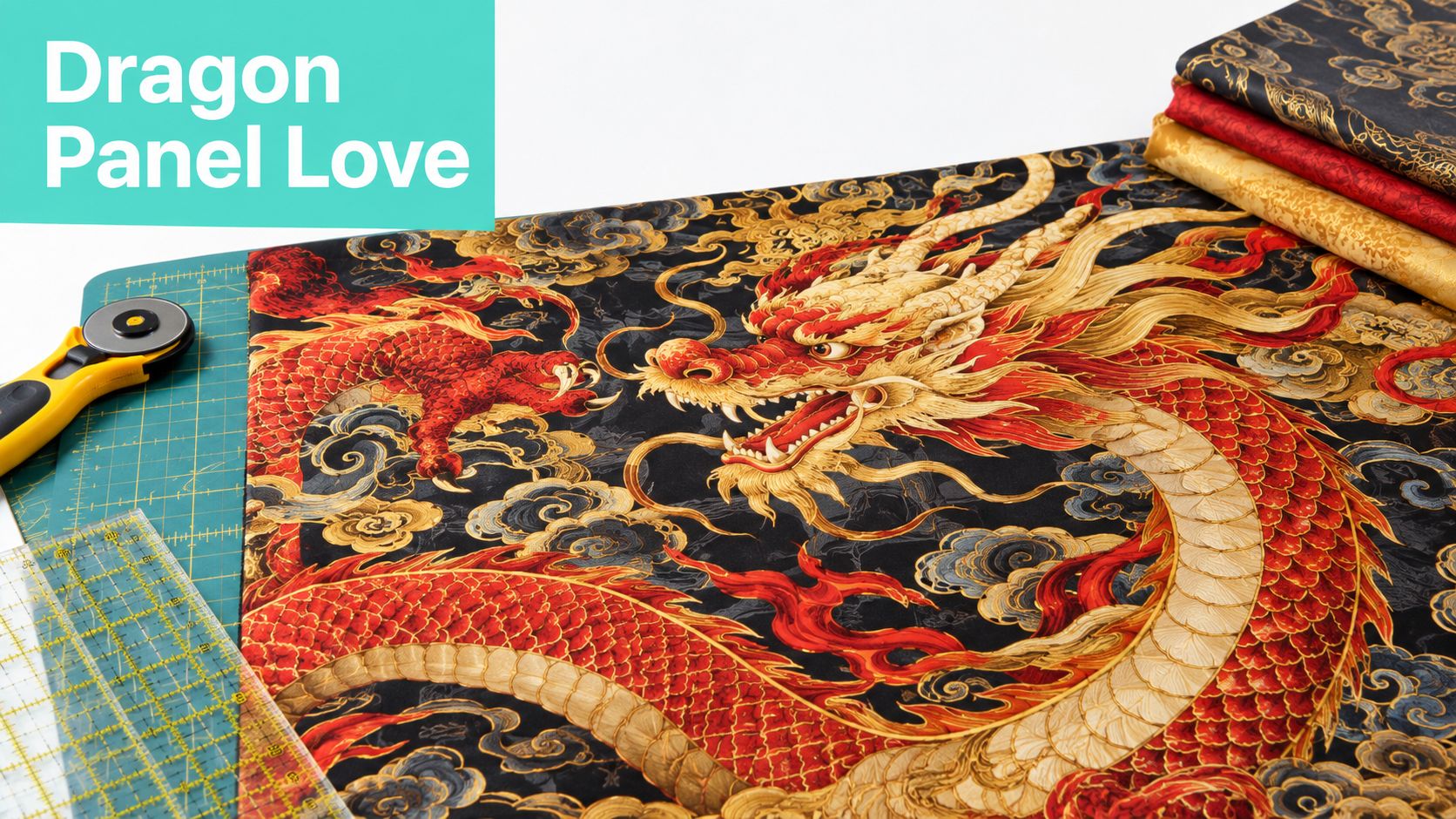
How does a panel differ from regular fabric
Traditional yardage gives you a repeating print or a broad collection of motifs. A panel gives you a specific layout, often with one dominant character, setting, or narrative scene. That distinction makes panels especially useful when you want a dramatic quilt center without drafting an image from separate blocks.
Digital printing also allows artists to place gradients, fine linework, atmospheric backgrounds, and layered color directly on the cloth. The result can resemble an illustrated storybook more closely than a conventional repeating quilting print.
Panel dimensions vary by collection, so always check the finished size before choosing borders or batting. If you're also making stuffed creatures, costumes, or soft accessories, this practical guide to how to pick fabric for toys can help you think through softness, stability, and handling.
Why does the motif carry so much visual weight
Dragon imagery has a long textile history. The Metropolitan Museum documents a coiled dragon used on princely robes as far back as the Tang dynasty, while a Jin-dynasty textile from 1115–1234 is described as an early example of a five-clawed dragon. Research on Chinese textile archives also notes that Qing dragon design remained regulated for more than 200 years, with changes in the head, mane, claws, body movement, and cloud placement helping identify its period (textile and costume archive research).
That history helps explain why modern dragon panels feel richer than novelty prints. The dragon often acts as the entire composition, not merely one small repeat.
We've handled many minky projects at OPN, and the same planning principle applies to panel quilts: preserve the focal art first, then choose soft fabric and quilt textures that support it. Our guide to minky fabric panels for quilting offers a useful companion when you're considering a plush panel or a soft backing.
How Are Dragon Panels Made and What Makes a Quality Print
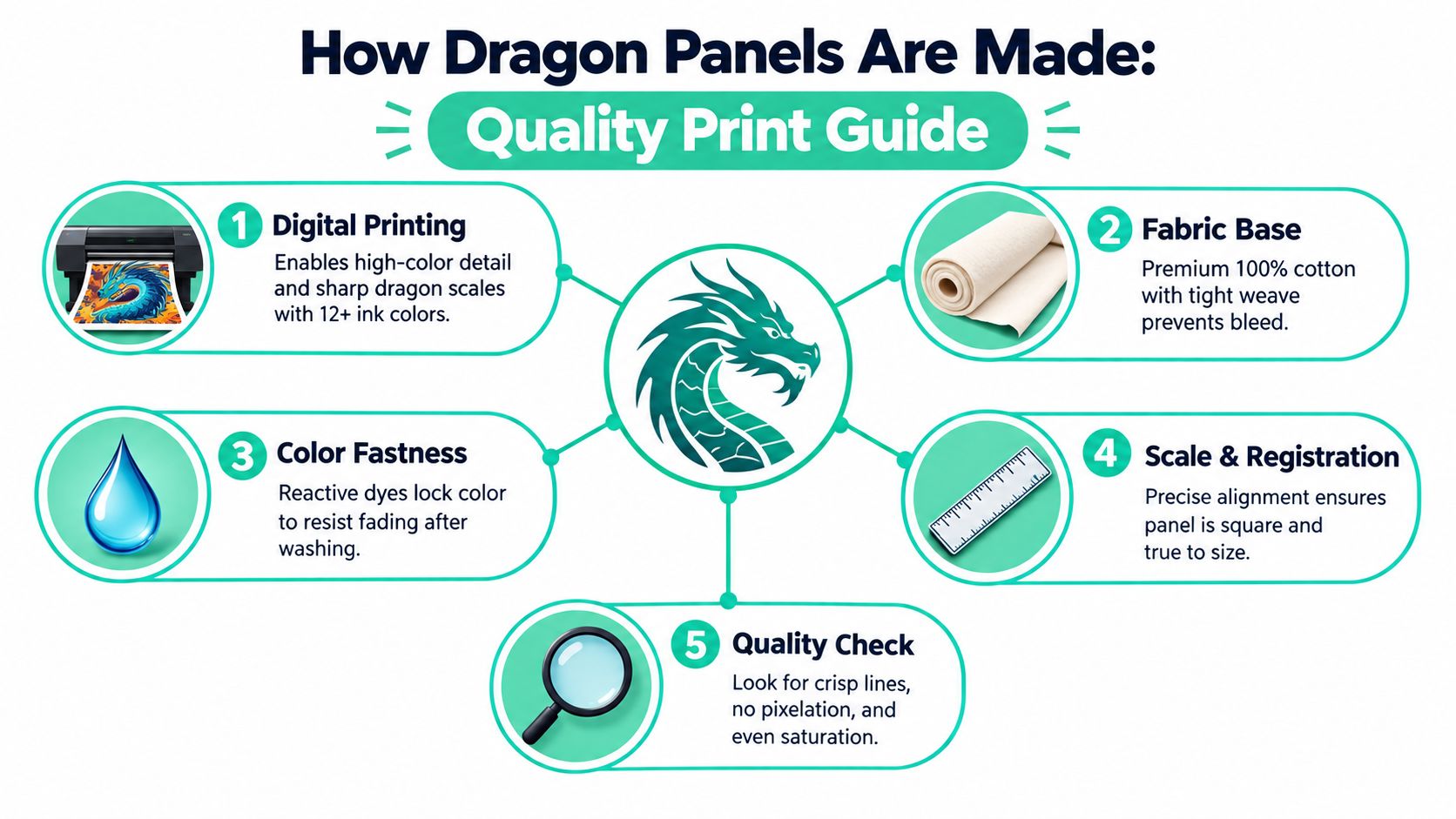
A good panel starts with artwork that can survive enlargement onto fabric. Digital printing is well suited to dragon illustrations because it can carry complex multicolor artwork, gradients, flame effects, tiny scales, and detailed backgrounds without the registration limits associated with screen printing.
Independent textile-printing guidance indicates that digital printing supports high-color designs without an extra color-count cost and performs well when artwork is supplied at approximately 150 dpi at print size (digital textile printing guidance). That resolution point matters because a low-resolution file can make scales, feathers, and fire edges look soft after printing.
What should you inspect before buying
Use the product photograph as a quality check rather than looking only at the subject. Zoom in on the dragon's face, claws, wing edges, and the smallest background details.
- Look for crisp edges: Scales and linework should appear defined rather than cloudy.
- Check the focal area: The eyes, horns, claws, and facial expression deserve particular attention because they carry character.
- Study color transitions: Flames, skies, smoke, and metallic effects should change smoothly instead of breaking into obvious bands.
- Confirm the fabric base: A tightly woven quilting base can make fine artwork easier to cut and sew accurately.
- Review the panel layout: Printed borders and scene edges should give you enough room to square the piece without cutting into the illustration.
Why did dragon styles change over time
Dragon imagery traveled through exchange networks beyond China. Textile history research records that the Chinese dragon motif entered European sartorial design during the Middle Ages under Pax Mongolica, while another study describes dragon imagery on imperial court garments by the end of the 7th century and identifies the dragon as the dominant emblem of rank from the Song dynasty onward (textile exchange and dragon imagery research).
Yuan-era textile research describes a shift from restrained, symmetrical dragons before the Yuan period toward more dramatic later forms, including gold coloration, enlarged claws, and fiercer expressions. That visual history gives today's panel designers a large vocabulary, from calm guardian dragons to theatrical fantasy creatures.
Before washing or backing a printed panel, review OPN's explanation of color fastness testing. A careful test is especially sensible when your project includes strong darks, saturated reds, or contrasting light areas.
What Sizes Do Dragon Panels Come In and How Do You Choose
The common finished formats described in panel listings range from approximately 24 inches by 44 inches to 36-inch panels (dragon fabric panel size guide). Those dimensions are not interchangeable in practice. A larger panel can carry more of a complete scene, while a smaller format may fit more naturally into a lap quilt or a block-based design.
The artwork is usually arranged to fit a single panel repeat. That means you're buying a preplanned focal unit rather than a strip of a repeating pattern, which can reduce piecing and keep the main dragon intact.
Which panel size fits your project
| Panel Size | Scene Detail | Best For | Piecing Tip |
|---|---|---|---|
| About 24" x 44" | Compact focal artwork | Lap quilts, small wall hangings, themed blocks | Add narrow or medium borders after carefully protecting the printed edges |
| Between 24" x 44" and 36" | Flexible scene scale | Throw quilts, pillows, bags, and framed textile art | Measure the finished panel before cutting companion fabrics |
| About 36" | Larger narrative composition | Quilt centers, statement wall hangings, and broad decorative pieces | Plan the surrounding borders and backing around the complete scene |
How should you plan borders
Start with the panel's actual cut size, not the advertised category. Selvages, printed margins, and squaring cuts can change the usable area, so place the fabric flat and measure before purchasing or cutting borders.
A dark border can make a bright dragon appear more dramatic, while a quiet tonal print can prevent the frame from competing with the artwork. For a soft finish, compare the panel with curated options in the Shannon Fabrics 2-yard Luxe Minky Cuddle Cuts collection, especially when your project needs a coordinated backing or plush accent.
Planning rule: Choose the quilting scale after you decide whether the dragon should read as a complete scene or as a collection of smaller motifs.
If the panel will become a block, preserve the dragon's face and major silhouette first. Decorative borders can be trimmed later, but a removed focal feature can't be restored.
What Creative Projects Use Dragon Panels Beyond the Quilt Center
A dragon panel doesn't have to become a traditional bed quilt. Its complete artwork can solve a different design problem in each project, especially when you want a bold result without piecing an elaborate image.
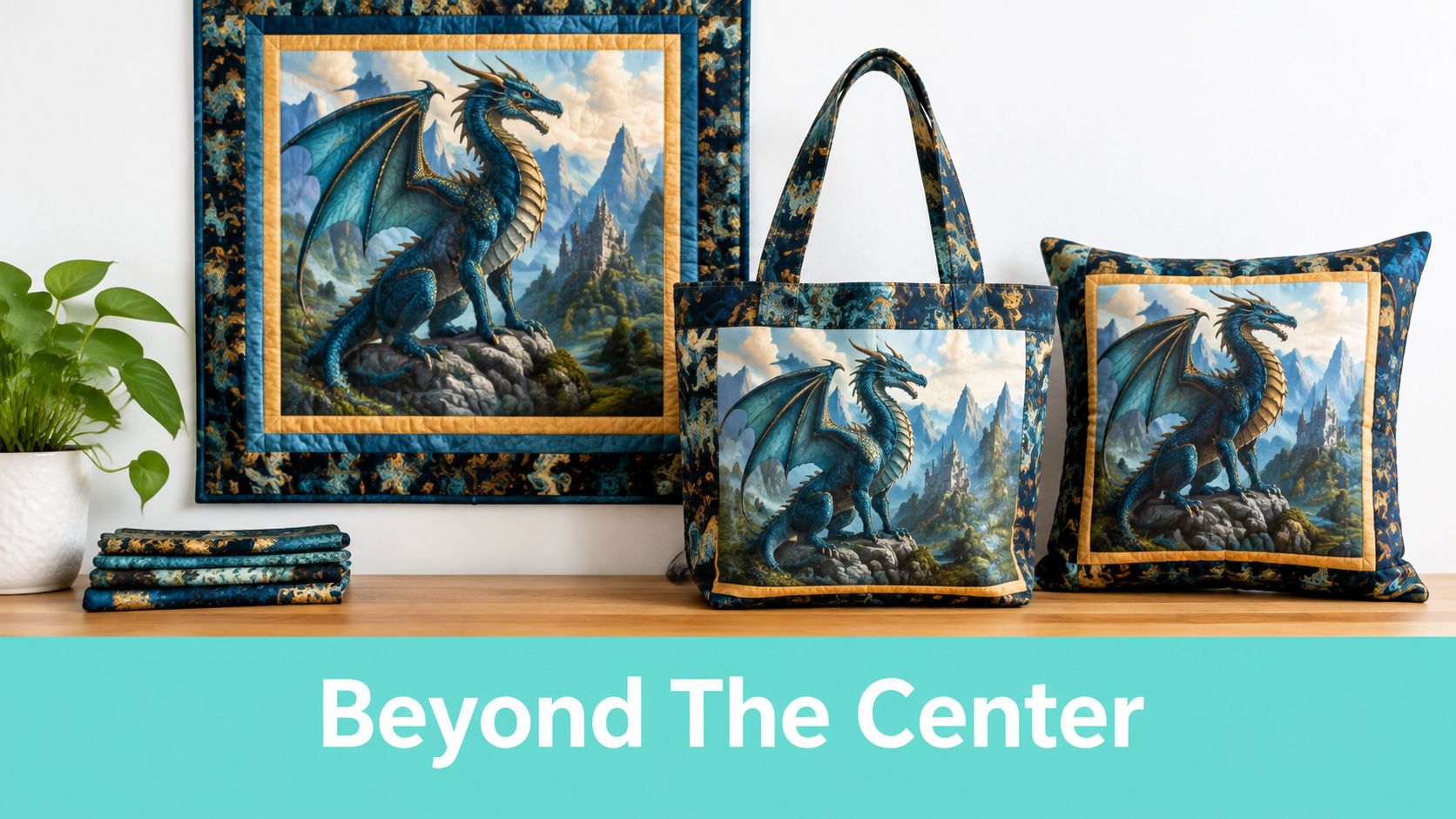
Which projects make the most of a complete scene
A quilt center is the obvious choice, but it isn't the only one. Add borders in a quiet coordinate and you'll have a strong centerpiece for a throw, reading blanket, or themed bedroom quilt.
A wall hanging works well when the panel's artwork deserves to be viewed vertically. Stabilize the top with suitable support, quilt around the dragon's outline, and finish the edges with binding or a sleeve designed for display.
Pillows are a practical option when you want the image close at hand. A panel can become the front, while soft minky on the reverse adds comfort and tactile contrast. Pay attention to seam allowances around faces, claws, and wing tips so the final pillow doesn't crop the important features.
Jackets, tote bags, and accessories let you use a panel as wearable or carryable art. For these projects, consider which portion of the illustration will appear on the back, front, pocket, or flap before you make the first cut.
How can companion prints turn one panel into a collection
Recent listings show dragon-themed materials appearing as panels, patch panels, blocks, and large digital scenes alongside companion prints (dragon collection listings). That mix suggests a useful planning approach: treat the panel as the anchor and use coordinates for borders, sashing, straps, pillow backs, or smaller blocks.
We've seen this collection mindset work particularly well for gift projects. One dragon panel can inspire a wall quilt, a cushion, and a matching accessory without forcing every item to use the full scene.
Here's a short visual reference for thinking about panel placement and finished objects:
For ready-to-build projects, browse OPN's minky pillow kits, which pair soft fabric choices with a project format that doesn't require you to design an entire quilt.
How Do You Sew and Finish a Dragon Panel Like a Pro
Panel sewing becomes much easier when you treat the printed image as a delicate layout that needs controlled preparation. Rushing the first cut is the fastest way to lose a border, crop a claw, or create a slightly skewed center that becomes more noticeable after quilting.
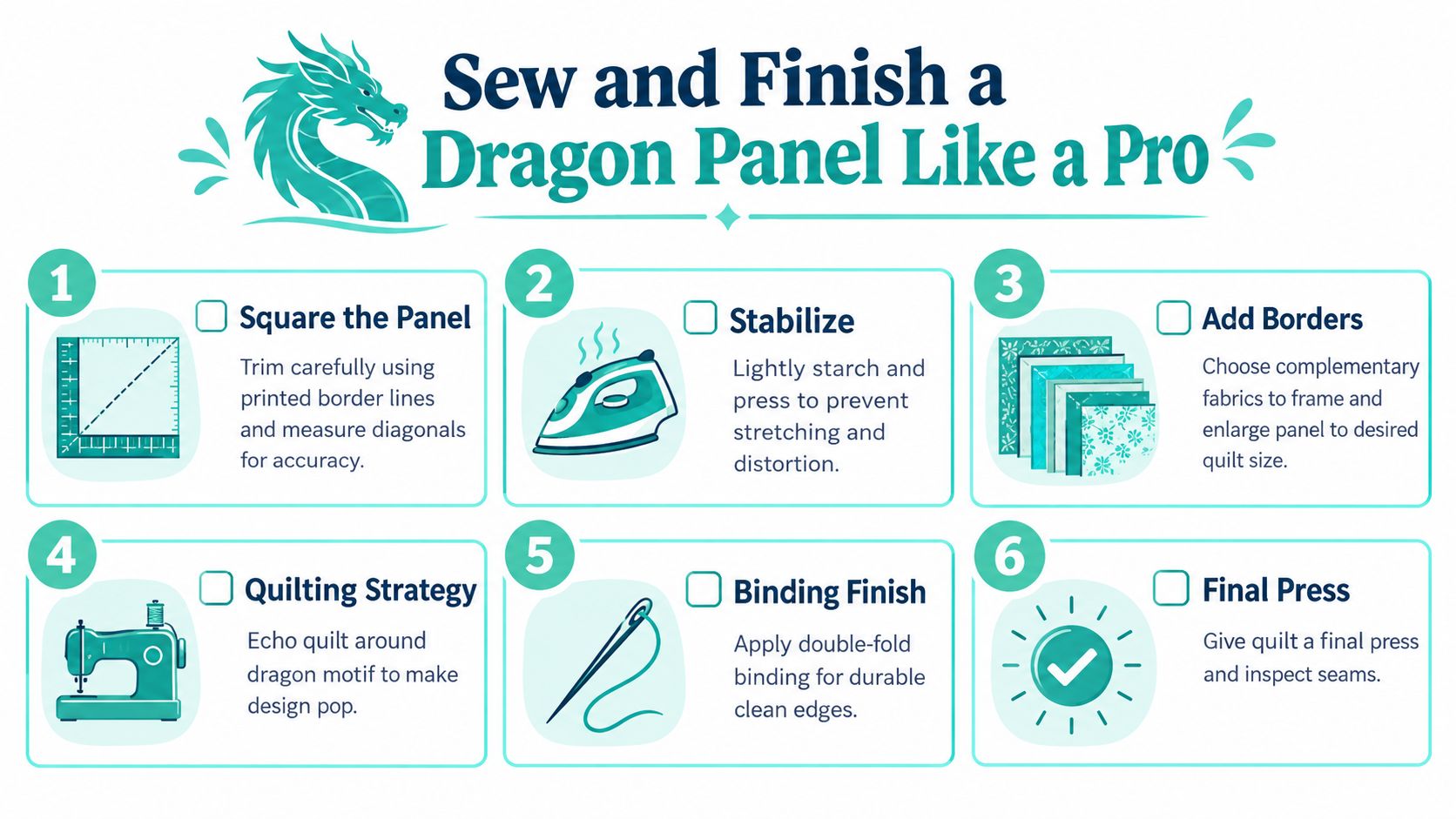
What steps keep the panel accurate
- Square the panel: Use the printed border lines as a guide, then check the diagonals before trimming away excess fabric.
- Stabilize gently: Press from the wrong side and use light starch only if the fabric needs help staying flat.
- Add borders with intention: Measure the panel after squaring it, then cut border strips to the panel's measured length rather than relying on an assumed size.
- Choose a quilting strategy: Echo quilting around the dragon can emphasize the silhouette, while simpler background quilting keeps a busy scene readable.
- Finish the edge: Double-fold binding gives a clean, durable perimeter for a wall quilt or throw.
- Inspect before the final press: Look for loose threads, open seams, distortion, and any area where quilting has pulled the artwork out of alignment.
Which Luxe Cuddle texture belongs on the back
Backing changes the personality of the finished quilt. Shannon Fabrics Luxe Cuddle Hide has a subtler embossed texture and can sit behind a busy top. Snowy Owl creates a fuller, more dramatic plush surface, and a separate product description identifies it as a textured Cuddle with an animal-hide effect. Fawn sits between those choices, with visible but gentler patterning (Shannon Fabrics texture guidance).
| Texture | Visual effect | Useful pairing |
|---|---|---|
| Hide | Subtle texture | Detailed dragon scenes and busy pieced borders |
| Snowy Owl | Dramatic, fuller plush surface | Statement throws and high-contrast fantasy tops |
| Fawn | Noticeable but gentler patterning | Versatile everyday quilts and gift projects |
If minky feels slippery under your presser foot, use a walking foot, reduce handling, and support the fabric on the table. OPN's guide to sewing with minky without it sliding covers the handling approach we use in our own projects.
Fabric choice matters: Let the dragon artwork lead. A textured backing should add touch and depth without creating a competing focal point.
Shop OPN's Luxe Cuddle Hide fabric for a quieter backing option, or choose Luxe Cuddle Snowy Owl when you want the reverse to make its own statement.
Receive 15% off your first order, and qualify for free U.S. shipping on orders over $70 when available through the shop's current offer.
How Do You Choose Backing and Prepare Your Dragon Quilt for Longarm
A dragon panel can fit neatly into the quilt top while still needing a carefully planned backing. The backing affects seam placement, softness, and how the finished artwork reads from the reverse. Standard quilting cotton provides about 42 inches of usable width after selvage removal, so a larger quilt often needs a pieced backing (quilt backing width calculator).
Wideback fabric is commonly sold at 108 inches wide, which lets many quilts use one continuous piece without a center seam (wide quilt backing fabrics). For oversized projects, 110-inch Cuddle cuts are marketed as backing material for king-sized quilts and large throws. Match the backing scale to the panel: a quiet, broad surface lets a detailed dragon scene remain the focal point.
Which backing route makes sense
Choose pieced cotton when the seam placement can become part of the design or when you already have suitable yardage. Choose a wideback when you want to avoid a seam, especially behind a large uninterrupted scene.
Extra-wide minky gives the quilt a soft reverse, but its stretch and pile require careful loading. Our longarm quilting guide explains why the backing must be larger than the top on every side, and covers preparation for minky-backed longarm quilting.
How do you prepare a mail-in longarm quilt
- Extend the backing: Allow 4 to 6 extra inches on all four sides for longarm loading, as outlined in the guide above.
- Skip home basting: Send the top, backing, and batting according to the service's preparation requirements instead of pinning them together at home.
- Mark the project clearly: Include quilt-specific intake details, including batting and thread preferences, so the quilting plan suits the panel and backing.
- Pack without crushing the texture: Fold plush backing with care and keep the package secure during shipment.
- Confirm return details: OPN's Mail-in Longarm service includes batting, thread, and free return shipping, giving panel makers a practical finishing route without owning a longarm machine.
Our longarm team sees the same preparation issues repeatedly. Accurate measurements before mailing are much easier than correcting an undersized backing after loading. Check the panel's finished size, decide whether the backing should be pieced or continuous, then add the required loading allowance before cutting.
Where Can You Find Dragon Panel Fabric and Coordinating Supplies at OPN
A successful dragon project usually needs more than the panel itself. Before checkout, make a short materials list of the focal fabric, border or companion print, backing, batting, binding, and any finishing service.
What should you add to your cart
Start with the panel or panel-style focal print, then look for coordinates that repeat one color from the dragon's body, fire, armor, wings, or background. A quiet coordinate often frames detailed artwork better than another large novelty print.
For soft projects, OPN carries Shannon Cuddle and Luxe Cuddle options, including textured choices such as Hide, Snowy Owl, and Fawn. The shop also offers curated 2-yard, 2.5-yard, and 3-yard cuts, strip bundles, pillow kits with forms, infinity scarf kits, and extra-wide backing options.
Use the Minky fabric collection when you're comparing plush yardage, panels, prints, and backing materials in one place. If your project needs a coordinated cut rather than a full bolt, review the curated fabric cuts before ordering.
Why source the full workflow together
Buying the backing and companion fabric at the same time lets you compare color, scale, and texture before cutting the panel. It also reduces the chance that a bold dragon center ends up paired with a backing that feels too thin, too busy, or too difficult to load for quilting.
For a finished quilt top that needs professional stitching, choose OPN's Mail-in Longarm service. The service is designed for edge-to-edge quilting and includes batting, thread, and free return shipping, subject to the provider's current terms.
The broader shift toward digitally printed fantasy materials makes dragon designs useful as collection systems rather than one-off novelty pieces. A panel can anchor a quilt, while coordinates support pillows, jackets, bags, and other gifts. That approach helps you buy with a project plan instead of collecting attractive fabric without knowing how the pieces will work together.
Check the current offer for 15% off your first order and free U.S. shipping on orders over $70. Then measure your panel, choose the backing width, and decide whether you'll finish it yourself or send it through Mail-in Longarm.
On Pins & Needles Quilting Co. offers dragon panel fabric options, Shannon Cuddle backing, curated cuts, project kits, and Mail-in Longarm finishing for a complete soft-quilt workflow. Visit On Pins & Needles Quilting Co. to choose your panel supplies, claim the available first-order offer, and book your longarm service today.