

A standard throw blanket size in the U.S. is 50 by 60 inches, but that number alone won't tell you whether the blanket will cover your lap, span a loveseat, or sit neatly across a bed. The right choice depends on your furniture, how you'll use the blanket, and whether you're making it from minky fabric.
You're probably comparing product listings that call several different cuts a “throw.” One looks perfect folded over a chair, another seems better for a movie-night couch blanket, and a third is labeled oversized without explaining what that means in a real room.
As a minky specialist at OPN Quilting, we approach throw blanket size from both directions. First, choose the finished dimensions that fit your furniture. Then, choose the minky width and yardage that can produce that size without an unnecessary center seam, awkward piecing, or a shortage at the cutting table.
What Throw Blanket Size Really Means
The standard U.S. throw blanket measures 50 by 60 inches, or about 127 by 152 centimeters, according to Casper's throw blanket size guide. This format is intended for sofa, chair, and lounging use rather than full bed coverage.
The first measurement is usually the width, and the second is the length. On a seated adult, a 50-inch width can stretch across the body and lap, while a 60-inch length can drape from the shoulders toward the shins or fold across the legs.
That sounds precise, but “throw blanket” describes an intended use more than a strict measurement. Retailers may use the term for compact accent pieces, standard couch blankets, or larger lounge blankets. The finished dimensions matter more than the category name.
Why the label can be misleading
A listing may show 50 by 60 inches, 50 by 54 inches, 60 by 60 inches, or 60 by 72 inches and call each one a throw. Those sizes don't behave alike on furniture.
- A narrower cut works well folded over a chair arm or placed at the foot of a bed.
- A standard cut gives one seated adult comfortable lap and leg coverage.
- A wider or longer cut creates more useful drape on a sectional, chaise, or larger sofa.
Bed blankets sit in a different scale. A twin blanket is listed at 66 by 90 inches, a full or queen at 90 by 90 inches, and a king at 108 by 90 inches, as shown in this blanket size comparison. That gap explains why throws are generally accents or personal lounging blankets, not replacements for primary bed blankets.
For practical shopping, sort your options into three tiers: lap, standard, and oversized. Then ask where the blanket will live, how much body coverage you want, and whether you're buying finished goods or minky yardage for a handmade project.
Practical rule: Choose the finished size first. Buy fabric second.
Standard Throw Sizes You Will See Online
Throw sizes make more sense when you group them by the problem they solve. A compact lap throw is easy to fold and move, a standard throw balances coverage with portability, and an oversized throw adds the length needed for taller users or shared seating.
The most common reference point remains 50 by 60 inches, but broader size guides describe throws as a range from about 40 by 50 inches to 60 by 80 inches. Mattress Nut's throw blanket guide also distinguishes a 40 by 50-inch lap or travel throw, a 50 by 60-inch standard throw, and a 60 by 80-inch oversized throw.
| Tier | Dimensions (inches) | Dimensions (cm) | Primary Use |
|---|---|---|---|
| Lap | About 40 by 50 | About 102 by 127 | Chair, lap, travel, or foot-of-bed accent |
| Standard | 50 by 60 | About 127 by 152 | One-person couch lounging and decorative draping |
| Oversized | About 60 by 80 | About 152 by 203 | Taller users, shared lounging, sectional or bed layering |
How each tier behaves
A lap throw around 40 by 50 inches is compact enough for a reading chair or a small accent at the end of a bed. It's a practical choice when the blanket needs to look tidy rather than cover an entire seated body.
A 50 by 60-inch standard throw is the familiar sofa size. It can wrap around one person, fold across a lap, or hang over the back of a couch without the bulk of a bed blanket.
An oversized throw from roughly 54 by 72 inches to 60 by 80 inches gives taller adults more length and provides greater coverage across a sectional or shared couch. Some retailers use “oversized throw” for even larger dimensions, so check the finished measurements instead of relying on the label.
International listings may use centimeters. Seating-area guides commonly describe throws at roughly 130 to 180 centimeters wide by 150 to 200 centimeters long, which maps broadly to about 50 to 70 inches by 60 to 80 inches, as summarized by SizeFit's blanket size chart.
Baby throws, stroller blankets, and lovey sizes can appear beside adult throws in search results. Those products serve different purposes, so check the dimensions before comparing price, fabric, or construction.
For furniture planning, a space-saving furniture measurements guide can help you verify the usable width and depth of compact seating before choosing a blanket. For the familiar standard format, OPN's guide to 50 by 60 blanket sizing translates the measurement into a minky project context.
Matching Throw Size to Couch Chair and Bed Use
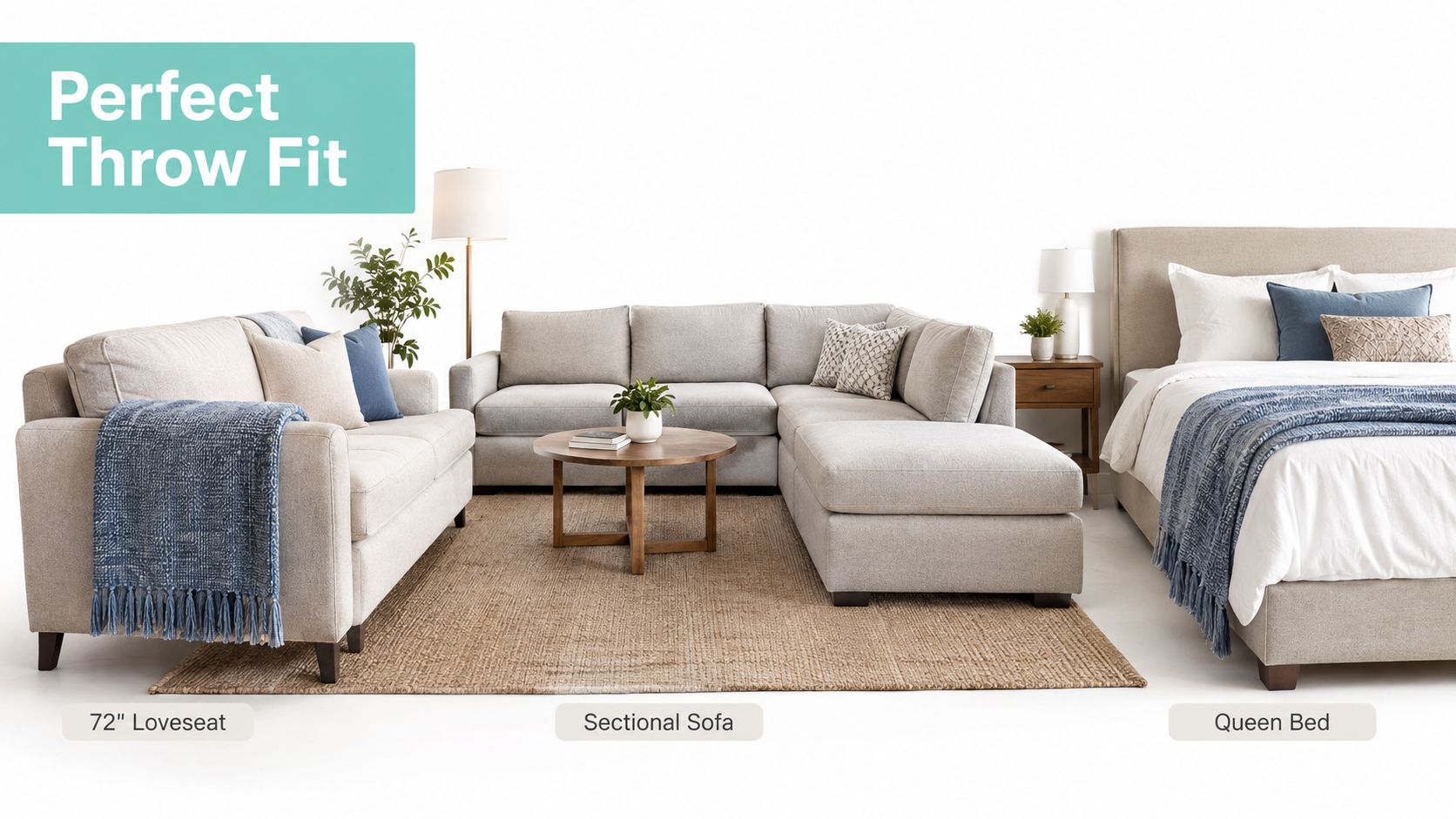
Furniture changes how a throw looks and functions. A 50 by 60-inch blanket may feel generous in a chair, adequate on a loveseat, and noticeably small on a wide sofa.
What happens on different seating
On a 72-inch sofa, a 50-inch-wide throw won't span the full seating area. Folded over one arm, it can cover the nearest sitter while leaving the opposite cushion exposed. That isn't a sizing mistake. It's the normal behavior of a personal throw on a wider sofa.
On a 60-inch loveseat, the same 50-inch width can cross both sitters' laps when positioned horizontally. The length still won't hang from the back to the floor, but it can provide shared lower-body coverage without feeling like a bed blanket.
A 60 by 72-inch throw changes the experience on a sectional. Its additional length can extend across a chaise, while the extra width gives more room for shoulders, legs, or a second person. Depending on the fabric's drape, the lower edge may pool lightly near the floor.
For a single armchair, a lap-sized throw may be enough. A standard throw gives more shoulder-to-shin coverage, especially when the chair has a deep seat or the user likes to pull fabric around the sides.
How a throw behaves on a queen bed
A 50 by 60-inch throw placed across the foot of a queen bed acts as a decorative layer. It covers part of the mattress rather than reaching across the full bed surface, which keeps the bedding arrangement visually light.
A 60 by 80-inch oversized throw spans more of the queen bed's width and leaves additional fabric for a soft fold or partial tuck. It still isn't the same as a full or queen bed blanket, whose listed dimensions are much larger, but it can create a substantial top layer.
Measure the furniture's usable span, not just the room. A broad sofa arm, deep chaise, or thick mattress changes the amount of fabric that disappears over edges.
Sizing check: If you want the blanket to stay on one person, choose by body coverage. If you want it to visually connect two seating zones, choose by furniture width.
For more examples involving soft blanket construction and finished dimensions, see OPN's guide to Minky Couture blanket sizes.
Decorative Versus Functional Throws
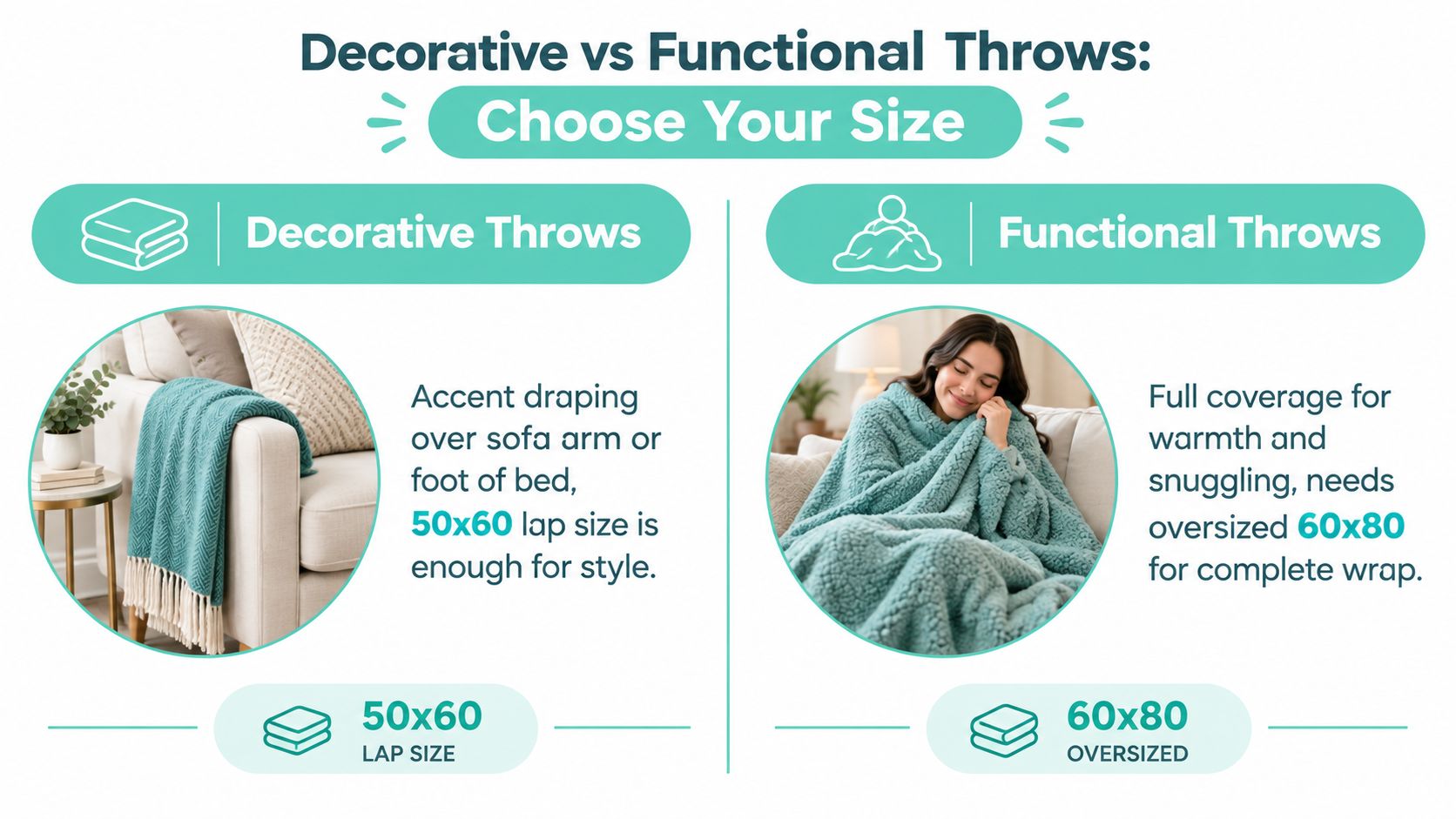
The easiest size decision starts with the blanket's job. A decorative throw needs to look intentional while folded or draped. A functional throw needs enough surface area to stay wrapped around a person during sustained use.
A 50 by 60-inch cut is usually a flexible decorative choice. Fold it over a sofa arm, place it across the back of a chair, or layer it at the foot of a bed. If the blanket will mostly be seen rather than handled, a compact format keeps the display neat.
Functional use calls for more fabric. A standard throw works for lap coverage and everyday couch lounging, while a 54 by 72-inch or 60 by 80-inch oversized throw offers more room for shoulders, knees, and side coverage.
Use time is a useful test
Ask how long someone will stay under the blanket.
- Brief contact: If the throw is picked up for a quick decorative adjustment or used for less than 10 minutes, a compact accent cut may be sufficient.
- Lap warmth: If someone will watch a movie or read while covered from the waist down, the standard tier is more useful.
- Full snuggling: If the blanket needs to wrap around the shoulders and legs, choose an oversized format.
The same rule applies to styling accessories. A coordinated Comfort Pure throw pillow collection can complete a decorative arrangement, but pillows don't replace the extra blanket length needed for warmth.
If the blanket will be grabbed and held, size up. Minky's plush pile can make a smaller piece feel cozy, but softness doesn't create extra coverage.
How Much Minky Yardage to Buy for Each Throw Size
Minky shopping becomes easier when you separate the finished blanket size from the fabric cut. A finished 50 by 60-inch throw isn't made by ordering fabric that measures exactly 50 by 60 inches. You need room for cutting, construction, and the finished edges.
For a basic project, use these practical cut ranges:
| Throw Type | Finished Size (inches) | Minky Cut to Buy | Best Use |
|---|---|---|---|
| Compact lap | About 40 by 40 to 44 by 45 | Single cut sized for the project | Chair, lap, or accent |
| Baby or stroller | About 30 by 36 to 36 by 45 | 1 yard | Small gifts and portable blankets |
| Standard throw | 50 by 60 | 2 yards | Sofa lounging and one-person coverage |
| Oversized throw | 54 by 72 | 2.5 yards | Taller users and broader seating |
| Large oversized throw | 60 by 80 | 3 yards | Sectional drape or substantial bed layering |
Build in cutting room
For minky projects, add 4 to 6 inches per side for seam allowance and trimming. The exact amount depends on the construction method, edge treatment, and whether you're pairing the minky with another layer.
Wash and dry the minky before cutting. Prewashing helps you account for fabric behavior before the final dimensions are established, rather than discovering after construction that the finished blanket no longer matches the intended size.
OPN's yardage calculation guide for quilts offers a useful way to think through cut planning before ordering. The same habit helps with throws: write down the finished dimensions, identify the fabric width, and then decide whether the piece can be cut in one section.
When rounding up makes sense
A 2-yard cut aligns naturally with the standard throw tier. A 2.5-yard cut gives more length for an oversized design, and a 3-yard bundle supports a large 60 by 80-inch project.
Don't round down when the fabric has a directional design or a nap-sensitive pile. Shannon Fabrics textures such as Hide, Snowy Owl, and Fawn can have a strong visual direction, so layout may matter as much as raw yardage.
A little extra fabric is easier to manage than a piece that arrives too short for the planned finish. Check the usable width and consider the direction of the pile before placing the order.
Choosing the Right Minky Width to Avoid a Center Seam
A throw's fabric width determines whether its plush face can remain in one piece. Standard 44 or 45-inch Quilting Cuddle suits compact lap throws, while a finished blanket wider than the usable fabric usually requires a center seam.
With minky, that seam affects more than construction. Piecing can change how the pile lies, add bulk, and interrupt the way the texture flows across a couch throw or bed layer. A carefully sewn seam can still work, but a single-width cut keeps the surface simpler when the fabric allows it.
How the width options compare
OPN carries several width categories for different furniture and blanket plans:
| Fabric Width | Example Line | Max Width Without a Center Seam | Best For |
|---|---|---|---|
| 44 to 45 inches | Quilting Cuddle | Compact projects within usable width | Lap throws and pillow-style accents |
| 80 inches | Mirage | Standard and many oversized throws | 50 by 60 projects without a center seam |
| 90 inches | Extra-wide Cuddle | Broad oversized cuts | Larger throws and bed-skimming layers |
| 110 inches | Extra-wide Cuddle | Very wide blanket faces | Large throws and small top-of-bed cuts |
An 80-inch Mirage gives a standard 50 by 60-inch throw enough width for a continuous plush face. It can also fit many oversized layouts, depending on the finished dimensions and the fabric removed at the selvage.
For a 60 by 80-inch throw, 90-inch or 110-inch extra-wide Cuddle offers more room for planning. OPN's guide to 110-inch extra-wide minky fabric explains why extra-wide fabric helps when a broad blanket face or backing would otherwise need piecing.
Construction choice: Use 44 or 45-inch fabric when a center seam suits the design. Choose 80-inch, 90-inch, or 110-inch fabric when a continuous plush surface is central to the finished look.
Texture changes the visual effect, too. A short, even Cuddle surface looks different from a high-pile option such as Hide, while Snowy Owl and Fawn bring their own directional styling considerations.
Picking Your Throw Size and Next Steps
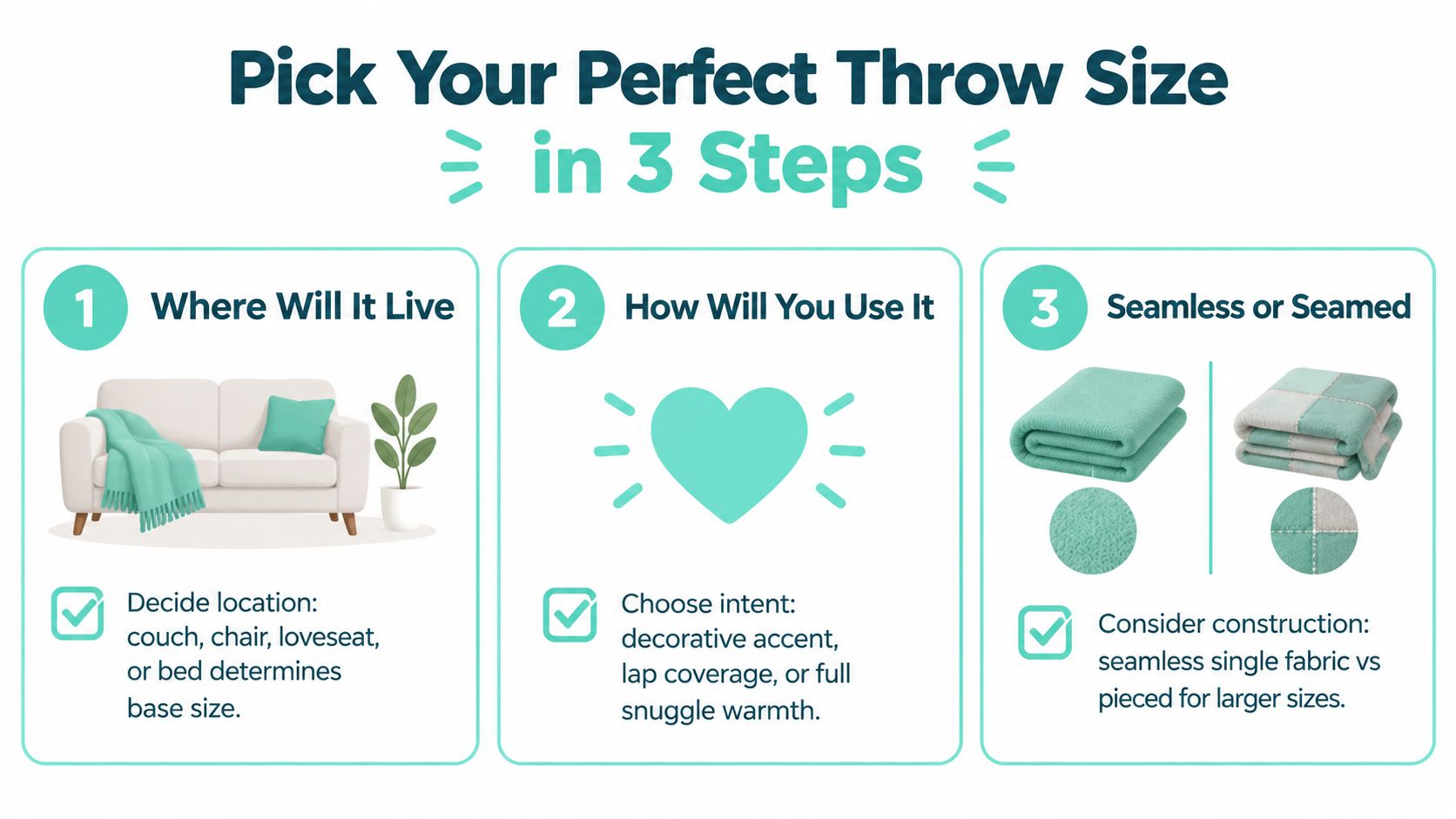
Choose your finished throw by answering three questions. The sequence prevents a common mistake, ordering fabric because the texture is appealing before confirming whether the cut fits the furniture.
Where will the throw live
- Chair: Choose a compact lap size for an accent, or standard for fuller personal coverage.
- Loveseat: A standard throw can serve one person or stretch across both laps.
- Sofa or sectional: Consider oversized dimensions when you want the blanket to cross a chaise or cover more than one seating position.
- Bed: Use a standard throw as a folded foot-of-bed accent, or choose oversized for a broader top layer.
How will someone use it
Decorative draping points toward a compact cut. Lap warmth suits the standard tier. Full-body snuggling calls for more length, with a large oversized cut offering the most room to wrap and reposition.
Does a seamless surface matter
If a center seam won't bother you, 44 or 45-inch Quilting Cuddle can work for a smaller project or pieced design. If you want one continuous plush face, choose an 80-inch Mirage for a standard throw, or 90-inch and 110-inch extra-wide Cuddle for broader formats.
For fabric planning, OPN's resource on where to buy material for quilts can help you compare minky widths, textures, and project-ready cuts. Our shop includes Shannon Cuddle and Luxe Cuddle options, including textures such as Hide, Snowy Owl, and Fawn, along with Mail-in Longarm services for quilt finishing. OPN also has hundreds of verified reviews, which gives shoppers a practical reference when comparing fabric and service providers.
Before ordering: Write down the finished size, required cut, fabric width, and pile direction. Then add the 15% first-order coupon or check the free U.S. shipping offer for orders over $70 when available.
Start with the furniture, choose the throw blanket size that matches the use, and order the corresponding minky cut rather than guessing from the product label. Shop the Luxe Cuddle Collection, choose your texture and width, then order the yardage that matches your planned finish.
On Pins & Needles Quilting Co. offers premium Shannon Cuddle and Luxe Cuddle fabric, project-ready cuts, and Mail-in Longarm quilting for makers who want a polished finish. Visit On Pins & Needles Quilting Co. to match your throw blanket size with the right minky width and start your project today.