
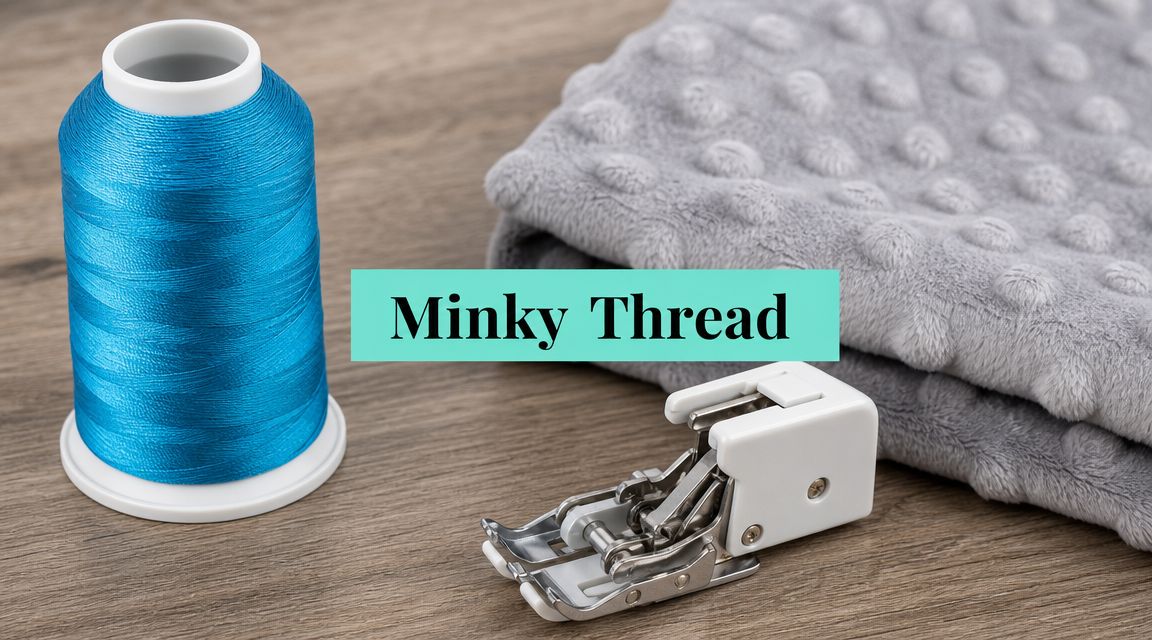
A strong, low-lint 100% polyester thread, such as a 40 or 50 weight, is the best choice for sewing minky fabric. It has the strength and stretch-resistance minky needs without adding unnecessary bulk or shredding through long, plush seams.
If you're staring at a slippery cut of minky beside your machine, you're probably trying to avoid the usual mess: puckered seams, skipped stitches, lint everywhere, and thread that looks fine on the spool but fails as soon as the seam gets long. That frustration is real, especially on quilt backs, baby blankets, and any project where softness matters as much as durability.
Your Guide to Flawless Minky Seams
The best thread for sewing minky fabric is a strong, low-lint polyester thread, ideally in a practical 40 or 50 weight range, paired with the right needle and machine setup. Thread choice matters more on minky than it does on many cotton-only projects because the fabric's pile, stretch, and shedding all work against a weak or linty seam.
We see the same pattern over and over. A project starts with beautiful Shannon Cuddle or Luxe Cuddle, then the sewing turns aggravating because the thread isn't suited to plush fabric. The fix usually isn't exotic. It's a better-matched thread, a better needle, and a machine setup that respects how minky behaves.
If you need a broader primer on keeping layers under control, our guide on how to sew with minky fabric without it sliding is a useful companion to the thread advice in this article.
Why Does Minky Fabric Need a Special Thread?
Minky doesn't behave like quilting cotton. It looks soft and harmless on the cutting table, but once you start stitching, it exposes every weak point in your setup.

How does the pile affect stitching
The plush surface creates drag. The presser foot rides over a fuzzy layer instead of a flat woven surface, and that makes consistent stitch formation harder.
That's why minky often seems to creep out of alignment. One layer shifts faster than the other, and the seam starts to wave or twist. A thread that's too weak, too fuzzy, or too grabby tends to make that worse instead of better.
Minky asks your thread to move through depth, not just through fabric.
Why does stretch change the thread choice
Most modern minky and Cuddle-style fabrics have some give. That stretch is useful in a finished project because it adds drape and softness, but it's demanding at the machine.
Cotton quilting thread can work beautifully on cotton patchwork because the seam stays relatively stable. On minky, that same thread can feel less forgiving. If the fabric shifts or stretches during stitching, a less flexible thread is more likely to fray, snap, or leave a seam that doesn't recover well after handling.
Why is shedding such a big issue
Minky sheds. Anyone who has cut it knows that the fluff gets everywhere.
That shedding doesn't just make a mess on the table. Loose fibers build around the stitch line, collect in the machine area, and can interfere with clean stitching. A low-lint thread helps because it doesn't add more fuzz to a fabric that's already producing enough of its own. If you're newer to the fabric itself, what Cuddle minky fabric is and how it behaves gives useful background.
Polyester vs Cotton Thread for Minky Fabric
| Feature | Polyester Thread | Cotton Thread |
|---|---|---|
| Strength for plush seams | Better suited to minky's drag and handling | More likely to struggle when seams are stressed |
| Lint behavior | Low-lint options are widely preferred | Adds more lint to an already fuzzy project |
| Stretch tolerance | Better match for stretchy plush fabric | Less forgiving on fabrics with give |
| Long seam consistency | More reliable for extended runs | More prone to trouble as bulk and friction build |
| Best use on minky | Primary recommendation | Better reserved for other fabric types |
What Is the Best Type and Weight of Thread for Minky?
The clear answer is polyester. Not because it's trendy, and not because cotton is “wrong” in every situation, but because polyester solves the exact problems minky creates.
A strong, low-lint polyester thread is the recommendation that keeps showing up across practical sewing guidance for plush fabrics. One technical recommendation specifically advises pairing a #90/14 topstitch needle with a low-lint thread, then lengthening the stitch to 3.0–3.5 mm and using a walking foot to reduce stretch-related problems, which helps resist shredding and breaking on high-pile surfaces (Superior Threads on quilting on minky fabric).
Why does polyester win on minky
Polyester handles friction well. That matters because minky creates more resistance at the needle area than a smooth woven cotton does.
It also stays cleaner in use. Since minky already fills the sewing area with fibers, adding a linty thread is asking your machine to work harder than it should. For large quilt backs and multi-yard seams, lower-lint performance isn't a luxury. It's part of seam reliability.
There's also the stretch question. Minky has give, and the seam needs to tolerate that movement without feeling brittle. Polyester is a better fit for that job than a thread chosen mainly for traditional cotton quilting.
Should you use 40 wt or 50 wt
Both can work well. The better choice depends on the project and the look you want.
- Choose 40 wt if you want a slightly more visible seam or topstitch and you're working on a project where durability and stitch presence matter.
- Choose 50 wt if you want a finer look with less visual build-up in the seam.
- Stay consistent across the project when possible, especially if you're testing tension.
- Prioritize quality over theory because a smooth, strong polyester thread usually performs better than an unsuitable thread picked only by weight.
A simple rule works well in practice. If the minky is thick, lofty, or being used as a backing on a substantial quilt, many sewists prefer the security of a good polyester in that 40 to 50 wt neighborhood. If the project is softer, smaller, or more detail-focused, the finer option may look cleaner.
Practical rule: If your thread sheds, frays, or starts roughing up before the seam is finished, it's the wrong thread for minky no matter what the label says.
What should you avoid
Avoid treating minky like cotton yardage. That's where most thread mistakes begin.
Common trouble choices include:
- Old mystery thread that snaps under light tension
- Very linty thread that compounds cleanup problems
- Thread selected only for color without regard for fiber type
- Bulky decorative thread that makes plush seams harder to control
If you want a better sense of how thread thickness affects visibility and handling, a thread weight chart for quilting and sewing is a helpful reference point.
How Do I Choose the Right Thread Color for My Project?
You notice thread color mistakes fastest on minky after the seam is finished, the nap is brushed back, and the line you thought would disappear is suddenly staring at you. Color choice matters less on the spool than it does on the actual pile.
For most minky projects, matching close is the safest call. The plush surface already breaks up the stitch line, so a near match gives you a cleaner result with less effort. We use that same logic in our longarm work. If the goal is a polished finish and the quilting should support the fabric rather than compete with it, thread usually needs to recede.
When should thread blend in
Blending makes sense when the texture is already doing the visual work. High-pile and embossed minky can make even a well-sewn seam look busy, so a matching thread keeps the project from feeling overworked.
Choose a blending color when you want:
- A low-visibility seam on plush or textured minky
- More forgiveness if your topstitching is not perfectly uniform
- Quilting that reads softer on a minky-backed quilt
- A cleaner finish on baby blankets, loveys, and bindings
A close match does not have to be exact. On minky, one shade darker often disappears better than one shade lighter because the pile creates shadow.
When should thread contrast
Contrast should be intentional. It can look great on a simple shape, a modern quilted motif, or a decorative edge, but it also puts every small inconsistency on display.
That trade-off matters on both home machines and longarms. On a domestic machine, contrast can spotlight minor feeding shifts at the edge. On a longarm, it can make pathing, point accuracy, and tension changes much more obvious across a large field of minky.
Thread Color Strategy for Minky Projects
| Goal | Strategy | Best For |
|---|---|---|
| Invisible seam | Match the dominant minky color closely | Baby blankets, plush bindings, simple construction |
| Softly blended finish | Choose one shade darker or lighter | Textured Luxe Cuddle surfaces |
| Decorative stitching | Pick a deliberate contrast | Topstitching and visible edge details |
| Quilt backing harmony | Match the backing, not the quilt top | Minky-backed quilts where the back will show |
Test color on the nap, not just against the fabric base. Lay a strand across the surface, stroke the pile in both directions, and check it under natural light and room light. Minky shifts color more than flat cotton does.
We see this regularly in mail-in quilting. A thread that looked perfect against a sample card can turn cooler, warmer, lighter, or more visible once it sits on the actual plush surface. If your project includes both pieced cotton and minky, decide which side matters more visually. For many quilts, that means choosing for the minky backing if the quilting will show there.
If you are still deciding between a subtle stitch line and a more visible one, the needle choice affects that result too. Our guide to the best needle size for Shannon Cuddle fabric helps you pair thread visibility with cleaner stitch formation.
On Pins & Needles Quilting Co. carries Shannon Fabrics textures and coordinating supplies, which helps when you want to compare thread against the actual kind of minky you are sewing instead of relying on color names alone.
What Needle and Machine Settings Should I Use?
The right thread won't save a bad setup. Minky rewards a complete system: thread, needle, stitch length, foot pressure, and feeding all have to cooperate.

A technical sewing guide explicitly advises all-purpose polyester thread, a 90/14 ballpoint needle, and long pins, then recommends increasing stitch length to 3.0 and decreasing tension for better seams on minky (Sew Can Do guide to sewing with minky). That matches what many experienced minky sewists learn by trial and error.
Which needle works best
For domestic sewing, a 90/14 ballpoint needle is one of the most dependable places to start. The rounded point helps the needle move through a knit-like plush structure more cleanly than a sharper needle often will.
Some sewists also do well with stretch needles or topstitch needles, depending on the thread and machine. But if you want one practical starting point, 90/14 is a sound choice for many minky seams.
If you want a deeper breakdown of pairings by project type, the best needle size for Shannon Cuddle fabric is worth keeping nearby.
Which machine settings matter most
Many problem seams are fixed here.
Use this setup checklist:
- Stitch length: Start around 3.0 and test longer if the pile is lofty.
- Tension: Reduce it slightly if the seam looks tight or puckered.
- Walking foot: Use one whenever possible to help both layers feed evenly.
- Pins or clips: Secure generously because minky shifts while you sew.
- Fresh needle: Don't troubleshoot for twenty minutes with a tired needle.
A longer stitch helps because tiny stitches can sink into pile and make the seam look cramped. A walking foot matters because minky likes to crawl. If the top and bottom layers feed at different speeds, the seam won't stay straight.
What does a good test seam look like
Before sewing the actual project, stitch on scraps from the same fabric stack. Don't test on cotton and assume it applies to minky.
A good test seam should show:
- Even feeding without one layer extending past the other
- No skipped stitches
- No thread roughing up near the needle
- A seam that lies calm rather than tunneling or waving
This short demo can help you compare what you're seeing at your machine with real stitching behavior on plush fabric.
If the seam looks bad at six inches, it won't look better at sixty. Stop, adjust, and test again.
How Does OPN Handle Thread for Mail-In Longarm Services?
Large minky-backed quilts create a different kind of challenge. The thread question isn't just about seam construction anymore. It's about how to get a plush backing quilted cleanly without fighting drag, bulk, and shifting through a domestic throat space.
That's where professional longarm handling changes the equation. Many piecers enjoy making the top but don't want to wrestle a heavy quilt sandwich with minky on the back through a home machine. That hesitation is sensible. Plush backings behave differently once the full quilt is loaded.

What changes on a longarm
The principles stay the same. Clean thread matters. Stable tension matters. Thread has to cooperate with a plush, fiber-shedding backing.
What changes is the control. With a longarm setup, the quilt is mounted and managed in a way that avoids bunching a full minky-backed quilt through a small domestic opening. That reduces the physical struggle many hobbyists hit halfway through a large project.
A useful reference for what's included in that kind of finishing is affordable longarm quilting with batting and thread included.
How does that help a home sewist choose thread
It clarifies priorities. Professionals don't choose thread for romance. They choose for clean performance, predictable tension, and durability over the full project.
That perspective helps at home too. If a thread is likely to lint heavily, rough up under speed, or behave unpredictably on plush backing, it's not a good choice just because the color is pretty.
For quilts using extra-wide minky backing, this matters even more because the scale of the project punishes weak decisions. Wider backing can help avoid bulky seams, and pairing that with mail-in quilting removes much of the hardest handling.
When should you stop DIYing the quilting
A few signs are obvious:
- The quilt is too bulky to move smoothly at your machine
- The minky backing keeps shifting no matter how carefully you baste
- You trust your piecing, not your quilting
- You want a finished result without battling setup
If that sounds familiar, the practical answer may be to book a mail-in longarm quilting service. It's a good fit for quilters who want minky softness on the back without the domestic-machine wrestling match.
How Do I Troubleshoot Common Minky Thread Problems?
Even with the right thread, minky can still test your patience. The useful part is that most problems leave clues.
Why am I getting skipped stitches
Skipped stitches usually point to the needle before they point to the thread.
Likely cause: the needle is worn, too small, or not well matched to plush stretch fabric.
Try this:
- Replace the needle with a fresh 90/14
- Check insertion because a slightly misseated needle can cause erratic stitching
- Retest on scraps using the full project layers
- Slow down if the fabric is bouncing under the foot
Why is the thread shredding or fraying
This often happens when the thread and needle eye aren't working well together, or when friction builds over a long seam.
Likely cause: poor thread quality, too much friction at the needle, or a setup that's too tight.
Try this:
- Switch to a smoother low-lint polyester
- Re-thread completely with the presser foot up
- Inspect the needle for burrs or damage
- Reduce stress by avoiding tiny stitches on lofty pile
A thread that starts fuzzy during sewing usually won't improve if you keep going.
Why do my seams pucker or show loops
Loops on one side and puckers on the other usually signal tension imbalance, feeding issues, or both.
Likely cause: tension too tight, stitch length too short, or top and bottom layers feeding unevenly.
Try this:
- Lengthen the stitch if the seam looks cramped.
- Lower tension slightly and test again.
- Use a walking foot if you tried to sew without one.
- Pin more densely because minky shifts between anchor points.
Should the bobbin thread match the top thread
For most minky sewing, matching the bobbin thread to the top thread keeps troubleshooting simpler. It gives you one known variable instead of two.
You can use a dedicated bobbin thread in some situations, but if you're fighting tension already, keeping the same fiber type and a compatible weight top and bottom usually makes the machine easier to dial in.
Start Your Next Minky Project with Confidence
The best thread for sewing minky fabric isn't a mystery. It's a strong, low-lint polyester thread in a practical weight, paired with a larger needle, a longer stitch, and a walking foot. Most minky disasters come from treating plush fabric like flat cotton.
Don't let a beautiful cut of Luxe Cuddle Fawn, Hide, or Snowy Owl turn into a frustrating afternoon because the thread was an afterthought. Choose the thread first, build the machine setup around it, and your seams will look calmer, cleaner, and more professional from the start.
If you're ready to sew softer projects with fewer headaches, browse On Pins & Needles Quilting Co. for Shannon Cuddle and Luxe Cuddle fabrics, then use the 15% first-order coupon and remember that free U.S. shipping starts at $70.