Vet wholesale fabric suppliers by the total cost of a bad lot, not by price per yard. Dead stock, returns, and a missed reorder wipe out a cheap quote. The popular advice is to buy the lowest sticker price in the biggest quantity you can finance. I would start with the minimum, the restock promise, and the paperwork instead. A bolt you can't label, match, or sell is not a bargain.
Minimums and Lead Times
A wholesale fabric supplier sells bolts or yards at tiered prices to businesses, and the right type depends on how much you buy and how often you restock, not on the lowest price per yard.
Treat every range below as a starting point. Confirm it in writing before you compare quotes.
| Supplier type | Typical minimum order | Typical lead time | Best fit |
|---|---|---|---|
| Domestic fabric distributor | 1 bolt or 1-5 yards per color | 2-5 business days | Small runs and fast restocks |
| Minky specialist or online wholesaler | 1-3 yards per color | 5-10 business days | Blankets, scarves and kits |
| Importer wholesaler | 1 bolt or 1 carton per color | 3-8 weeks | Repeat runs of one fabric |
| Mill direct | A production lot, often 500 yards or more | 10-16 weeks | Established brands with demand forecasts |
How to read each row
Domestic distributors win when a color must come back in days and you can live with a bolt, or with 1 to 5 yards per color. Minky specialists and online wholesalers are built for blankets, scarves, and kits, where 1 to 3 yards of one color is a real order, not a sample favor. Importer wholesalers make sense for a repeat run of one fabric, once you can wait weeks and fund a bolt or carton per color. Mill-direct only fits a brand that already forecasts demand months ahead and can hold a production lot.
Minimums often apply per color or per cut. Order three colors and you can multiply the floor three times before a single yard is cut.
Place yourself with three questions
- Monthly yards: How many yards do you cut in a normal month, not a holiday spike?
- Restock speed: How soon must that color return after it sells through?
- Assortment: How many colors or widths does the line need at once?
Search by fabric type, such as extra-wide minky or quilting Cuddle, not only by the word wholesale. Ask each shortlisted supplier for a trade account, a minimum sheet, and a sample policy in writing before prices enter the conversation. Read reviews for shipping accuracy and substitutions. At On Pins & Needles we keep our hundreds of verified reviews visible so buyers can check shipping and cut accuracy before they order. A shop like ours lists Cuddle colors and widths in one place, which makes those minimums easier to compare.
Shortlist two supplier types that match your three answers, then request quotes only from that pair.
Which Minky Width Fits Your Quilt or Blanket?
A low price per yard is a bad lot when the width cannot cover the quilt. Wrong width turns into pieced seams, returns, and cloth you cannot place on the top already cut.
Choose width first, then pile and texture. Width decides how many seams a quilt back or blanket needs. Pile decides how the finished piece feels in the hand.
Cuddle is generally a lower pile minky. Luxe Cuddle is a higher pile minky. The same project can feel flat or plush depending on that choice, even when the width is right.
| Width | Best for | Seam trade-off |
|---|---|---|
| 44-45 inch Quilting Cuddle | Appliqué, piecing, small quilts and clothing | More seams on large backs |
| 80 inch Luxe Cuddle Mirage | Lap quilts and throws | Fewer seams than a narrow cut |
| 90 inch Extra Wide 3mm | Queen-size quilt backs cut in one piece | Often no center seam on queen tops |
| 110 inch Extra Wide 3mm | King-size and oversized quilt backs | One-piece backs for large quilts |
A king back pieced from a narrow cut shows every join. A 110 inch extra-wide minky can cover an oversized top in one piece, and a 90 inch cut often does the same for a queen. Our extra-wide backing fabric guide walks through how those widths sit on a real quilt.
Match the width to the finished size before you commit a color. A bolt of 44-45 inch Quilting Cuddle fits appliqué, clothing, and small quilts. It is a poor buy for a queen or king back: leftover after piecing sits as dead stock, and the seams are what come back. I would rather pay more per yard for 90 or 110 inch Extra Wide 3mm than miss the order and fund a second cut.
Texture after the width is settled
Hide, Snowy Owl, and Fawn are texture-led picks, not width substitutes. Hide reads more like a pelt, Snowy Owl is a softer animal look, and Fawn sits in between for blankets and throws. Compare them on a swatch under your own light before you cut. Warehouse bulbs and a phone photo both lie about shade.
A narrow width pieced onto a large top is a common mismatch. The seams show, the pile direction fights itself, and the back never looks like one cloth. Put the cut width on the order, not only the collection name, so the lot you receive is the width the quilt can use.
What Does Minky Really Cost per Yard After Freight?
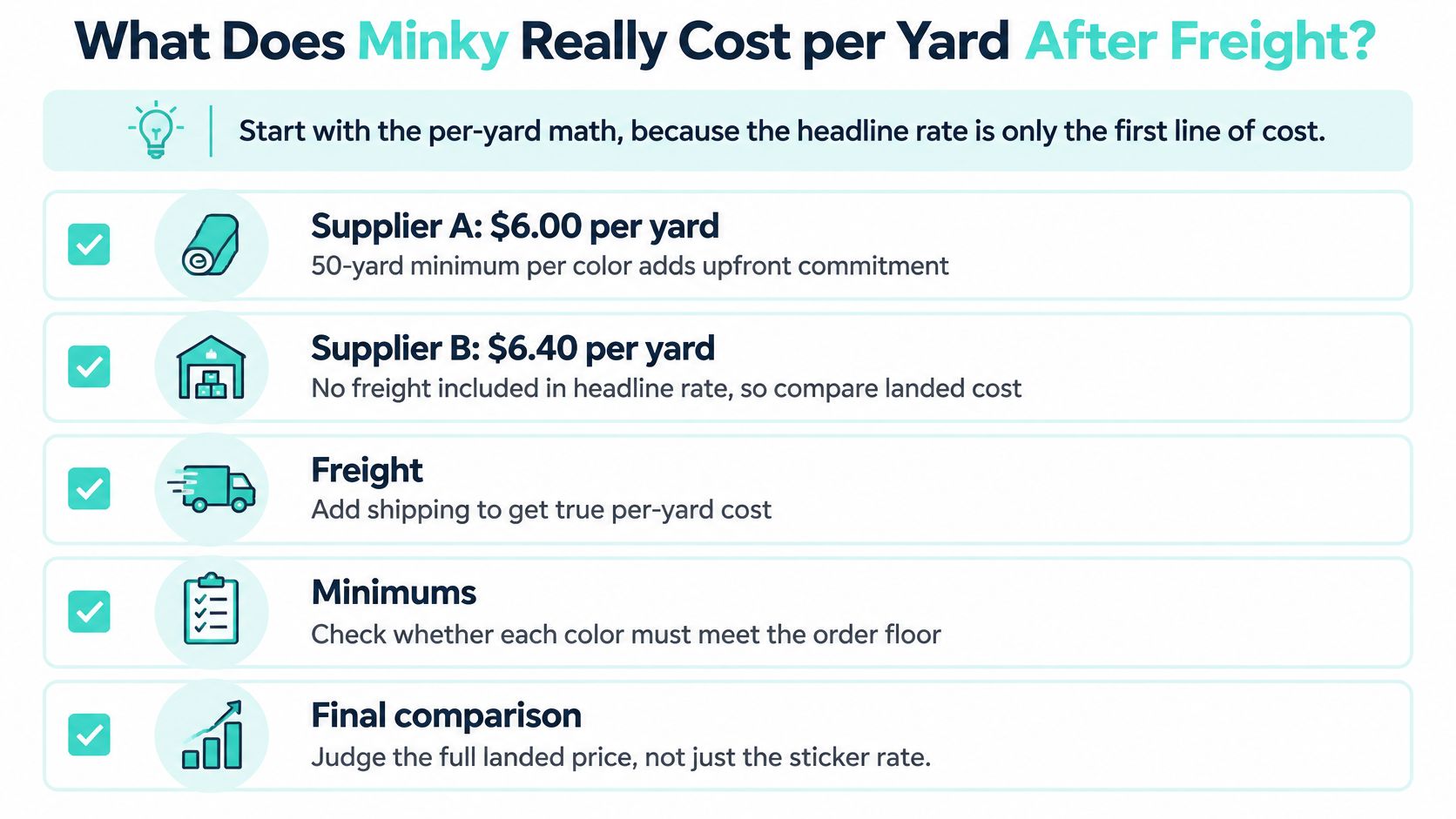
The cheapest yard can become the most expensive purchase if a high minimum leaves fabric unsold. Suppose you need 20 yards of one color this season.
Supplier A charges $6.00 per yard with a 50-yard minimum per color. You commit $300; if 20 yards sell, the remaining 30 yards tie up $180 in dead stock. Supplier B charges $7.50 per yard with a 5-yard minimum. A 20-yard order costs $150, with no unsold yardage.
| Supplier | Minimum per color | Dead stock if 20 yards sell |
|---|---|---|
| Supplier A | 50 yards at $6.00 ($300 committed) | $180 |
| Supplier B | 5 yards | $0 |
Landed cost, not the sticker
A lower price break only helps if you can sell the extra yardage. Compare bolt pricing with your actual use, and count unsold fabric as a cost rather than a saving.
Calculate landed cost per usable yard: add the invoice, freight, duties, and any cost from short cuts, then divide by the yards that pass inspection. This captures more than the supplier's listed rate. A bad lot can add dead stock, returns, and missed orders, so judge the offer by the cost of those risks as well as by price.
For a practical scale check before committing to a bolt, use this guide to how much fabric a bolt contains.
A slightly higher price with a smaller minimum can be the better buy when you restock regularly.
How Do You Score Suppliers and Lock Terms Before Paying?
Inconsistent stock and an unverified substitution can cost more than a modest gap in unit price. Score every supplier on the same eight points before you line up quotes.
- Landed cost: Invoice, freight, and duties, not the catalog rate.
- Minimum flexibility: Whether each color must hit the floor on its own.
- Reorderability: Whether the same dye lot can come back next quarter.
- Stock reservation: Whether unsold demand can be held before you place the order.
- Defect policy: A written time limit, plus replace or refund.
- Sample approval: A signed swatch before any bulk release.
- Cut accuracy: Yardage received against yardage ordered.
- Backup availability: A second source if that color sells out.
Red flags are simple. No written sample policy, a restock date that stays vague, and a substitution shipped without your approval.
Turn the swatch into the purchase order
Shopify's fabric sourcing guidance treats reliability as a logistics problem. Inconsistent inventory, unverified substitutions, and long replenishment cycles can hurt more than a small price gap. Record the approved construction, width, GSM, color standard, finish, packaging, and allowable tolerances on the purchase order so the swatch is binding. Keep the lot number, inspection date, test result, and cutting batch so a complaint points at one shipment. A process certificate is not a lab result on this cloth.
If you are wiring an overseas deposit, read understanding 30/70 supplier payment splits before the pilot is paid like a full production run.
Confirm these six terms in writing.
- The cancellation window before cutting or shipping.
- Any restocking fee after cutting.
- Yardage tolerance, and who pays for short cuts.
- The defect claim window, and whether the supplier replaces or refunds.
- The restock date, and approval required for any substitution.
- Sample or pilot approval before bulk release.
On our own orders, cancellation is available before the fabric is cut or the order ships. Once fabric has been cut but before shipping, a 20% restocking fee applies. Paste this clause into any purchase order: no substitutions without written approval. For a quilter building a stash rather than a production run, our notes on where to buy material for quilts show the smaller-quantity path.
How Do You Test Fabric Quality Before a Bulk Order?
A low price per yard means little if a bad lot leaves you with dead stock, returns, or missed orders. Test the fabric against a retained reference, then check that the pilot and bulk lot meet the same requirements.
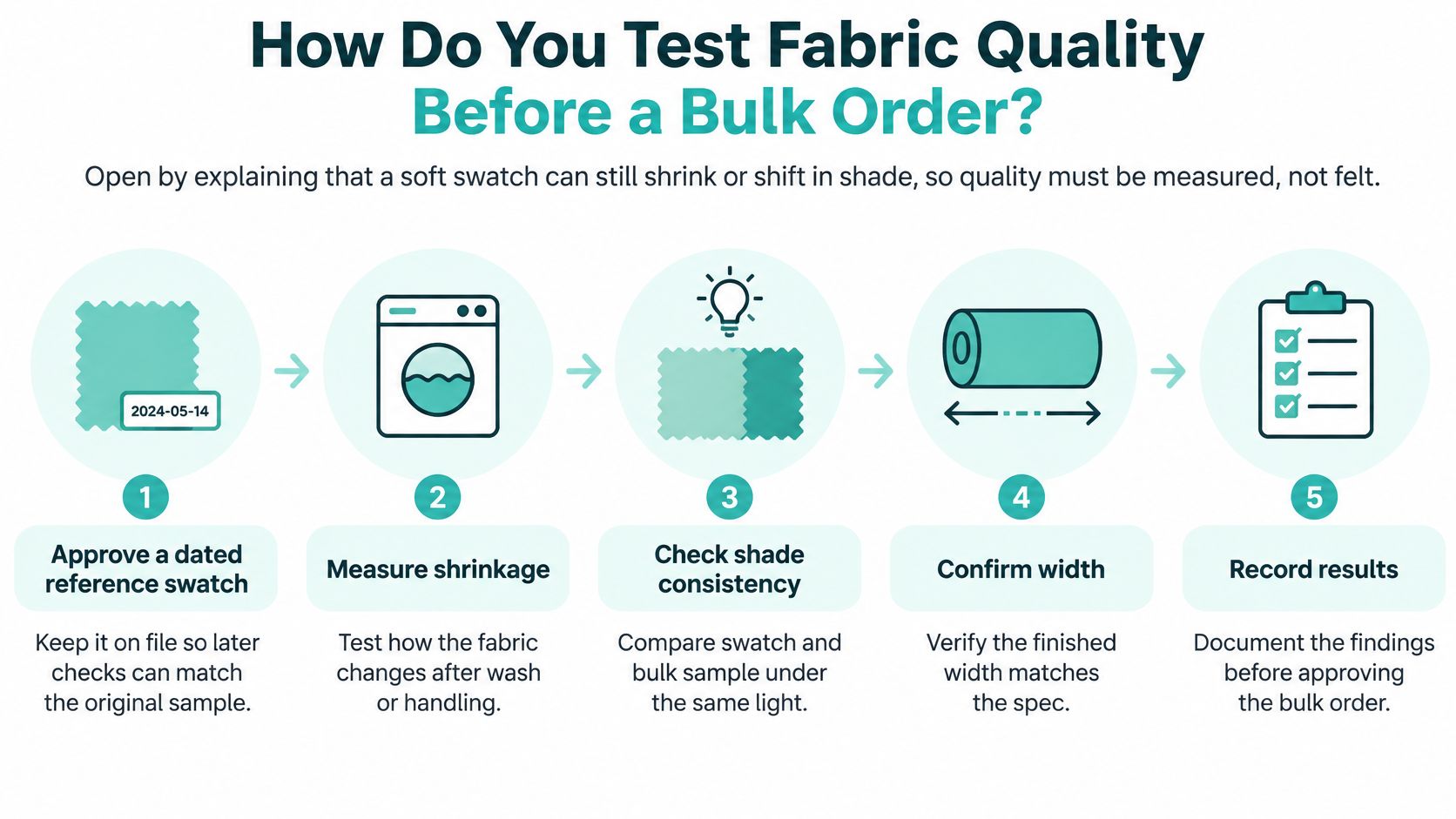
Put measurable standards on the purchase order: weight, usable width, wash change, colorfastness, pilling, tear strength, and visual-defect limits. A dated, approved swatch gives both sides a physical reference.
- Approve and keep a dated reference swatch. Compare later samples with the actual cloth, not a photo or memory. Record the construction and color alongside the swatch.
- Set the approved GSM and agree on a weight tolerance with the supplier. GSM affects drape, warmth, yield, and shipping weight. Write the agreed tolerance into the order rather than accepting fabric described as “about the same.”
- Request dimensional-change results after washing. Specify a test method, such as ISO 6330 or AATCC 135, so the result can be compared with the agreed requirement. Plush hand alone does not show how fabric will behave after washing.
- Check washing and rubbing for color transfer. ISO 105-C06 and ISO 105-X12 are methods to specify for those checks. Color that transfers onto a quilt top can lead to returns. Our colorfastness testing guide explains why rubbing should be checked before sewing.
- Compare shades under consistent lighting. D65 lighting can reveal differences that shop or warehouse lights may hide. Keep the reference swatch beside the sample during comparison.
- Inspect pilot yardage for usable width, pilling, and tear strength. Usable width is the area available for cutting, not just the width printed on the selvedge ticket. Check the fabric itself; a certificate that does not cover the roll cannot establish its condition.
- Check samples from the first bulk lot before releasing the rest. Preproduction results do not show whether the bulk dye lot matches. Hold the remaining fabric until the bulk samples meet the approved requirements.
- Set lot acceptance and rejection criteria before delivery. ISO 2859-1 provides an attribute-sampling approach. Agree on the sampling plan and defect limits in advance, not after defects appear.
A passing lot matches the reference in shade and meets the agreed weight and usable-width requirements. It also needs to pass the specified checks on bulk samples before you commit the fabric to kits or quilt backs.
Which Paperwork Proves Fiber, Origin and Care?
A product claim is only as good as the paperwork behind it.
The FTC's clothing and textiles guidance says most textile and wool products must disclose fiber content, country of origin, and the identity of the manufacturer, importer, or other responsible marketer. If you turn minky into blankets, pillows, apparel, or household goods, those three items have to be true before the product reaches a customer.
The FTC's Textile and Wool Acts labeling guide says fiber percentages generally appear by weight and in descending order. Each fiber present at 5% or more of total fiber weight needs its generic name and percentage. Words like "soft" or "plush," or a trade name alone, don't replace that name. Shannon Fabrics Cuddle is a trademark, so the listing still needs the generic fiber.
The FTC's apparel labeling overview requires care instructions on covered goods so buyers know how to clean them. Texture branding is not a wash method. The Textile Fiber Products Identification Act also treats inaccurate labeling, invoicing, and advertising as unlawful under the FTC Act, so the purchase order, the invoice, and the product page need the same fiber story.
A 2026 TrusTrace survey of 57 fashion companies across 24 countries found trusted supply-chain data fell from 75% at Tier 1 factories to 33% at Tier 3 yarn and fiber suppliers and 20% at Tier 4. The same survey said 69% of respondents were preparing for Digital Product Passport requirements while rating supply-chain data accuracy only 3 out of 5. The cheapest supplier becomes the expensive one when you can't support a fiber or recycled claim.
| Document | What it proves | Why it matters to you |
|---|---|---|
| Fiber composition sheet | Fiber names and percentages by weight | Required label content for covered products |
| Country of manufacture | Where the fabric was made or finished | Required origin disclosure on labels |
| Manufacturer or importer name | Who is responsible for the product | Identifies the responsible party on the label |
| Lot or batch number | Which production run you received | Traces a complaint back to one shipment |
| Test reports | Wash, colorfastness and shrinkage results | Backs up performance claims |
| Care instructions | Cleaning method for the finished item | Required under the FTC Care Labeling Rule |
| Recycled or environmental claim support | Evidence for any green or recycled claim | Protects against misleading claims |
The fiber sheet protects your labels. The lot number ties a complaint to one shipment. Care instructions have to exist before a finished blanket ships. An ISO 9001 certificate shows process control, not how this lot washes. Questions about dyes belong in the same file, which is why we point buyers to our notes on non-toxic fabric dyes before a green claim goes on a listing.
Request the core documents before you pay a deposit.
How Do You Place a Pilot Order Without Risking a Full Bulk Run?
A low price per yard is a poor bargain if a bad lot leaves you with dead stock, returns, or missed orders. Start with a small pilot before committing to a full run. Request a dated reference swatch, then order yardage in two commonly used colors. Compare the pilot with the swatch for weight, shade, and width, and confirm that the written terms you agreed on apply to this order.
Our Cuddle and Luxe Cuddle fabrics include Hide, Snowy Owl, and Fawn, as well as 90-inch and 110-inch extra-wide 3mm options. Hundreds of verified reviews are available for buyers to read before ordering. For a finished-product check, mail-in edge-to-edge longarm quilting includes batting and thread, so you can assess a quilted top before ordering more fabric.
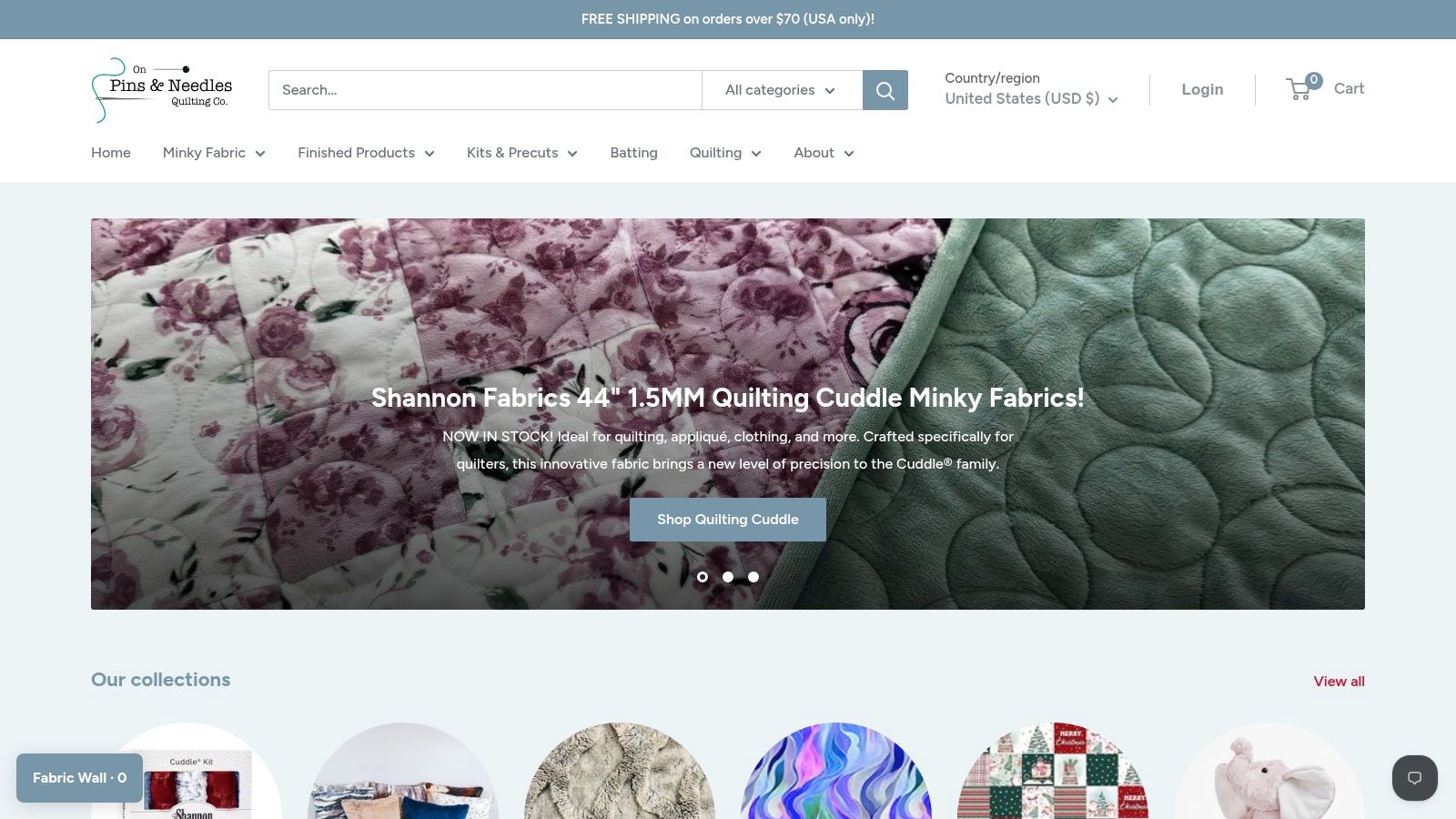
The 15% first-order coupon and free U.S. shipping on orders over $70 apply to a pilot order. They can reduce its cost, but the decision should still turn on whether the fabric meets your needs and the supplier's terms protect you if it does not. Among wholesale fabric suppliers, favor the one whose pilot performs reliably over the one offering the lowest initial price.
Shop the Luxe Cuddle Collection
Get 15% Off Your First Order
On Pins & Needles Quilting Co. specializes in Shannon Fabrics Cuddle and Luxe Cuddle, extra-wide quilt backing, and mail-in edge-to-edge quilting. For minky, order a small quantity first and check it before making a larger commitment. Visit On Pins & Needles Quilting Co. to shop or book quilting.