
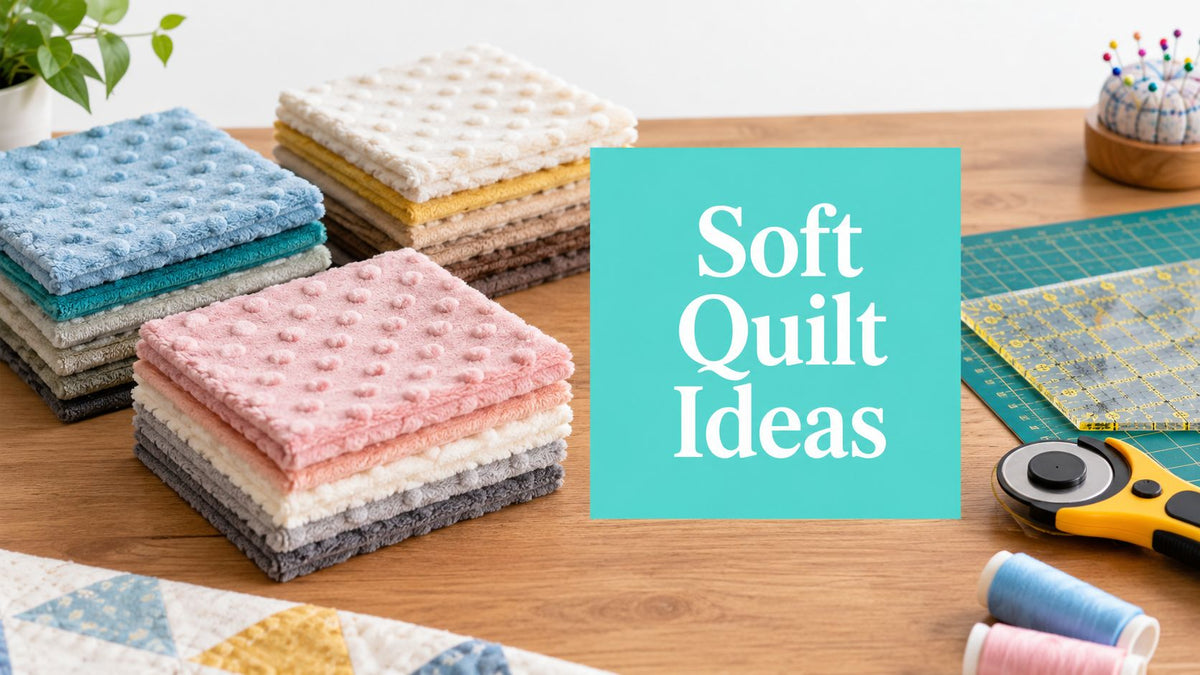
A surprising amount of quilting becomes easier when the starting unit is already cut. 5 inch square quilt patterns can turn coordinated precuts into baby quilts, lap quilts, and throws with predictable layouts and less setup. That practicality is closely tied to the rise of retail pre-cut bundles in the late 2000s and early 2010s, including Moda's “Charm Packs,” which standardized the 5-inch square format (Diary of a Quilter).
The best approach depends on your goal. Charm packs prioritize fast setup, Four-Patch blocks build beginner confidence, Pinwheels create visual movement, and Nine-Patches support repeatable production. With Shannon Fabrics Cuddle and Luxe Cuddle, the fabric choice matters just as much as the block. Textures such as Hide, Snowy Owl, and Fawn change how seams press, how layers baste, and how the finished quilt feels. Backing width and mail-in longarm quilting can change the workflow again, especially when you want a soft, professionally finished result.
Which 5 inch square quilt pattern is best for your project?
Use the project goal as your starting point rather than choosing a block only because it looks attractive. A simple layout often gives you more control over minky, while a directional design may justify extra cutting and pressing.
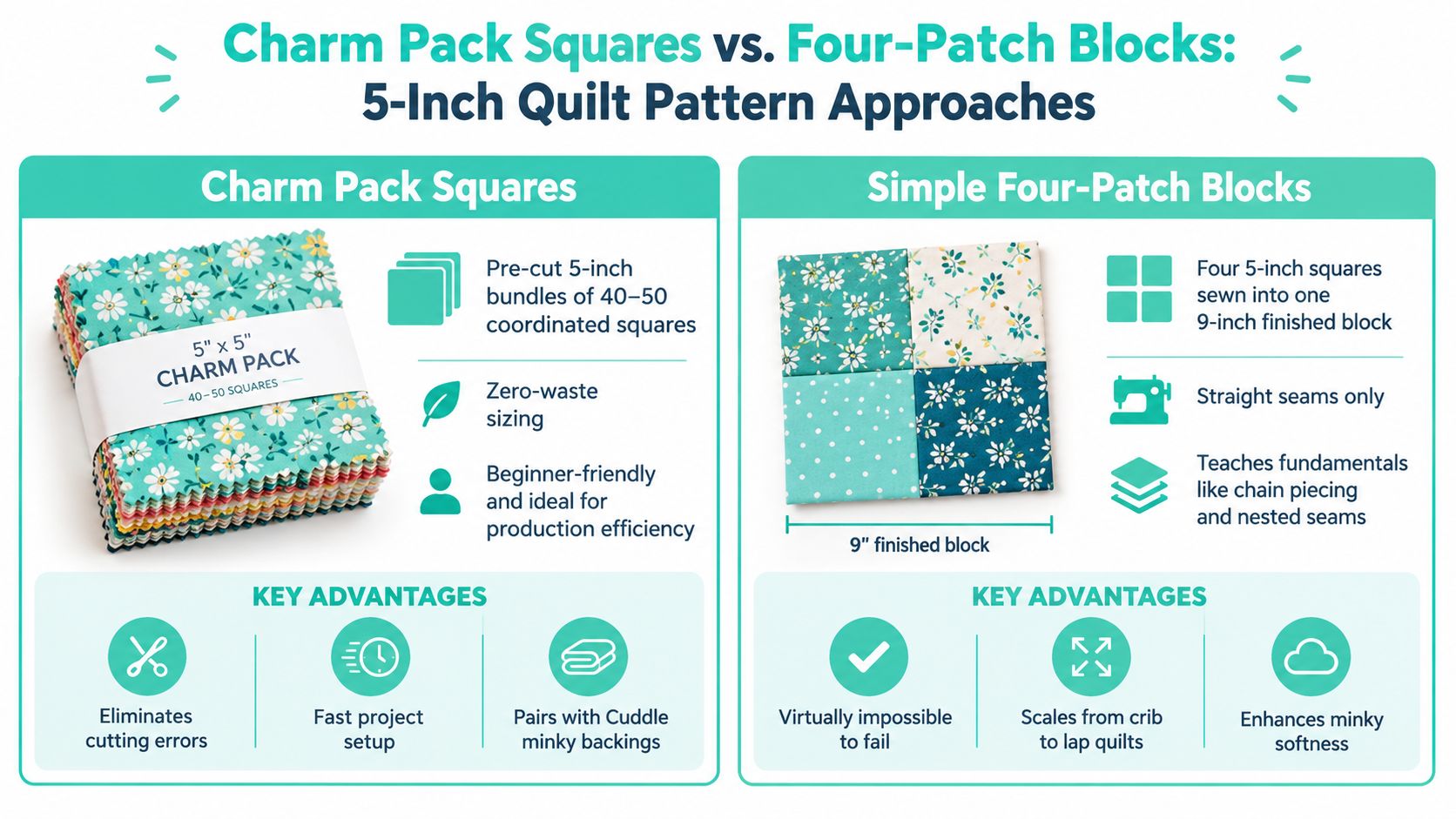
- Fast setup: Choose charm pack squares when you want coordinated fabric without cutting a large batch of squares.
- Beginner confidence: Choose a Four-Patch when you want straight seams, repetition, and an easy block to evaluate.
- Visual movement: Choose a Pinwheel when contrast and diagonal lines matter more than the fastest construction.
- Production efficiency: Choose a Nine-Patch when you need a block that can be batched and repeated consistently.
A throw-sized quilt made with 5-inch squares typically uses about 180 squares in a balanced multi-block layout, while a simpler 5-by-5 square design uses approximately 145 squares. Those figures are planning guides, not universal cutting requirements, because borders, sashing, block arrangement, and seam allowances change the final yield (The Willow Market).
For minky projects, keep the top design controlled. Dense prints can disappear into a textured backing, while a calm solid or subtle texture can give the pieced top more room to lead. OPN Quilting Co.’s Shannon Cuddle fabric collection is a practical place to compare soft backing options before you commit to the block layout.
1. Why are charm pack squares the fastest way to start?
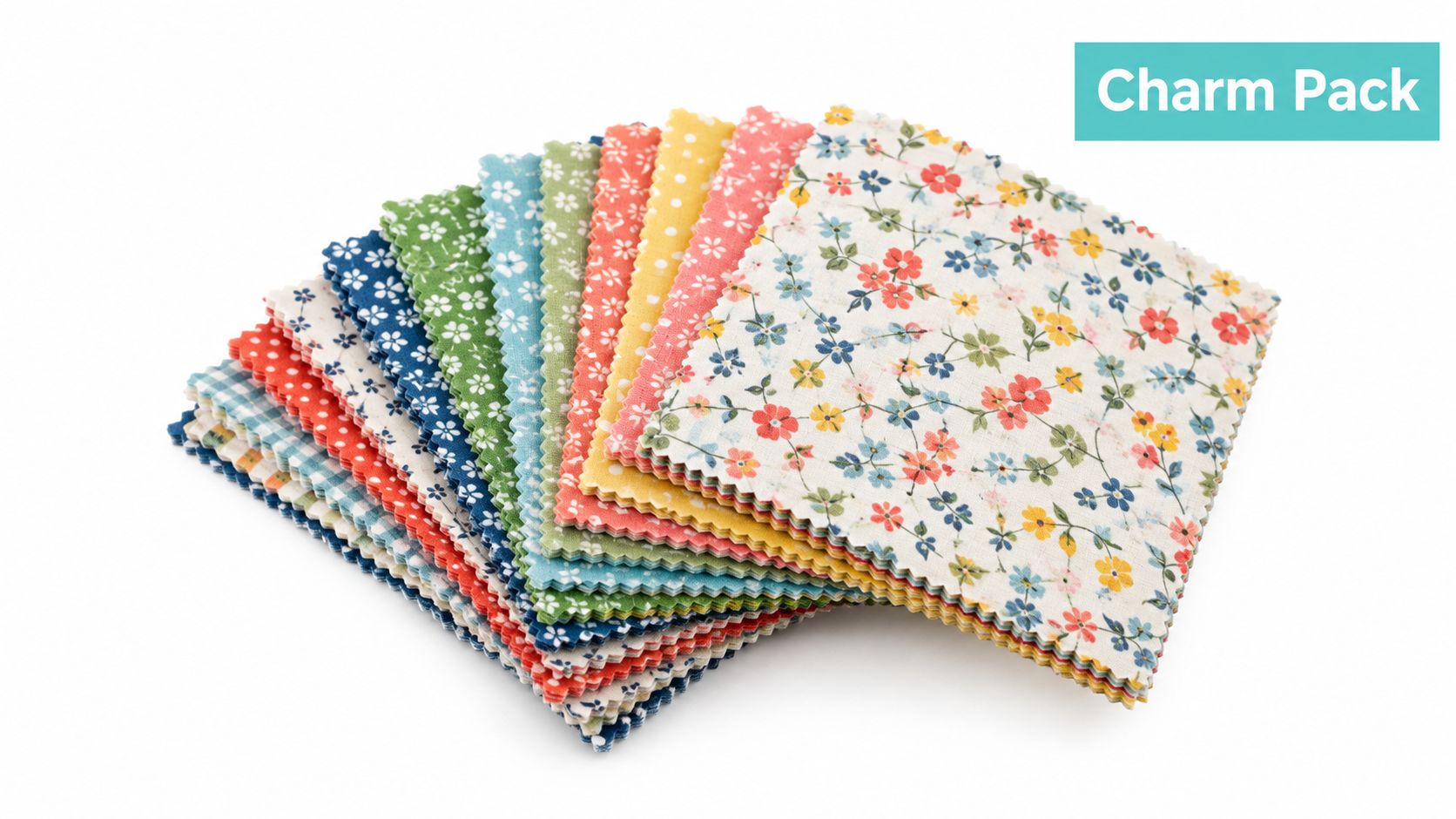
Charm pack squares are the fastest setup when you want coordinated fabric without cutting a large batch of 5-inch pieces. A charm pack contains 5-inch precut fabric squares, a format commonly sold alongside 2.5-inch strips, 10-inch squares, and fat quarters (Missouri Star Quilt Co.). You can begin arranging the quilt as soon as the package is open.
Many bundles are organized around 42 squares per pack. That count gives you a practical planning unit, although collections with fewer prints may repeat fabrics. Repetition can create rhythm in the quilt rather than looking like a mistake.
How should you pair charm packs with minky?
Charm squares pair effectively with Cuddle because the pieced cotton top supplies structure while the minky backing adds softness and texture. A solid Luxe Cuddle surface keeps the top visually clear. A mixed-print pack creates a busier, more traditional scrappy effect, so choose the backing with that contrast in mind.
Snowy Owl suits a soft nursery palette. Hide makes texture more noticeable, while Fawn adds warmth without requiring a complicated pieced design. Compare the pile, hand, and available width in OPN's Luxe Cuddle fabric selection before ordering. Minky texture affects handling, quilting density, and how clearly the top remains visible.
Keep the top layout controlled when the backing has a strong texture. Dense prints can disappear against a plush surface, while a calm solid or subtle texture gives the piecing more room to lead.
What makes charm packs practical for repeated projects?
Precut bundles suit beginners, donation sewing, and small handmade businesses because the color coordination is already established. A guild can divide matching packs among members, and a maker can repeat the same construction process without cutting every top from yardage.
Arrange the squares on a design wall or clean floor, then photograph the finished layout before sewing. The image helps preserve row order and fabric direction, especially if the top will be mailed to a longarm quilter. Confirm the backing width and any piecing requirements before shipping. A narrow backing may need a seam, and a minky backing usually benefits from careful, even handling during quilting.
Use these habits to keep setup efficient:
- Sort before sewing: Group lights, darks, solids, and strong prints before committing to an arrangement.
- Press with control: Press cotton seams consistently, and avoid dragging a hot iron across minky.
- Plan the backing early: Select a Cuddle texture that supports the top rather than competing with it.
- Track inventory: Store unused packs in clear bins so future color choices remain visible.
For more planning ideas, see OPN's guide to charm packs for quilts. Charm packs suit projects where speed, repeatability, and coordinated color matter more than intricate block construction.
Practical rule: Photograph the complete layout before stacking the rows. Minky makes repeated rearranging awkward once you begin handling the layers.
2. How does a simple Four-Patch build beginner confidence?
A Four-Patch is one of the most forgiving 5 inch square quilt patterns because the construction relies on repeated straight seams. Sew four squares into a larger unit, keep the orientation consistent, and the block begins to reveal its structure without demanding advanced points or curved piecing.
The approach works particularly well when you're learning to handle minky. The cotton squares give you a familiar piecing surface, while a Cuddle backing introduces the need for lower iron heat, careful pinning, and controlled movement. OPN's Quilting Cuddle fabric can provide a smoother backing choice when you want softness without an overly dominant pile.
How can you keep Four-Patch blocks accurate?
Start by checking the squares before sewing. Precuts are convenient, but fabric can shift during handling, and minky especially needs gentle control. If a cotton square has stretched slightly, trim it with a square ruler before assembly rather than forcing it to match another piece.
Pressing is where many beginner projects either settle into shape or begin accumulating bulk. Press seams consistently, usually toward the darker fabric, and avoid dragging the iron across minky. A pressing cloth and reduced heat help prevent shine, flattening, or unwanted stretching.
OPN's easy quilt blocks and patterns guide is a useful companion when you want to move from a basic Four-Patch into other beginner-friendly arrangements.
What workflow works best for small batches?
Chain piecing keeps units connected and reduces the stop-start rhythm of sewing each seam separately. It also makes sense for a sewing circle or small production run, where consistent handling matters more than improvising each block.
If you're unsure how much fabric to buy, use a quilt fabric needs calculator before placing an order. That prevents the common mistake of planning the top carefully but underestimating the backing and binding.
Four-Patch blocks also tolerate modest variation better than designs that depend on sharp points. If the finished top needs help settling into a square shape, an experienced longarm quilter can often manage minor unevenness through careful loading and quilting. OPN's Mail-in Longarm service includes batting, thread, and free return shipping, which simplifies the finishing stage when you don't want to quilt a minky-backed project on a domestic machine.
Four-Patch is the right choice when confidence matters more than visual drama. You'll see your progress quickly, and every finished unit reinforces the same basic skills.
3. How do Pinwheel blocks create movement from 5 inch squares?
Pinwheels make a small starting square look much more active. The construction begins by cutting 5-inch squares diagonally and recombining the resulting triangles, so the final block has directional lines that rotate or spin across the quilt.
That extra movement comes with a real trade-off. Diagonal cuts create bias edges, and bias can stretch while you sew, press, or move the pieces across the work surface. The design is rewarding, but it asks for more restraint than a direct patchwork layout.
How should you cut and press Pinwheel pieces?
Cut the complete batch before you begin sewing. When the layout requires diagonals in different directions, mark or sort the pieces immediately so you don't create a block with a misplaced rotation.
Light spray starch can stabilize bias edges, but apply it carefully and allow the fabric to dry before pressing. Pin the triangle intersections, match the points deliberately, and avoid stretching the pieces into alignment. With minky involved, press seams open when possible to distribute bulk rather than building a ridge on one side.
OPN's 45-degree ruler guide can help you think through angled cutting and alignment before you start on the full set of squares.
Contrast controls the success of this design. Hide paired with Snowy Owl can make the rotation easy to read because the textures separate the triangles visually. If the values are too similar, the pinwheel can lose definition even when the seams are accurate.
Which quilting finish supports the spinning effect?
A subtle spiral or radiating edge-to-edge design can reinforce the movement already present in the top. A straight grid may still finish the quilt successfully, but it can compete with the directional geometry instead of extending it.
Send the finished top with a clear note about the intended rotation and include the layout photograph. OPN's Mail-in Longarm service is a sensible option when you want the quilting, batting, thread, and return shipping handled as one finishing workflow. The company also maintains a pattern gallery with modern, floral, juvenile, holiday, and nature motifs, so you can choose a finish that supports rather than overwhelms the Pinwheel.
Bias edges punish rushing. Cut in batches, handle the triangles by their stable edges, and let pressing support the shape instead of forcing it.
Pinwheels suit a lap quilt or gift where visual movement is the main goal. They're less efficient than direct patchwork, but the extra handling earns its place when the design needs energy.
4. Why is the Nine-Patch a strong choice for production efficiency?
The Nine-Patch organizes nine 5-inch squares into a 3-by-3 grid, creating a balanced block that can be repeated across a quilt. It's one of the most practical choices for makers who need a dependable rhythm, because the block can be planned, chain pieced, checked, and assembled in batches.
A full charm pack can support a repeatable system, but don't assume every pack will divide perfectly into your chosen block arrangement. Lay out the squares first, identify the repeat fabrics, and decide whether you want those repeats distributed evenly or grouped for a scrappier effect.
How can you batch Nine-Patch blocks without losing control?
The fastest workflow is also the one most likely to create an unwanted mistake if you skip the layout check. Arrange all nine squares for each block, photograph the plan, then stack the rows in order before sewing.
Pressing direction deserves attention because multiple seams meet in the finished unit. Press toward darker squares where that reduces bulk, or alternate the pressing direction by row so neighboring seams can nest. With minky, keep the iron away from the plush surface whenever possible and use a pressing cloth if the fabric needs gentle shaping.
Use these production habits:
- Batch cutting: Start with accurate precuts so you don't spend time recutting a complete set of squares.
- Batch sewing: Chain piece the same seam across multiple blocks before changing direction.
- Batch pressing: Press each row in a consistent sequence so the blocks remain easy to stack.
- Batch finishing: Send several completed tops to longarm quilting together when your production calendar allows it.
The OPN guide to calculating yardage for quilts can help you plan the top, backing, and supporting materials before you buy. For larger quilts, extra-wide backing options in the 90-inch and 110-inch range can reduce the need for a center seam, subject to the finished quilt dimensions and required quilting margins. OPN stocks extra-wide minky options alongside standard-width Quilting Cuddle and wider Mirage fabric.
What backing and quilting choices work best?
A plush backing can make a Nine-Patch feel luxurious, but too much texture can hide the grid. Choose a quieter texture when the top already contains strong color changes, or use a more pronounced texture when the top is built from calm solids.
Subtle edge-to-edge quilting usually preserves the softness and regularity of the Nine-Patch. Heavy visual motifs may distract from the block structure, particularly when the quilt is intended for a baby or small child.
OPN has hundreds of verified reviews, along with responsive phone and email support, so production quilters can ask practical questions about cuts, textures, and finishing before ordering. That support matters when consistency is more valuable than experimentation.
Production efficiency comes from repeatable decisions. Use the same pressing direction, layout check, backing plan, and finishing notes each time.
4-Way Comparison of 5-Inch Square Quilt Blocks
| Pattern | 🔄 Implementation Complexity | Resource Requirements | ⚡ Speed / Efficiency | 📊 Expected Outcomes & 💡 Ideal Use Cases |
|---|---|---|---|---|
| Charm Pack Squares (5-inch Pre-Cut Bundles) | Very low, no rotary cutting, minimal layout prep | Pre-cut 40–50 coordinated 5" squares, extra‑wide minky backing, batting, basic sewing tools | ⚡⚡⚡ Tops often assembled in 1–3 sessions; excellent production efficiency | 📊 Consistent seams, ultra‑soft finish. ⭐⭐⭐ Ideal for beginners, gift makers, small businesses. 💡 Pair with Cuddle backings; photograph layout before longarm. |
| Simple Four‑Patch (Beginner‑Friendly 5‑Inch Blocks) | Low, straight seams, forgiving construction | Four 5" squares per finished block (charm packs or cut yardage), pressing tools | ⚡⚡ Fast, ~3–5 hrs for a 16‑block lap quilt top | 📊 Reliable grid that teaches fundamentals. ⭐⭐⭐ Ideal for beginners, sewing circles, charity quilts. 💡 Chain piece and press consistently; trim stretched squares. |
| Pinwheel (Dynamic 5‑Inch Geometric Pattern) | Medium, diagonal cutting, HST precision, bias handling | 5" squares cut on the diagonal into triangles, accurate ruler, pins, optional starch | ⚡⚡ Moderate, ~5–8 hrs for a 16‑block top; more assembly time than Four‑Patch | 📊 Dynamic, modern visual effect; quality tied to accuracy. ⭐⭐–⭐⭐⭐ Ideal for intermediate quilters seeking motion in design. 💡 Starch bias edges, pin intersections, request spiral quilting to emphasize rotation. |
| Nine‑Patch (Classic 5‑Inch Block for Bulk Production) | Low, straightforward 3×3 grid, ideal for chain piecing | Nine 5" squares per block (aligns well with charm packs), extra‑wide backings recommended | ⚡⚡⚡ Very fast per block (experienced makers <15 min); excellent for batching | 📊 Balanced, production‑friendly results. ⭐⭐⭐ Ideal for bulk producers, nurseries, and budget builds. 💡 Chain piece entire batch; use wide backing to avoid seams. |
Final Thoughts
The strongest 5 inch square quilt patterns aren't necessarily the most complicated. They're the patterns that match the way you want to work, the time you have available, and the behavior of the fabric you've chosen.
Charm packs are the clear choice for fast setup. The precut format gives you coordinated squares without a separate cutting session, and the standardized retail bundle makes it easier to plan repeat projects. It also pairs naturally with Cuddle and Luxe Cuddle backings when you want a soft quilt without turning the top into a demanding construction exercise.
Choose Four-Patch when you're building confidence or teaching someone else. Straight seams, repeated units, and forgiving layouts make it easier to identify where accuracy needs improvement. The block also gives you a useful foundation for learning how minky changes pressing, pinning, and fabric control.
Pinwheel is the better option when the quilt needs movement. Diagonal cutting and bias edges require more care, but contrast between textures such as Hide and Snowy Owl can make the rotation easy to see. Plan the longarm design at the same time as the top, particularly if a spiral or radiating pattern will strengthen the geometry.
Nine-Patch belongs in a production workflow. Its grid is easy to batch, easy to inspect, and easy to repeat across baby quilts, lap quilts, and larger projects. Extra-wide backing can simplify the finish, while a restrained edge-to-edge design keeps the minky softness at the center.
Before ordering, confirm the final layout, backing width, and finishing plan. OPN Quilting Co. offers premium Shannon Fabrics Cuddle and Luxe Cuddle, curated cuts, kits, extra-wide options, and Mail-in Longarm quilting that includes batting, thread, and free return shipping. A first order can receive 15% off, and U.S. orders over $70 qualify for free shipping, subject to the shop's current terms.
Choose the 5 inch square quilt patterns that fit your project, then visit On Pins & Needles Quilting Co. for Shannon Cuddle textures, Luxe Cuddle options, extra-wide backing, and Mail-in Longarm finishing. Order your backing and quilting supplies together, use the 15% first-order offer when eligible, and start your next soft quilt with a workflow you can repeat.