

You're standing at the table with a runner that either disappears beneath the centerpiece or leaves too little room for plates and glasses. The most reliable starting point for table runner width is about one-third of the tabletop's width. A 42-inch-wide table, for example, suits a runner close to 14 inches wide, with wider settings often working well with 16- or 18-inch options.
The Standard Rule for Table Runner Width
A runner should anchor the table without swallowing it. On a broad dining table, a strip that is too narrow can make the centerpiece feel disconnected. A runner that reaches too far toward plates and glasses creates visual crowding and starts to function like a partial tablecloth.
Why does one-third work so well?
The familiar proportion offers a reliable starting point: divide the tabletop width by three. A 42-inch tabletop points to a runner about 14 inches wide, leaving visible wood, glass, or tablecloth along both sides for everyday dining. Birch Lane's table runner sizing guide documents this proportion and notes that ready-made runners commonly come in 14-, 16-, and 18-inch widths.
Treat that figure as a baseline, not a decorating law. Texture, layered place settings, centerpiece size, and the runner's finished thickness can all change the amount of visual space it occupies. A plush or quilted design may need a little more room than a flat cotton strip, even when both share the same cut width.
The same calculation works in metric measurements. A 90 cm table is often paired with a runner around 30 to 40 cm wide, while a 100 cm tabletop translates to roughly 33 cm under the one-third proportion, as Birch Lane's guide also notes.
Which standard width should you choose?
Retail guidance varies slightly, but the practical range remains compact. Le Jacquard Français lists common widths of 25, 30, 33, 35, and 38 centimeters, or approximately 10 to 15 inches. Other guidance places standard options at 12 to 18 inches.
- Narrow widths expose more tabletop and suit a restrained centerpiece.
- Middle widths provide an easy balance for daily dining.
- Wider widths carry more visual weight and give layered décor a broader base.
For a handmade runner, test the planned width with paper or scrap fabric before cutting premium fabric or sending measurements to a quilter. A free Christmas table runner pattern can help you judge how piecing, borders, loft, and quilting alter the finished scale.
Calculating the Perfect Proportions
A runner can look balanced on paper yet crowd the table once plates, glasses, and a thick quilted surface are in place. Measure the tabletop first, then test the finished width in the setting where it will be used.
How do you calculate the width?
- Measure the tabletop from edge to edge. Keep the tape level and record the widest usable section, rather than measuring the surrounding furniture.
- Divide that measurement by three. Use the result as a proportional starting point.
- Preview the width. Place paper, muslin, or folded fabric along the centerline and view it from each side of the table.
- Adjust for function. Reduce the width when plates and glasses sit near the center. Add width when the runner must support a substantial centerpiece or layered décor.
- Account for construction. Binding, seams, batting, and quilting affect the finished size. Set the final dimensions before cutting premium fabric or commissioning longarm work.
A 48-inch-wide table points to roughly 13 to 16 inches, while a 42-inch table points to about 14 inches, according to the proportional guidance from the American Sewing Guild. That range allows for practical styling choices. A sleek cotton strip leaves a different visual impression from a lofty minky or quilted runner, even when both finish at the same width.
Which width suits your table habits?
| Table Width | Ideal Runner Width | Best Use Case |
|---|---|---|
| 42 inches | About 14 inches | Everyday dining with clear place-setting space |
| 48 inches | About 13 to 16 inches | Centerpieces with moderate visual weight |
| 90 cm | About 30 to 40 cm | Metric-sized dining tables and layered décor |
| 100 cm | Roughly 33 cm as a starting point | Proportional centerline styling |
Use matters as much as measurement. A console table can carry a broader decorative runner because it does not need to hold dinnerware. A kitchen island used for meals needs more clearance for serving dishes, glasses, and seating.
Before ordering fabric, sketch the runner's finished width and mark the place-setting zones. Then use this fabric yardage calculation guide to translate the finished measurement into a cut plan, especially for a pieced or quilted design. Plush fabrics also deserve a physical test because their loft and drape can make a planned width feel fuller.
Practical rule: If the runner starts competing with the plates, it is too wide for the way you use the table, even when the proportion looks correct.
Adapting Width for Different Table Shapes
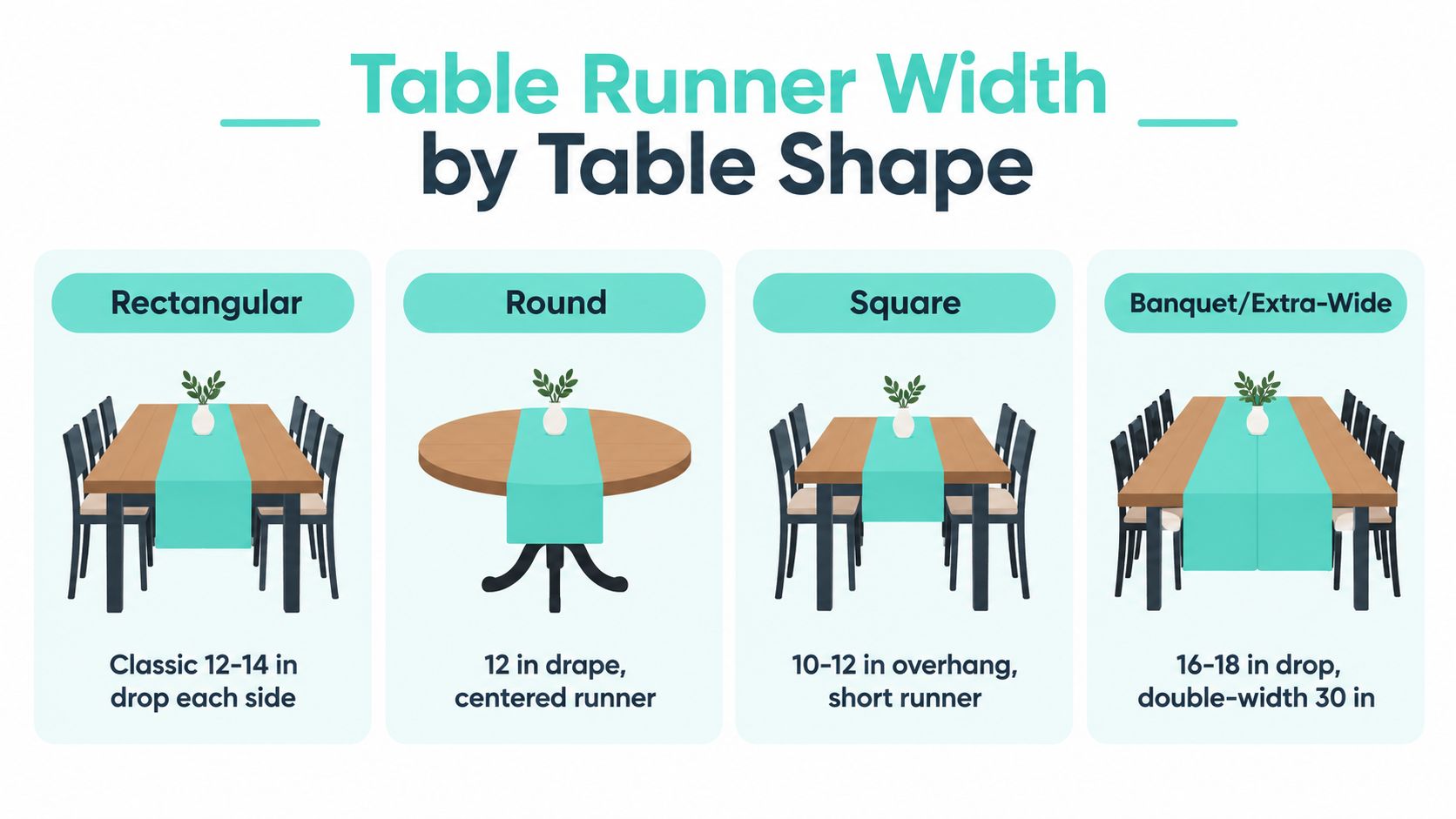
Table shape changes how a runner frames the setting. Rectangular tables usually call for a long centerline, while round and square tables depend more on centered placement, edge clearance, and how the fabric interacts with place settings.
What changes on a round table?
Use the tabletop diameter as the effective width when selecting a runner. The American Sewing Guild also recommends this approach. A centered runner may cross the diameter, stop short of the edge, or extend from one side to the other with a measured drop.
A narrow strip keeps attention on one centerpiece and leaves more room around each setting. A wider runner creates a stronger foundation, but it can crowd the circular arrangement. Check the runner from every seat. A front-facing view may conceal uneven centering, especially on a custom piece whose plush fabric shifts as it drapes.
For sewn runners, mark the center points before cutting. That simple step matters more on a round table because even a small offset remains visible from several angles.
How should square tables be styled?
Square tables support two practical layouts. Run one runner through the center in either direction, or cross two runners beneath the centerpiece to form a grid. Crossing runners adds structure, yet it also puts more fabric beneath plates, serving pieces, and hands reaching across the table.
A short centered runner should leave enough visible tabletop around the design. The goal is a balanced frame, not maximum overhang. Solino Home's table runner measuring guide also emphasizes proportion, layering, and table function rather than one universal width.
When is a banquet table too wide for a standard runner?
Long banquet and extra-wide tables can make a standard runner appear undersized. 16- to 18-inch widths can maintain visual authority, while a specialty design may go wider when fuller coverage is intentional, according to Solino Home.
Test a double-width arrangement with the actual centerpiece and place settings before committing to fabric. A broad surface can support more textile, but additional width should organize the composition rather than just fill empty space.
Quilted accessories provide a useful proportion check. These free quilted placemat patterns can help you judge how much runner should sit beneath the centerpiece and how much tabletop must remain available for individual settings. For a commissioned minky runner, make that test with a fabric sample, since loft can make the finished width feel more substantial than the cutting measurement suggests.
Designing Custom Runners with Premium Minky
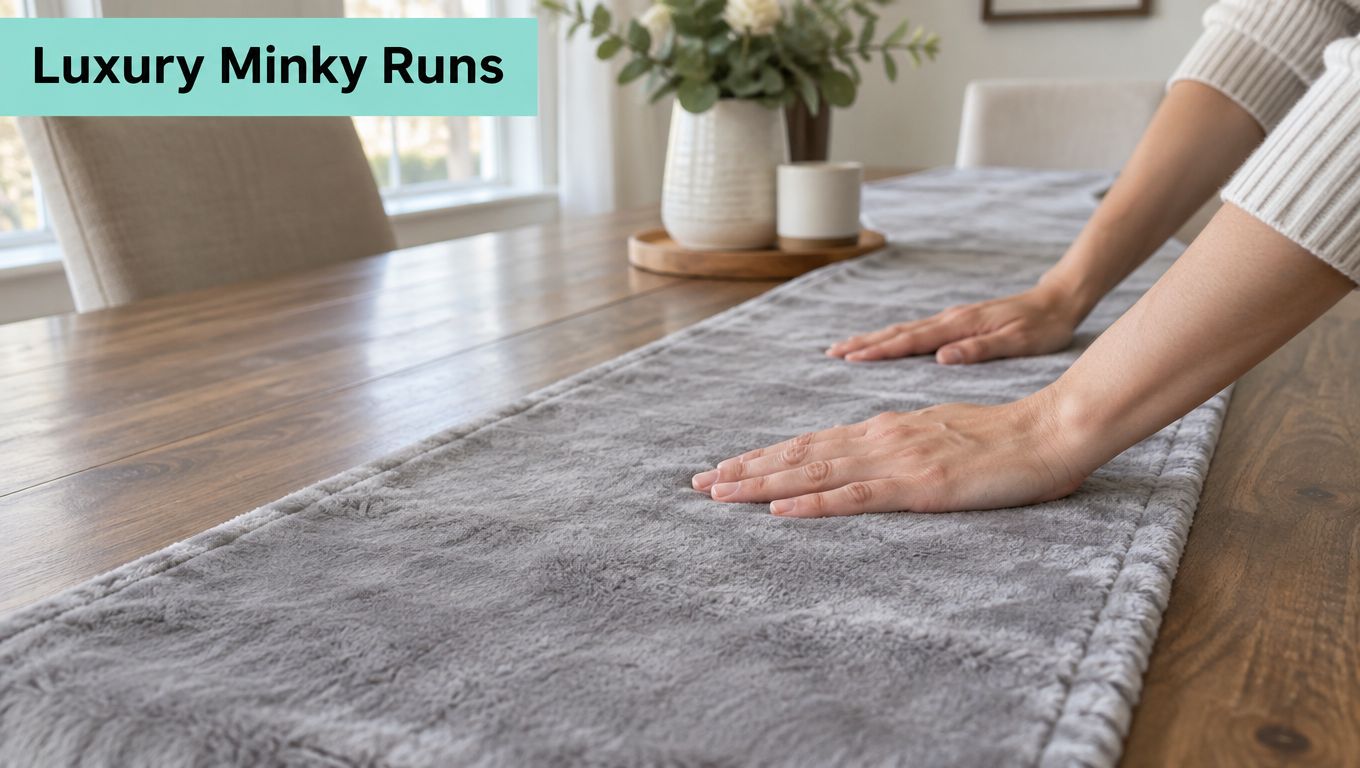
A custom runner made from plush fabric doesn't behave like a flat cotton strip. Pile height, surface texture, and drape all increase its visual weight, so the width that looks balanced on paper may feel fuller once the fabric is on the table.
Which minky textures suit a table runner?
Shannon Fabrics Cuddle and Luxe Cuddle bring a soft, tactile finish to winter, holiday, and autumn tablescapes. Hide adds a high-pile, cozy look, Snowy Owl creates a plush winter mood, and Fawn offers a warm, organic texture that works well with wood tones and neutral dinnerware.
The same width can read differently across these surfaces. A low-profile fabric preserves a clean center stripe, while a loftier texture may need more breathing room around the edges so the table doesn't appear visually compressed.
A practical approach is to cut a sample strip, place it beneath the centerpiece, and view it from seated height. That reveals whether the fabric's pile makes the runner look broader than its measured dimensions.
For fabric behavior, this explanation of Cuddle minky fabric provides useful background before you plan a custom project. Makers who are developing a complete set of linens may also appreciate this guide to homemade table linens, especially for ideas about combining textures and finishes.
A wide cut can reduce the need for piecing when you want a substantial runner. It also lets you position the texture deliberately, rather than breaking the centerline with a seam.
What finishing details make minky practical?
Minky can shift while cutting and sewing, particularly when the pile is thick. Use a stable cutting surface, mark the wrong side clearly, and handle the fabric gently so the pile stays oriented consistently.
For a custom quilted runner, consider:
- A simple shape: Straight edges showcase plush texture without adding unnecessary construction difficulty.
- A stable backing: A compatible backing gives the runner more body and helps it lie smoothly.
- Careful edge finishing: Binding or a clean finished edge keeps the project looking intentional.
- A restrained quilting plan: Dense texture can compete with an already tactile surface, while widely spaced quilting preserves softness.
Elevating Your Runner with Professional Longarm Quilting
Professional quilting can solve a problem that proportion alone can't. A runner may have the right width and still slide, bunch, or look uneven when the top, batting, and backing aren't held together consistently.
Why does longarm quilting help plush fabric?
A longarm service adds structure across the full runner rather than relying on a few seams or hand-tacked points. The quilting pattern becomes part of the design, giving a plain centerline visual movement while helping the finished piece maintain a more stable hand.
This matters most when a runner uses plush fabric as the surface. Minky's softness is appealing, but its loft can make layered construction harder to manage on a domestic machine. Professional equipment and an appropriate edge-to-edge pattern can produce a more even finish without forcing the maker to wrestle with a bulky project.
The mail-in edge-to-edge longarm quilting service is particularly useful for quilters who have a finished top but don't own a longarm machine. The service description includes batting, thread, and free return shipping, which simplifies the finishing decision and makes the project easier to plan from the outset.
A runner should feel finished from the underside as well as the top. Even quilting and a clean edge are what make a decorative textile practical for repeated use.
When is professional finishing worth it?
Choose professional quilting when the runner is a gift, an heirloom-style project, or a feature piece that needs consistent texture. It also makes sense when the fabric is difficult to control, the design depends on uninterrupted quilting, or the maker wants to avoid bulky seams.
A domestic machine can still be the right choice for a simple runner. Straight-line quilting, careful pinning, and a manageable width may deliver exactly the casual finish you want. The trade-off is time, handling effort, and the amount of control required to keep the layers flat.
Think of longarm quilting as a finishing upgrade, not a replacement for good sizing. The service won't correct a runner that overwhelms the table, but it can help a correctly proportioned piece feel more polished and durable.
Finalizing Your Tablescape and Next Steps
The best table runner width balances three things: the tabletop's proportions, the placement of functional dinnerware, and the visual weight of the fabric. Start with one-third of the table width, then test the actual material in position before you cut or commission the finished piece.
What should you check before making the runner?
- Measure the usable tabletop: Include only the surface where the runner will sit.
- Mark the centerline: Check alignment from several viewing positions.
- Place representative dishes: Plates, glasses, and serving pieces reveal clearance problems quickly.
- Compare texture and scale: A plush Hide or Snowy Owl surface may need more visual breathing room than a flat woven fabric.
- Decide whether the runner is decorative or functional: A centerpiece strip can be narrower than one intended to support layered settings.
- Preview the finish: Use scrap fabric or paper before committing premium material.
The runner should support the room rather than operate as an isolated accent. Wood furniture, napkins, centerpieces, placemats, and lighting all affect how wide the textile appears. For broader decorating ideas, this guide to dining room table accessories offers useful context for building a coordinated setting.
For a handmade minky runner, a proportional design paired with professional quilting can deliver both comfort and presence. For a faster update, a ready-made textile or a simple fabric project may be the better fit. The right choice depends on whether you're solving a decorating gap, making a gift, or creating a durable piece for regular meals.
Final fitting test: Put the runner, centerpiece, and place settings on the table at the same time. If the table feels crowded before anyone sits down, reduce the width or simplify the layers.
If you're ordering materials, look for a shop that carries the specific Shannon Fabrics texture and cut width your project requires, with clear support for custom finishing. A first-order offer of 15% off and free U.S. shipping on orders over $70 can also make it easier to start with the fabric, backing, or finishing service your runner needs.
On Pins & Needles Quilting Co. offers premium Shannon Cuddle and Luxe Cuddle fabrics, including textures suited to custom table runners, plus mail-in longarm quilting with batting, thread, and free return shipping. Visit On Pins & Needles Quilting Co. to choose your fabric or book your finishing service, then turn the right table runner width into a polished piece for your home.