
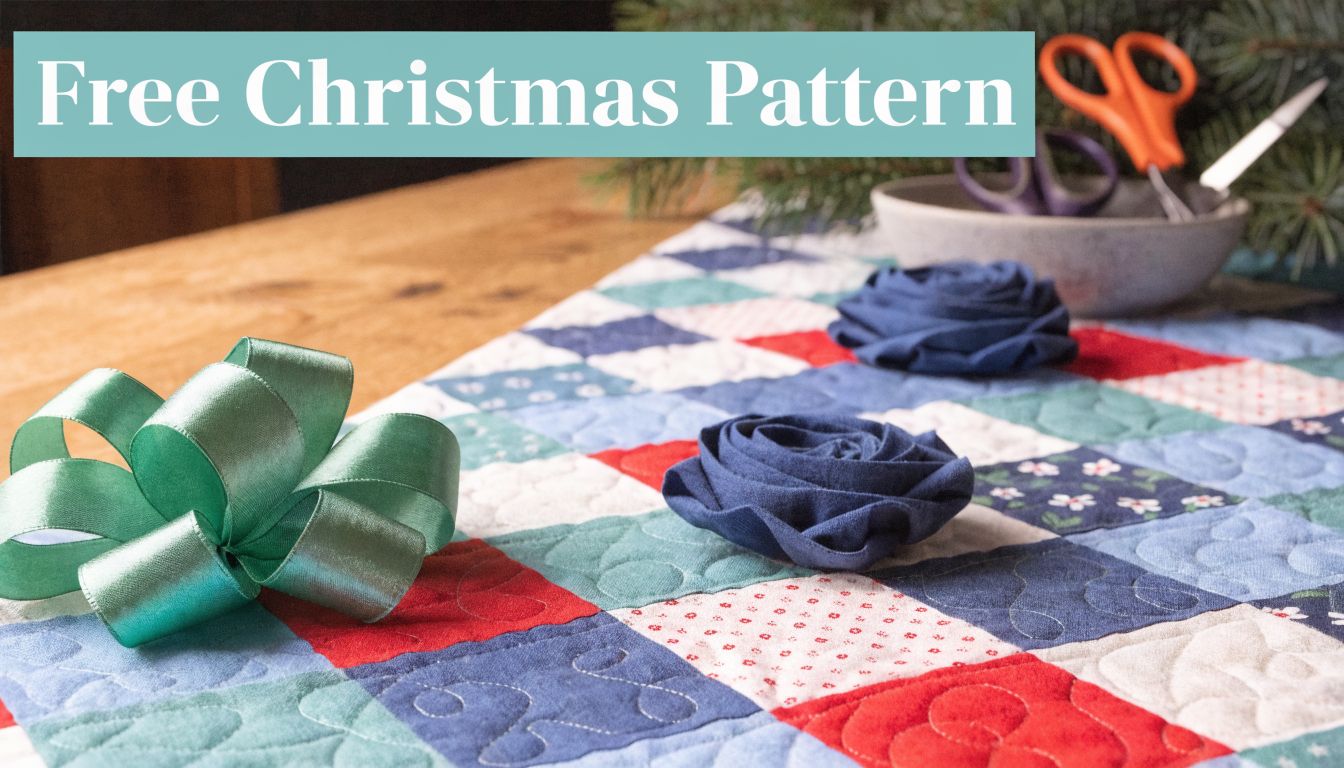
TL;DR: This free pattern provides everything needed to sew a festive Christmas table runner, including printable instructions, measurements, and special tips for using premium minky fabric for a luxurious finish. A practical beginner option is the strip-based runner that uses ¼ yard of a main color, ¾ yard of a background, and ⅛ yard of an accent, and that format has been noted for reducing fabric waste by up to 70% compared to full quilts.
The holiday table always seems to need one more handmade touch. Not a whole quilt. Not a complicated heirloom project. Just something cheerful, polished, and satisfying enough to finish before the season races ahead.
A good free pattern for christmas table runner solves that beautifully. The catch is that most free patterns are written for quilting cotton only, while many sewists want the softness and richness of minky. That gap matters, especially when quilting forums show 30% of holiday project queries mention minky substitutions and Google Trends shows a 45% year-over-year spike in searches for “minky Christmas table runner pattern” as of late 2024, as noted in this QuiltingBoard discussion about free holiday runners.
Your Guide to a Stunning Handmade Holiday Runner
A Christmas table runner is one of my favorite holiday makes because it gives quick visual payoff. You can cut it in an afternoon, sew it without committing to a full quilt, and still end up with something that looks thoughtful on a table, sideboard, or buffet.
That’s why this project works so well for gift-making too. A runner feels substantial, but it doesn’t demand the time or fabric of a bed quilt.

Why is this free pattern worth making
The best free holiday patterns have one thing in common. They keep the piecing friendly. Straight strips, easy nesting, simple borders, and clear measurements beat fussy construction every time when December gets busy.
This pattern follows that logic. It’s practical, forgiving, and easy to personalize with prints, solids, or a soft backing.
A lot of sewists also want a project that feels more luxurious than basic cotton. That’s where minky changes the look and feel. It turns a simple runner into something giftable and cozy, especially if you want a plush backing or a soft winter texture on the front.
What makes minky different from standard cotton
Cotton behaves. Minky negotiates.
That doesn’t mean minky is difficult. It means it needs a few deliberate choices. You have to respect stretch, watch nap direction, and keep your layers from shifting. Most free tutorials skip that part, which is exactly why people end up frustrated with puckering or wavy edges.
A simple pattern gets elevated fast when the fabric choice adds softness and depth, not just color.
If you’d like extra inspiration for motifs and quilting layouts, this holiday pattern gallery is a useful place to compare seasonal styles before you cut.
What Do You Need for Your Festive Table Runner
Holiday tables get handled hard. Platters slide, candles drip, kids tug corners, and if a runner is too stiff or too delicate, it shows by New Year’s Day. Good materials solve a lot of that before you sew the first seam.

Which fabrics and notions should you gather
For the strip-based runner with a 16″ x 49″ finished size, gather ¼ yard blue, ¾ yard white, and ⅛ yard black for the top, plus batting and backing cut slightly larger than the finished size for quilting, and 4 strips at 2¼″ width of fabric for binding, based on the published cutting method noted earlier from Alanda Craft’s 2024 tutorial.
That supply list gives you a reliable cotton version. If you want a softer, more gift-worthy finish, add Shannon Cuddle minky on the back instead of standard quilting cotton. That one choice changes the feel of the whole project, and it is the part many free table runner patterns skip over.
Keep the tool list simple and sharp:
- Rotary cutter: Fresh blades matter. Minky and layered cotton both show ragged cuts fast.
- Acrylic ruler: Useful for clean strip cuts and accurate trimming.
- Cutting mat: Helps long cuts stay square.
- Walking foot: Worth using if minky is involved anywhere in the sandwich.
- Fine pins or clips: Clips often work better on plush fabrics because they do not distort the pile as much.
- Iron and pressing surface: Use them for the cotton top. Keep heat low and controlled around minky.
- Polyester thread: A good choice for mixed-fabric projects because it handles a little movement without snapping.
Fabric Choice Face-Off
| Feature | Quilting Cotton | Shannon Luxe Cuddle Minky |
|---|---|---|
| Handling while cutting | Stable and crisp | Softer, stretchier, needs more control |
| Pressing | Easy to press sharply | Needs low heat caution and gentler handling |
| Piecing | Predictable at ¼-inch seams | Better with a walking foot and less handling |
| Texture | Classic quilted look | Plush, soft, high-end feel |
| Best use in this project | Entire top, binding, pieced units | Backing, borders, or selective feature areas |
| Common mistake | Over-handling bias edges | Ignoring nap direction and stretch |
I usually recommend cotton for the pieced top and minky for the backing if this is your first runner with plush fabric. You get the clean points and straight seams cotton is known for, plus the softness and drape that make the piece feel special.
Using minky on the front can work, but it asks more of your cutting, pinning, and quilting. That trade-off is fine for experienced sewists. For a fast holiday finish, a minky backing is the smarter choice.
What batting works best
Low-loft batting gives this project the nicest balance of body and flexibility. The runner still lies flat on the table, but it has enough structure to quilt well and enough softness to pair nicely with plush backing.
If you are comparing options, this batting collection by loft and fiber makes it easier to match the batting to the finish you want.
One practical rule helps here. The plusher the backing, the simpler the quilting should be. Dense quilting can flatten minky and make the runner feel heavier than it needs to.
New shoppers can get a 15% first-order discount, and orders over $70 qualify for free U.S. shipping, which is useful if you want to pick up batting, backing, and binding at the same time.
What works best for a polished finish
A few combinations consistently give good results:
- Cotton top with minky backing: The easiest upgrade for a richer holiday runner.
- Cotton top with minky border accents: Adds texture, but still takes more care than minky on the back only.
- All-cotton top and backing: Best for maximum crispness and the fastest finish.
The least forgiving combination is lofty batting plus stretchy backing plus a dull blade. Small projects make those problems obvious. Clean cuts, stable piecing, and controlled bulk matter more on a table runner than many sewists expect.
How Should You Prepare and Cut Your Fabric
Accurate cutting does most of the heavy lifting in a runner like this. If the strips are straight and the sub-cuts stay square, the sewing becomes calm and predictable. If the cutting drifts, you’ll chase alignment the whole way.

A practical reason this style remains so popular is efficiency. The rise of free Christmas table runner patterns in the 2010s included an early 2012 Alanda Craft tutorial showing a runner could be finished in under a day, and the later strip-based version uses ¼ yard of a main color, ¾ yard of a background, and ⅛ yard of an accent, reducing fabric waste by up to 70% compared to full quilts, as noted in this Alanda Craft tutorial reference.
What should you cut first
Start with the cotton pieces for the top.
For the strip-based method, cut:
- Main fabric strip: 6½″ x width of fabric
- Accent strip: 3½″ x width of fabric
- Background strips: 1½″ x width of fabric, enough for the block units
- Border pieces: Cut from remnants to 14½″ lengths as needed for the short borders
Keep the strips flat on the mat. Don’t let the selvage pull inward while you cut, or your strip width will wander.
How do you keep the cuts square
A few habits help more than fancy tools:
- Align the ruler with printed lines on the mat: Don’t trust the fabric fold alone.
- Trim one clean edge before measuring strips: Starting from a crooked edge compounds every cut.
- Cut with steady pressure: Choppy cuts can nick plush fabrics and wobble across cotton.
- Stack sparingly: One or two layers are safer than a tall stack on this kind of precise project.
If you plan to send your finished top out for professional quilting later, it’s smart to read prep requirements before you sew borders on. These quilt prep instructions are helpful for avoiding avoidable finishing issues.
How should you cut minky without fighting it
Minky needs a different rhythm. It isn’t difficult, but it rewards patience.
Use a fresh rotary blade and cut from the back side if that lets you see the grain and nap more clearly. Keep the fabric supported on the table so its own weight doesn’t stretch it while you’re measuring.
Pay attention to nap direction if you’re using a texture like Hide or Snowy Owl. If one border strip is cut with the nap reversed, it can look like a different shade even when it’s the same color.
Cut minky in one consistent direction whenever possible. The project looks more intentional, and the texture reads more evenly under holiday lighting.
Here’s a visual walkthrough if you prefer to see strip cutting in motion before starting.
What should you avoid while cutting
The most common mistakes are simple:
- Don’t lift and shake minky repeatedly: It stretches more than you think.
- Don’t cut with a dull blade: Plush fabrics especially show drag.
- Don’t ignore lint and fluff: Clear your mat and ruler often for accuracy.
- Don’t rush sub-cuts: Even a small angle error shows up when blocks are alternated.
The cleanest runners usually come from slow cutting and faster sewing, not the other way around.
How Do You Sew the Table Runner Top
A holiday runner starts to feel real the moment the first strip set comes off the machine. With cotton alone, this stage is straightforward. With Shannon Cuddle minky in the design, the same steps still work, but cleaner results come from a little more control at each seam.

How should you build the strip sets
Sew the strips into their units first, using a consistent 1/4-inch seam allowance. Press those seams before you sub-cut anything. Once the strips are cut into repeat units, lay them out on a flat surface and alternate the direction of the blocks so the design has movement instead of reading like straight bars.
That order matters. If the strip sets are off even a little, every piece after that carries the same error.
For a runner with minky accents, I like to keep the minky pieces simple and place them where the texture can stand out without creating too many bulky seam intersections. Narrow borders, center panels, or larger feature strips usually behave better than tiny pieced minky units.
Why does pressing matter so much
Pressing sets the shape of the top. A well-pressed runner goes together faster, nests more cleanly, and lies flatter when you quilt it.
Press one row in one direction and the next row in the opposite direction. That gives you seams that lock together at intersections instead of sliding past each other. On a small project, that one habit makes a visible difference.
Minky needs a little restraint here. Use heat carefully, avoid crushing the pile, and press from the cotton side whenever possible. I do not iron minky back and forth. I press, lift, and move on.
What does a smooth assembly order look like
A practical sequence keeps the top square:
- Sew the long strip sets first: Consistency is easier to maintain on repeated seams.
- Press the strip sets before sub-cutting: The units come out more accurate.
- Sub-cut and lay everything out before row assembly: It is much easier to catch a rotated unit on the table than after stitching.
- Nest seam intersections as you join rows: This reduces bulk and helps points meet cleanly.
- Measure the center before adding borders: Borders should fit the runner, not pull it into shape.
If you already know binding is the part you dread, it helps to read a clear quilt binding tutorial for beginners before you finish the top, because border accuracy affects how neat those final edges look.
How do you sew with minky in the mix
Minky changes the handling more than the construction. The stretch and nap can shift under the presser foot, especially on longer seams, so let the machine feed the fabric. Do not pull from the front or back.
A walking foot usually gives the best control here. I also prefer a slightly longer stitch length than I would use for tightly woven quilting cotton. The seam stays smoother, and the fabric is less likely to ripple.
Pin or clip a little more closely on minky than you would on cotton. That is one of those trade-offs worth making. It takes an extra minute, but it saves a lot of frustration with creeping layers and mismatched ends.
If a seam starts to wave, stop and check your handling first. Minky usually behaves well when it is supported and fed evenly.
What if your blocks don’t line up perfectly
Small errors happen, especially on a seasonal project with mixed textures. The fix is deciding which problems affect the finish and which ones are only visible when your nose is six inches from the table.
| Problem | Likely cause | Best fix |
|---|---|---|
| Points not meeting | Seam allowance drifted | Test your 1/4-inch seam on scraps, then resew the affected join |
| Runner looks bowed | Border was attached with stretch | Re-measure the center and cut borders to that length |
| Bulky intersections | Seams were pressed in one direction | Re-press adjoining rows in opposite directions |
| Top layer creeping | Minky shifted during stitching | Use a walking foot and add more clips on the next seam |
Perfection is not the goal here. A runner that lies flat, holds its shape, and shows off that soft Cuddle texture across the holiday table is a successful finish.
Batch sewing helps with that. Stitch all the same seams while your machine settings are working well, then press, then cut, then assemble. It is the most reliable way to keep a mixed cotton-and-minky top looking polished.
How Do You Finish Your Quilted Table Runner
Finishing is where the runner turns from a pieced top into a durable holiday piece for use. The layers need to stay aligned, the quilting needs to support the fabric choice, and the binding needs to sit flat at the corners.
How do you make the quilt sandwich
Lay the backing wrong side up, then batting, then the pieced top right side up. Smooth each layer as you go instead of trying to flatten everything at the end.
With minky backing, support the fabric on a large surface so the plush doesn’t stretch under its own weight. Baste thoroughly. More clips or pins usually help more than fewer when the backing is soft.
Should you quilt it at home or send it out
Both approaches are valid. The right one depends on the finish you want and how much wrestling with layers you enjoy.
For home quilting, simple straight lines are usually the best fit for a runner like this. They suit the strip-pieced design, and they’re easier to control on a domestic machine.
A practical home method looks like this:
- Start in the center: Work outward to reduce shifting.
- Use a walking foot: Especially important if the back is plush.
- Choose straightforward lines: Follow seams or echo the block shapes.
- Check the back often: Minky can fold under if you stop watching it.
- Trim only after quilting is complete: That keeps all three layers square together.
A small holiday project is the perfect place to be conservative with quilting. Straight lines almost always look better than an overcomplicated motif done in a rush.
If you want a more polished finish without handling the bulk yourself, mail-in longarm quilting is the easier path. It removes the hardest part of the job, especially when plush backing is involved. The appeal is simple: less struggle, cleaner stitching, and a finish that looks ready to gift.
How should you bind the edges
Binding tidies the project and protects the edges from wear. For this runner style, use the prepared binding strips and join them into one long strip before attaching.
Fold the binding in half lengthwise and press. Sew it to the front first, mitering the corners as you go, then wrap it to the back and stitch it down by hand or machine.
If you’re newer to this stage, this beginner-friendly guide on how to bind a quilt for beginners is worth keeping open while you work.
What gives the runner a crisp final look
A few finishing habits make a big difference:
- Trim with a ruler after quilting: Don’t eyeball the edges.
- Keep binding width consistent: Uneven binding is noticeable on a narrow project.
- Reduce bulk at corners: Especially if your backing is minky.
- Give it a final gentle smoothing, not aggressive pressing: Plush fabrics don’t like high heat.
What doesn’t help is overworking the finish. If the runner lies flat, the quilting is secure, and the binding is even, it’s done. Holiday projects should earn use, not perfectionism.
What Are Some Optional Design Variations
Once you’ve made one runner, it’s hard not to imagine the next version. That’s one reason this category stays popular. The base project is simple, but the surface design can go in many directions.
Could you switch to a Christmas tree layout
Yes, and it’s a smart variation if you enjoy strip projects. The Christmas Tree Table Runner from Center Street Quilts creates a 64″ x 12″ runner from 12 strips of 2½″ fabric, and that kind of efficiency pairs well with extra-wide plush backing because one width can back 5+ runners without piecing, as shown in the Center Street Quilts Christmas Tree Table Runner tutorial.
That’s useful if you’re batch sewing gifts or making coordinated holiday décor for multiple rooms.
Which minky textures suit holiday runners best
Different textures create very different moods.
- Hide: A richer, dimensional look that feels especially good for a statement backing.
- Snowy Owl: Bright and wintery, great for snowy palettes and crisp contrast.
- Fawn: Softer texture visually, nice when you want subtle interest instead of drama.
A smooth cotton top with one of these textures on the back usually looks more refined than trying to combine too many plush textures in the piecing itself.
What other layout changes are worth trying
A few easy variations keep the same basic construction but shift the style:
| Variation | Best for | Trade-off |
|---|---|---|
| Scrappy strips | Stash busting and casual charm | Can look busy if values are too similar |
| High-contrast modern palette | Clean, graphic holiday décor | Less traditional Christmas feel |
| Tree blocks with plush backing | Giftable statement piece | Slightly more cutting and layout work |
| Wide minky border | Soft, luxe frame | Requires careful handling on long seams |
Some of the best runners come from limiting the idea, not expanding it. One strong print, one quiet background, one plush texture. That combination rarely fails.
If you’re sewing for a specific room, match the runner to the room’s finishes rather than defaulting to red and green. Cream, blue, black, and metallic-inspired neutrals can feel just as seasonal and often work longer into winter.
Your Questions About Minky Table Runners Answered
Can beginners really use minky on a table runner
Yes. The easiest entry point is a cotton top with minky backing.
That keeps the piecing stable while still giving you the softness people love. Beginners usually struggle more with fully pieced minky tops than with minky as a backing or border.
Should you iron minky
Use caution with heat. Plush fabrics don’t respond like quilting cotton.
If you need to smooth it, use the gentlest approach your fabric can tolerate and avoid treating it like a crisp cotton seam that needs aggressive pressing.
What if the runner isn’t perfectly straight
Small imperfections usually disappear once the runner is on a table. The eye sees the festive whole, not every tiny variance.
If the runner lies flat and the quilting is secure, you’ve done the important part well.
How should you wash a finished minky runner
Wash it gently and avoid harsh treatment. The goal is to preserve softness and keep the quilting stable.
For a deeper primer on what makes this fabric behave differently from cotton, this explainer on what cuddle minky fabric is is helpful.
Is a free pattern for christmas table runner worth making as a gift
Absolutely. It’s one of the best holiday projects for that purpose.
It’s useful, fast enough to finish, and easy to personalize through print, color, and texture. A well-made runner with a plush backing feels more special than its size suggests.
What’s the best mindset for this project
Treat it like décor you made with care, not a test of technical perfection. Holiday sewing should still be enjoyable.
Hundreds of verified reviews across specialist quilt shops tell the same story in practical terms. Sewists come back to minky when they want softness, comfort, and a finish that feels luxurious without requiring a giant project.
If you’re ready to turn this free pattern for christmas table runner into something softer and more giftable, browse On Pins & Needles Quilting Co. for premium Shannon Cuddle and Luxe Cuddle textures like Hide, Snowy Owl, and Fawn, plus extra-wide backings and mail-in longarm quilting. New customers can get 15% off their first order, and U.S. orders over $70 ship free. Shop the Luxe Cuddle Collection