
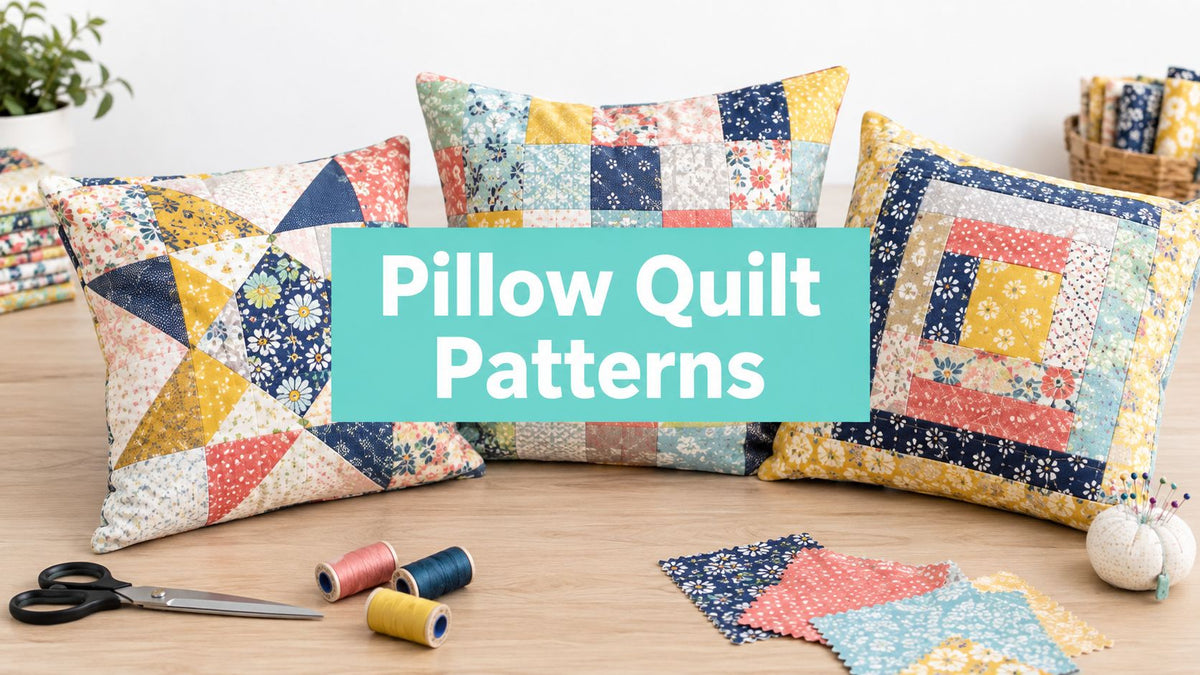
Pillow quilt patterns are easiest to choose when you match the source to your skill and fabric: OPN pillow kits offer the fastest coordinated finish, while Shannon Fabrics patterns provide the most targeted guidance for Cuddle and Luxe Cuddle. The best starting point is a manageable pillow size, a front design you can construct accurately, and a backing fabric that supports the intended finish.
That combination matters because a pieced cotton front behaves differently from plush minky, especially around seams, nap direction, closures, and quilting density. The seven sources below move from ready-to-finish OPN pillow kits through large pattern retailers, modern indie design, free project libraries, and Cuddle-specific guidance.
You'll see how each option handles pattern access, construction support, finished dimensions, and fabric compatibility. OPN's pillow kits, forms, Quilting Cuddle, and Luxe Cuddle textures such as Hide, Snowy Owl, and Fawn are especially useful when the goal is a soft, coordinated gift rather than a long bed-quilt project.
The renewed interest in heritage patchwork also makes small pillows commercially relevant. Crazy quilt pillows became closely associated with the Victorian decorative arts boom from 1876 to 1905, and one historical account connects their emergence with America's Centennial year and the Philadelphia Centennial Exposition. Historical background on crazy quilt pillows helps explain why antique-inspired surface design still feels current.
If you're new to small-format sewing, compare these approaches with easy no sew pillows for children before committing to a pieced or plush construction.
Which pillow quilt patterns are the best starting points?
A pillow pattern should match the fabric and finish before it matches the trend. A coordinated kit removes sizing guesswork, a major retailer supports broad style exploration, an independent designer may teach modern piecing more clearly, and a Cuddle-specific project addresses the handling issues that plush pile creates.
The seven sources below follow a practical progression, from ready-to-finish OPN pillow kits through traditional and modern pattern libraries, free project collections, and Shannon Fabrics guidance for Cuddle and minky. Each option makes different demands on cutting accuracy, seam control, backing choice, and insert fit.
1. Pillow kits and pillow forms from OPN Quilting
In practice, a coordinated kit with a matched form removes the most common fit error: cutting a cover before choosing the insert. OPN's Pillow Kits and Pillow Forms collection brings together Sweet Dreamz pillow kits in Luxe Cuddle fabrics with Cuddle Dreamz forms in accent, square, body, and bolster shapes. You can select the outer fabric and form as one project rather than trying to make two separate purchases work together.
That makes the collection practical for gifts, nursery décor, and soft accent pillows. The form establishes a dependable finished target, while the curated fabric choices keep the colors and textures coordinated. For a maker who wants to sew rather than source every component, that reduction in preparation has real value.
The trade-off is a narrower range of choices than a large pattern or fabric marketplace. You may not find every color, motif, or specialty shape. Product photos also cannot fully communicate the hand and nap of minky, so read the fabric name and texture description carefully before ordering.
Practical rule: Decide whether the pillow is decorative, cuddly, or supportive before choosing the form. A plush accent pillow and a body pillow need different construction priorities.
Shannon Fabrics textures change the visual result even when the construction remains simple. A raised surface such as Hide can give a plain pillow front more dimension. Snowy Owl and Fawn create a tactile finish without requiring a complicated patchwork block. Before cutting, review OPN's guide on how to cut minky fabric without the mess. Cut with the nap direction in mind, keep the pile out of the seam allowance where possible, and plan the closure around the thickness of the fabric.
The OPN Pillow Kits and Pillow Forms collection also suits makers producing finished goods in small batches. Matched forms make sizing more repeatable, kits shorten sourcing time, and small pillows are easier to package than full-size quilts. The form still needs checking before production, because a repeatable result depends on consistent cutting, seam allowances, and closure placement.
2. Missouri Star Quilt Co. for broad pattern discovery
A broad catalog is useful when the pillow needs to relate to a larger quilt or a particular decorating style. Missouri Star Quilt Co.’s pillow pattern collection gathers traditional, novelty, appliqué, and pieced options in one established source. Printed patterns, selected PDF options, and video tutorials let you compare the visual design with the amount of construction support available.
MSQC works well for a companion pillow or sham. You can repeat a block, fabric family, or appliqué idea without making an entire second quilt. That approach is especially helpful when a pillow needs to coordinate with bedding or a room rather than stand alone.
Access format is the main limitation. Some titles are paper patterns instead of instant downloads, and availability can change. If the pillow is planned for a fixed gift date, confirm that the instructions are available in the format you can use immediately.
A printed pattern remains useful beside the sewing machine, particularly for makers who prefer marking and notes on paper. Check the finished size, skill level, closure method, and fabric assumptions before cutting. A pattern written for standard quilting cotton may require adjustments when the backing is plush.
For a Cuddle adaptation, keep the pieced front in quilting cotton and use Shannon Cuddle for the reverse only when the seam structure can handle the thicker, shifting fabric. Keep the nap oriented consistently. A cotton seam allowance does not automatically behave the same way when plush pile is caught in the seam, so baste and handle the layers with care.
3. Fat Quarter Shop for PDF patterns and coordinated projects
Makers who want downloadable instructions and designer variety will find a useful range in Fat Quarter Shop's pillow patterns. The category includes pillow designs as well as quilt-and-pillow-sham projects. Product details can help you check finished dimensions and construction before buying.
The source is well suited to coordinated home décor. Matching kits and single-block kits make it easier to repeat a design across a pillow, table accent, or larger quilt without estimating the fabric requirements from scratch.
PDF access saves time. You can print the instructions when ready to sew, and sew-along materials can clarify piecing order, pressing direction, and block assembly. Those details matter on a small project because a minor alignment error is easy to see across the front.
Check the printed scale before cutting templates. A printer setting error can turn accurate patchwork into an insert or closure problem.
Premium designer patterns can cost more than free resources, and companion kits or notions may sell out separately. The pattern category is therefore strong for design discovery and coordinated projects, though it may not be the most convenient place to source every material.
For fabric planning, OPN's guide to fat quarter bundles helps separate the needs of a pieced cotton front from those of a plush backing. A structured block usually benefits from stable cotton. A Cuddle reverse can provide softness without requiring every patch to be cut from pile fabric.
4. Suzy Quilts for modern piecing
Suzy Quilts fits a contemporary, graphics-forward pillow front. Photo-rich instructions, videos, modern color relationships, and pillow or sham finishing guidance support a project that looks deliberate rather than traditionally ornamental.
Modern blocks can pair beautifully with plush fabrics when the materials have clearly defined roles. Use crisp cotton or another stable woven fabric for intricate front piecing, then use Luxe Cuddle for tactile contrast on the reverse. Small plush sections are harder to align and press, and the pile can hide seam lines that need to remain visible.
The teaching support is the main strength. Clear photographs show how pieces should meet, while finishing tutorials explain envelope backs, flange details, and insert fit. This guidance helps when the project combines a quilted front with a soft, dimensional backing.
The catalog is smaller than those of major retailers, popular designs may be seasonal, and most offerings are PDFs. Makers who want paper patterns may find fewer suitable choices. Before starting, check whether the finished dimensions match the form you already own.
Use OPN's resource on easy quilt block patterns to judge whether a modern block suits your first pillow. A bold, simple block often gives the plush reverse more visual space than a crowded design, especially with textures such as Hide or Fawn.
5. Riley Blake Designs for free patterns
A free library is a sensible place to test construction before purchasing a premium pattern. Riley Blake Designs' free sewing patterns includes seasonal projects, panel-based designs, and quilted pillow ideas, with downloadable instructions and materials lists.
These patterns can help you practice an envelope back, panel finish, or simple pieced front before using more expensive fabric. They also let you evaluate how you handle a small project, including pressing, turning, clipping corners, and fitting the insert.
The weakness is discoverability. Pillow projects appear among many other sewing categories, so browsing takes time. The styles also vary by collection, and some projects may feel less suited to current décor than newer independent designs.
Panel-based projects can be forgiving for beginners because the visual focus is already established. Makers selling finished pillows should assess whether the design feels distinctive enough for their customers and whether the cutting instructions support consistent repeat production.
OPN's free quilt pattern resource gives you another place to compare ideas before shopping. Pairing a simple free front with a premium Shannon Cuddle backing can control piecing costs while preserving a soft, giftable finish. Keep the front and back construction compatible, especially if the pattern was written only for woven fabrics.
6. Moda Fabrics for free downloads and seasonal pillows
Official project PDFs make Moda Fabrics' free-pattern hub useful for seasonal pillows, pillow shams, and quick projects designed around precuts. It suits gift-makers who want established instructions without starting with a paid pattern.
Moda is particularly practical for themed décor. Holiday motifs, collection-based palettes, and precut-friendly cutting can reduce design decisions when the pillow is intended for a season or a particular recipient. A clearly defined palette also makes it easier to add a plush reverse without creating visual conflict.
Finding the right pillow project may require searching through collection downloads. Some patterns assume familiarity with basic piecing terms, so read the materials and cutting sections before choosing fabric. Confirm the finished size rather than relying on the project photo.
Standard quilting techniques work well for a cotton front, but the backing needs its own plan. Plush fabric adds softness and contrast, yet it can stretch or shift more than woven cotton. Baste generously, keep pile away from seam allowances where possible, and compare the finished cover with the intended insert before closing it.
Moda offers a low-risk starting point for seasonal sewing. Once the construction feels comfortable, you can choose a more specialized Cuddle project or select a matched form and plush fabric from OPN for the next version.
7. Shannon Fabrics for Cuddle and minky-specific guidance
When Cuddle or Luxe Cuddle is the central design feature, Shannon Fabrics' free patterns provides the most targeted guidance in this group. The project sheets focus on plush pillows and pillowcases, with supply lists, cutting instructions, kit tutorials, and videos written around pile fabrics.
That focus addresses problems conventional cotton patterns often leave unexplained. A standard pattern may show block assembly clearly while offering little help with nap direction, shifting layers, clipped pile, plush seam bulk, or changes to the final dimensions.
Shannon's projects are generally more plush-style than quilt-block focused. Choose another source if intricate traditional patchwork is the primary goal. Some downloadable projects may also refer to kits or materials that are no longer available, so check the supply list before committing.
The benefit is less trial and error. Instructions that account for Cuddle's behavior support better choices about clips, seam handling, closures, and edge finishing from the beginning. They also make it easier to decide whether a plush texture belongs on the front, the back, or both.
Fabric decision: Use a Cuddle-specific pattern when plush texture carries the design. Use a conventional quilt pattern when the patchwork front carries the design and plush fabric has a supporting role.
Before selecting a texture, read OPN's explanation of the difference between minky and Cuddle fabric. OPN's Quilting Cuddle collection suits softer quilt backs, while Luxe Cuddle textures work well when the surface itself should feel luxurious. Confirm the nap, stretch, and thickness before adapting any cotton pattern, because those characteristics determine how the finished pillow will feel and how accurately its edges will meet.
Pillow Quilt Patterns: Top 7 Source Comparison
| Item | Implementation Complexity 🔄 | Resource Requirements ⚡ | Expected Outcomes ⭐ / 📊 | Ideal Use Cases 📊 | Key Advantages 💡 |
|---|---|---|---|---|---|
| Pillow Kits and Pillow Forms (On Pins & Needles) | Low, kits + ready forms | Moderate, premium minky + forms | ⭐ High, plush, professional finish | Nursery, gifts, quick plush pillows | 💡 Curated kits + Shannon Cuddle; shop conveniences |
| Missouri Star Quilt Co. (MSQC) | Medium, varies by pattern/technique | Low–Moderate, patterns, pre-cuts/kits | ⭐ Good, coordinated quilt + pillow results | Traditional/home décor, learners | 💡 Large catalog, strong video/tutorial ecosystem |
| Fat Quarter Shop | Medium, designer PDFs, sew-alongs | Moderate, downloadable patterns + optional kits | ⭐ High, designer-quality outcomes | Sew-alongs, coordinated kit projects | 💡 Wide designer mix; frequent promotions/support |
| Suzy Quilts | Low–Medium, clear, photo-rich instructions | Low, PDF-focused; standard fabrics | ⭐ High, modern, polished results | Modern pieced fronts; beginner-friendly projects | 💡 Excellent clarity and multiple size options |
| Riley Blake Designs (Free Patterns) | Low, quick free projects | Low, free PDFs, panel-friendly | ⭐ Moderate, good for sampling techniques | Budget makers, panel-based pillows, testing ideas | 💡 Free brand-backed patterns; themed seasonal ideas |
| Moda Fabrics | Low–Medium, precut-friendly quick makes | Low, free downloads, precuts | ⭐ Moderate–High, consistent, gift-ready projects | Quick gifts, seasonal/holiday pillows | 💡 Centralized free hub; precut-friendly projects |
| Shannon Fabrics (Cuddle / Minky-Focused) | Low, patterns tailored for pile fabrics | Moderate, requires Cuddle/Luxe Cuddle materials | ⭐ High, optimized for plush/minky finishes | Minky/plush pillows, kid-friendly gifts | 💡 Minky-specific guidance, videos, kit tutorials |
How do these pillow quilt patterns compare?
How do you choose among pillow quilt patterns?
Start with the finish rather than the cover image. A decorative pillow with a pieced front needs accurate seams and a stable closure, while a cuddle pillow prioritizes softness, edge durability, and comfortable handling.
Use this selection guide:
- Choose the construction level. Select an OPN kit or a simple free project when you want a fast finish. Choose a modern or traditional PDF when the pieced front is the main attraction.
- Confirm the finished dimensions. Pillow patterns commonly target standardized sizes. One distributor lists finished sizes of 18 by 18 inches and 20 inches, while another describes patterns with paper templates and complete step-by-step instructions. Pattern size and template examples show why checking the finished measurement before cutting prevents insert mismatch.
- Match the fabric to the pattern. Quilting cotton gives sharper piecing; Cuddle and Luxe Cuddle provide softness and texture but need more control during cutting and assembly.
- Plan the closure. Envelope backs are accessible and washable, while zippers create a cleaner, more fitted finish but require more precision.
- Check the seam allowance. Quilted pillow instructions commonly call for an accurate 1/4-inch seam allowance. One documented construction example uses side border strips measuring 1 1/2 by 16 1/2 inches and top and bottom strips measuring 1 1/2 by 18 1/2 inches, then squares the block to 18 1/2 by 18 1/2 inches. Patchwork pillow construction details illustrate how quickly small measurement errors affect the final fit.
- Decide whether quilting is necessary. A pieced cotton front may benefit from quilting, while a textured plush fabric often supplies enough surface interest on its own.
For a plush finish: Cut with the nap running consistently, keep seam allowances free of excess pile where possible, and test the closure before attaching the final backing.
A quillow introduces a different construction problem because the pillow becomes part of a folded quilt. One documented sequence prepares 12 blocks, joins 9 blocks into a 3-by-3 quilt section, and uses the remaining 5 blocks for the pocket and pillow assembly. Quillow construction guidance is useful if you want a pillow that unfolds into a practical quilt rather than a fixed cushion.
For makers creating items to sell, simple heritage-inspired surfaces may be more commercially flexible than highly ornate novelty techniques. Trend coverage for 2026 points toward renewed interest in patchwork, heirloom looks, and visible hand-stitch aesthetics, while textile reporting emphasizes the appeal of hand-stitched appearance translated into surface pattern. Current patchwork and quilt décor direction supports choosing a restrained block, a nostalgic palette, or a small repeat that works across different rooms.
How should you finish a larger quilt project?
A small pillow usually doesn't need professional longarm quilting, but a pillow pattern can be the entry point to a larger quilted project. If the quilt top is complete and you don't have the equipment or time to quilt it, OPN's Mail-in Longarm service offers edge-to-edge finishing with batting, thread, and free return shipping included.
Mail-in preparation affects the result. A longarm checklist recommends pressing the top flat, trimming loose threads, packing the top and backing separately rather than basting them together, and placing both pieces in a protective plastic bag inside a sturdy shipping box. Longarm preparation guidance gives the practical packing details to follow.
For pillow-scale work, quilting at home may be faster because you can adjust the density and stop as soon as the layers are secure. For a bed quilt, professional finishing can remove the need to manage a large quilt sandwich on a domestic machine.
OPN also stocks extra-wide backing options for larger projects, including 90-inch and 110-inch choices, alongside 44 to 45 inch Quilting Cuddle and 80 inch Mirage. Extra-wide fabric can reduce the need for a center seam, but always compare the backing width with the actual quilt dimensions and pattern requirements before ordering.
Mail-in Longarm is the better fit when the project has outgrown your machine, not when a small pillow only needs a simple quilted front.
Which pillow quilt patterns suit current décor and gifting?
A pillow quilt pattern succeeds when its design, fabric, and finishing method suit the room or recipient. The smaller format uses less fabric than a bed quilt, yet it makes block proportions, color balance, texture, and workmanship easy to see.
Puff or pillow-style quilts have a long design history. They appeared in the fancy show-quilt fad of the late 1880s and 1890s, with a quilt historian identifying an 1882 Victorian-era “Raised Patchwork” example as the oldest dated one. The style returned during the quilting revival of the 1970s and 1980s, when polyester stuffing and recycled nylons were common fillers, and again during the 2010s and 2020s as retro and boho décor drew attention. Background on puff and pillow quilts places current plush designs within that history.
Current décor favors patterns that can be adapted without losing their shape. A simple panel works well for a nursery, while a restrained pieced front suits a housewarming gift. For seasonal projects, a free Moda or Riley Blake design can be paired with a plush reverse to add warmth and texture without complicating the front.
Gift construction should match use. A frequently washed pillow benefits from an envelope closure and a 1/2-inch seam allowance on Cuddle, which keeps pile away from the stitch line. A zipper can look refined, but its teeth and tape require more care around plush fabric.
Makers producing several finished pillows should standardize the insert, cut sizes, closure method, and seam allowance. OPN's pillow kits and forms can support that workflow, while coordinated Shannon Cuddle and Luxe Cuddle fabrics allow a repeatable pattern to gain tactile character.
A commercially useful pillow needs a design that photographs well, feels good in the hand, and can be constructed consistently.
How do you prepare pillow materials before cutting?
Begin by matching the insert to the finished cover. A cover that's too loose can look flat, while one that's too small may distort the seams and place unnecessary stress on the closure.
For pieced fronts, press fabric before cutting and follow the pattern's stated seam allowance. Accurate quarter-inch seams are especially important in small blocks because even minor variation accumulates around borders and can change the final square.
For Cuddle and Luxe Cuddle, keep the nap direction consistent across every piece. Mark the wrong side clearly, use clips instead of relying only on pins, and expect some pile to shed during cutting. The texture can hide small alignment problems, but it can't correct a cover that was cut inaccurately.
If the pillow uses a quilted front with a plush back, stabilize the cotton side before assembly and avoid over-quilting the plush layer. Excessive stitching can flatten the texture and make the finished pillow less supple.
For a removable cover, choose a closure that matches how the pillow will be used. An envelope back is approachable and easy to remove, while a zipper or bound opening can give a more polished finish. The pattern source should explain the closure sequence, but the insert size remains your responsibility.
Before mailing a larger quilt to a longarm service, press the top flat, trim threads, separate the top and backing, and pack them in a protective bag inside a sturdy box. That preparation protects the materials and gives the quilting service a clean starting point.
Choose your pattern and start sewing
Choose OPN's pillow kits and forms when you want the quickest coordinated plush project and don't want to hunt for a matching insert. Choose a large retailer such as Missouri Star Quilt Co. or Fat Quarter Shop when you want broad pattern discovery, designer variety, printed options, PDFs, and companion projects.
Choose Suzy Quilts for modern piecing and strong visual instruction. Choose Riley Blake Designs or Moda Fabrics when you want to experiment with free patterns, seasonal projects, panels, or precut-friendly construction before buying a premium design.
Choose Shannon Fabrics when the project depends on Cuddle or Luxe Cuddle behavior. Its plush-focused guidance is more useful than a generic cotton pattern when you need help with pile, nap, clips, cutting, and soft edge finishing.
Before cutting any of these pillow quilt patterns, confirm the finished dimensions, seam allowances, nap direction, backing behavior, and insert size. If you're adapting a cotton pattern to plush fabric, make a small test section first and check whether the seams stay flat without losing the texture that made you choose the fabric.
OPN's Mail-in Longarm service is better suited to a larger quilted project than a small pillow. The service includes batting, thread, and free return shipping, and OPN's hundreds of verified reviews provide useful reassurance when you're sending a completed quilt top for professional finishing.
For supplies, OPN offers Shannon Cuddle, Luxe Cuddle, Quilting Cuddle, pillow forms, curated fabric cuts, and ready-to-finish kits. New customers can use the 15% first-order coupon, and U.S. orders over $70 qualify for free shipping. Shop the Pillow Kits and Pillow Forms Collection to choose your form, texture, and next pillow project in one place.
On Pins & Needles Quilting Co. offers premium Shannon Cuddle and Luxe Cuddle fabrics, coordinated pillow kits and forms, and Mail-in Longarm finishing for larger quilt projects. Visit On Pins & Needles Quilting Co. to choose soft materials, use the 15% first-order offer, and start your next pillow quilt project with supplies selected for a professional finish.