
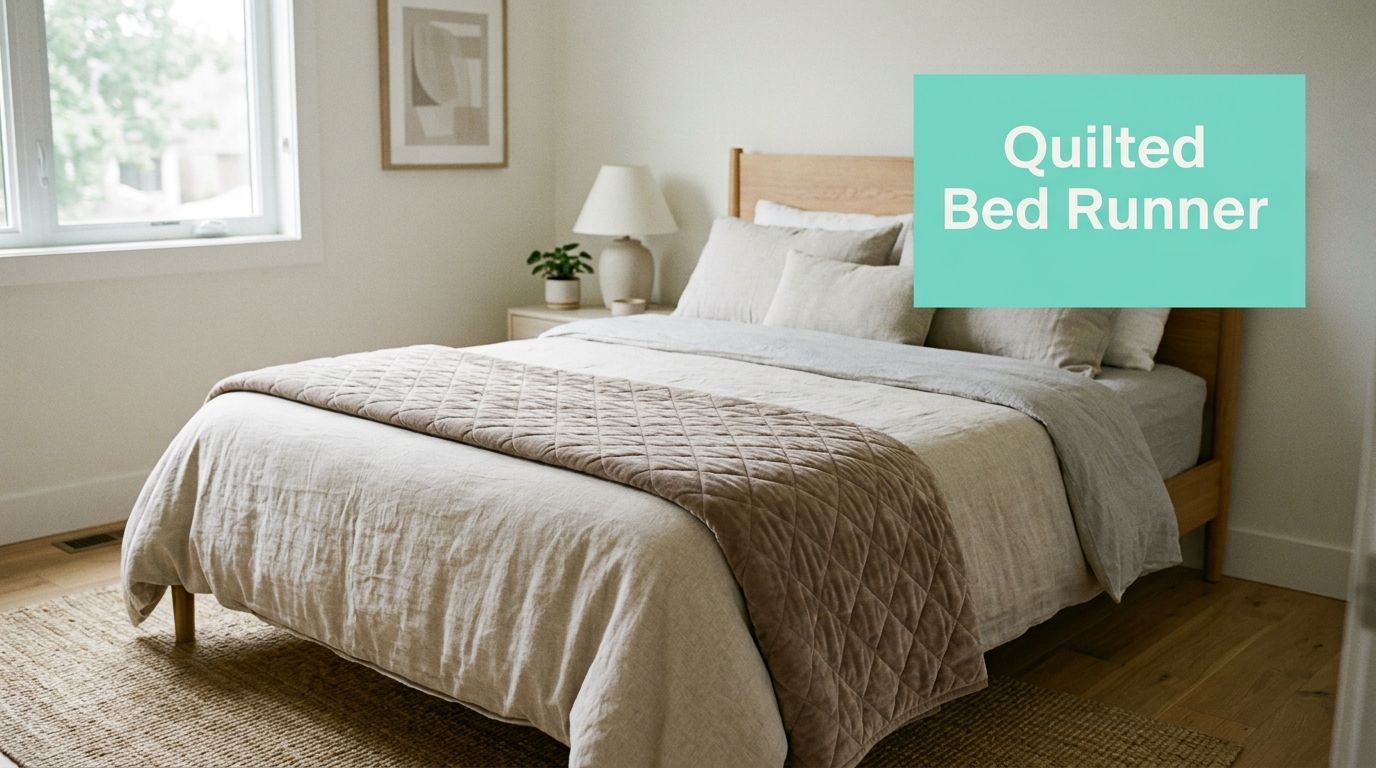
You've got a finished quilt top, or maybe a stack of gorgeous minky and a bedroom that still needs a polished finish. A quilted bed runner is the small project that gives you a big visual payoff, and the sizing choice matters more than the stitching drama.

What Is a Quilted Bed Runner and Why Make One
A quilted bed runner is the long, narrow layer that sits across the foot of the bed. It does two jobs at once, it adds color or texture, and it helps protect the duvet or sheets from dust, crumbs, and scuffs.
That's why it's such a good project for quilters who want a finish that feels complete without committing to a full bedspread. In quilting history, this kind of layered construction sits inside a very old tradition, one that historians trace back to at least 3400 BCE and that includes surviving quilt examples from the 14th century and an American quilt dated to 1704 (Britannica). The format may be smaller, but the idea is the same, stitched layers with purpose.
For home use, the bed runner also solves a practical decorating problem. It gives a guest room a hotel-style look, lets you rotate colors seasonally, and makes it easy to experiment with a texture like Luxe Cuddle without redoing the whole bed.
Quilters usually like runners because they're manageable. They use the same layered build as a full quilt, but with less fabric and less time.
Practical rule: if the room already feels finished, a runner should sharpen the bed, not overwhelm it.
The market for quilting still supports that kind of project. A 2003 U.S. survey reported more than 21 million quilters and 15% of households, with annual spending of $2.27 billion on supplies, and a 2014 survey estimated 16.4 million quilters and a quilt industry valued at $3.76 billion (American English PDF). That's the consumer base behind runners, accessories, and smaller stitched projects.
When I guide customers through fabric choices, I often point them toward Luxe Cuddle textures for this exact use case. A bed runner is the perfect scale for testing plush hand-feel without buying enough yardage for a full bed ensemble.
How to Size Your Quilted Bed Runner for Any Bed
Sizing is where most runners go wrong. Too short, and the piece looks accidental. Too narrow, and it reads like a stripe instead of a real bed-end accent.
A reliable rule is to draft the runner length from the bed's width plus the intended drop or overhang, then keep the width in the 18 to 24 inch range for a balanced look (QuiltingBoard). For a queen bed, one quilting discussion gives a useful example of about 84 inches long, based on the bed's 60-inch width plus 12 inches of overhang on each side (Missouri Star forum).
A simple sizing method that works
Measure the bed first, not the fabric. Then decide whether the runner is purely decorative or meant to hang enough to visually frame the mattress.
- Measure the bed width: Use the mattress or finished bed width as your starting point.
- Decide the overhang: A modest overhang keeps the runner looking intentional.
- Add seam allowance before cutting: This avoids ending up short after quilting and finishing.
- Test-drape before quilting: A quick bed test tells you whether the piece reads as balanced.
| Quilted Bed Runner Size Guide | Bed Size | Mattress Width | Runner Length (with 12" overhang each side) | Recommended Width |
|---|---|---|---|---|
| Size guide | Twin | Qualitatively smaller than queen | Bed width plus overhang | 18–24 inches |
| Size guide | Full | Qualitatively wider than twin | Bed width plus overhang | 18–24 inches |
| Size guide | Queen | 60 inches | 84 inches | 18–24 inches |
| Size guide | King | Qualitatively wider than queen | Bed width plus overhang | 18–24 inches |
The point of the table isn't to force one retail size. It's to show why a runner should be drafted to the bed, not pulled from a one-size-fits-all package.
A common mistake is making the runner too slim. On a king bed, that can make a carefully sewn piece look underscaled, even when the stitching is beautiful.
For yardage planning, I'd use the calculations in OPN's fabric yardage guide before you cut anything. It keeps the math tied to the actual bed footprint instead of guesswork.
Choosing the Right Luxe Cuddle Texture for Your Runner
The texture choice decides whether the runner feels indulgent or just bulky. For a bed runner, softness matters, but so does how the fabric behaves after repeated use.

Picking texture by room use
Hide reads as bold and tactile, so it works well when the runner is meant to be a focal point. Snowy Owl and Fawn lean softer in appearance, which makes them easier to layer into calm guest rooms or master bedrooms. Marble gives you visual movement without needing a busy print.
| Luxe Cuddle Texture Comparison for Bed Runners | Texture | Pile Height | Best For | Care Level | Durability Rating |
|---|---|---|---|---|---|
| Comparison | Hide | Plush, textured | Statement beds and contrast | Moderate | Strong when stabilized well |
| Comparison | Snowy Owl | Soft, fluffy | Guest rooms and cozy styling | Moderate | Good with gentle handling |
| Comparison | Fawn | Soft, smooth plush | Everyday master bedrooms | Easier | Very solid for frequent use |
| Comparison | Marble | Plush with visual texture | Decorative runners and mixed bedding | Moderate | Solid for layered looks |
That tradeoff matters because softness isn't the only quality shoppers feel. In bedding reviews, hand-feel and pilling are major concerns, and those concerns become more noticeable when a runner is touched daily (Architectural Digest).
For a runner that gets washed often, lower-pile textures usually hold their shape more cleanly. For a guest room piece that lives mostly at the foot of the bed, a plusher surface is easier to enjoy because it isn't taking constant wear.
Commercial runners are commonly made from 100% polyester or cotton-polyester blends such as 60/40, with published examples ranging from 120 gsm to about 370 gsm depending on fill and finish (Printify product page). Polyester is described there as resistant to stretching and shrinking, which is why it's the safer choice when you want low-maintenance shape retention.
If you're trying to choose a starting point, I'd look at Luxe Cuddle Fawn details for an everyday runner and keep the extra-wide 90-inch or 110-inch options in mind for larger backing needs. We also see plenty of first-time buyers use the 15% first-order coupon and the free shipping on orders over $70 to make the project easier on the budget.
Cutting and Piecing Your Minky Bed Runner Top
Minky looks forgiving on the shelf and slippery on the cutting table. That's normal. It just means you need a calmer setup than you would for cotton patchwork.
Start with a cleared surface, a self-healing mat, and a rotary cutter with a fresh blade. Pattern weights are the better choice here because pins leave holes and can distort the nap, especially on plush surfaces.

Keep the layers from drifting
Minky stretches if you tug it. Let the fabric rest flat before cutting, and always keep the nap direction consistent across all pieces.
A scant 1/4-inch seam works well for minky because it reduces bulk without swallowing your piecing line. If you're building a patchwork runner, cut your strips cleanly first, then sub-cut into squares or triangles for block work, the same way a traditional quilt top is built.
If the fabric is moving under your hands, slow down instead of forcing it. Minky rewards steady handling, not speed.
A walking foot or even-feed foot helps pull both layers through evenly. That matters on longer seams, where the top layer wants to shift just enough to create ripples at the edge.
For material planning, OPN's curated 2-yard and 2.5-yard cuts are practical starting points for bed runner projects. Those lengths are easier to handle on a domestic machine than a loose bolt-width scramble, especially when you're making a runner with borders or block units.
This cutting guide for minky is worth keeping open while you work, because the layout and trimming order matter as much as the seam line itself.
A good minky runner doesn't need complicated construction to look polished. It needs consistent grain, careful trimming, and enough patience to keep the pile from shifting under pressure.
Here's a short workflow that keeps things sane:
- Lay every piece in the same direction. Nap mismatch shows up fast under bedroom lighting.
- Cut with the rotary cutter, not scissors. Clean edges are easier to match.
- Use a scant seam allowance. Bulk drops quickly when the seam stays narrow.
- Press lightly, never crush the pile. Minky needs shaping, not force.
- Check the finished width before quilting. A small miscut gets obvious at the foot of a king bed.
Quilting Options for Your Finished Bed Runner
The quilting method should match the runner's size, your machine, and how polished you want the finish to feel. There isn't one universal answer, only trade-offs.
Domestic machine quilting is the most accessible path. It works well for smaller runners and simple linework, but larger pieces can become awkward fast, especially once batting and minky are both in play.
Choosing between home machine, quilt-as-you-go, and longarm
Quilt-as-you-go is a smart middle ground. A tutorial for this approach shows the runner assembled by sewing through the top, batting, and backing at the same time, then joining sections with a scant 1/4-inch seam allowance and finishing the join with strips, including one about 1 inch by 20 1/2 inches and another 1 1/4 inches by 20 1/2 inches (Create with Claudia).
Mail-in longarm quilting is the cleanest professional option when you want even stitch quality across the whole surface. OPN's mail-in edge-to-edge service includes batting, thread, and free return shipping, which removes a lot of finishing friction for runners and quilts alike.

| Quilting Method | Pros | Cons | Best Use |
|---|---|---|---|
| Domestic machine | Accessible, low setup cost | Harder to manage on larger runners | Smaller runners and simple quilting |
| Quilt-as-you-go | Reduces bulk and fits home setups | Requires accurate joining | Patchwork runners and sectioned builds |
| Mail-in longarm | Consistent stitch quality and professional finish | Requires shipping the project | Finished tops that need polished quilting |
If you're sending a runner for finishing, the backing should be at least 4 inches longer and wider than the top so the service has room to load and trim it correctly. OPN's edge-to-edge quilting pattern gallery is useful here because the motif choice changes the final feel as much as the fabric does.
I keep On Pins & Needles Quilting Co.’s mail-in longarm service in the conversation for customers who want a polished result without buying longarm equipment. For runners that need repeatable symmetry, that option usually makes more sense than forcing a domestic machine to do a large job it doesn't enjoy.
Finishing Touches and Styling Your Quilted Bed Runner
Finishing is where the runner stops looking handmade in the unfinished sense and starts looking intentional. Binding, blocking, and placement all affect how the piece lands on the bed.
Machine-sewn binding makes sense when the runner will be washed often or used in a busy room. Hand-finished binding gives a softer edge and a cleaner visual line, especially on a decorative piece that doesn't need heavy abuse.
Make the finish look deliberate
A flat runner is a better runner. If the layers have shifted during quilting, block the piece before styling it so the edges sit square and the surface lies calmly across the bed.
For design ideas, the shape and placement work especially well when paired with broader room styling. The 3D bedding design inspiration from BEDHEAD shows how layered textiles change the whole feel of a room, which is exactly why a bed runner can carry so much visual weight even though it's a small piece.
Care should match the fiber. Polyester runners are generally washed in cold water on a gentle cycle and tumbled on low heat, which helps preserve shape and reduce distortion. That matters because uneven loft or shifting fill shows up quickly at the edges after laundering.
Practical rule: if the runner is meant for frequent use, keep the quilting dense enough to stabilize the fill before you ever wash it.
Styling can be casual or formal. A loose drape feels relaxed and works well in family rooms or guest rooms, while a neatly centered fold at the foot of the bed creates the hotel look many buyers want. Seasonal rotation also works well here, because a runner is easy to swap without changing the whole bed.
If you want a clean binding finish before you send a piece out, this minky binding guide is a useful reference. It keeps the edge treatment aligned with the softness of the fabric instead of fighting it.
On Pins & Needles Quilting Co. carries Luxe Cuddle textures, extra-wide minky, and mail-in longarm finishing for projects like a quilted bed runner. If you're ready to turn your fabric into a polished bed accent, visit On Pins & Needles Quilting Co. and choose the fabric or quilting service that fits your room, your timeline, and your finish.