
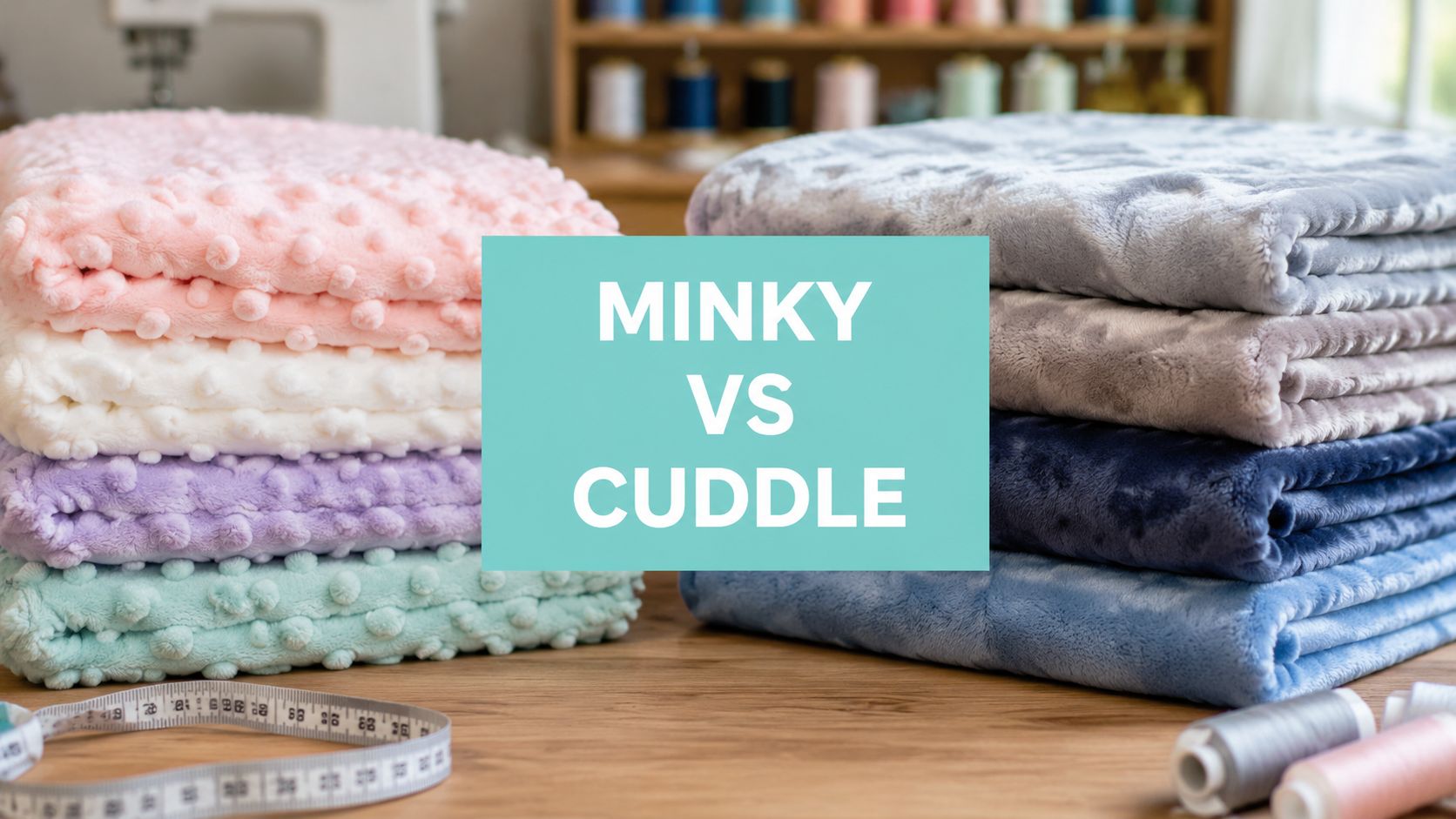
Cuddle® is Shannon Fabrics' trademarked brand name for high-quality minky, while minky is the generic name for the broader plush fabric category. The primary difference lies in consistent quality, controlled stretch, and higher density, which is why the two fabrics can behave very differently once you start cutting, sewing, and washing them.
You usually notice the difference when the project matters. A baby blanket starts shifting under the presser foot, a quilt back grows wider than expected, or a bargain plush fabric sheds all over the cutting table and keeps moving no matter how carefully you baste it.
If you want the short answer, Cuddle® isn't a different fiber family. It's a branded, premium-spec version of minky that's made to be more predictable in real sewing. That predictability matters more than marketing language when you're trying to avoid puckered seams, wavy borders, or a quilt back that won't stay square.
At our shop, we work with minky every day, and that practical difference is what crafters usually need explained. The label matters less than how the fabric performs when you cut it, join it, quilt it, and live with it afterward.
What Is the Difference Between Minky and Cuddle Fabric?
You usually see the difference after the first few inches at the machine. One plush fabric feeds cleanly, stays reasonably square, and gives you a backing you can trust. Another starts stretching under the presser foot, sheds across the table, and leaves you easing in extra width by the time you reach the end of the seam.
Minky is the generic category. Cuddle® is Shannon Fabrics' trademarked version of that plush knit fabric. The name difference is simple. The sewing difference is what directly affects the project, because generic minky can vary a lot from one mill or importer to the next in pile, stretch, density, and finish.

Why the naming difference matters
For quilters, bag makers, and anyone sewing baby gifts, the label on the bolt gives you a clue about how much guesswork you are buying. Cuddle® is a branded line with more predictable specs. Generic minky might be perfectly serviceable, or it might be slippery, stretchy, thin in the backing, or inconsistent from bolt to bolt.
That is the real question at the cutting table. Softness gets attention first. Sewability decides whether the project stays enjoyable.
At OPN, that is the distinction I end up explaining most often. A plush fabric can feel wonderful in your hands and still be frustrating once you start matching edges, keeping nap straight, or loading a quilt back.
For a clearer explanation of the naming and fabric category, OPN's guide to what Cuddle minky fabric is is a useful reference.
What that means at the sewing table
The fiber content is not the main issue here. The practical difference is how the fabric behaves during cutting, piecing, quilting, and washing.
A well-made Cuddle® backing is usually easier to square up, less likely to distort while you sew, and more consistent across the width of the fabric. Generic minky can still work well, but it often asks for more testing and more correction along the way. That trade-off matters if you are trying to avoid puckered seams, wavy borders, or a quilt back that finishes out of square.
Practical rule: If the project needs straight seams, stable edges, and a backing that holds its shape over time, choose the fabric with the most consistent structure, not just the softest hand.
That is why experienced makers split the question in two:
- What is it called? Generic minky or branded Cuddle®
- How does it perform? Predictable and stable, or variable enough that you need to compensate for it
For professional-looking results, the second question usually decides the better fabric.
Why Do Quilters Prefer Shannon Cuddle Fabric?
Quilters usually don't choose Shannon Cuddle® because they want a fancier label. They choose it because they want fewer surprises.
When a fabric behaves consistently, everything downstream gets easier. Cutting stays more accurate. Seams stay flatter. Quilt backs load more cleanly. Binding lines up better at the end because the backing didn't creep and distort while you were piecing or quilting.

Consistency matters more than softness alone
Most plush fabrics feel good when you first touch them. That alone doesn't make them equal. Quilters tend to prefer Shannon Cuddle® because the line is built in a more standardized way, with recognizable families and known characteristics.
That matters if you're choosing between flatter options and plusher ones, or if you're trying to match the right backing to a quilt top that already has a lot of seams. If you want a shorter pile option, the Shannon Cuddle 3 solid colors guide is a useful reference point because it shows how the line is organized around a known format rather than vague “soft fabric” labeling.
Predictable fabric makes better finished work
In our own minky-heavy workflow, predictable fabric is what keeps a project from turning into cleanup and correction. That's especially true on larger backings, where instability gets amplified across the width of the quilt.
A quilt back doesn't need drama. It needs to stay square, feed evenly, and recover well instead of stretching into a shape you never intended.
Cheap plush can still feel nice in your hands. The problem shows up later, when the edges ripple, the seamline waves, or the backing no longer matches the top.
Why experienced makers keep coming back to it
Quilters who make baby gifts, sell finished blankets, or send tops out for quilting often become loyal to Shannon Cuddle® for one reason. They can repeat their process with fewer variables.
That reliability matters whether you're choosing a smooth backing or a textured finish like Hide, Snowy Owl, or Fawn. It also matters if you use a quilting service and want the backing to arrive ready to work with rather than needing correction before loading. We hear that concern often from customers, and our hundreds of verified reviews reflect how much people value fabric that performs the way they expect.
A few situations where branded consistency pays off:
- Gift sewing: You don't want a baby blanket that starts looking tired after regular use.
- Quilt backs: Stable width and controlled movement help the backing behave more like a planned material and less like a wrestling match.
- Repeat projects: If you make the same item more than once, predictable fabric saves time because your settings and methods still apply.
How Does Cuddle Fabric Compare to Generic Minky?
The biggest practical difference shows up when the fabric is under tension. That's where lower-grade minky often reveals its weaknesses.
In Shannon Fabrics' side-by-side demo, lower-quality chain-store minky is described as stretching in both directions and becoming thinner or less dense over time, while Cuddle is engineered to stretch mainly width-wise with better recovery and less long-term distortion, which directly affects cutting accuracy and seam control in actual sewing work (Shannon Fabrics comparison video).
| Feature | Generic Minky | Shannon Cuddle® Fabric |
|---|---|---|
| Category | Broad fabric family from many manufacturers | Branded minky line from Shannon Fabrics |
| Stretch behavior | Can be less predictable and may stretch in both directions | Engineered to stretch primarily width-wise |
| Density over time | May become thinner or feel less dense with wear | Better recovery and less long-term distortion |
| Shedding behavior | Can shed more and feel less pliable | Initial cut shedding, then tends to stabilize |
| Sewing control | More likely to shift, creep, or wave at seams | More predictable for cutting and seam handling |
| Best fit | Casual projects where exact behavior matters less | Projects where finish quality and consistency matter |
What stretch means for real projects
If your plush fabric stretches in every direction, your rotary cuts can drift and your sewn edges can ripple. That's one of the main reasons some minky projects look homemade in the wrong way.
One-way stretch is easier to plan around. You can orient the fabric, support it correctly, and avoid letting it grow while stitching.
Why density changes the finished look
Density affects more than hand feel. It affects how full the fabric looks after repeated use and whether it continues to support a clean finish.
A thinner, less dense plush can start to look worn sooner, especially on throws, child-use blankets, and quilt backs that get pulled, folded, and washed often. Cuddle's better recovery is part of why many quilters think the premium price is tied to performance, not just branding.
Shedding and cleanup
Most plush fabrics shed during cutting. That part is normal. The difference is whether the mess settles down or keeps showing up as an ongoing annoyance.
If a fabric drops fibers heavily and keeps loosening, the project becomes harder to manage. You notice it in your machine area, in the seam allowance, and sometimes in the final appearance along the cut edge.
A fabric that sheds once at the cutting table is manageable. A fabric that keeps shedding through the project usually costs more in frustration than it saved in price.
For quilters comparing pile styles, the Shannon Cuddle 3 mm pile overview helps clarify why a lower, more controlled pile often feels easier to handle than a generic plush with less defined specs.
What Are the Main Types of Shannon Cuddle Fabric?
Shannon Cuddle is easier to choose once you sort it by pile height, texture, and width. Those three details affect how the fabric feeds, how bulky the seams get, and how the finished project holds up after regular washing.
For quilters, that matters more than category names alone. A baby blanket, a throw, and a queen-size quilt backing do not ask the same things from a plush fabric.

Cuddle 3
Cuddle 3 is the option I recommend most often to quilters who want predictable results. The lower pile gives you a flatter surface, less seam bulk, and better control at the cutting table and machine.
It works well for:
- Baby blankets
- Quilt backs
- Simple throws
- Binding-adjacent edges where excess loft can fight you
- Projects for newer minky sewists
That lower profile also tends to help with accuracy. Corners are easier to square up, quilting cotton pairs more cleanly with it, and the project is less likely to feel overly thick once it is turned, topstitched, or bound.
Luxe Cuddle
Luxe Cuddle has a taller, more decorative pile. It is the right choice when touch and visual texture are part of the finished look, not just a soft backing hidden on the reverse.
You see that in textures such as Hide, Snowy Owl, and Fawn. They add dimension beautifully, but they also create more loft at seams and can be less forgiving if the project has a lot of piecing or tight curves.
For that reason, I usually steer Luxe Cuddle toward:
- Cuddle throws
- Nursery gifts
- Wholecloth style blankets
- Accent pieces where texture is the feature
It sews well, but it asks for a little more handling discipline than a shorter pile. If sliding has been a problem in your sewing room, these practical steps for sewing with minky without it sliding help a lot.
Extra Wide Cuddle
Extra Wide Cuddle solves one of the biggest quilt-backing headaches. It lets you back larger quilts with fewer seams, and in many cases no center seam at all.
That changes the sewing experience and the finished result. Fewer backing seams means less bulk across the quilt, less chance of puckering where plush layers meet, and less prep time before basting. On bed-size quilts, that is a real quality difference, not just a convenience.
If the project is large, width often matters more than surface texture.
Which type should you buy
Match the fabric to the job first. Then choose the texture you want.
| Fabric type | Best use | What to expect |
|---|---|---|
| Cuddle 3 | Quilt backs, baby items, easier sewing | Lower pile, flatter handling, less seam bulk |
| Luxe Cuddle | Throws, statement blankets, textured gifts | Higher pile, richer texture, more loft in seams |
| Extra Wide Cuddle | Large quilt backs | Fewer seams, easier layout, cleaner backing finish |
For a quilt back, I usually start with width and pile height. For a gift blanket, I look at texture next. That order saves a lot of frustration, especially if the goal is a project that still looks good after heavy use and repeated washing.
What Are the Best Tips for Sewing With Cuddle Fabric?
A lot of sewing trouble starts the minute Cuddle gets treated like quilting cotton. The fabric is plush, knit, and mobile, so the goal is not to flatten it into obedience. The goal is to control feed, support the pile, and keep the layers from creeping apart while you sew.
That matters even more on projects that need to hold up through washing and daily use. A baby blanket with wavy edges or a quilt backing with stretched sections may still look soft on day one, but it will not finish as cleanly or wear as well. Good results with Cuddle come from repeatable handling, not luck.

Studio habits that prevent sliding and puckering
In my studio, the best fix for puckering starts before the first seam.
- Cut with a rotary cutter: Plush stays more stable when it remains flat on the mat.
- Use clips generously: Clips secure layers without distorting the pile the way heavy pinning sometimes can.
- Slow the machine down: Fast stitching encourages the top layer to creep.
- Lengthen the stitch slightly: A slightly longer stitch sits better in plush and helps the seam relax.
- Use a walking foot when possible: More even feeding usually means straighter seams and fewer ripples.
- Keep lint tools nearby: Cuddle sheds while cutting, and cleanup is part of the job.
If sliding is your main frustration, this tutorial on how to sew with minky fabric without it sliding walks through the handling details that make the biggest difference.
What works better than forcing it flat
Heat and pressure are not the answer here. Cuddle responds better to controlled handling, seam support, and patient feeding.
Shop-floor advice: The cleanest minky seams usually come from better feeding, not more force.
Tools and preparation matter here too. A walking foot, sharp rotary blade, fine clips, and a test scrap solve more problems than aggressive pressing ever will. For quilt backs and gift sewing, I also recommend choosing fabric with a pile height that matches the precision the project needs. Lower pile is usually easier to keep square, easier to baste, and less bulky in the seam allowance.
Here's a helpful demonstration to watch before you start cutting:
Free U.S. shipping starts at $70+, and first-time shoppers can use the 15% first-order coupon when they're building a backing or gift project order.
Prep choices that save time later
A few prep decisions consistently improve the finish:
- Square the backing first: Do not assume the cut is ready to sew or load.
- Test on a scrap: Check stitch length, tension, and feeding before you commit to the project.
- Match the pile to the job: Lower pile works better for precise seams and quilting prep.
- Plan for lint breaks: Stopping to clean the machine area and table keeps the fabric easier to manage.
For longarm prep, this part is easy to underestimate. A backing that stayed square during cutting, clipping, and seaming loads more cleanly and is less likely to fight you later. That is one of the practical differences between a project that feels homemade and one that finishes with a more professional result.
What Are the Best Projects for Shannon Cuddle Fabric?
Some fabrics are pleasant to own but awkward to use. Shannon Cuddle usually earns its place when the project benefits from softness and reliable construction at the same time.
Baby blankets and gifting projects
Baby blankets are one of the most natural uses because they combine frequent handling with a need for a soft finish. For newer sewists, curated cuts and simple blanket formats are often easier than jumping straight into pieced plush work.
If you want a beginner-friendly path, OPN's post on how to make a minky baby blanket is a solid place to start.
You can also shop by project instead of by yardage:
- Minky fabric by the yard
- Luxe Cuddle fabric collection
Quilt backs that need fewer seams
Practical performance often matters more than texture. Extra-wide backing helps avoid bulky joins and gives the quilt a cleaner finish.
If your goal is a smoother back for a larger project, these are the most useful categories to browse:
- Extra wide Cuddle and minky backing options
- Mail-in longarm quilting service
Plush throws, scarves, and finished gifts
Luxe textures like Hide, Snowy Owl, and Fawn are especially good for throws and accessories where the texture is part of the appeal. Some shoppers want yardage. Others just want the finished gift without sewing it themselves.
That's where these product paths make sense:
- Infinity scarf kits
- Ready-made minky blankets
- Hide texture Luxe Cuddle options
- Snowy Owl texture options
- Fawn texture options
The right project depends on whether you need ease, texture, width, or speed. That's the practical answer behind what is the difference between minky and Cuddle fabric. One is a broad category. The other is a more controlled product line that tends to make demanding projects easier to sew and easier to trust.
If you want fabric that's easier to cut, more predictable to sew, and better suited to quilt backs and gift projects, browse the Shannon Cuddle and Luxe Cuddle selection at On Pins & Needles Quilting Co. and Get 15% Off Your First Order.