
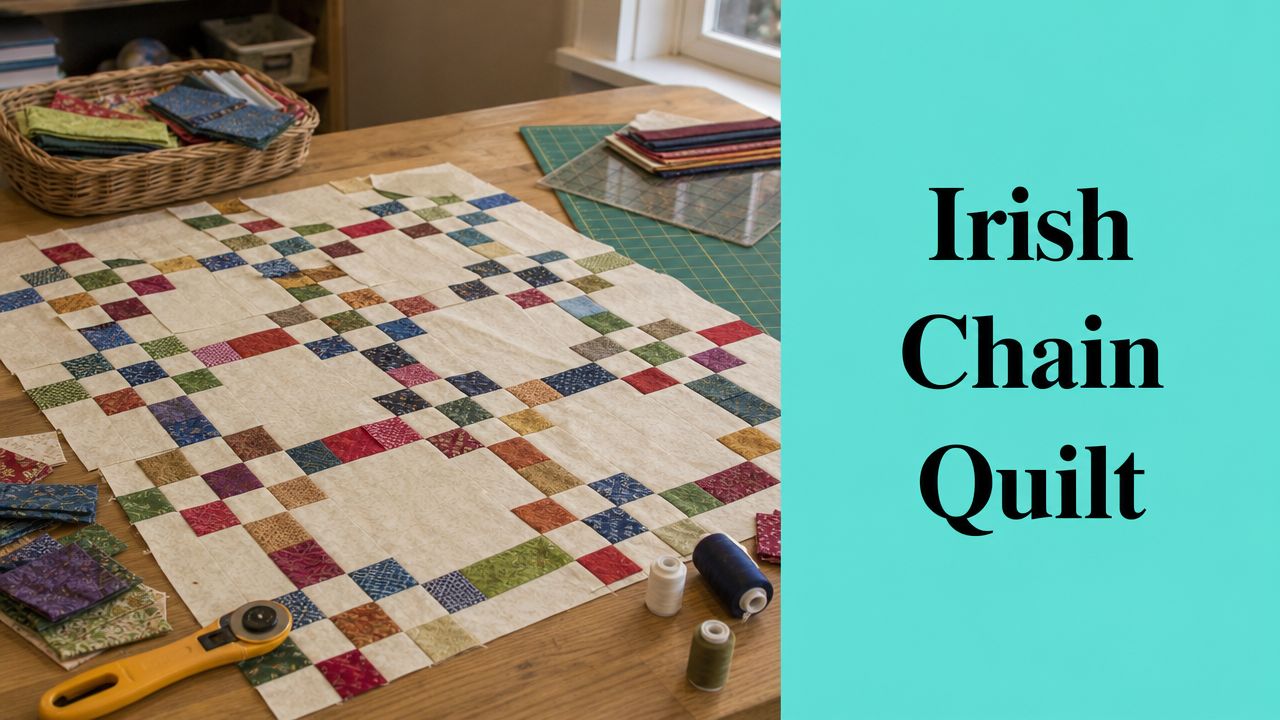
A workable pattern for a Double Irish Chain quilt starts with 2.5-inch strip piecing, then builds 32 nine-patch chain blocks from 64 white-green-white units and 32 green-white-green units, laid out with background blocks in an alternating grid. For quilters who want a complete pattern instead of scattered tips, this classic design is absolutely achievable, and it scales beautifully from a small baby quilt to a bed quilt.
You may be here with fabric on your table, a rotary cutter nearby, and that familiar question in your head: how much do I cut before I regret it? The Double Irish Chain has that effect on people. It looks intricate at first glance, but the structure is orderly once you understand the rhythm.
This article gives you a complete free pattern for a Double Irish Chain quilt, along with practical planning help for modern fabric choices, precuts, backing decisions, and finishing. Your search for a complete pattern for a Double Irish Chain quilt ends here. You'll find the piecing logic, the layout, and the finishing decisions that affect whether the quilt feels crisp, soft, traditional, or updated.
It also helps to remember you're working with a design that has real roots. The Irish Chain family is among the earliest documented American quilt patterns, with the earliest known example dated to 1814, and the Double Irish Chain was formally named by 1897 according to this Irish Chain history overview. That long history is part of the charm. You're not just making a patchwork top. You're joining a pattern lineage that stayed beloved through the 19th and 20th centuries.
Introduction
A Double Irish Chain is one of those quilts that rewards orderly sewing. The block work is repetitive in a good way, the layout creates movement without complicated templates, and the result looks more advanced than the piecing really is.
The pattern developed from the early Irish Chain family in America in the early 1800s, and that heritage still shows in the design. It has a clean geometry that works in reproduction prints, solids, holiday colors, nursery palettes, and modern high-contrast fabrics.
Why this pattern still works so well
The single Irish Chain is built from three strips of three squares, while the double version expands to five strips of five squares, which is a useful way to think about the structure before you cut anything. That extra chain creates the richer interlocking effect that makes the pattern feel fuller and more architectural.
A museum-held Double Irish Chain dated 1875–1900 confirms that the pattern was already established by the late 19th century, including examples in red, green, and white cottons. If you love traditional quilts, that history gives you a strong starting point. If you prefer a softer, more contemporary finish, the same structure still works with newer textures and backings.
The Double Irish Chain looks formal on the bed, but it's built from repeatable units. That's why it remains such a reliable pattern for both first-time chain makers and experienced piecers.
What you'll need before you start
Keep your setup simple and accurate:
- Rotary cutting tools for clean strip cutting
- A consistent quarter-inch seam for every seam in the chain units
- Pressing tools and starch if you want sharper block alignment
- A clear backing plan before the quilt top gets large
If you're still sorting out the math side, our guide to calculating yardage for quilts is a helpful companion before you cut your first strip.
How Much Fabric Do You Need for a Double Irish Chain
Fabric math is where many Double Irish Chain projects wobble. The piecing itself is straightforward. The planning is what tends to trip people up, especially if you're mixing yardage, jelly roll strips, fat quarters, and a larger backing choice.
One practical reason is scale. A Jelly Roll-based version can still require 446 individual 2.5-inch squares, which is why strip counts and trimming losses matter more than many beginners expect, as noted in this discussion of Double Irish Chain fabric planning.
A planning chart that keeps you out of trouble
The chart below is a practical starting point for a traditional two-fabric Double Irish Chain. Because fabric shrinkage, trimming, borders, and exact block size choices vary by maker, treat these as planning estimates rather than rigid formulas.
| Finished Size | Chain Fabric (42" WOF) | Background Fabric (42" WOF) | Backing (90" or 110" Minky) | Binding (42" WOF) |
|---|---|---|---|---|
| Baby | Plan for chain strips first, then add extra for mistakes and borders if used | Plan for background blocks plus layout allowance | 90" minky works well for a small seamless back | Standard binding strips from quilting cotton |
| Throw | Moderate yardage need, especially if chain fabric is scrappy | Background usually takes more than quilters expect | 90" minky may still work depending on final width | Cut enough strips after final measurement |
| Queen | Substantial strip yield needed, especially with trimming loss | Background becomes the dominant yardage decision | Extra-wide backing reduces pieced-back bulk | Measure perimeter after quilting if possible |
| King | Best planned on paper before buying | Underbuying background fabric is common | 110" minky is the cleanest option for many layouts | Buy generously to avoid piecing binding late |
Yardage vs precuts vs wide backing
There isn't one right way to buy for this quilt. There is only the method that fits how you like to sew.
- If you like controlled repeats, yardage is easier to manage than mixed precuts.
- If you want speed, precut strips can help, but only if you verify how many usable units they'll produce.
- If you hate piecing a back, extra-wide backing changes the whole experience.
For the chain itself, quilting cotton is still the most predictable choice. Cleanly woven cotton strips press well, stay square, and behave during sub-cutting. For the backing, many quilters prefer something softer and less seam-heavy than a pieced cotton back, especially once the quilt moves into throw, queen, or king territory.
Where beginners usually underbuy
These are the spots I'd flag before checkout:
- Trim loss after sewing strip sets. Those ends add up.
- Direction changes if you're using a print that needs a specific orientation.
- Borders if you decide later the top needs more drop.
- Backing width when the quilt outgrows your original plan.
If you want a brighter chain, start with quilting cottons that give clear contrast. If your main concern is avoiding a bulky pieced back, look at extra-wide minky backing options before you finalize your quilt size.
Planning rule: buy fabric for the quilt you're actually making, not the quilt you first imagined. Double Irish Chain projects often grow once the blocks start looking good on the wall.
What Are the Best Fabrics for a Modern Irish Chain
A Double Irish Chain doesn't have to stay locked into the old cotton-on-cotton formula. Traditional construction still works beautifully, but modern fabric choices can change the feel of the finished quilt more than the piecing does.

Which fabric goes where
For the chain fabric, I still prefer quilting cotton. It gives the chain crisp edges, holds a press well, and keeps the pattern readable from across the room.
For the background, you have more room to play. Cotton keeps everything flat and traditional. A soft backing changes the drape and warmth without interfering with the piecing on the front.
Here's a simple comparison:
| Choice | What works well | What to watch for |
|---|---|---|
| Quilting cotton top and cotton back | Crisp structure, traditional look | Larger backs may need seams |
| Quilting cotton top and minky back | Soft hand, richer drape, fewer backing seams with wide widths | The finish feels less formal, which some quilters want and some don't |
| Scrappy chain with solid background | Strong chain effect | Contrast has to stay clear |
| Tonal chain with tonal background | Sophisticated, softer look | The chain can disappear if values are too close |
A few fabric pairings I'd actually recommend
If you want a classic chain face and a softer finish, use cotton on the front and a plush backing on the back. That gives you the visual definition the pattern needs without making the finished quilt stiff.
Shannon textures are especially useful here because they let you tune the final feel:
- Luxe Cuddle Hide in Fawn for a warm, customized back
- Luxe Cuddle Snowy Owl if you want loft and a more textured, cozy finish
- Quilting Cuddle when you want a lighter plush option
If minky is new territory, this primer on what Cuddle minky fabric is helps explain where each type fits.
A good pattern for Double Irish Chain quilt projects often benefits from restraint on the front and softness on the back. That balance lets the chain remain legible while the quilt still feels inviting on the couch or bed.
Dense traditional piecing on the front doesn't require a traditional backing. In practice, many quilters are happiest when the top stays crisp and the back gets softer.
If you're choosing backing by touch, browse the Luxe Cuddle collection and compare textures such as Hide, Snowy Owl, and Fawn before you commit.
How Do You Cut and Piece the Quilt Blocks Efficiently
The fastest reliable method is strip piecing. That's the difference between a quilt that feels manageable and one that turns into a long chain of tiny repetitive cuts.
One published method for a Double Irish Chain specifies making 64 white-green-white units and 32 green-white-green units from strip sets, which then become 32 nine-patch blocks, as shown in this strip-pieced Double Irish Chain tutorial.

The cutting sequence that saves time
Start with fabrics that have already been pressed. If your cotton is loose or wavy, add starch before cutting. That single choice often matters more than people expect because every inaccuracy compounds as the strip sets get longer.
Use this flow:
- Cut 2.5-inch strips from chain and background fabrics.
- Sew strip sets with a consistent quarter-inch seam.
- Press carefully before sub-cutting.
- Cross-cut units into matching segments.
- Arrange the nine-patch rows before sewing the block.
- Press again with consistency so your seams nest later.
For another approachable patchwork reference, browse these easy quilt blocks and patterns.
Step-by-step block construction
Use two strip-set combinations:
- White-green-white
- Green-white-green
Then cut those strip sets into equal segments and arrange them into nine-patch chain blocks. The order matters, so it's worth stacking a few completed sample blocks beside the machine as a visual check.
A basic sewing rhythm looks like this:
- First pass sew all strip sets
- Second pass press and straighten edges
- Third pass sub-cut all units
- Final pass build blocks in batches
That batching keeps your seams more consistent than making one fully finished block at a time.
Shop note: If you're buying backing, binding, or plush fabrics for this quilt, many quilters appreciate that there's a 15% first-order coupon available, and free U.S. shipping on orders over $70 can make it easier to bundle supplies in one order.
This process video helps if you're a visual learner:
What usually goes wrong
Most mistakes show up in three places:
- Strips cut a bit wide or narrow
- Seams that creep beyond a quarter-inch
- Pressing that distorts the strip set instead of flattening it
If your first units don't match perfectly, stop and measure before sewing more. Don't assume it will disappear later. In a Double Irish Chain, small errors repeat quickly.
For supplies, this is the stage where a sharp blade, a dependable ruler, and a pressing setup earn their keep. If you're also planning the back at the same time, 90-inch Cuddle backing is worth a look for quilts that need a soft finish without extra seams.
How Do You Assemble the Quilt Top for Perfect Points
Once your chain blocks are made, the quilt top becomes a layout problem instead of a piecing problem. The chain effect only reads clearly when the blocks alternate correctly and the seam intersections meet cleanly.
A common assembly uses 32 chain blocks and 31 background blocks arranged in an alternating 9-row layout, with seams pressed in opposite directions so they nest more reliably, as explained in this Irish Chain assembly tutorial.

How to lay out the rows
Before sewing rows together, place every block on a design wall or floor. Stand back. The chain should read as an unbroken path.
A practical approach:
- Chain blocks carry the movement
- Background blocks give the eye rest
- Alternation is what creates the pattern
If one block is rotated incorrectly, the chain breaks immediately. That's why I like row labels or small sticky notes pinned above each row before sewing.
Pressing for cleaner intersections
The act of careful pressing delivers clear benefits. Press adjoining seams in opposite directions so they lock together at intersections.
A few habits help:
- Pin at every major seam join
- Sew rows without stretching
- Press rows flat after each join
- Check the chain path before adding the next row
If you've ever fought a shifting plush backing in another project, these minky sewing tips for reducing sliding are useful once you move beyond the quilt top.
At the assembly stage, precision matters more than speed. A slow row join is faster than seam ripping eight intersections later.
For notions, fine pins and a dependable iron make a visible difference. If you need them, quilting notions and tools are the category I'd check before finishing the top.
How Should You Quilt and Finish Your Masterpiece
You finish piecing the top, spread it out, and the chain finally shows itself across the whole quilt. That is the moment many quilters realize the last decisions matter just as much as the first fabric pull. A Double Irish Chain can stay crisp and architectural, or it can turn soft and cozy, and the quilting design, batting, and backing are what push it in one direction or the other.
Many pattern write-ups stop after the top is sewn. For this pattern, I always recommend planning the finish with the same care you gave the blocks, especially if you are working from precuts or trying to match a modern print palette with a softer backing like minky or Cuddle.

Which quilting style suits this pattern
The Double Irish Chain gives you a clear design choice. You can emphasize the chain, or you can let the surface texture become the star.
If the top has strong contrast, quilting that follows the piecing usually gives the cleanest result. Straight-line quilting, gentle curves around the chain, or a simple custom plan in the background squares all keep the pattern easy to read. I like this route for classic red-and-white, navy-and-cream, or any version where the chain is the whole point.
If the fabrics are busier or more modern, an edge-to-edge design often works better. It spreads texture across the quilt and helps mixed prints sit together. The trade-off is that the chain reads a little less sharply from across the room.
| Quilting approach | Final effect | Good fit for |
|---|---|---|
| Dense allover quilting | Flatter surface, more unified texture | Busy prints, everyday throws |
| Quilting that echoes the chain | Chain stays readable | High-contrast traditional tops |
| Softer, more open quilting | More drape, less structure | Plush-backed comfort quilts |
Batting changes the result too. Cotton batting gives a flatter, more traditional look. A loftier batting adds definition to the quilting lines. With minky backing, I usually avoid overly dense quilting unless the quilt needs extra stability, because dense stitching can take away some of that soft, cuddly feel people usually want from a plush-backed finish.
Backing and finishing choices that affect use
Backing is where practical use comes in. A bed quilt that gets washed often has different needs than a wall quilt or a baby gift.
Quilting cotton on the back is familiar and easy to bind, but larger sizes often require a pieced back. That is not a problem by itself, though it does add seam bulk and one more thing to keep straight during basting. If you want a softer finish with fewer back seams, wide plush backing can be the simpler choice.
For many throw and bed-size Double Irish Chain quilts, I recommend this combination:
- Cotton pieced top
- Cotton or cotton-blend batting
- Wide minky or Cuddle backing
- An edge-to-edge design or open geometric quilting
That combination wears well, feels good in use, and suits the pattern without making the quilt stiff.
For larger tops headed to a longarm, review these longarm quilt prep tips before quilting. Good prep saves time and helps avoid pleats, trimmed points, or backing issues later.
For backing choices, 110-inch extra-wide Cuddle solves a lot of headaches on larger quilts. A one-piece back is easier to load, and it keeps the finish soft without an extra center seam. If you are binding it yourself, binding-ready quilting cottons and coordinates make it easier to pull the last color choice from the quilt top instead of settling for a near match.
One last practical tip. On a Double Irish Chain, I usually choose binding that frames the chain rather than competes with it. A solid, a small print, or a stripe cut carefully will finish the quilt better than a loud novelty print. The pattern already has plenty to say.
Conclusion
The Double Irish Chain has lasted because it balances order and beauty. You get repetition without boredom, strong geometry without difficult templates, and a finished quilt that can read as historic, cheerful, crisp, or soft depending on your fabric and quilting choices.
A good pattern for Double Irish Chain quilt making doesn't stop at block instructions. It also helps you avoid the usual trouble spots, especially fabric planning, seam accuracy, and finishing decisions. If you handle those well, the quilt goes together with far less frustration.
That's what makes this pattern such a satisfying project. It can become a baby gift, a couch quilt, a bed quilt, or an heirloom. And once you've made one, the next version usually comes together faster because the chain logic clicks.
We can't wait to see what you make with it.
If you're ready to finish your quilt with soft backing or professional quilting support, browse On Pins & Needles Quilting Co. and Book Your Longarm Service Today.