
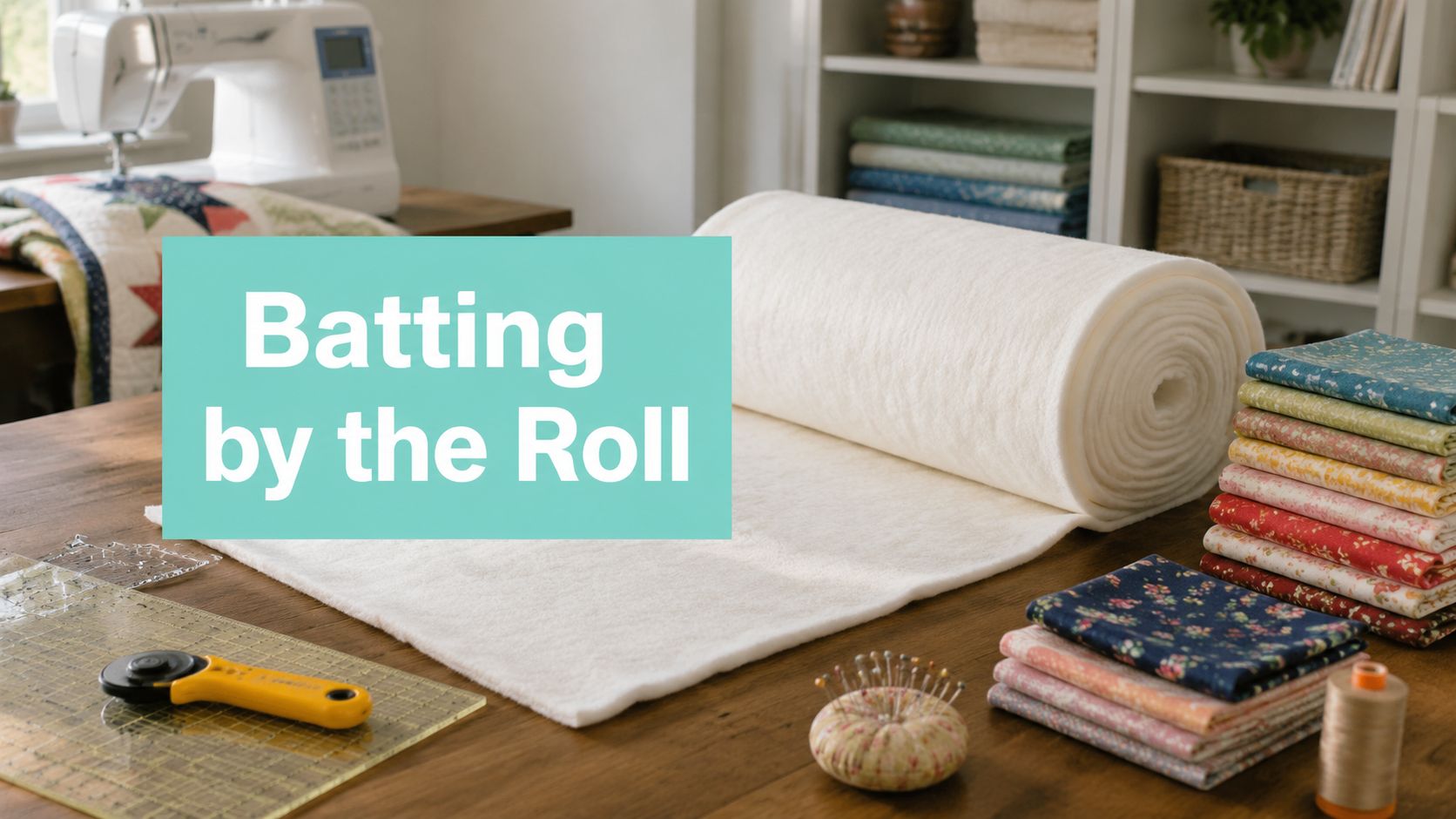
Buying batting by the roll is a way to purchase a large, continuous length of quilt batting instead of individual packaged cuts. It makes the most sense when you're finishing quilts regularly, working on queen- or king-size tops, using a longarm, or trying to cut down on waste and reordering.
You feel the difference most when the quilt top is done, the backing is chosen, and the batting becomes the part that either keeps the finish smooth or turns into a workaround. If you've ever had to piece batting under a large quilt with an extra-wide minky back, you already know where the trouble starts.
At our longarm table, the combination that needs the least fuss is simple: a backing wide enough to stay in one piece, and batting wide enough to do the same. That's where batting by the roll stops being a bulk purchase and starts being a workflow decision.
Your Guide to Batting by the Roll
Batting by the roll is a method for buying one continuous supply of batting so you can cut what you need for large quilts, repeated projects, and longarm work without relying on multiple packaged pieces.
That matters more than many quilters expect. Batting is the structural middle layer that gives a quilt warmth, loft, and weight, and buying it in a roll format is commonly used for repeated or large-format projects rather than one small quilt at a time, as explained in Missouri Star's guide to quilt batting by the roll.

The usual pain point is easy to recognize. You finish a big top, maybe choose a plush backing, then realize your batting supply is a stack of packaged cuts that don't quite match the quilt's width. Now you're joining pieces, checking overlap, and hoping the final quilt won't show a ridge or shift under the needle.
Why serious quilters switch to roll batting
Buying a roll solves a practical problem first. You can cut to the size you need, match the width to the quilt top more deliberately, and avoid the stop-and-start cycle of buying batting one project at a time.
For anyone making gifts in batches, quilting customer tops, or prepping several bed quilts at once, that consistency matters. You aren't changing batting brands, loft, or hand from one package to the next unless you want to.
Practical rule: If your projects are getting larger, more frequent, or more uniform, your batting format should change with them.
Where roll batting fits especially well
A roll is usually the better fit when you're dealing with:
- Large bed quilts that need wider batting to avoid piecing
- Longarm quilting where smooth loading and uniform loft matter
- Minky-backed quilts where a continuous finish is already the goal
- Gift production when you want repeatable results from one project to the next
If you're also shopping backing, pairing roll batting with extra-wide soft fabric is often the cleanest route. For quilt backs that avoid center seams, 110-inch Cuddle fabric options are a practical place to start.
What Exactly Is Batting by the Roll
Batting by the roll is a long, continuous length of batting sold in bulk instead of as a pre-cut piece. You trim off what each quilt needs, which gives you more control over size, waste, and consistency from one project to the next. If you want a quick foundation on the material itself, this quilt batting guide covers the basics.
For a quilter who makes bed quilts regularly, that format changes day-to-day work. A packaged batt asks you to fit your project to the sizes available. A roll lets you cut for the actual quilt top, including the extra inches you want around the edges for loading and quilting.
How is a batting roll different from a packaged batt
The main difference is simple. A packaged batt is pre-sized. A roll is continuous yardage.
That affects more than storage.
With a roll, you can keep one batting type on hand for repeat projects, cut generous margins for the frame, and avoid piecing batting on larger quilts unless the project calls for it. I see the benefit most clearly on queen and king quilts, where a pre-cut batt can leave you choosing between waste on one project and not enough width on the next.
Instructional quilting references also treat batting as a project decision based on loft, fiber, and use, not a one-size purchase, which is part of why bulk batting fits serious machine quilting so well, as discussed in Suzy Quilts' batting guide.
Why longarm quilters care about the format
On a longarm, clean inputs matter. One continuous cut of batting loads more predictably than pieced sections, and it gives the quilt a more even foundation across the frame.
That matters even more with extra-wide minky backs. A wide Cuddle or minky backing already reduces one major source of bulk and shifting because you are not dealing with a center back seam. If the batting underneath is also cut as one piece from a roll, the whole quilt sandwich is easier to square up, baste, and quilt without fighting extra joins in the middle.
This is one of the trade-offs I talk through with customers at OPN Quilting. Buying a roll takes storage space and a bigger upfront spend. In return, you get fewer compromises on large quilts, better consistency across multiple projects, and less last-minute problem solving at the prep table.
If you mostly make occasional lap quilts, packaged batting may still be the practical choice. If you longarm regularly, finish customer quilts, or pair large tops with extra-wide plush backing, roll batting usually gives you better control where it counts. A one-piece minky back works best when the batting under it is one piece too.
How Do I Choose the Right Batting Fiber
Fiber choice controls how a finished quilt behaves. The main decision points are loft, shrinkage, feel, and stability. If you choose batting by habit instead of by project, you usually notice it after quilting, or after washing.
Batting guidance identifies fiber, loft, shrinkage, and scrim as the main performance factors. Polyester is described as the highest-loft and least expensive option, cotton and wool generally shrink more than polyester or silk, and an 80% cotton / 20% polyester blend is a common benchmark because it balances softness, loft, strength, and minimal shrinking while resisting bearding, based on the quilting guidance summarized in this batting video reference.
Batting Fiber Comparison Guide
| Fiber Type | Loft | Shrinkage | Best For |
|---|---|---|---|
| Cotton | Lower to moderate | Moderate to high | Breathable quilts, traditional feel, flatter drape |
| Polyester | High | Minimal | Loftier quilts, reduced shrinkage, budget-minded bulk use |
| Wool | High | Moderate to high | Warm quilts, visible quilting definition |
| 80/20 Cotton/Poly | Balanced | Minimal | Large quilts, stable longarm work, frequent use projects |
A lot of quilters start with fiber and stop there. I'd go one step further and ask how the quilt will live. Bed quilt, wall piece, baby gift, cuddle-heavy throw, or a quilt with a plush backing all benefit from different trade-offs.
What role does scrim play
Scrim doesn't get enough attention, but it matters. It's a stabilizing binder layer that helps batting hold together and can allow quilting lines to be spaced farther apart without the batt pulling apart.
That makes scrim-backed batting useful when you want structure and predictability. It can be a smart choice for longarm patterns with wider spacing, and for quilts that need to stay stable through repeated handling.
- Choose cotton if you want a breathable, classic quilt feel and don't mind more shrink texture after washing.
- Choose polyester if loft and lower shrinkage matter more than a traditional cotton hand.
- Choose wool when you want warmth and more dimensional quilting.
- Choose an 80/20 blend when you want a reliable middle ground for bed quilts and longarm finishing.
Which batting works well with minky backing
With extra-wide minky, I usually think about balance. The backing already adds softness and visual weight, so the batting doesn't need to do every job at once.
An 80/20 blend is often a sensible match for large quilts because it stays stable without making the quilt feel overly stiff. If you're pairing batting with plush backing fabric, batting options in the shop make it easier to compare what will suit your project. For a premium backing choice with a soft, fur-like surface, Shannon Luxe Cuddle Fawn is one of the textures quilters often consider for gift and bed quilts.
What Size Batting Roll Matches My Projects
Width is where batting by the roll becomes practical instead of theoretical. If the roll isn't wide enough for the quilt you're making, you're back to piecing. For large quilts, that defeats one of the main reasons to buy a roll in the first place.
Retail listings for batting rolls show wide-format options such as 54 to 60 inches and larger widths such as 96 to 120 inches, and the value of those wider rolls is that they eliminate pieced batting joins, helping preserve uniform loft and reducing localized thickness variation across the quilt field, especially for longarm work, according to Fabric Warehouse's roll batting overview.

How do I match batting width to quilt size
The easiest way to think about this is by project type, not by brand packaging.
- Smaller quilts can work well with narrower roll widths if you mainly make crib, lap, or wall quilts.
- Bed quilts usually push you into wider rolls, especially once you want extra room around the top for loading and quilting.
- King and oversized quilts are where the widest rolls become the most useful because they let you cut one continuous piece.
If you're still planning the backing, this quilt yardage guide helps sort out width decisions before you cut into anything expensive.
Why width matters more with seamless minky backs
This is the part many batting guides skip. If you're using extra-wide minky backing, especially plush widths meant to avoid a center seam, the batting needs to support that same clean build.
A single-piece back with pieced batting underneath can still quilt fine, but it adds another layer where thickness can change. That's not ideal when you're trying to keep the quilt surface smooth and the stitch formation consistent.
When the backing is seamless, the batting should aim for the same standard whenever the quilt size allows it.
For quilters who like the look and feel of plush backs, extra-wide Cuddle in 90-inch widths and Luxe Cuddle Snowy Owl are the kinds of backing choices that make batting width a real finishing issue, not just a supply question.
What works in practice
If your projects range from throws to queen quilts, a wide roll gives you flexibility. You can trim down for smaller pieces and still have enough width available when a large top comes through the studio.
That versatility is one reason roll stock works so well for quilters who don't make the exact same size every time. You aren't locked into one pre-cut format, and you're less likely to stall a project because the batting on hand is almost right, but not quite.
How Do I Correctly Prepare Roll Batting for Longarming
Preparation starts before the quilt reaches the frame. A batting roll is efficient, but only if you cut and store it in a way that keeps the edges clean and the loft undisturbed.

How should I cut batting from a roll
Treat batting more like a soft structural layer than a fabric yardage cut. It doesn't need rough handling, and it definitely doesn't improve when it's stretched across the table.
Use this method:
- Clear the surface so the batting stays clean and fully supported.
- Unroll only what you need instead of dragging out excess length.
- Measure against the quilt top and backing plan before making the cut.
- Cut with long, controlled passes so the edge stays even.
- Roll or fold loosely after cutting so you don't compress the batt more than necessary.
A lot of quilt prep problems start with rushed trimming. Crooked batting can still work, but uneven margins make loading harder and can create extra fuss around the edges.
What should I do before mailing a quilt to a longarmer
If you're sending your project out, prep matters as much as product choice. The batting should coordinate with the quilt top and backing dimensions, and everything should arrive clean, labeled, and easy to identify.
For detailed finishing prep, these longarm quilt prep tips are worth reviewing before you pack your quilt.
Quilts move through the machine more smoothly when the batting is square enough, the backing is appropriate for the job, and nothing in the package leaves the longarmer guessing.
In our studio, we see the difference quickly. Cleanly cut batting and a properly chosen backing reduce avoidable handling issues. That's one reason quilters use mail-in longarm quilting at OPN when they want batting, thread, and finishing handled in one workflow, and it helps that we've earned hundreds of verified reviews from customers who value a straightforward process.
Here's a useful visual reference on batting behavior and selection before you finalize your prep:
How should I store the rest of the roll
Storage doesn't need to be complicated, but it does need to be intentional.
- Keep it covered so dust and pet hair don't become part of the quilt.
- Store it dry because batting can pick up moisture from the room.
- Avoid crushing it under heavy bins or stacked supplies.
- Label the fiber type if you keep more than one roll in the studio.
That last step saves a lot of confusion later, especially if you switch between cotton-heavy batting and loftier blends depending on the quilt.
Is Buying Batting by the Roll a Smart Investment
A queen or king quilt on the frame shows the answer fast. If the backing is extra wide minky and the batting came from a roll, the whole setup is simpler to load, easier to square up, and less likely to force compromises at the last minute. If the batting is coming from packaged cuts, you feel every limit in real time.
For quilters who finish projects regularly, buying by the roll usually makes financial sense. The upfront cost is higher, but an accurate comparison considers cost per quilt, wasted offcuts, emergency reorders, and the time spent piecing or substituting materials you did not plan to use.
Where the value actually shows up
The savings are practical, not theoretical.
- You cut the length you need, which reduces waste on repeated projects
- You get more consistency from one quilt to the next
- You avoid supply gaps when you are quilting on a schedule
- You make better use of extra-wide backings, especially on large quilts headed to a longarm
That last point matters more than many batting guides admit. In my studio, the cleanest large-quilt setups usually pair roll batting with a one-piece backing, especially minky. When the backing is already wide enough to skip a pieced seam, it makes sense to give the batting the same advantage underneath. The quilt loads cleaner, the layers behave more predictably, and the finished quilt keeps that soft, full look people want from minky-backed work.
If you send quilts out for quilting, that predictability also helps with budgeting. Quilters comparing total finish cost often look at affordable longarm quilting with batting and thread included because it shows how batting choice affects the full job, not just the supply shelf.
Worth using: First-time shoppers can get 15% off their first order, and U.S. orders over $70 qualify for free shipping at OPN. That can make it easier to build a backing-and-batting order in one purchase.
When a roll makes less sense
A roll is not the smart buy for every quilting room.
It may be the wrong fit if:
- You only make a few quilts a year
- You switch fiber types constantly
- You do not have a clean, dry place to store a roll
- Most of your work is baby quilts, wall quilts, or other small projects
The trade-off is straightforward. Bulk buying rewards consistency. If your projects vary wildly, or you are still testing what batt you like, packaged batting gives you more flexibility with less commitment.
But if your quilts are trending larger, and especially if you love extra-wide minky backs, the economics improve quickly. A backing without seams already removes one construction headache. Roll batting supports the same goal. Fewer joins, fewer awkward workarounds, and a cleaner path from quilt top to finished quilt.
There is also a quality habit built into buying this way. Quilters who keep batting, backing, and finishing plans aligned usually make stronger decisions earlier. That shows up in the final drape, the feel of the quilt, and how smoothly the whole project comes together.
Common Questions About Batting Rolls
Questions start once the roll is in the studio and the quilt is on the frame. Large quilts, especially ones headed for extra-wide minky backs, leave less room for guesswork. A small batting decision can change how the quilt loads, how it drapes, and how it looks after the first wash.
Does it matter which side of the batting is up
Sometimes it does.
With needle-punched batting, the manufacturer may designate a right side and wrong side. That can affect bearding and surface appearance over time, so I always tell quilters to check the packaging before loading the quilt. This batting orientation article gives a good explanation of what to look for.
If the batting includes scrim or has a clearly needled side, treat that as a handling instruction, not a suggestion. On a longarm, those details matter more on bigger quilts because any issue is spread across a lot more surface area.
Should I pre-wash batting from a roll
Usually, no.
Pre-washing batting creates more handling problems than it solves for most quilts. The better question is what you want the finished quilt to do. Cotton and some blends can give you more crinkle after washing. Lower-shrink options keep the quilt flatter and more predictable.
For quilts paired with extra-wide minky, I usually prefer predictability. Minky already adds weight, softness, and a different kind of drape. Batting that shifts too much in the wash can fight that nice, fluid finish.
Which fiber is better for baby quilts and gift quilts
Start with how the quilt will be used, not with a favorite fiber label.
Gift quilts and baby quilts usually need easy washing, stable texture, and a result that still looks good after regular use. Cotton gives a traditional look and can change more after laundering. Polyester and some blends tend to stay more consistent. Neither is automatically better. The trade-off is feel versus wash behavior, and sometimes loft versus familiarity.
A practical way to decide:
- For frequent washing, choose a batting with less shrink and less drama after laundering.
- For a classic cotton look, expect a little more texture and change over time.
- For minky-backed gifts, keep the batting moderate so the backing stays soft instead of getting overwhelmed by too much loft.
That last point gets missed a lot. Plush backing plus high-loft batting can push a quilt into bulky territory fast, especially on bed-size projects.
Can I use batting by the roll with extra-wide minky every time
Often, yes, if the pairing makes sense for the quilt.
This is one place where buying by the roll can help a lot. If you regularly make larger quilts and like extra-wide minky backs, roll batting lets you cut one clean piece for the job instead of piecing batting and hoping everything settles evenly on the frame. That matters on longarm projects. Less piecing means fewer chances for a visible ridge, a shifted join, or extra bulk in the sandwich.
I see the best results when the batting supports the backing instead of competing with it. If the minky is already thick and plush, a lofty batting can make the quilt feel stiff or overbuilt. A lower-loft cotton, poly, or blend usually gives a better drape and a cleaner finish.
How do I prevent bearding and other finish issues
Good results start before quilting starts.
Handle roll batting cleanly, keep it stored dry, and cut what you need without crushing or stretching it. On the frame, check orientation if the batting is needle-punched. For large quilts, avoid piecing unless there is a real reason to do it. The more joins you add, the more chances you create for uneven texture.
I also match batting to the job, not just the habit. A wall quilt, a child's quilt, and a king-size minky-backed bed quilt should not all get the same default batt. The quilt tells you what it needs.