
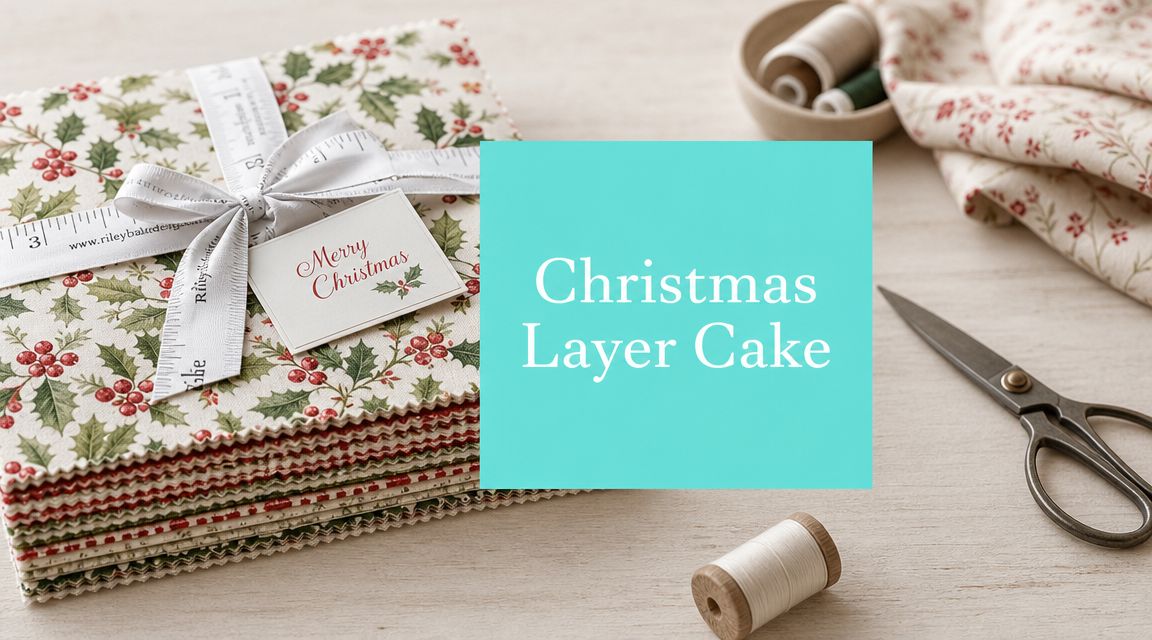
A Christmas layer cake fabric pack is a curated bundle of 42 ten-by-ten-inch squares of coordinating quilting cotton, perfect for quickly creating holiday quilts and gifts. Its value comes from saving cutting time and providing a professionally designed color palette right out of the box.
If you're staring at a stack of Christmas prints and wondering whether to make one quilt or stretch that bundle into something bigger, the better move is usually to plan the whole holiday suite first. That's how you keep the prettiest prints from disappearing into test cuts, avoid waste, and end up with a quilt, a few gifts, and a cleaner finish.
What Exactly Is a Christmas Layer Cake Fabric Pack
If the goal is to stretch one Christmas precut into a throw quilt, a few giftable extras, and a polished holiday look that all works together, a layer cake is one of the easiest places to start. I reach for it when I want the suite to feel coordinated without spending the first hour pulling yardage, testing reds against greens, and second-guessing every print.
A layer cake is a precut bundle of 10-inch by 10-inch quilting cotton squares, usually grouped from a single fabric collection. Quilters often expect about 42 squares in a pack, though exact counts can vary by manufacturer. The appeal is simple. The cutting is started for you, the palette is already coordinated, and the squares are large enough to support a main quilt while still leaving room for smaller projects if you plan carefully.

Why this format works so well for holiday sewing
Christmas sewing usually happens on a deadline.
A good layer cake saves time in the two places that slow beginners down most: fabric selection and first cuts. Instead of building a holiday palette from scratch, you start with prints that were designed to sit together. That matters even more if the plan is maximum value extraction from one pack. You can assign standout prints to the quilt center, reserve quieter squares for gift projects, and keep the whole set looking intentional.
The format also gives you useful flexibility.
- Large enough for subcuts: A 10-inch square can become charm-size units, strips, half-square triangle pieces, or simple feature blocks without forcing awkward math.
- Consistent across the stack: Uniform cuts make batch sewing faster and reduce trimming errors.
- Better for coordinated sets: One pack can support a throw quilt, pillow front, table runner, gift bags, or patchwork stockings that still read as one collection.
The real value is not just speed. It is getting several finished pieces from one fabric family without the leftovers looking random.
What beginners often misunderstand
Many newer quilters use "layer cake" to mean any pile of festive squares. In practice, it refers to a standard precut format, and many patterns are written around that size. That predictability is what makes planning easier, especially if you want one pack to do more than one job.
It also helps to know what a layer cake does better than other precuts. A layer cake gives you repeatable medium-size cuts for blocks and matching accessories. A fat quarter bundle gives you more flexibility for larger pieces, borders, backing accents, and directional prints. For a Christmas project suite built from a single purchase, the layer cake usually wins on speed and coordination, while fat quarters win on custom cutting freedom.
The trade-off is straightforward. You gain efficiency, but you lose some freedom with print placement and piece size. Used well, that is a fair trade, especially for holiday sewing where finished projects matter more than perfectly unlimited options.
How Do I Choose the Best Layer Cake and Coordinates
Not every Christmas layer cake fabric pack gives the same mileage. Some are packed with novelty prints that look fun in the stack but become hard to distribute across a full project. Others include enough subtle blenders and tone-on-tones that the finished quilt still feels elegant after the tree comes down.
The first thing to judge is print scale. If every square has a large focal motif, your blocks can feel busy fast. If the pack mixes bigger prints with calmer textures, tiny berries, stripes, dots, or low-volume backgrounds, you'll have more flexibility when you start splitting the bundle across several projects.
What to look for before you buy
Use the top square only as a clue, not as the decision maker. Fan the stack or study the full collection photos if they're available.
A good Christmas bundle for maximum value usually has:
- A mix of statement and supporting prints: You need some stars, florals, plaids, or festive motifs, but you also need fabrics that let the eye rest.
- More than one red and green family: Blue-red, brown-red, pink-red, pine-green, and emerald-green all behave differently when pieced together.
- At least a few non-holiday coordinates: Creams, blacks, soft metallic-neutrals, winter florals, greenery, and subtle prints tend to carry past December more gracefully.
Practical rule: If a print only works in one exact block placement, it has less value than a print you can use in a quilt, a pillow front, or a table runner.
How to choose backing and texture without second-guessing later
The backing plan determines whether many quilts level up or stall out. A cheerful cotton top needs a backing plan early, not after the top is finished and folded on a chair for weeks.
For a cozy holiday throw, soft backing options can completely change the feel of the project. Quilters who want a plush finish often pair holiday piecing with Luxe Cuddle minky. Textures like Snowy Owl, Hide, and Fawn work especially well when the quilt top already has enough visual movement and you want the backing to add softness instead of more print competition.
If you're still deciding between playful and refined holiday style, this guide to holiday minky fabric prints for Christmas is useful for thinking through mood and finish.
What doesn't work well
Some combinations look good on the shelf and disappoint on the design wall.
| Choice | What works | What usually fails |
|---|---|---|
| Print mix | Varied scale with some quiet coordinates | All large novelty prints |
| Color balance | A few strong anchors plus softer fillers | Too many competing reds and greens |
| Seasonal tone | Florals, greenery, plaids, subtle metallics | Overly theme-specific motifs in every square |
| Backing choice | One texture that complements the top | Busy backing that competes with the piecing |
A pack can be festive without being locked into one month of the year. That's usually the smarter buy if you want the most use from a single bundle.
How Can I Plan and Cut for Multiple Projects
Most guides spend an entire layer cake on one quilt top. That's fine if your only goal is speed. It isn't the smartest use of the fabric if you want a coordinated holiday set.
A published free pattern uses 36 ten-inch squares plus 12 five-inch contrast squares, which shows that many holiday quilts don't need the full 42-piece pack and that leftovers can be reserved for accents or matching accessories (free Christmas layer cake quilt pattern). That's the opening you use to extract maximum value.

Start with a fabric budget, not a pattern impulse
Before cutting anything, sort the full stack into three groups:
- Hero prints you want visible in larger pieces.
- Supporting prints that can repeat often.
- Utility prints that work as binding accents, patchwork fillers, or small gifts.
That sorting step keeps you from slicing your strongest squares into pieces too small to show their character. Christmas fabrics often have directional motifs and stronger contrast, so a rushed first cut is expensive.
A sample allocation that stretches one bundle
You don't need to use this exact breakdown. The point is to assign jobs before the rotary cutter touches the first square.
| Project | 10x10 Squares Needed | Notes |
|---|---|---|
| Throw quilt | 30 | Reserve the strongest value contrast here |
| Table runner | 4 | Use coordinated prints that echo the quilt without copying it |
| Pillow covers | 4 | Choose medium-scale prints that still read well on a sofa |
| Coasters or ornaments | 4 | Save novelty prints, directional motifs, and small leftovers |
That kind of plan keeps the main quilt substantial while still leaving enough for visible matching pieces around the room.
If you cut for the small gifts first, the quilt usually gets the leftovers. Reverse that order and the whole set looks more intentional.
How to cut without drifting into waste
I like to batch cuts by project type, not by fabric print. That means I cut all quilt units first, then all runner pieces, then pillows, then the smallest accessories. It reduces accidental overcutting.
Keep these habits:
- Inventory before subcutting: Confirm all 42 squares are present before you commit to a layout.
- Set aside your best anchors: Deep reds, dark greens, and strong neutrals give the quilt structure.
- Use leftovers on purpose: Border inserts, pieced backs, gift tags, mug rugs, and ornament fronts all benefit from the scraps.
For quilters who want to sanity-check companion fabrics before shopping, this article on calculating quilt yardage helps you think through background, borders, and backing before you're halfway through the stack.
Shop note: If you're adding backing or soft finishing materials to your cart, it's worth remembering the 15% first-order coupon and free U.S. shipping on orders over $70. Those offers make it easier to buy the coordinating pieces while the palette is still fresh in your mind.
The best part of this approach is that the projects don't look like leftovers. They look like a set.
What Is the Main Project A Simple Throw Quilt
Set the finished throw over the sofa, and the whole plan starts to make sense. This is the piece that carries the collection, sets the palette for the room, and makes the smaller gifts look coordinated instead of improvised.

For a single Christmas layer cake, a simple throw quilt gives the best return. It uses a wide range of prints without chopping them so small that wreaths, script, deer, and ornament motifs lose their shape. It also protects yardage. Intricate blocks can be beautiful, but they burn through a precut fast and leave you with scraps that are harder to turn into matching accessories.
I usually keep the main quilt straightforward for another reason. Holiday fabric already has plenty to say. Clean patchwork lets the prints do the work.
How to keep the quilt top balanced
Before sewing rows, put every square on a design wall, floor, or bed where you can see the whole top at once. Christmas collections often have a few bossy prints and a few quiet blenders. If the strong pieces land too close together, one corner gets heavy and the quilt starts to feel lopsided.
A good layout alternates scale as much as color. Mix a large print beside something calmer. Spread dark greens and deep reds across the top instead of stacking them in bands. If you have directional prints, check them twice before chain piecing. Lettering, trees, and hanging ornaments are the prints beginners regret rushing.
These checks catch most layout problems:
- Check value before color: Squint at the layout. If one area reads darker, swap a few blocks before sewing.
- Repeat standout prints sparingly: A novelty print looks stronger when it appears in a few planned spots instead of clustering.
- Press with intention: Consistent pressing keeps intersections flatter, which matters more on high-contrast Christmas fabrics.
- Size the throw on purpose: A 50 x 60 blanket size guide helps you decide whether you want a couch throw, a lap quilt, or something roomier.
How to finish the top without losing momentum
Many holiday quilts stall at this point. The piecing is done, the season gets busy, and the top sits folded on a chair until January.
Finish the top while the layout is still fresh in your mind. Clip loose threads from the front and back. Check that seams at the edges are secure. If you added borders, measure through the center before attaching them so they lie flat instead of waving after quilting. Those small corrections save trouble later.
If you want a polished result without wrestling a throw quilt through a domestic machine, mail-in longarm quilting services are a practical option. On Pins & Needles Quilting Co. offers that kind of finishing, and it is especially useful for seasonal quilts you want ready on time. If you're planning ahead, these quilt prep tips for longarming cover the details that prevent delays.
If you'd like to watch a simple Christmas quilt process in motion, this tutorial format is helpful:
A straightforward throw quilt is often the smartest use of a Christmas layer cake. It gives you a strong main piece and still leaves enough of the pack to build out the rest of the holiday set.
What Other Gifts Can I Make with the Leftovers
A single Christmas layer cake can do more than produce one throw quilt. If you cut with leftovers in mind from the start, the remaining squares, strips, and corner trimmings can become a coordinated set of gifts that looks planned instead of pieced together at the last minute.
The key is to assign fabrics by scale. I save the bold focal prints for pillow fronts or a runner center, use medium prints for patchwork, and push the small blenders into coasters, ornaments, and binding accents. That one habit stretches a precut much farther than cutting whatever square lands on top.
Table runner that feels like part of the set
A table runner is usually the smartest second project because it uses enough fabric to look substantial without eating the prints you still need for smaller gifts. Pull fabrics that echo the quilt's palette, then change the block size or layout so the runner does not look like leftover quilt parts laid end to end.
For a practical starting point, this free Christmas table runner pattern works well with layer cake cuts and smaller subcuts.
Directional prints often land here. They can be awkward in repeated quilt blocks, but they shine in a runner where you only need a few well-placed motifs.
Pillow covers that use the better prints wisely
Pillows are where I spend the prettiest leftovers. They sit at eye level, so mismatched scale shows fast. Medium prints, plaids, subtle holly, and winter florals usually read better than tiny toss prints or oversized novelty scenes.
A few combinations work almost every time:
- Plaids and checks for structure and contrast
- Greenery, berries, and florals for a softer holiday look
- Low-volume Christmas prints paired with solids for quieter rooms
If the room already has a busy tree skirt, stockings, and wrapped gifts, calmer pillow fronts usually look better than high-contrast patchwork. This is one of those trade-offs beginners often miss. More piecing is not always a better finish.
Small gifts that make good use of the scraps
The smallest leftovers still have value if the project matches the cut size. Tiny pieces belong in items that welcome variety instead of fighting it.
Good options include:
- Coasters for hostess gifts
- Ornaments for fussy-cut motifs
- Gift card sleeves or lavender sachets for odd-shaped scraps
- Mini stocking fronts for place settings or gift toppers
Batch these in sets. Four coasters tied with ribbon or two matching sachets usually feel more complete than one single small item.
Keep the color story tight. Repeating the same reds, greens, creams, and one accent print across the runner, pillows, and small gifts is what makes the whole suite feel intentional. That is how one Christmas layer cake starts earning real value instead of leaving you with a pile of unusable festive scraps.
How Do I Professionally Finish My Christmas Quilt
Finishing is where a handmade holiday quilt either becomes a keeper or stays half-done in a closet. The piecing gets the attention, but the backing, batting, quilting design, and final texture are what make the quilt feel complete in daily use.

What backing choice solves the biggest frustration
Piecing a backing from narrower cuts can work, but it also introduces extra seams, extra matching, and more chances for bulk. If your goal is a cozy throw that feels smooth and substantial, an extra-wide backing is usually the cleaner solution.
For quilters who want a plush finish, 110-inch wide minky fabric is worth considering because it can help avoid pieced backing seams on many quilt projects. That's especially appealing for holiday throws that get used hard on sofas and guest beds.
If you prefer specific Shannon textures, this is also the stage where Snowy Owl, Hide, and Fawn make sense. The quilt top already carries the seasonal print story. The back can supply the softness.
When professional quilting makes sense
Some quilt tops are simple enough to finish at home, but Christmas sewing often happens during the busiest stretch of the year. That's when outsourcing the quilting step becomes less about indulgence and more about getting the project finished.
One option is On Pins & Needles Quilting Co., which offers mail-in edge-to-edge longarm quilting and notes that batting, thread, and free return shipping are included. For a quilter trying to move from pieced top to finished gift without adding another technical hurdle, that kind of all-in service is straightforward. The company also notes it has hundreds of verified reviews, which helps when you're mailing out a top you spent real time making.
A professionally quilted holiday throw usually gets used sooner because it doesn't sit in the "I'll finish it later" pile.
A clean prep checklist before you send it out
This part matters. Good quilting can't rescue a poorly prepared top.
- Clip loose threads: Dark reds and greens can shadow through lighter fabrics.
- Press the quilt top flat: Don't fold it hot from the iron and create hard creases.
- Check seams at stress points: Corners and intersections should be secure.
- Choose backing with the finished use in mind: Cotton feels crisp. Minky feels warmer and softer.
- Keep the palette cohesive: If the top is busy, let the backing texture carry the luxury.
Order saver: If you're buying backing, pillow supplies, or gift fabrics at the same time, remember the 15% off first order and free shipping on $70+ offers. That combination often makes it easier to finish the whole Christmas layer cake fabric plan in one purchase instead of piecing it together later.
A Christmas quilt deserves a finish that feels as considered as the fabric pull. That doesn't always mean doing everything yourself. It means choosing the finish that lets the quilt get used, washed, loved, and brought back out next season.
If you're ready to turn your Christmas layer cake fabric into a finished quilt and matching gifts, shop soft backing options, coordinating pillow supplies, or book quilting help through On Pins & Needles Quilting Co.. If finishing is the step holding you up, Book Your Longarm Service Today.