
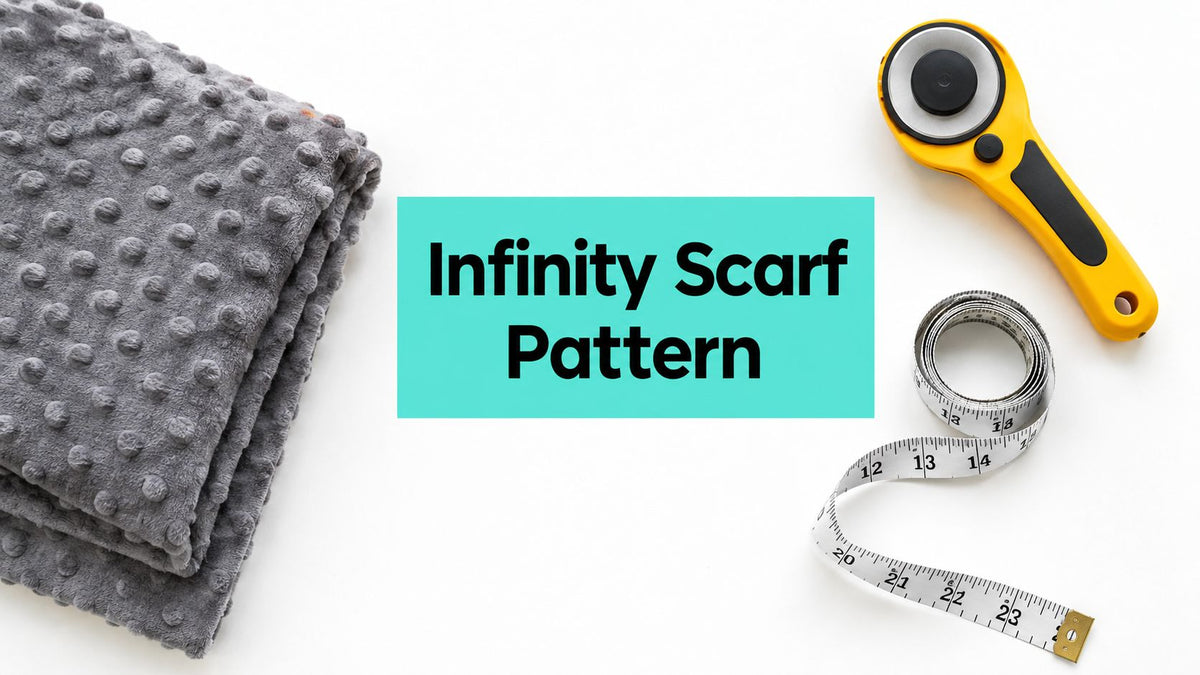
You want a soft, giftable scarf, but minky's slippery pile makes a simple sewing project feel risky. The most reliable pattern for an infinity scarf is one rectangle, two main seams, and a closed loop, with minky-specific tools and handling doing the heavy lifting. Choose the texture first, then cut accurately, control the feed, and check for twists before closing the opening.
Why a Minky Infinity Scarf Is the Beginner Project You've Been Avoiding
An infinity scarf looks more complicated than it is. The finished piece is a continuous fabric loop that can be worn loose, doubled around the neck, draped over the shoulders, or pulled up as a hood-like layer. You aren't shaping sleeves, matching corners, or installing hardware. You're managing a rectangle and making sure the tube stays untwisted.
That simple construction follows a much older textile idea. Circular knitting forms fabric continuously as a tube instead of making a flat panel that must be cut and sewn. William Lee's mechanical stocking frame dates to 1589, and Marc Isambard Brunel patented a circular knitting machine concept in 1816. Commercially significant circular machines followed during the 1860s and 1870s as manufacturing tolerances and latch-needle technology improved, as described in this history of the circular knitting machine.
What makes minky different
Minky is forgiving to wear but demanding under the presser foot. Its plush pile can hide the cut edge, creep between layers, compress unevenly, and make a seam look flatter in one place than another. That doesn't make it a poor beginner fabric. It means the beginner project needs a fabric-specific method, not generic cotton instructions.
At OPN, we tell new makers to decide on the Cuddle texture before they buy a rotary blade or mark a seam. A smoother Quilting Cuddle behaves differently from a higher-pile Luxe Cuddle, and those differences affect seam bulk, drape, and how much patience you'll need at the machine. Our infinity scarf ideas are useful for choosing a finished look before cutting.
Practical rule: The texture determines the handling. The pattern only works smoothly when the tools and technique match that texture.
The project has three decisions worth making early:
- Fabric: Pick a lower pile for easier control or a plush texture for maximum gift appeal.
- Size: Choose the circumference based on how the scarf will wrap, not just on how wide you want it to look flat.
- Machine setup: Use a walking or dual-feed foot, a suitable stretch needle, and a longer stitch so the pile doesn't drag or perforate.
Once those choices are settled, the sewing becomes pleasantly repetitive. That's why a minky infinity scarf is a strong first plush project, especially when you want a handmade result without a long list of pattern pieces.
Choosing the Right Cuddle Fabric for Your Scarf
Minky is a plush polyester fabric with a velvety texture. Cuddle is Shannon Fabrics' trademarked name for this fabric family, while Luxe Cuddle is a higher-pile variant, as explained in OPN's guide to what Cuddle and minky fabric are.
The right choice depends on whether you value easy handling, dramatic texture, or a convenient stash project. Don't choose by softness alone. Run your fingers over the pile, look at how the nap lies, and consider how much bulk the finished loop can comfortably carry.
| Fabric choice | What it feels like at the machine | Best use | Practical verdict |
|---|---|---|---|
| Quilting Cuddle | Lower pile and easier seam visibility | First scarf or clean everyday accessory | The safest starting point |
| Luxe Cuddle Hide | Dense, pronounced texture | Plush winter gift | Luxurious, but seam bulk needs control |
| Luxe Cuddle Snowy Owl | Soft, shaggy surface | Statement scarf or special gift | Beautiful drape, slower handling |
| Luxe Cuddle Fawn | Textured, cozy finish | Gift-making and seasonal accessories | High appeal, test the pile first |
| Anti-pill fleece | More stable and familiar | Stash-busting or practice piece | Less plush, easier to sew |
A standard Quilting Cuddle is the sensible choice when you're learning to keep layers aligned. It still gives you the soft polyester feel people want, but it won't exaggerate every small handling mistake. If you want to shop Shannon Cuddle fabric, start there when the scarf is your practice run.
When should you choose Luxe Cuddle
Choose Hide, Snowy Owl, or Fawn when texture is part of the gift. These fabrics make a scarf feel special, but high pile can compress under the foot and increase the apparent thickness at the join. A walking foot helps, yet it won't compensate for pulling the fabric or using a short stitch.
Luxe Cuddle also deserves directional attention. If the pile has a visible nap, cut both long edges in the same direction so the finished loop doesn't show a texture reversal. For related home projects, makers comparing plush textiles may also want to choose washable sofa covers, particularly when washability matters as much as surface feel.
Fleece is useful when your priority is control rather than luxury. It can be a good test piece, but don't assume its behavior will predict a thick minky seam exactly. A test seam using the actual fabric, pile direction, and seam thickness is the only dependable trial.
Cutting Sizes for One, Double, and Petite Wraps
Start with the finished use in mind, then cut for the drape you want. For a standard adult minky infinity scarf, use an 18.5-inch-wide by 36-inch-long rectangle, the size specified in Shannon Fabrics' Luxe Cuddle infinity scarf tutorial. That cut makes an approximately 9-inch-wide by 17-foot finished loop and can produce three scarves from 1 yard when cut lengthwise, according to the tutorial.
Width determines how much fabric rests at the neck. Length determines how freely the loop hangs and how easily it wraps. Reduce both measurements for a smaller scarf rather than shortening only the width. A narrow, short loop can feel crowded, especially in thick minky.
| Wrap Style | Cut Rectangle | Finished Loop Width | Best Fabric |
|---|---|---|---|
| Double-wrap adult | 18.5 inches by 36 inches | Approximately 9 inches | Quilting Cuddle or medium-pile Luxe Cuddle |
| Single-loop adult | 60 inches by 22 inches | Varies by seam allowance | Quilting Cuddle, fleece, or lighter minky |
| Petite adult | 54 inches by 20 inches | Varies by seam allowance | Quilting Cuddle or low-bulk fleece |
Which size should you cut
The 18.5 by 36-inch rectangle is the most manageable starting point for a plush adult scarf. Fold it lengthwise, sew the long seam, turn the tube, and join the short ends. The compact proportions suit a doubled wrap without forcing bulky minky into an unnecessarily wide panel.
A longer, simpler version uses a 60 by 22-inch rectangle, with a 1/2-inch seam line marked along the long edge. For petite wearers under 5 feet 2 inches, use the suggested 54-inch by 20-inch cut from this adult and petite infinity scarf pattern. On bulky or fleece-backed fabric, a 1/4-inch seam allowance leaves less excess inside the loop, but it also gives you less room for correcting an uneven seam.
Other cutting systems suit different fabric widths and sewing habits. One adult method uses a 62-inch by 28-inch rectangle, then finishes the join with a 1/4-inch first seam trimmed to 1/8 inch and a 3/8-inch second seam, as described in this repeatable seam method. Another method uses 36-inch-wide fabric, dividing a 1-yard cut into two 36-by-22-inch rectangles before joining them into an approximately 11-inch-wide tube, as shown in this narrow-width fabric method.
For a first minky scarf, stick with the 18.5 by 36-inch cut. The 62 by 28-inch method pays off once you are comfortable trimming plush seams to 1/8 inch.
Mark the wrong side before cutting. Chalk can vanish into the pile, and a directional texture can make a correctly measured scarf look reversed after assembly.
Prepping Your Workspace and Marking the Minky
Minky rewards a clean, calm setup. Lint-roll the cutting surface first, because loose fibers and thread scraps can disappear into the pile and travel into the seam. Use a rotary cutter rather than scissors when possible, and make a small starter snip at the corner so you can keep the pile flat while cutting.
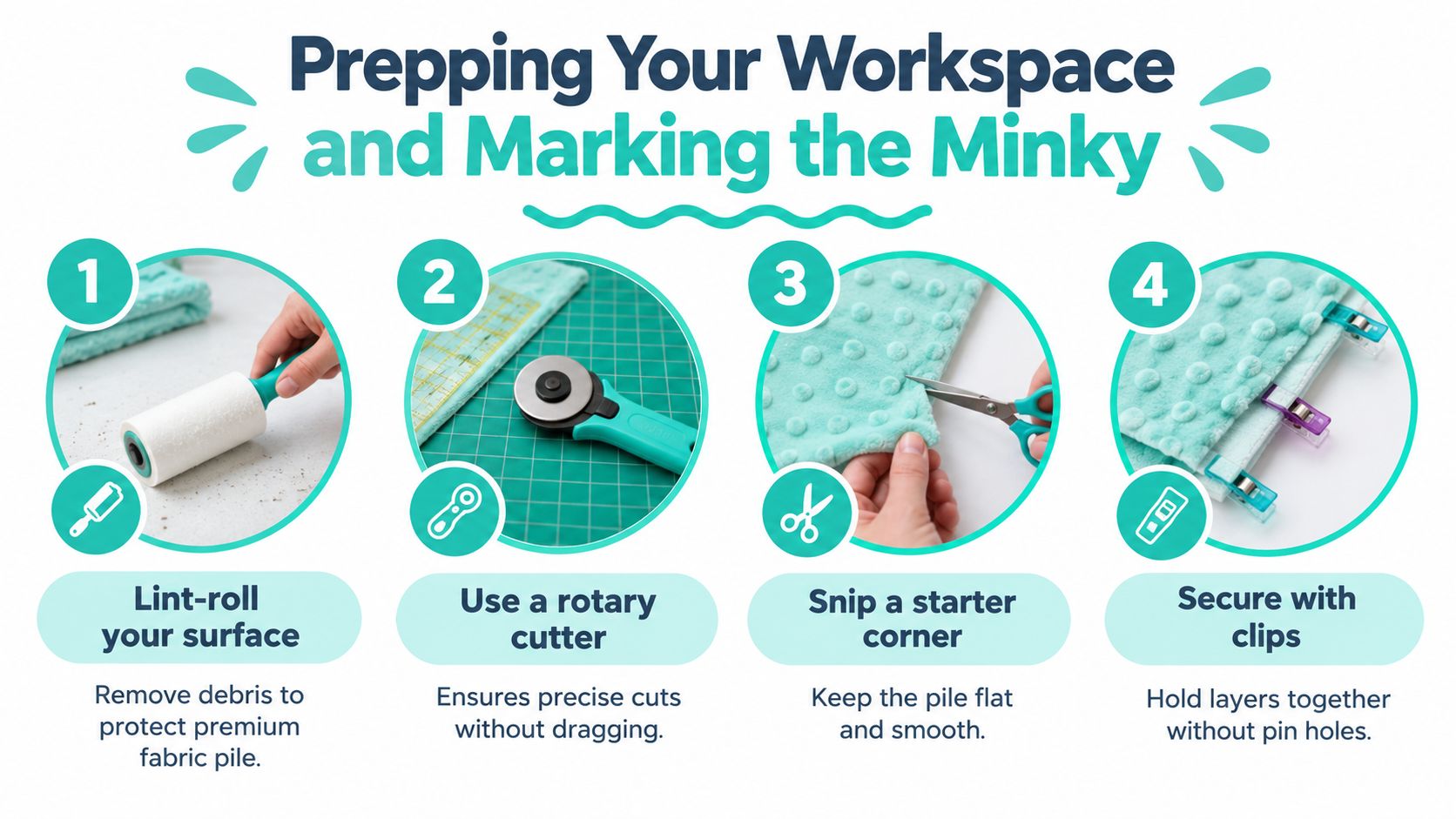
Keep these supplies beside the machine:
- Clips: Use clips instead of pins, placing them roughly every 1 inch on minky-to-minky seams.
- Walking or dual-feed foot: Let the machine move both layers together.
- 80/12 or 90/14 stretch needle: Match the needle to the plush fabric's stretch-like surface behavior.
- Low-lint polyester thread: Reduce loose lint in the seam and around the machine.
- 3.0 to 3.5 mm stitch setting: A slightly elongated stitch avoids perforating or gathering the pile.
- Turning tool: A chopstick or similar blunt tool helps ease the tube without stabbing through the fabric.
For additional cutting control, use OPN's guide to cutting minky fabric without the mess. It helps to cut with the pile facing down when the cutting surface allows it, then brush the seam edges so trapped fibers don't form hard ridges.
Mark before you sew
Clip the two short ends together before you begin the long seam. This isn't the final join. It's a quick check that the rectangle hasn't been twisted and that the nap runs in the direction you expect.
Fold the fabric lengthwise with right sides together, align the long edges, and clip from the center outward. Minky can shift while you work, so don't rely on a few clips at the corners. Sew slowly, keep your hands relaxed, and never push or pull the fabric beneath the presser foot, a handling rule also emphasized in this minky sewing guidance.
Sewing the Loop Without Twists or Bulk
The walking foot is worth using because minky's pile and stretch-like surface can make the top layer creep ahead of the lower layer. A standard foot may sew a seam that looks acceptable at the beginning and then develops ripples or a shifted edge several inches later. The walking foot doesn't make the fabric behave like cotton, but it gives the layers a fair chance to travel together.
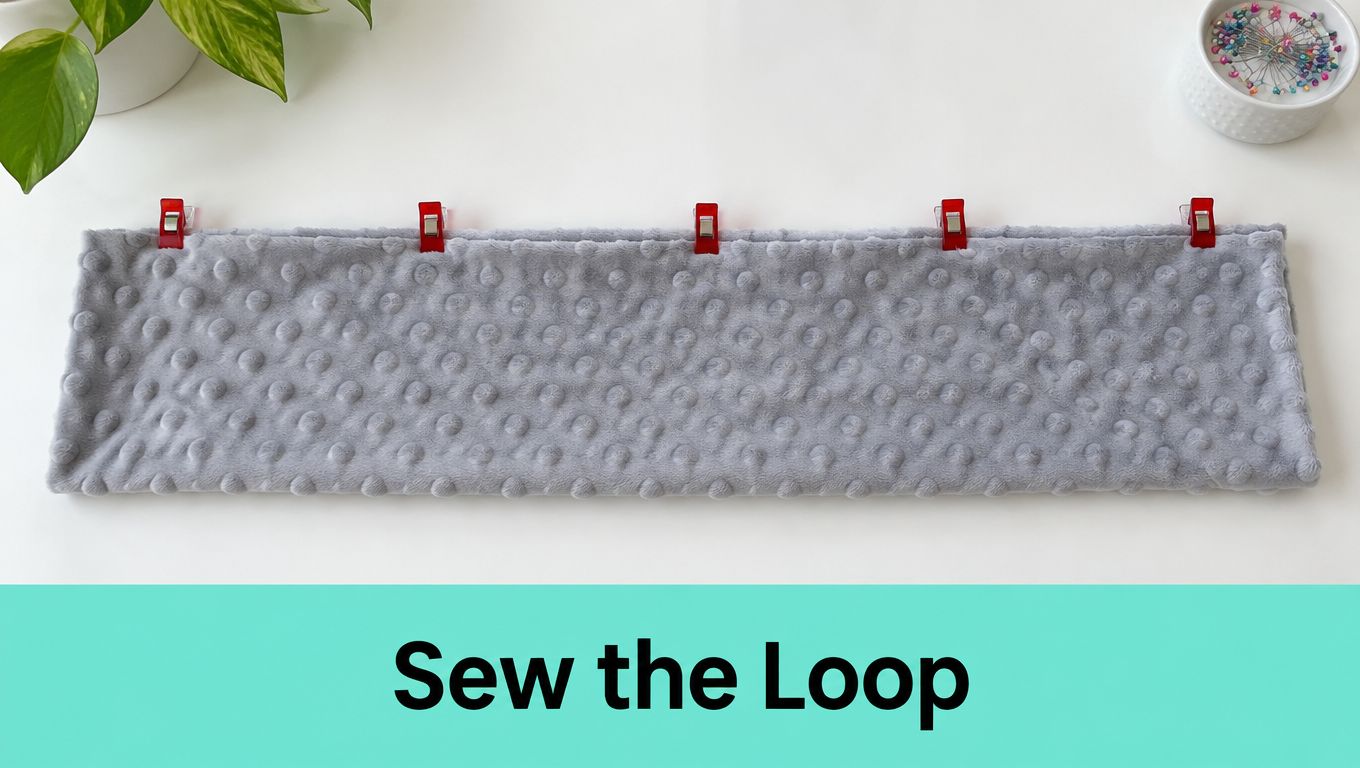
Fold the rectangle lengthwise, right sides together, and secure the long edge with clips. Sew that seam using a 3.0 to 3.5 mm stitch and a 3/8-inch seam allowance, then backstitch at both ends. A stretch needle helps prevent skipped stitches, while the longer stitch reduces the risk of creating a perforated or gathered seam in the pile.
Turn the tube right side out without forcing the fabric. If the turning tool catches the nap, stop and work the fabric back rather than pushing harder. Once the tube is smooth, flatten the seam gently with your fingers instead of pressing aggressively.
How do you join the loop without twisting it
Align the short ends with the long seam nested neatly. Before sewing, hold the tube in a ring and let it hang. If the seam travels around the tube without flipping, the loop is oriented correctly. If it crosses over itself, untwist it now. This test takes moments and prevents an entire seam from being unpicked.
Sew around the short ends while leaving a 2-inch opening for turning and access. Close that opening with a ladder stitch for the least visible finish, or topstitch carefully if the fabric's pile hides the line. The most common failures are a twisted loop, a forgotten turning gap, and a seam that stretches because the maker pulls the fabric through.
For another machine-focused view, see OPN's guide to sewing with minky without letting it slide.
The construction is also easy to watch in motion:
Run this inspection before trimming thread tails:
- Check the ring: Confirm the scarf lies flat and isn't twisted.
- Check the pile: Look for compressed ridges or sections caught in the seam.
- Check the stitches: Inspect both seams for skipped stitches and uneven feeding.
- Check the opening: Make sure the turning gap is fully closed and secure.
Finishing Techniques for a Professional-Looking Scarf
A plush scarf looks finished when the inside seams lie flat instead of forming a hard ridge. Grade bulky seam allowances by trimming one layer slightly narrower than the other. Pull loose pile out of the stitching with a needle or pin, taking care not to cut the seam. This matters with Hide, Snowy Owl, and Fawn, whose dense textures can make a join feel thicker than expected.
For a stronger enclosed seam, use two passes. Sew a 1/4-inch first seam, trim it to 1/8 inch, then sew a 3/8-inch second seam, creating a 5/8-inch finished seam structure that helps prevent the edge from pulling apart during wear. The method takes more attention, but it suits a scarf that will be worn often or given as a gift. Keep the fabric flat as you sew, since minky can shift when its pile catches against the presser foot.
Which finish suits the fabric
A serged edge works well when you own a serger and the pile sheds into the seam allowance. It trims and encloses the edge in one pass, but check that the differential feed is not stretching the tube. A turned-and-topstitched finish is easier to manage on a standard machine. It can, however, leave the join stiffer and more visible.
A hand-closed opening gives the cleanest result when the pile is short enough to hide the stitches. Bury thread tails inside the seam, then brush the surface gently to restore the nap. If pressing has flattened the pile, test a low-heat iron with a pressing cloth on a scrap first, and follow the fabric maker's care instructions. OPN's guidance on preventing fabric pilling also helps protect the finished surface.
Synthetic plush needs careful laundering. A 2025 review reported that microfiber emissions vary with washing temperature, detergent, water-to-clothing ratio, machine type, cycle duration, and mechanical friction. It also reported that knitted fabrics generally release more microfibers than woven fabrics, as discussed in this textile microfiber review. Wash the scarf only when needed, choose a cool, shorter cycle, avoid high heat and excessive spin, wash it with similar soft goods, and air-dry or use low heat according to the fabric maker's instructions.
A machine-washable scarf still benefits from gentler washing. Softness and durability do not make synthetic plush impact-free.
Try the finished loop three ways before deciding whether the size works: wear it as a single shoulder drape, double it close to the neck, or pull the doubled loop upward for a hood-like layer. For makers who prefer a ready-to-sew route, OPN offers an infinity scarf kit. A finished Buffalo Check Steel/Snow minky infinity scarf removes the sewing step entirely. The shop is supported by hundreds of verified reviews, which can help gift-makers choose fabric or finishing help.
Care card idea: Include the fabric name, nap direction, and washing guidance with every handmade scarf. It protects the recipient's experience after sewing is complete.
If you prefer a prepared route, On Pins & Needles Quilting Co. offers curated minky cuts, infinity scarf kits, Shannon Cuddle textures, and finished accessories for gift-making. Visit On Pins & Needles Quilting Co., use the 15% first-order coupon, and take advantage of free U.S. shipping on orders over $70.