
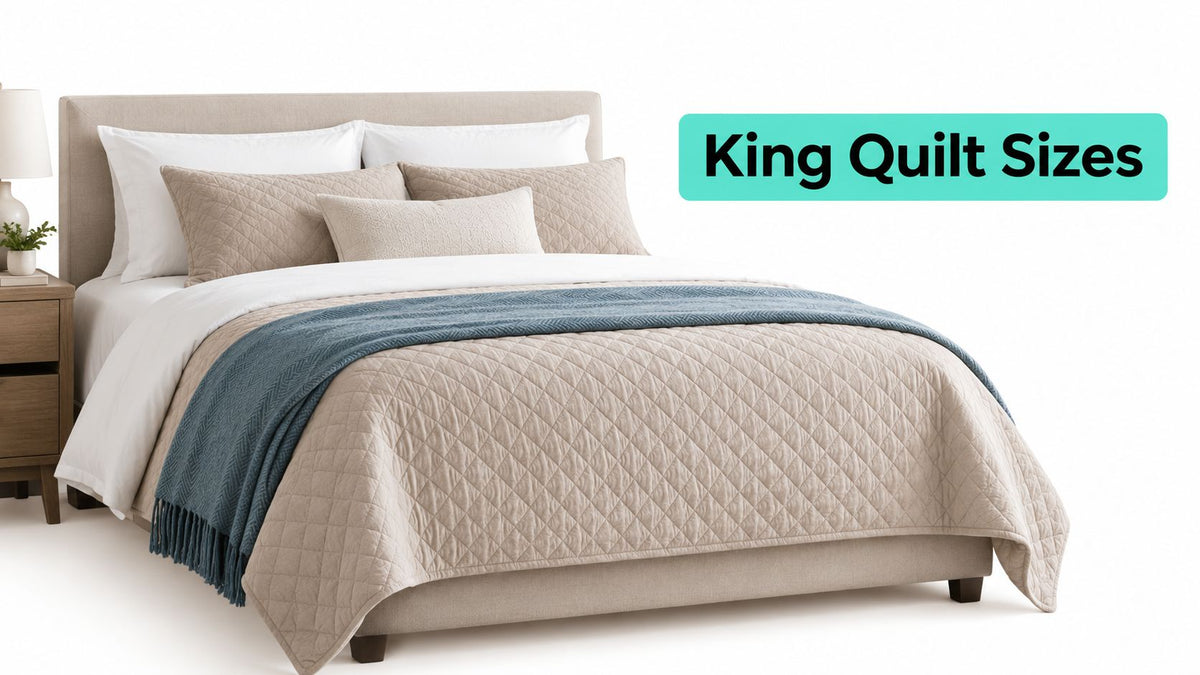
A standard king quilt's finished size isn't fixed. Most projects land around 104 by 92 inches to 108 by 108 inches, with 108 by 95 inches and 104 by 100 inches also common planning targets depending on drop, tuck, and bed style.
What the Size of a King Quilt Really Means
The size of a king quilt is a calculation, not a single number. Start with the mattress, add the side and foot drop you want, then adjust for whether the quilt will be tucked, draped, or allowed to pool.
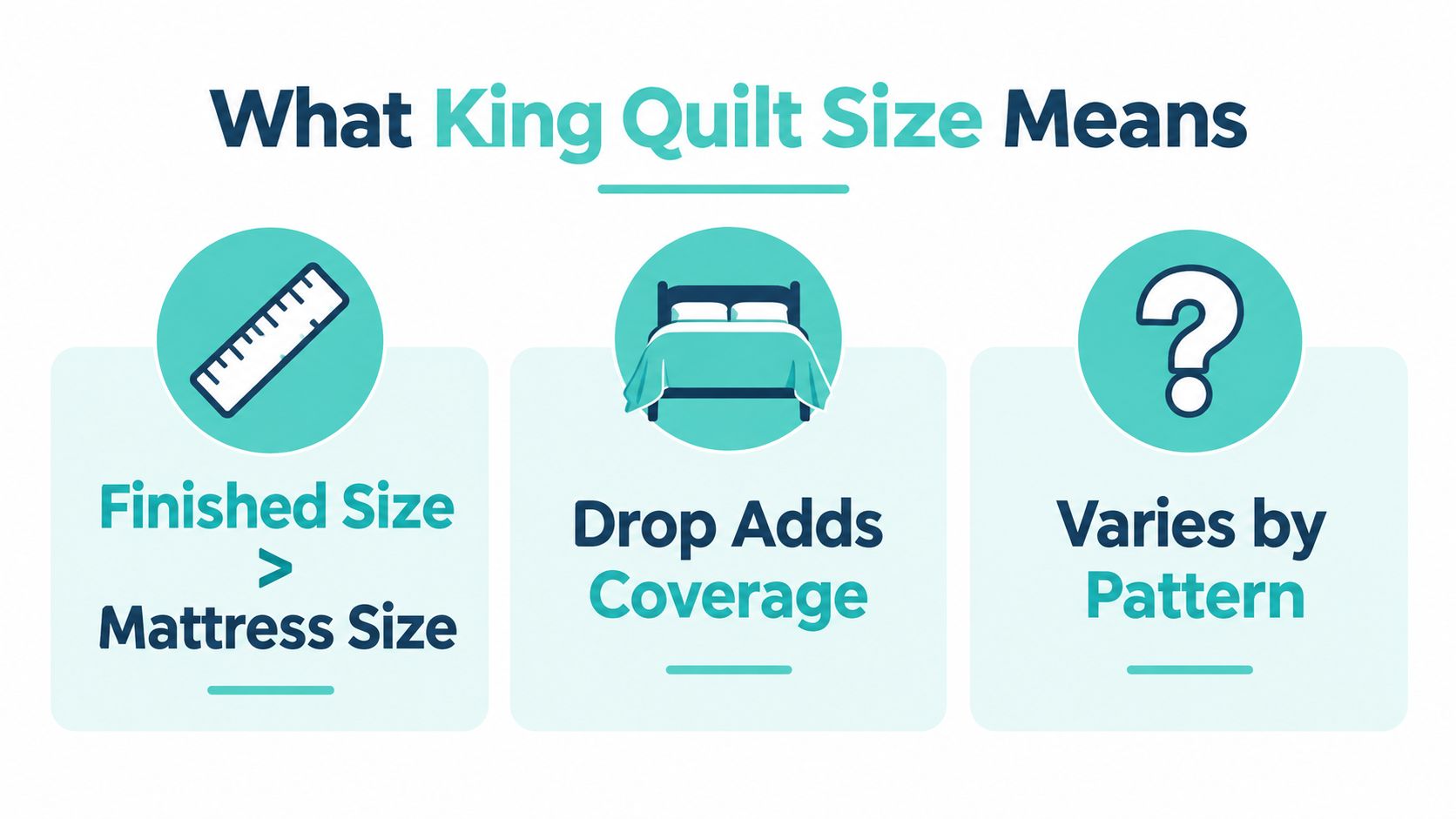
A useful shorthand is this, finished size > mattress size. That sounds obvious, but it's where a lot of king projects go wrong, because a quilt that only matches the mattress looks like a fitted sheet, not bedding.
Three questions that set the number
First, how deep is the mattress. A pillow-top or hybrid bed changes the drop you need, even if the label still says king. Second, how much overhang do you want on the sides and foot. Third, are you tucking at the pillows or letting the quilt stop short of them.
For a practical reference, the common planning band for a standard king ends up around 104 by 92 inches to 108 by 108 inches, and that spread exists because styling choices change the finished dimensions. If you want a quick outside guide while you compare measurements, the perfect fit king size quilt tips resource is worth a look.
Practical rule: Measure the bed first, then choose the quilt style. If the quilt size comes before the bed dimensions, the math usually gets expensive.
Once the finished size is set, backing, batting, and longarm prep all become much easier to plan.
Standard King Mattress Dimensions and Why the Quilt Is Bigger
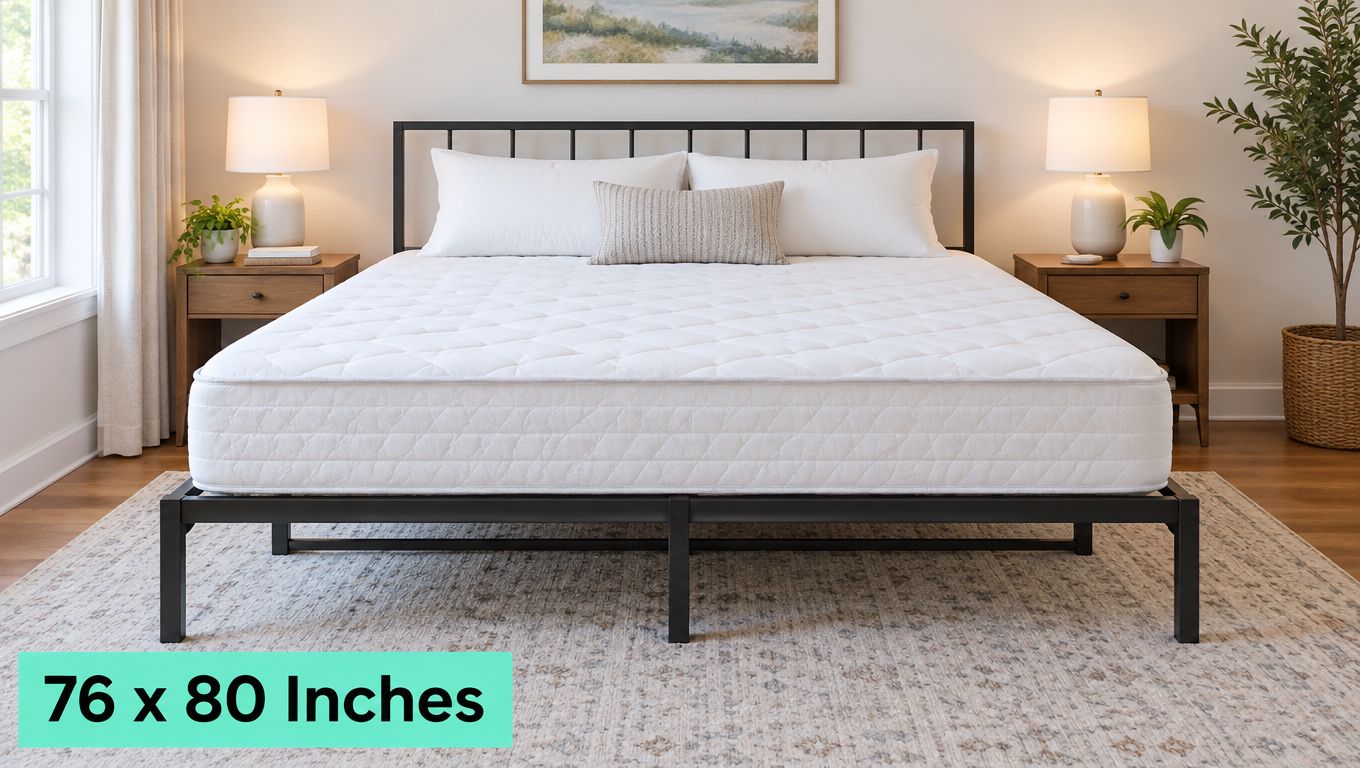
A standard U.S. king mattress measures approximately 76 inches wide by 80 inches long, with 6,080 square inches of surface area, and it's 16 inches wider than a standard queen while keeping the same 80-inch length Sleep Foundation. That width is exactly why a king quilt needs to be larger than the mattress itself.
Why drop matters more than the label
The mattress is the anchor, but the quilt has to cover the sides and foot. A king quilt sized exactly to the bed would barely reach the edges, and on a real bedroom setup that usually looks underbuilt.
A better frame of reference is the drop, which is the amount the quilt hangs past the mattress. With a 14 to 16 inch side drop, a king top lands around 104 to 108 inches wide, and a 10 to 15 inch foot drop puts the length around 90 to 95 inches before any pillow tuck The Stitch Desk. For a clean mattress reference point, the 76 by 80 inch mattress detail helps anchor the scale.
That's also why a king quilt takes more fabric than a queen. The bed is wider, the quilt body is larger, and every extra inch adds weight and material demand.
A king quilt that looks balanced on the bed usually starts with the overhang, not the block layout.
For makers comparing bed sizes, the important takeaway is simple. A king mattress defines the minimum, but the quilt size is driven by how you want the bed to look when it's made.
King Bed Formats Around the World
King is a category, not one fixed size. Mattress makers use different king conventions, and the wrong assumption can throw off the quilt top, backing, and batting before the bed is even made.
| Bed Format | Mattress (in) | Typical Finished Quilt (in) | Key Planning Note |
|---|---|---|---|
| Eastern King | 76 by 80 | About 108 by 95 or 108 by 108 | Standard U.S. reference point |
| California King | 72 by 84 | About 104 by 114 | Longer and narrower, needs more length |
| Split King | About 76 to 78 by 80 combined | Varies by setup | Built from two twin XL mattresses |
| Wyoming King | 84 by 84 | Larger than standard king | Square format, needs wider planning |
| Alberta or Vermont King | 96 by 96 | Larger than standard king | Very wide square bed |
| Alaskan King | 108 by 108 | Much larger than standard king | Oversize square, backing becomes a major issue |
| IKEA standard king | About 63 by 79 | Depends on local convention | European sizing differs from U.S. sizing |
| IKEA super king | About 71 by 79 | Depends on local convention | Always verify the actual mattress size |
For a split setup, the practical question is not the label on the bed frame. It is whether the quilt needs to cover one continuous mattress or two separate bases. The king versus split king differences guide is useful when the setup is not a standard single mattress.
Why the label alone causes errors
A California king is 72 by 84 inches, so it is four inches narrower and four inches longer than an Eastern King NCOA. A quilt drafted for a standard king can fit the width and still miss the length.
The same sizing guide also points to oversized formats such as a Wyoming king at 84 by 84 inches, an Alberta or Vermont king at about 96 by 96 inches, and an Alaskan king at 108 by 108 inches NCOA. Those dimensions push the project into custom planning fast, especially once you account for backing width.
The rule I use is plain. Measure the mattress and write those numbers in the pattern notes. The word king is not enough.
One more trade-off shows up with wide specialty beds. On Pins & Needles Quilting Co. points quilters toward OPN's extra-wide minky when the backing turns into the hardest part of the build. That matters on oversized kings, where a backing decision can change the whole cutting plan.
Calculating the Finished Quilt Size From Drop
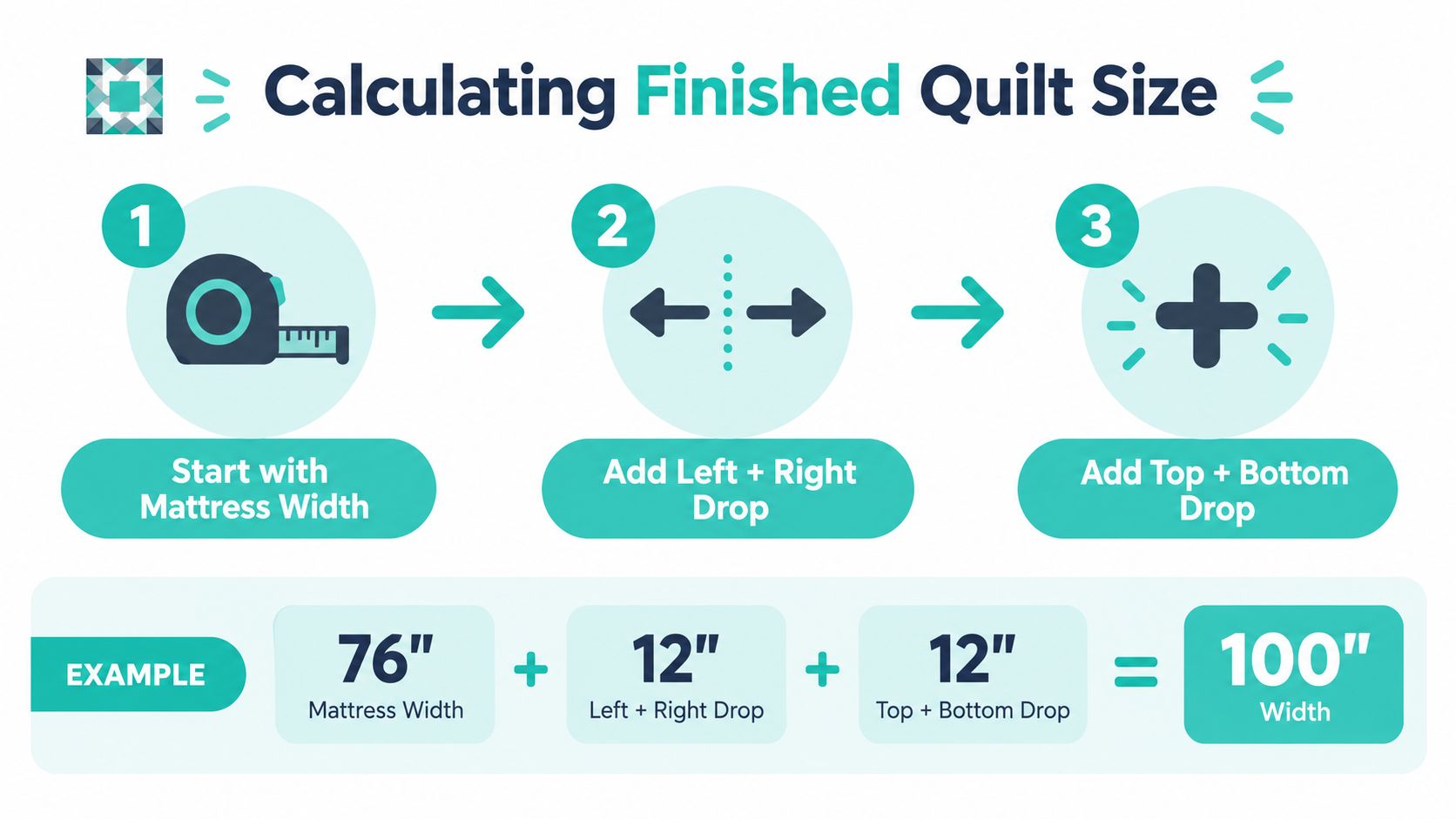
The clean formula is simple. Finished width = mattress width + left drop + right drop, and finished length = mattress length + foot drop + optional pillow tuck. That is the math that matters before you cut.
Benchmarks that actually work
Per The Stitch Desk, a 14 to 16 inch side drop on a 76 inch wide king mattress gives you about 104 to 108 inches of finished width. On the length side, an 80 inch mattress plus a 10 to 15 inch foot drop lands around 90 to 95 inches before pillow tuck, and that range matches the yardage planning approach in calculating yardage for quilts.
That is why king quilts usually fall into a few workable targets:
- 104 by 92 inches for a slimmer, cleaner drape.
- 108 by 95 inches for a fuller, more traditional bed cover.
- 108 by 108 inches for a square, generous look that suits some king setups.
Mattress depth still changes the result. Deep pillow-top beds use up drop faster than flatter mattresses, so the same quilt can look generous on one bed and short on another.
Measure the mattress you own, not the one on the product page. The label alone does not tell you how much quilt you need.
Backing and Batting Size for a King Quilt
Once the top size is fixed, backing and batting stop being estimates. They become cut sizes with a loading margin, and that margin matters on a king project because the fabric has to hold up through quilting, clamping, and trimming.
What the backing really needs
Longarm prep guidance calls for batting and backing to be at least 8 inches larger than the quilt top in both dimensions, which works out to 4 inches of extra material on each side Rainpos PDF. That range is enough for many king quilts, but standard-width fabric still forces a choice between piecing and buying wider yardage.
A practical example makes the gap clear. A 110 by 108 inch king top can call for backing of at least 118 by 116 inches under the 4 inch-per-side rule. A standard-width backing usually means a center seam, and that seam has to stay flat across a large surface. See our guide to king size quilt backing fabric for yardage by width.
Wide backing changes the job. OPN's 110 inch extra-wide minky backing can remove the need for a center seam on many king quilts, while 90 inch minky options work for projects that do not need the widest width. On a large back, width matters more than print scale.
A yardage comparison shows why. A 108 inch wide backing can take about 6.5 yards for a 110 by 108 inch king quilt, while standard 42 inch fabric can need about 9.75 yards because multiple panels are required Makers Math.
The practical result is simple. Wider backing reduces seams, cuts layout stress, and makes longarm loading cleaner. That is why OPN's extra-wide minky is often the easiest answer when king backing becomes the headache.
Shrinkage, Seam Allowance, and Pressing Tolerances
Cut size and finished size aren't the same thing, and king quilts make that difference obvious. Quilting, trimming, and finishing all nibble away at the measured top, so the cut plan has to leave room for reality.
What changes between the ruler and the bed
The first loss happens in seam allowance. The second loss comes from quilting and binding, which pull the quilt in slightly and can change the edge line more than new makers expect. Directional prints and border placement can also force a wider starting cut if the design has to stay centered.
That's why a quilt that's supposed to finish at 108 by 108 inches may need more top fabric on the cutting table. If you want clean borders and a crisp final edge, the safest approach is to cut with tolerance, then trim after quilting rather than trying to land on a perfect number too early.
Pressing matters more on a king project than on a lap quilt, because every small ripple multiplies across the bed.
This is also where backing helps. With a wide back, you don't spend time matching a center seam through the middle of a large quilt, and that makes the load flatter before the first stitch. The internal note on iron care for sewing projects fits neatly with this stage of the process, because pressing accuracy shows up in the final bed fit.
If the project uses multiple borders or a directional print, give yourself a little more room than the minimum. King quilts punish guesswork, and the extra planning almost always pays off in the finished drape.
Longarm Quilting Prep Checklist for a King Quilt
King tops leave little room for prep errors. The quilt is large, the backing is expensive, and loading it on a longarm exposes every uneven edge and skipped press.
The prep checklist that prevents headaches
- Backing excess: Add the allowance your longarm service specifies, usually enough extra to load and clamp the quilt without strain.
- Batting size: Cut batting larger than the top so it stays relaxed on the rollers.
- Edges: Stay stitch heavily pieced sections and any bias-prone edges before quilting.
- Threads: Clip loose threads on the back before loading.
- Surface prep: Press the backing flat, square it, and remove loose embellishments.
The exact margin depends on the machine and the operator. Some setups want more room for loading comfort, while others work cleanly with a tighter cut. Either way, the goal is the same, a top that lies flat and backing that does not fight the frame.
For a fuller checklist, use the top longarm quilt prep tips guide before you package the quilt. If you prefer to send the project out, OPN's Mail-in Longarm service handles finished tops and returns the quilt after edge-to-edge quilting with batting and thread included.
Practical rule: Send a top that is square, pressed, and thread-clipped. A king quilt does not hide uneven edges the way a smaller quilt sometimes can.
King prep is about control, not guesswork. When the top, backing, and batting all meet the loading requirements, the quilting runs smoother and the finish looks deliberate.
Shipping a King Quilt Without Surprises
A king quilt can fit the pattern and still fail at the post office. For shipping, the packed parcel matters more than the quilt's finished size.
USPS measures length as the longest side, height as one perpendicular side, width as the other perpendicular side, and girth as twice the height plus twice the width. Under USPS parcel standards, domestic parcels may not exceed 108 inches for combined length and girth. The same standards also trigger dimensional weight for parcels larger than 1 cubic foot, or 1,728 cubic inches, using length × width × height ÷ 139, rounded up.
That is why a king quilt should be packed tight, measured after boxing, and checked against carrier rules before you buy the label. The flat quilt size is only part of the shipping calculation.
For tops sent out for finishing, OPN's mail-in workflow includes free return shipping on longarm orders, which takes the guesswork out of the way back. It is a cleaner option than estimating box size from quilt dimensions alone.
King Quilt Quick Reference by Bed Type
A king quilt starts with the bed, then the drop, then the backing. That order keeps the numbers honest.
| Bed Type | Mattress (in) | Finished Quilt (in) | Backing + 4-6 in (in) | Batting + 3-4 in (in) |
|---|---|---|---|---|
| Eastern King | 76 by 80 | 108 by 95 or 108 by 108 | 116 to 120 by 103 to 112 | Similar or slightly larger |
| California King | 72 by 84 | About 104 by 114 | 112 to 116 by 122 to 126 | Similar or slightly larger |
| Split King | About 76 to 78 by 80 combined | Varies by layout | Measure each side separately | Measure each side separately |
| Wyoming King | 84 by 84 | Oversize square | Much wider than standard king | Much wider than standard king |
| Alaskan King | 108 by 108 | Oversize square | Custom width required | Custom width required |
Eastern king and California king are the everyday starting points, but the backing plan changes fast once the quilt gets wider or longer. Split king projects need separate measurement for each side, since the layout controls the finished size more than the bed name does.
For quick backings and smoother loading, I'd rather reach for 110 inch minky options than piece a center seam into a king-sized back. Our minky blanket size guide covers how those widths map to finished projects. OPN also keeps Shannon Cuddle by the yard for makers who want a softer back without going oversized, and Luxe Cuddle textures when the project needs a more premium finish.
The bed label still does not give you one fixed answer. California King quilts often land near 104 by 114 inches, while standard King recommendations often sit near 108 by 108 inches because the California bed runs longer and narrower House and Hold. That gap is why the drop matters more than the name on the mattress.
Plan Your King Quilt and Get Started at OPN
Every king project comes down to three numbers, the mattress dimensions, the chosen drop, and the finished quilt size that follows. Once those are locked in, backing and batting choices stop feeling like guesswork.
For many quilters, the easiest next move is a back made from a single piece of fabric. OPN stocks extra-wide minky, plus textures like Hide, Snowy Owl, and Fawn for projects that need a softer finish without piecing a center seam. We also offer Mail-in Longarm quilting for finished tops that are ready to move from the sewing room to the bed.
If you're starting from scratch, use the bed size, add the drop you want, then match backing width to the finished top. If you're trying to save time, OPN has hundreds of verified reviews behind its cutting and finishing workflow, plus a 15% first-order coupon and free U.S. shipping on orders over $70.
On Pins & Needles Quilting Co. has the backing, textures, and longarm services that make a king quilt easier to finish cleanly. Visit On Pins & Needles Quilting Co. to choose extra-wide backing, send in a top for mail-in longarm quilting, and get the measurements working in your favor before you cut.