

You've chosen a quilt top, batting, and backing, but the longarm pattern gallery still feels impossible to narrow down. The right long arm quilting stitch patterns are selected by balancing motif family, stitch density, fabric texture, batting loft, and the finished quilt's intended use, not by choosing the most attractive thumbnail.
Introduction to Long Arm Quilting Stitch Patterns
A gallery full of loops, feathers, florals, grids, and novelty motifs can make even an experienced quilter hesitate. The reassuring reality is that most edge-to-edge designs belong to a few recognizable families, and each family creates a different combination of texture, movement, softness, and restraint.
Start by asking what the quilting needs to do. A loose meander can secure a quilt while preserving loft. A dense geometric fill can create a firmer surface and make the quilting itself the main visual feature. A feather may add traditional movement, while a seasonal or juvenile motif can give a simple quilt a clear personality.
Longarm stitch patterns are more than decoration. They form a repeatable path through the quilt sandwich, securing the quilt top, batting, and backing. The Smithsonian's National Quilt Collection documents approximately 250 years of quilt-making history, including changes in needlework techniques, materials, processes, styles, and patterns. Modern computerized quilting continues that tradition by translating drawn motifs into consistent stitch paths.
The technology behind today's edge-to-edge designs developed gradually. The earliest known machine-sewn quilt in the available historical record was a crib-size quilt made by Joseph Granger of Worcester, Massachusetts, in 1879. Janome's 1979 MEMORY 7 Model 5001 was described as the world's first programmable computer sewing machine, with up to 26 computerized stitch patterns and functions such as mirroring, reversing, and automatic stitch-width and stitch-length settings. Digital quilt design then advanced through PCQuilt in 1986, Electric Quilt in 1991, and additional programs by 1999, according to the available historical overview of computerized quilting.
That history explains why a modern longarm service can offer extensive pattern variety without drawing every row by hand. Your decision is still personal, but it becomes much easier once you judge each pattern by its structural behavior, not just its appearance on a screen.
The Five Core Families of Quilting Motifs
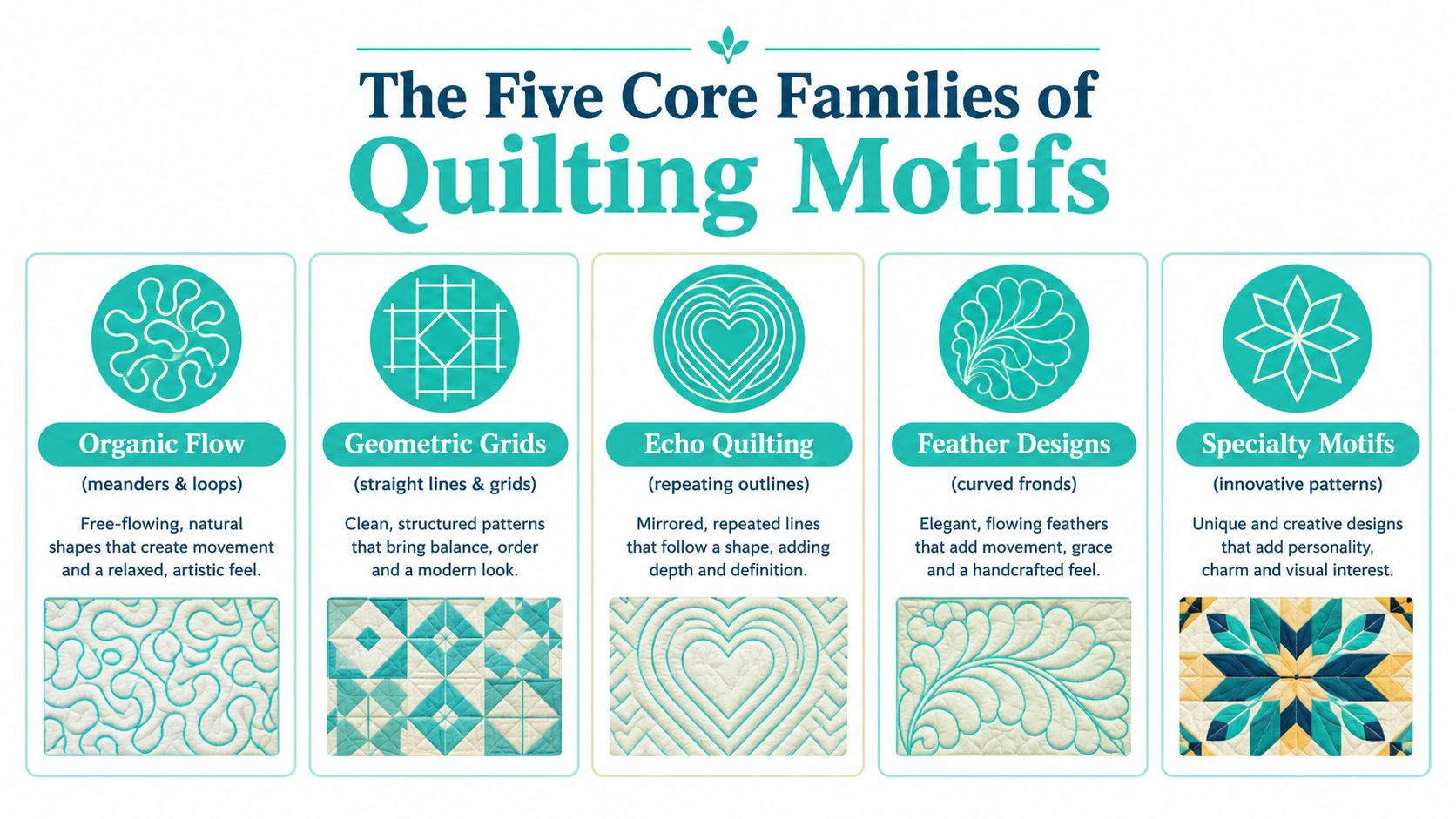
Most long arm quilting stitch patterns fit into five practical families. Knowing the family helps you describe your preference clearly and anticipate how the quilting will interact with your piecing, fabric, and batting.
Which motifs create soft all-over texture?
Organic flow patterns include meanders, loops, swirls, stippling, and wandering curves. They distribute visual attention rather than directing it toward one section of the quilt. Open meanders work well when you want the pieced design to remain dominant, while micro-stippling creates a more textured and controlled surface.
These motifs are often forgiving on quilts with busy prints because they don't compete with strong patchwork lines. They also adapt well to many quilt sizes, although the repeat should still be enlarged when the batting is lofty or the fabric has a pronounced pile.
Feather designs range from simple feather trails to wreaths and flowing feather borders. Their curved fronds add movement and a traditional tone, making them a natural match for medallions, traditional blocks, and elegant solids. A feather can look delicate at a large scale, but a tightly packed feather repeat may compress the quilt more than expected.
How do geometric and echo designs change the surface?
Geometric patterns use straight lines, grids, diamonds, crosshatching, or angular paths. They emphasize piecing, create a modern appearance, and can visually reinforce the architecture of a quilt top. Crosshatch is especially effective on quilts with strong blocks, but it requires careful spacing because uneven rows are easier to notice than irregular curves.
Echo quilting repeats outlines or follows the contours of a shape. It can frame pieced elements and create a sense of depth without filling every area with dense stitching. Echo-style designs may be a strong choice when the quilt top contains large motifs that deserve breathing room.
Paisleys and teardrops often sit between organic and structured categories. Their curved enclosed shapes can fill space efficiently, while their pointed ends add direction. They suit both traditional and contemporary quilts, but the smallest interior spaces should be checked carefully before selecting a dense scale.
When should you choose a specialty motif?
Specialalty patterns include florals, leaves, animals, stars, snowflakes, holiday imagery, and juvenile motifs. They add narrative rather than just texture. A floral edge-to-edge design can soften a geometric quilt, while an animal or playful motif can make a baby quilt feel deliberately designed instead of generically finished.
Pattern choice also depends on the backing. A smooth cotton backing may show intricate detail clearly. A plush Shannon Cuddle backing can soften the visual definition of a small motif, so a larger, more open design often reads better.
For a visual guide to choosing designs for plush backings, compare these edge-to-edge quilting patterns for minky. The most useful conversation with a quilter usually includes the family you prefer, the scale you want, and whether softness or texture should take priority.
Stitch Density and Fabric Texture Compatibility
Stitch density is a structural setting, not merely a decorative preference. Denser quilting increases the connection between the quilt top and batting, but the same density can flatten a lofty surface and reduce the softness that made you choose plush fabric in the first place.
SCHMETZ guidance places decorative quilting at approximately 4 to 5 stitches per centimeter, with pads and mattresses around 3 to 4 stitches per centimeter and an upper limit of about 6 to 7 stitches per centimeter, depending on the materials and purpose. These figures appear in SCHMETZ's quilting technical guidance, and they should be treated as a reference rather than a universal prescription.
What changes on plush fabrics?
On flat cottons, a denser motif can add definition and restraint without dramatically changing the hand of the quilt. On minky and other lofty fabrics, tight loops, micro-stippling, closely spaced pebbles, and compact feathers may compress the pile. The result can feel less plush, show tension problems more clearly, or lose the relaxed drape expected from a soft backing.
| Quilt condition | Pattern approach that often works | Main trade-off |
|---|---|---|
| Flat cotton top with stable batting | Moderate or detailed motifs | More texture and definition, with greater thread use |
| Lofty batting | Open meanders, broad florals, or larger geometry | Preserves loft, but leaves wider unquilted spaces |
| Plush minky or Shannon Cuddle backing | Enlarged, open edge-to-edge motifs | Protects softness, but fine detail may be less visible |
| Quilt needing stronger restraint | More closely spaced quilting after testing | Improves layer connection, but can reduce drape |
A dense pattern isn't automatically stronger in the finished quilt. Too much stitching can create puckering, compression, needle heating, visible thread concentration, or skipped stitches around tight curves. Conversely, an overly open pattern may allow batting migration or shifting if the assembly needs more restraint.
Practical rule: Test the actual quilt sandwich before approving the final pattern. Use the same top, backing, batting, thread, needle, and intended scale, then inspect both sides for puckering, compression, balanced tension, and skipped stitches.
Pattern minimum spacing also matters. A computerized machine still has to regulate movement around curves and sharp direction changes, and a design that looks spacious in a digital preview may become crowded at a smaller repeat.
For more detail on the relationship between stitch length, fabric, and quilting behavior, use this guide to stitch length for quilting. The practical principle is simple: choose density to support the quilt's materials and use, not to chase the most intricate thumbnail.
Selecting the Right Pattern Scale and Length
Pattern scale and stitch length work together. A small repeat emphasizes texture and creates more visible quilting activity, while a large repeat preserves softness and allows the motif to read across the quilt from a distance.
A commonly cited operating range for general longarm designs is about 10 to 12 stitches per inch, while heavier thread or thicker batting often pairs better with longer stitches around 8 to 9 SPI. Fine, dense heirloom work can reach approximately 13 SPI. These ranges are discussed in this longarm stitch-length guide, but the quilt sandwich remains the deciding factor.
How should you match scale to the quilt?
Use this sequence before committing to a digital pattern:
- Identify the visual role. Decide whether the quilting should disappear into the background, add an all-over texture, or become a major design element.
- Check the smallest spaces. Look at the tightest loops, feather interiors, corners, and enclosed shapes. Those areas determine whether the chosen scale will stitch cleanly.
- Compare repeat size with the quilt field. A small motif can make a large quilt feel richly textured, while a broad pantograph often suits a quilt with large blocks or a plush backing.
- Match stitch length to materials. Begin near 10 to 11 SPI for a general test, then adjust the scale, thread weight, batting, and stitch length together rather than changing only one setting.
- Quilt a representative sample. Inspect the front and back before proceeding. If the test looks hard, crowded, puckered, or too loose, enlarge the pattern or revise the density.
Different motifs can call for noticeably different settings. A technical comparison lists a Feather Wreath pantograph at 12 SPI, a Crosshatch Grid at 10 SPI, and a Micro-Dot Fill at 16 SPI, as shown in this comparison of quilting types and densities.
| Pattern type | Typical SPI | Best for |
|---|---|---|
| Feather Wreath pantograph | 12 SPI | Traditional movement and moderate detail |
| Crosshatch Grid | 10 SPI | Structured, modern surfaces |
| Micro-Dot Fill | 16 SPI | Dense texture and compact filled areas |
The table illustrates why one stitch setting can't suit every pattern. A 16-SPI fill places substantially more needle penetrations into the same surface area than a 10-SPI grid, which can create a firmer, more compressed result.
Stitch regulation helps maintain consistency when movement speed changes, but regulation doesn't correct a poor pattern-to-material match. If a regulated design still appears too dense, enlarge the digital pattern or reduce the design's fill rather than assuming the machine is malfunctioning.
For contemporary quilts with bold piecing, compare these longarm patterns for modern quilts. The right choice usually becomes clear when you judge the repeat at the same scale and on the same materials you intend to use.
Communicating Your Pattern Choice to a Longarm Service
A longarm quilter can turn a suitable design into a polished finish, but the choice must account for the quilt's structure. “Something pretty and not too dense” does not explain how the pattern should behave across plush fabric, thick batting, directional piecing, or areas that need reinforcement.
Send a short specification covering four decisions:
- Motif family: State whether you prefer organic, feather, geometric, echo, or specialty designs. If you have a visual reference, identify what you like about it, such as open curves, formal symmetry, or repeated texture.
- Visual priority: Explain whether the piecing should remain prominent, the quilting should create surface texture, or the finished quilt should stay especially soft and flexible.
- Scale preference: Use practical terms such as open, medium, or dense. Also say whether the quilt is intended as a bedcover, baby quilt, wall hanging, or everyday throw. Use and care help determine how much texture makes sense.
- Material information: Name the backing, batting loft, thread preference, and unusual layers. Plush backings, including Shannon Cuddle, can hide tension problems in the pile until the quilt relaxes or is washed. Their loft and surface also make a traditional edge-to-edge pattern behave differently, so an open design and careful testing may produce a better result than tight quilting.
A gallery helps you discuss appearance, while a consultation addresses how that appearance will work on your materials. A service may recommend enlarging a floral motif for minky, selecting a more open meander for high-loft batting, or avoiding tight turns when the quilt sandwich has unusual resistance. The computerized longarm quilting gallery can help you show the visual direction you want.
Computer-guided quilting still needs a test area. Software can convert graphic elements into stitch paths, and computer-guided equipment can quilt through the backing, batting, and quilt top. Longarm machines may be guided by hand or computer, with stitching serving as surface design. Testing confirms whether the selected scale, density, and thread produce the texture you expect on the actual quilt sandwich.
What should you ask before sending the quilt?
Ask how the service handles batting and thread selection, whether additional digital patterns can be requested, how pattern scale is confirmed, and what happens if a test area reveals a density problem. Clarify whether return shipping is included and whether the service has specific backing requirements.
Mail-in quilting suits makers who want professional edge-to-edge consistency without purchasing a longarm machine. A service can coordinate pattern selection, batting, thread, loading, quilting, trimming, and return handling, leaving you to finish the binding and enjoy the completed quilt.
Preparing Your Quilt for Professional Longarm Quilting
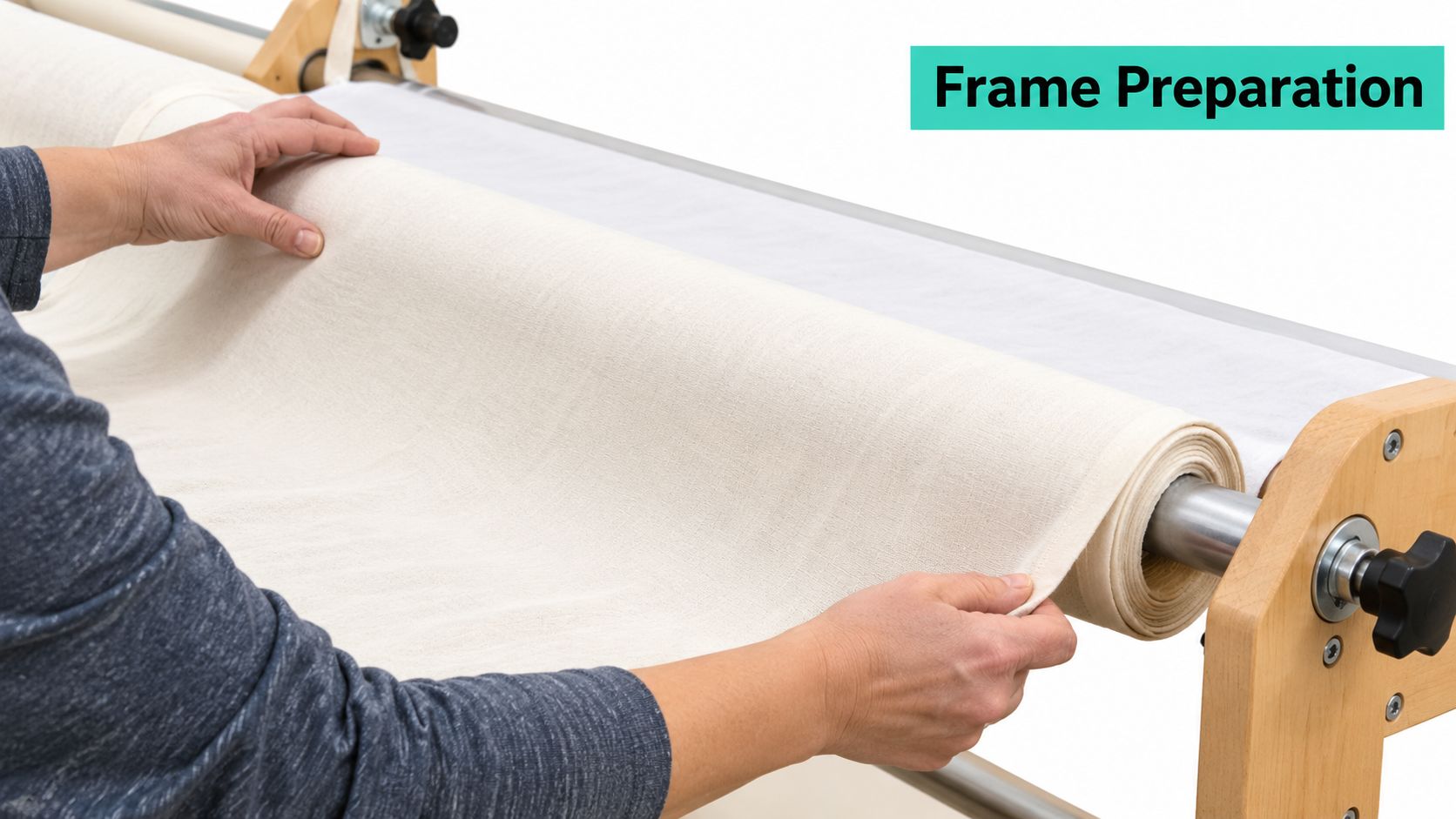
A smooth, square quilt top lets the longarm quilter load the sandwich accurately and keep the selected pattern consistent. Press seams flat, trim loose threads, and remove folds before packing the project.
What should you check before mailing?
- Press the top carefully: Flatten bulky seams and remove creases that could be stitched into the quilt.
- Clip loose threads: Contrasting threads may show through light fabric or form bumps on the backing.
- Avoid pins and basting: The service can load and align the layers using its own preferred process.
- Inspect the edges: Secure open seams and correct wavy borders before quilting. Stitching cannot repair construction problems.
- Prepare the backing generously: The backing must be at least 4 inches longer and 4 inches wider than the quilt top so the quilter can secure it properly on the machine.
Shannon Cuddle and other plush fabrics need extra attention. Smooth the pile in one direction before folding, and mark the top edge when the fabric has a clear nap or directional design. Plush materials can resist a dense edge-to-edge pattern, so batting loft, pile direction, and stitch spacing should be considered together. A more open pattern may preserve softness and avoid compressing the surface.
Extra-wide backing can remove a center seam, keeping the reverse side more comfortable and eliminating another line that could compete with the quilting. Check the backing for puckers, clipped corners, or directional issues before shipping.
A mail-in service may provide batting, thread, and return shipping. Confirm the exact inclusions first, then pack the quilt top and backing securely with your pattern notes. Follow the provider's preparation instructions rather than adding pins or last-minute embellishments. The top quilt preparation tips offer a useful final checklist.
Before shipping, record the pattern family, preferred scale, backing texture, batting type, and whether softness or density matters most. This note helps the quilter make consistent adjustments if the test area shows that the pattern is too tight for the quilt sandwich.
On Pins & Needles Quilting Co. offers mail-in edge-to-edge longarm quilting with batting, thread, return shipping, a pattern gallery, and verified reviews. Visit On Pins & Needles Quilting Co. to review the service and book the project.