
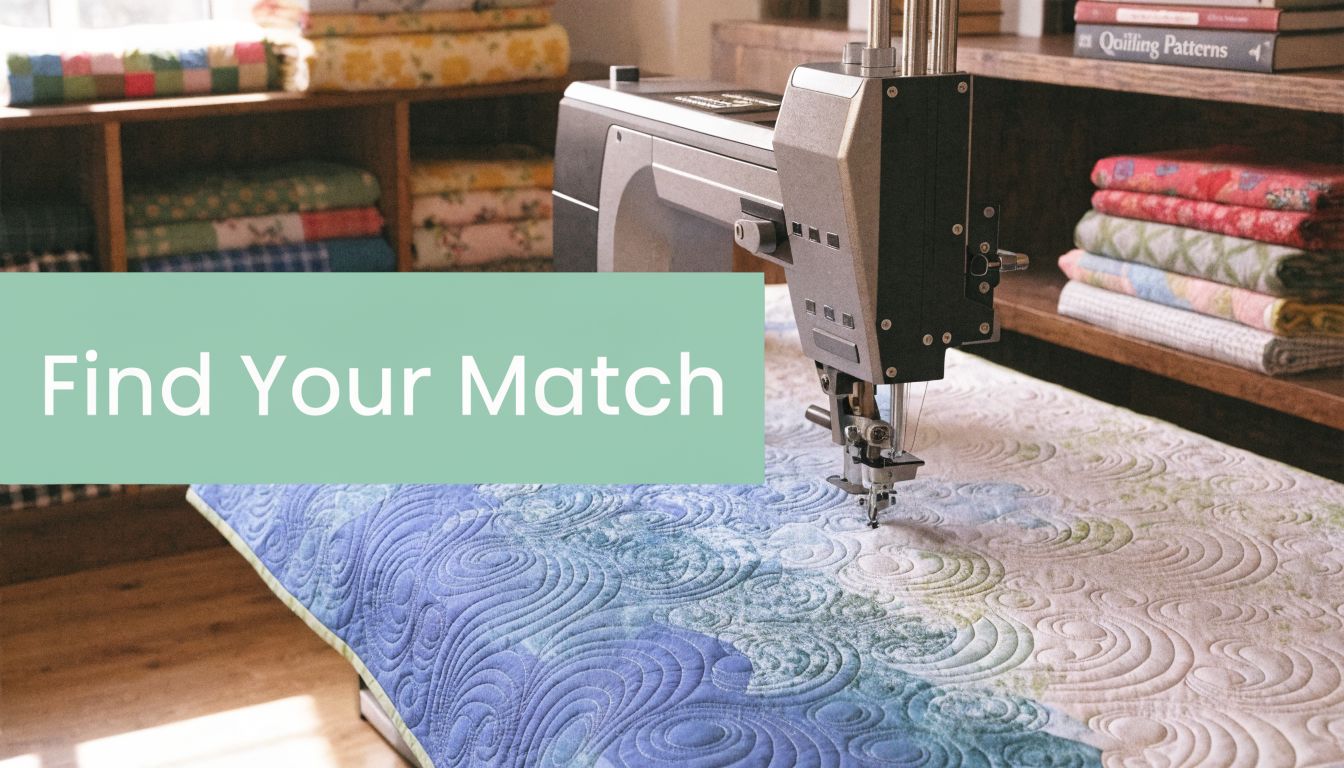
Finished quilt top on the table, backing folded nearby, and one big question left. A computerized longarm quilting gallery is the pattern library that helps turn your quilt top into a finished quilt with the right texture, movement, and durability, especially when you match the pattern to the fabric you're using. That matters even more with minky, where a design that looks great on cotton can stitch very differently on plush backing.
Welcome to Our Computerized Longarm Quilting Gallery
Your quilt top is finished, the backing is picked, and now the pattern choice will decide whether the quilt feels polished or fights the fabric. That is especially true with minky. A design that runs beautifully on cotton can flatten plush, pull awkwardly across stretch, or look blurry once it stitches into a higher-pile backing.
Our gallery is built to help quilters choose patterns that suit the whole quilt, not just the pieced top. We pay close attention to how digital designs behave on specific minky textures, including Luxe Cuddle Hide and Dimple, because those backings do not respond the same way under a longarm. Hide has directional texture and more visual movement. Dimple tends to show repeated motifs more clearly, but it can also highlight over-dense quilting if the scale is too tight.
Computerized quilting keeps the stitching consistent, but pattern quality on minky still depends on scale, density, and texture match. Analysts at Dataintelo reported that the global quilting machine market was valued at $1.82 billion in 2025 and is projected to reach $3.04 billion by 2034 in Dataintelo's quilting machine market report. For quilters, the practical takeaway is simple. More shops offer computerized quilting now, so the main difference is not access to patterns. It is knowing which patterns finish well on the fabric you chose.
That is why a useful gallery should narrow decisions fast.
What a good gallery should help you decide
- Style match: Does the quilting support the piecing, or does it pull attention away from it?
- Minky match: Will the pattern read cleanly on Luxe Cuddle Hide, Dimple, or another plush backing without puckering or distortion?
- Density match: Do you want soft drape, medium texture, or a firmer finished feel?
- Use match: Is the quilt meant for a baby, a bed, daily couch use, or gifting?
We often guide clients away from tiny, fussy repeats on minky, even when those same designs look great in a cotton sample book. On plush backings, open curves, balanced travel paths, and a scale large enough to read through the nap usually give a better result. The goal is a finished quilt that looks intentional from both sides.
If you are comparing options for a mail-in project, our mail-in longarm quilting services page explains how we handle pattern selection, backing choices, and finishing details.
A finished top becomes a finished quilt when the quilting pattern, batting, and backing all work together.
How Should You Prepare Your Quilt for Longarm Services
Good quilting starts before the quilt ever reaches the frame. Preparation mistakes don't always ruin a quilt, but they do create drag in the process. Fullness, wavy borders, clipped points, and short backings are the problems we see most often.
If you want clean results from a computerized design, give the machine a square, stable project to work with.
The prep checklist that solves most problems
-
Press the quilt top well
Press seams flat and remove fold lines before packing your quilt. A wrinkled top can hide fullness and make the pattern sit unevenly once the quilt is loaded. -
Clip loose threads
Dark threads behind light fabric, or bright threads behind pale solids, can shadow through after quilting. This is a simple fix at home and a frustrating one after the quilt is stitched. -
Check that the quilt is square
If the top bows or the borders wave, the machine can only do so much. Computerized quilting follows the shape it's given, so a square top gives the pattern the best chance to look balanced. -
Use a backing that's larger than the top
Longarm loading requires extra backing on all sides so the quilt can be mounted and tensioned properly. If your backing is too tight, too pieced-up at the edges, or not generously cut, that creates avoidable problems.
What to look at before you pack it
- Seams near the edge: Open seams or weak joins can pull apart during loading.
- Pins and embellishments: Remove them all. Buttons, clips, and thick trims don't belong on a longarm frame.
- Directional fabrics: Mark top edge clearly if orientation matters.
- Minky backing choice: If you're using plush backing, make sure the nap and print direction are exactly how you want them before shipping.
Practical rule: Most quilting problems blamed on the pattern really start with prep.
For a deeper walkthrough, the best companion read is these longarm quilting top 10 quilt prep tips. It covers the little choices that save time and protect your quilt once it's on the frame.
If you're mailing a quilt for the first time, keep the package simple. Fold the top and backing separately, label them clearly, and include any notes that would matter to the quilter, especially if the quilt has directional blocks, a special border treatment, or minky with a visible nap.
Exploring Modern and Geometric Patterns
Modern quilts usually need restraint. If the piecing already has strong blocks, sharp contrast, or negative space, the quilting should support that structure instead of muddying it.

Geometric patterns do that well. Straight-line looks, interlocking curves, orange-peel variations, echoed diamonds, and clean lattice designs all give a quilt surface texture without pulling attention away from the piecing. On a contemporary top, they read crisp and intentional.
When geometric quilting works best
Geometric designs tend to shine on quilts with:
- Bold piecing: Large blocks, modern patchwork, and graphic layouts
- High contrast fabrics: Black and white, jewel tones, or solids with strong value shifts
- Minimalist style: Tops where too much motion in the quilting would feel busy
- Smooth plush backing: A surface that lets linework stay visually clear
A low-pile texture proves its value. Shannon Luxe Cuddle Hide is a strong partner for modern quilting because it gives the back a plush hand without adding a lot of visual interruption. Clean geometric motifs stay readable instead of getting lost in heavy texture. If you're choosing backing at the same time as the quilting design, Luxe Cuddle Hide is worth a look.
A dedicated modern geometric pattern gallery also helps narrow choices faster than scrolling through mixed categories.
What doesn't work as well
Very intricate geometric patterns can backfire on plush fabric. Tight corners, repeated points, and heavily nested lines may look sharp in a digital preview but feel stiff in the finished quilt, especially when paired with lofty batting or a textured backing.
That doesn't mean modern quilts need sparse quilting. It means the best modern patterns usually have a clean repeat, enough breathing room, and a scale that suits the piecing.
Here's a closer look at how computerized edge-to-edge stitching flows across a quilt:
The best geometric choice often feels quieter than expected. If you notice the quilting first and the quilt second, it's probably too much.
Discovering Floral and Nature Inspired Designs
Some quilts need softness more than structure. Floral and nature-inspired patterns bring movement across the top, soften block transitions, and make a quilt feel more relaxed in the hand.

Leafy meanders, winding vines, open petals, feathered florals, and branch-like motifs are all good examples. They don't force your eye into a rigid repeat. Instead, they carry the eye gently across the quilt and unify a lot of different fabrics.
Why floral patterns are so forgiving
Floral designs work on more quilt styles than many quilters expect. They're a natural fit for traditional piecing, but they also pair beautifully with modern florals, soft pastels, and scrappy tops that need a little cohesion.
They're especially useful when:
- The piecing has a lot of small-scale print
- You want movement without a formal grid
- The quilt will be used often and should feel soft, not stiff
- You want the quilting to add romance or drift, not sharp definition
A textured backing can reinforce that softer look. Shannon Luxe Cuddle Fawn is one of those textures that plays nicely with floral and organic designs because it already carries visual depth. The quilting sits into that surface instead of fighting it. If that's the finish you're after, browse Luxe Cuddle Fawn.
Where to be careful
Dense florals can overwhelm delicate piecing. On the other hand, extremely open floral patterns can disappear on highly textured backing if the motif scale is too large. The sweet spot is usually a pattern with visible flow and enough repeat to show up consistently from edge to edge.
Soft doesn't mean vague. A good floral pattern still needs a clear path and a repeat that reads across the whole quilt.
This category also does a nice job on quilts that mix blocks and borders. A geometric pattern can make those layout changes more obvious. A nature motif often blends them together in a more graceful way.
What Makes a Computerized Pattern Minky Friendly
Most pattern galleries are built around how a design looks on cotton. That's where quilters get into trouble with minky. Plush backing changes how the quilting reads, how the stitches settle, and how much density the quilt can comfortably handle.
The first thing to know is that you're not imagining it if minky feels harder to plan for. A survey by the Professional Quilters Association found 68% of longarm users struggle with synthetics like minky, and patterns in the 10 to 12 stitches per inch range can help prevent fiber pull and keep the finish smoother on plush textures, as noted in this quilting industry discussion.
The pattern traits that work on plush backing
A minky-friendly computerized pattern usually has these qualities:
- Smooth travel path: Fewer abrupt starts, stops, and sharp points
- Balanced density: Enough stitch coverage to control the surface, but not so much that the quilt turns boardy
- Readable scale: A motif large enough to show through the pile
- Even distribution: Repeats that don't create hard visual bands across the backing
Patterns that are too fussy can sink into the nap. Patterns that are too open can look unfinished. That's why texture matters.
Texture-by-texture matching
- Hide: Great for modern curves, tidy geometrics, and clean repeated motifs
- Dimple: Better with simpler, more open patterns so the dimples and quilting don't compete
- Snowy Owl or other plush textures: Usually need a design that's visible without being sharp-edged
- Fawn: A natural fit for leaves, florals, and flowing movement
If you want examples centered on plush backing instead of cotton tops, edge-to-edge quilting patterns for minky is the right kind of resource to study.
Quilting that looks detailed on a screen can vanish on minky. The test isn't whether the file is pretty. The test is whether the stitched pattern still reads on plush fabric.
What tends to fail on minky
The biggest problem patterns are usually the ones with:
- Very tight pebbles
- Tiny backtracking details
- Dense point-to-point structure
- Sharp corners repeated close together
While these designs may stitch accurately from a mechanical standpoint, they frequently fail to provide the finished quilt with the specific softness and clarity desired by those using Shannon Cuddle or Luxe Cuddle.
Good to know: New customers can also stack savings into the planning stage. There's a 15% first-order coupon, and free U.S. shipping starts at $70+ on qualifying orders, which helps if you're ordering backing and project supplies together.
Choosing Juvenile and Whimsical Patterns
Baby quilts and children's quilts need a different kind of quilting language. You want movement, charm, and durability, but you don't want the quilting to feel too formal for the project.

Whimsical patterns solve that well. Think stars, clouds, simple loops, hearts, playful florals, rounded animal motifs, and light scatter designs. They hold up to frequent washing and still keep the finished quilt feeling cheerful.
The best fit for soft gift quilts
This category works especially well when the quilt is meant for:
- A nursery gift
- A toddler bed quilt
- A cuddle quilt with high softness factor
- A playful seasonal project
Dimple minky is often a smart backing match here. The surface already has a fun tactile quality, so an open, rounded quilting pattern complements it instead of trying to dominate it. If you're building a baby quilt around softness first, Dimple Minky options are a natural place to start.
What to avoid on juvenile quilts
Overly formal feathers, highly angular grids, or very dense motifs can make a child's quilt feel older than it needs to. The goal usually isn't seriousness. It's warmth, washability, and a design that still feels sweet years later.
A lot of quilters also forget scale here. A large star or cloud motif may look adorable on a crib quilt, but the same pattern can look too sparse on a larger throw unless the repeat is adjusted thoughtfully. Simpler doesn't mean careless. It just means the quilting should support the personality of the quilt instead of aging it up.
For makers who want the project to stay easy from start to finish, quilt kits can also simplify fabric and pattern planning before the quilting stage. Quilt kits and project bundles are helpful when you want a coordinated gift without overcomplicating the process.
Selecting Holiday and Seasonal Motifs
Seasonal quilts already carry a mood. The quilting can either reinforce that mood or flatten it. Holiday motifs are where a computerized gallery really shines because a simple pattern choice can make a familiar project feel polished and gift-ready.
Snowflakes, holly, pumpkins, stars, falling leaves, and festive swirls are the usual favorites. They work especially well on throws, wall quilts, table-sized projects, and gift pieces where the recipient will notice the theme right away.
When seasonal quilting is worth it
Holiday motifs are a smart choice when:
- The quilt is a gift
- The piecing is intentionally seasonal
- You want the backing and quilting to feel coordinated
- The project is small enough that a themed finish adds personality without becoming too busy
What works best depends on the fabric. A subtle holiday top can handle a more obvious seasonal quilting pattern. A print-heavy Christmas or autumn quilt usually benefits from a simpler motif that echoes the theme without crowding the surface.
A seasonal pattern should feel like a finishing touch, not a costume.
This is also a good category for smaller sewn gifts. If you're making soft accessories instead of a full quilt, Infinity Scarf Kits are an easy seasonal project that still showcases plush texture beautifully. The same principle applies. Choose a motif or fabric texture that supports the occasion without overloading it.
How Do We Choose the Right Batting and Thread
Batting and thread change the look of computerized quilting just as much as the pattern does. A quilt with airy batting and fine texture behaves differently from one with denser batting and a more visible stitch path. Many quilters get stuck at this stage, especially if they're also choosing a plush backing.
The good news is that the technical side doesn't need to be mysterious. The machine setup matters, and so does the thread-and-batting combination.
Why stitch regulation matters
Quilter's Creative Touch 6 allows precision stitch regulation from 0 to 7 stitches per inch, which is important for getting uniform stitches on plush minky and for matching thread and tension to the project, according to the QCT6-related spec information.
Uniform stitches are what keep a quilt looking intentional instead of uneven, especially when the backing has pile. If stitch length wanders, plush textures make that inconsistency more noticeable.
A simple way to think about batting and thread
| Choice | Best use | What it changes |
|---|---|---|
| Cotton batting | Traditional look | Flatter finish, more defined piecing |
| Polyester batting | Soft utility quilts | Loftier feel, often lighter in use |
| Wool batting | Texture-forward quilts | More definition and a slightly fuller look |
Thread choice matters just as much. A finer thread can blend and let the pattern become texture. A more visible thread can help the design show up, but on minky that can also spotlight any tension mismatch.
- For plush backing: smooth, balanced tension is the priority
- For modern tops: blending thread usually keeps the piecing in charge
- For floral or playful motifs: a little definition can help the movement read clearly
- For dense quilting: thread needs to behave well over repeated passes without building visual clutter
If batting still feels confusing, this guide on what quilt batting is is a practical primer.
What works best is rarely the most dramatic option. It's the combination that gives the quilt the right hand, the right drape, and a clean stitched surface.
Quick Reference Pattern Selection Guide
Sometimes you don't need more inspiration. You need a short list. This kind of quick view is the fastest way to narrow your computerized longarm quilting gallery choices before you send a quilt in.

OPN Quilting Pattern Guide
| Pattern Style | Ideal For | Recommended Minky Texture | Typical Density |
|---|---|---|---|
| Modern geometric | Contemporary piecing, solids, negative space | Luxe Cuddle Hide | Moderate |
| Floral and nature | Traditional quilts, soft prints, romantic styles | Luxe Cuddle Fawn | Moderate |
| Juvenile whimsical | Baby quilts, kids' throws, playful gifts | Dimple Minky | Open to moderate |
| Holiday seasonal | Gift quilts, themed projects, festive décor | Texture depends on motif visibility | Open to moderate |
| Simple loops and curves | Busy tops that need soft cohesion | Smooth or lightly textured minky | Open |
| Structured repeat motifs | Quilts that need visual order | Lower-pile plush textures | Moderate to denser |
A fast way to choose
- If the piecing is bold, go simpler with the quilting
- If the backing is plush, make sure the motif will still read
- If the quilt is for a child, favor rounded, open movement
- If the fabric itself has visible texture, avoid patterns that need tiny detail to shine
A good gallery doesn't just show beautiful patterns. It helps you eliminate the wrong ones.
How Do You Order Our Mail In Longarm Service
A quilt usually arrives with one question hiding underneath all the others. Will this pattern still look right once it is stitched over plush minky?
That is the right place to start, especially for mail-in quilting. Cotton-backed quilts give you more room for dense detail and crisp repeats. Minky asks for better pattern discipline. Luxe Cuddle Hide can handle more structure because the nap disguises travel nicely, while Dimple tends to show distortion faster if the motif is too tight or directional. We choose the quilting plan with that in mind before the quilt ever goes on the frame.
The ordering path we recommend
-
Choose the pattern family first
Start with the overall look you want, then narrow by backing texture. A geometric design that looks sharp on smooth cotton may lose definition on a higher-pile minky, while open curves and softer repeats often read better. - Tell us what minky you are using This matters more than many quilters expect. Hide, Dimple, and other plush textures do not stitch out the same way, so the exact backing helps us judge scale, density, and how much detail will be visible.
-
Prepare the quilt for the frame
Press the top, clip loose threads, and square it as well as you can. Keep the backing and top folded separately, and label the top edge if the orientation matters. -
Fill out the order details and include clear notes
If you want the quilting to stay soft and drapey, say so. If you are worried about puckering on a cuddly backing or you want a pattern to stay visible from across the room, note that too. Those details affect pattern choice more than quilters sometimes realize. -
Pack it securely and ship it
Once the quilt arrives, we review the project as a whole. That includes the top design, the backing texture, and whether your selected motif needs any adjustment to stitch well on minky.
Why quilters use a mail-in service
Mail-in quilting works well for quilts that are awkward to manage at home, especially larger projects and minky-backed quilts. A significant benefit goes beyond mere access to a longarm. It is getting a pattern matched to the fabric so the quilting improves the quilt instead of fighting it.
That is where experience shows. A pretty digital design on a screen is not always the right design for plush backing. We would rather scale a motif up, loosen the spacing, or redirect you to a different pattern family than stitch something that looks busy, sinks into the pile, or pulls the backing in the wrong way.
If you are ready to send a quilt, include the pattern choice you are considering and the exact minky you used. We can work from there and help you get a finish that looks clean, feels right, and holds its shape in real use.
Frequently Asked Questions About Our Longarm Gallery
Quilters usually ask the same few questions once they've narrowed their pattern style. Those questions are smart, because the final result depends on more than whether a motif looks pretty in a sample.
Can I request a pattern that isn't in the gallery
Sometimes yes, but compatibility matters. Computerized quilting has evolved a lot since the first systems of the 1990s, and today's digital libraries are broad. The actual value in a curated gallery is that the available patterns are selected because they perform well on modern fabrics, including Shannon Cuddle, rather than forcing you to gamble on an untested choice.
What if I'm not sure which pattern suits my minky backing
Then start with texture before motif. Hide, Dimple, Fawn, and Snowy Owl don't all show quilting the same way. If you choose the backing first and the pattern second, you'll usually end up with a better finish than if you choose only by how the digital file looks on a screen.
What happens if my backing isn't big enough
That's one of the most common delays in mail-in quilting. A backing that's too small can prevent proper loading or limit the best quilting options. It's better to catch that during prep than after the quilt arrives.
Is a computerized longarm quilting gallery better than picking “something simple”
Usually, yes. “Simple” can be perfect, but only if it fits the quilt. A computerized longarm quilting gallery gives you a better way to match style, density, and fabric texture so the quilting feels intentional instead of generic.
If you're shopping for backing at the same time, extra-wide minky backing options can solve the seam problem on larger quilts, and Luxe Cuddle Snowy Owl is a strong choice when you want plush softness with visible texture.
When you're ready for expert finishing, On Pins & Needles Quilting Co. makes the next step easy with premium minky, curated pattern options, and mail-in longarm quilting built for quilters who want a polished result. If you've been comparing a computerized longarm quilting gallery and wondering what will actually work on your quilt, this is the moment to stop guessing. Book Your Longarm Service Today, Shop the Luxe Cuddle Collection, or Get 15% Off Your First Order.