

The easiest barn quilt patterns are built from squares, right triangles, and rectangles, with Ohio Star, Square in a Square, and Churn Dash among the strongest starting points. These eight designs let you choose between bold stars, simple nested shapes, and repeating blocks, then make either a painted panel or a soft fabric version.
You've picked a spot on the garage wall, but the pattern suddenly looks complicated when you think about drawing it. Or you love the block's shape and would rather bring it indoors as a throw. Start with the design you can draw clearly on paper, not the one with the most impressive name.
Our approach at OPN Quilting separates painted geometry from fabric construction. A diagonal that's easy to tape can become a stretchy seam in minky, so the best panel design isn't always the easiest fabric project.
- For a painted panel: Choose broad shapes, strong contrast, and intersections you can mark accurately.
- For a first fabric block: Use quilting cotton for precise piecing and save plush texture for the backing.
- For a tactile accent: Explore our Shannon Luxe Cuddle collection, including Hide, Snowy Owl, and Fawn.
You don't need to reproduce every painted shape in plush fabric. Often, a crisp cotton block backed with Shannon Cuddle gives you the clearest design and the softness you wanted.
1. Why Choose an Ohio Star Barn Quilt Pattern?
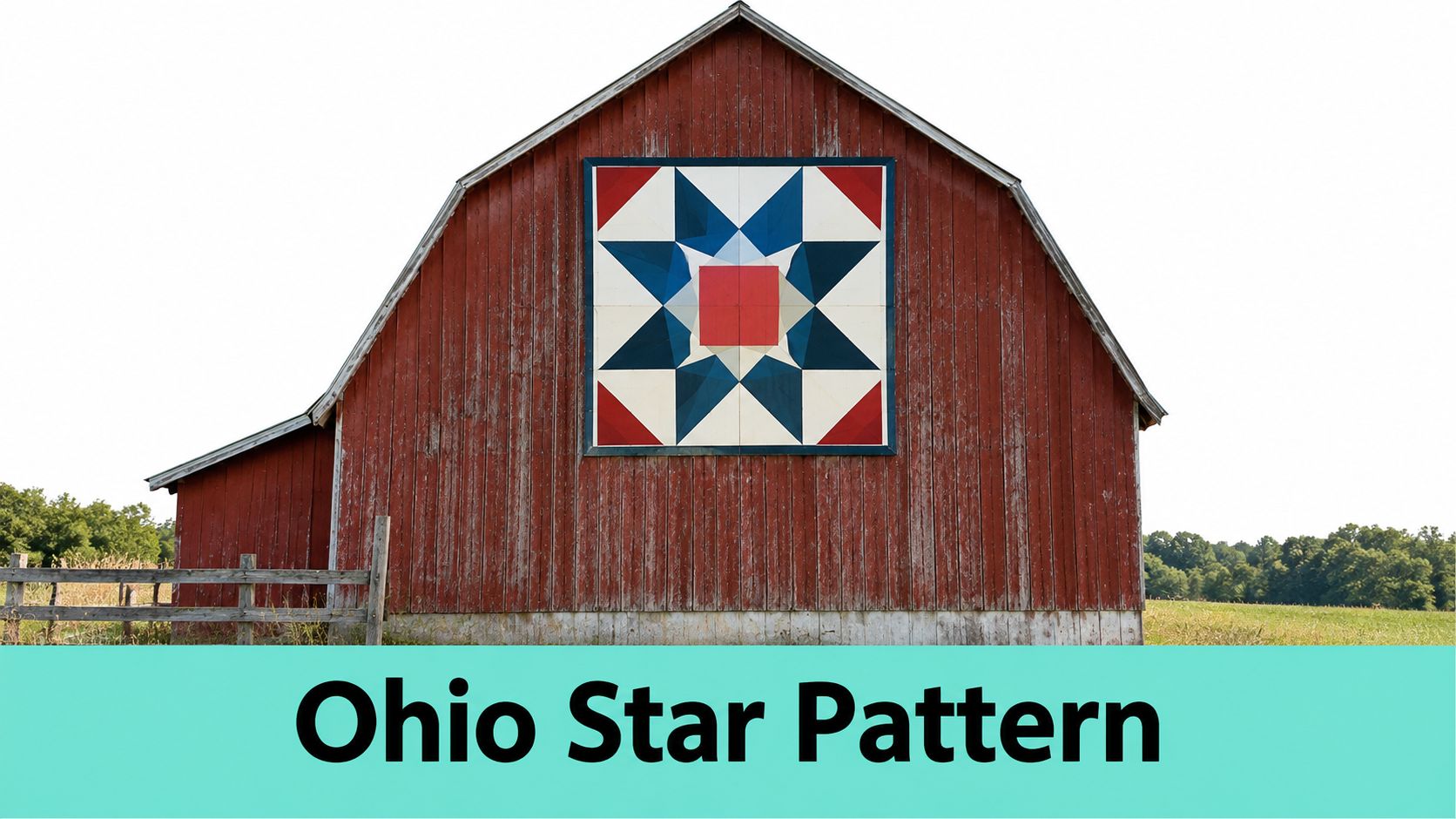
An Ohio Star gives you a strong central motif without filling the panel with tiny details. Choose navy and cream for a garage wall, or red and white for a traditional farm-building accent.
The movement's documented beginning belongs to Donna Sue Groves's community project in Adams County, Ohio, which displayed 20 painted quilt blocks in 2001, according to the Barn Quilt Trails historical overview. That history supports the community-art connection, but it doesn't establish Ohio Star as the original painted design.
This panel shows how a light background separates the star from dark siding.
How Do You Keep the Star Points Clear?
Traditional Ohio Star construction uses quarter-square-triangle units around a central square. Don't substitute a different star diagram just because it also has pointed edges.
For painting, draw the complete grid before taping anything. Check that opposing points meet their intended intersections, because strong contrast makes misplaced points easier to see, not easier to hide.
- Painted version: Keep the center quiet and let the surrounding points define the star.
- Fabric version: Piece the star in stable quilting cotton, then consider Snowy Owl for a plush backing.
- Finishing choice: Choose an open edge-to-edge quilting design if you want the throw to stay supple.
For help distinguishing star layouts before you cut, choose a design from OPN's star quilt block patterns. We'd rather resolve the diagram on paper than ask quilting stitches to disguise an incorrectly pieced point.
2. Is Square in a Square the Simplest Modern Option?
For a clean porch accent or an indoor pillow, Square in a Square is a practical choice. A central square surrounded by contrasting triangles gives you a strong focal point without a busy surface.
There's an important distinction, though. Nested upright squares are especially easy to paint, while a traditional Square in a Square block places a square on point inside another square, introducing diagonal seams.
For an outdoor panel, start with a manageable size. The University of Wisconsin Extension barn quilt instructions support a 2-by-2-foot to 4-by-4-foot starting format, exterior-grade plywood or MDO, sealed faces and edges, two coats of exterior primer, and at least three coats of each color.
How Does the Fabric Version Differ?
Say you want a warm accent pillow for a cream sofa. Use a cotton center and cotton corner triangles, then put Shannon Luxe Cuddle Fawn on the reverse rather than forcing thick plush seams into the central design.
- Measure the center: Unequal margins make a nested design look tilted.
- Control the palette: A light center, darker surround, and quiet outer edge are enough.
- Protect the points: Use a tested fabric pattern with seam allowances included, not your painted-panel drawing.
Practical rule: A paint template shows finished shapes. A sewing pattern must also account for seam allowances.
For the soft reverse of that pillow, shop Shannon Luxe Cuddle textures. Match the texture to the project's scale, since a pronounced pile can overwhelm small patchwork.
3. What Makes Churn Dash a Good Heritage Pattern?
Choose Churn Dash when you want a traditional block that feels settled rather than flashy. On a farm-stand wall, a cream Churn Dash against a deep green background gives the design enough contrast without needing a complicated palette.
The classic block combines corner half-square triangles, rectangular bar units, and a center square. Calling it a rectangle-only pattern overlooks the diagonal work, which is where beginners need to slow down.
For the painted version, establish the outer corners before filling the bars. If the bars are too narrow, the block can look fragile from a distance.
How Should You Piece a Cozy Churn Dash?
For a first throw, our recommendation is a cotton Churn Dash top with Luxe Cuddle Hide backing. You keep the recognizable patchwork edges while adding texture where your hands will feel it.
Cut matching bars from the same template or ruler setting. Lay out the entire block before sewing, because rotating a corner triangle changes the shape immediately.
- For a rustic panel: Use broad bars and an uncluttered center.
- For a pillow: Let the block fill the front rather than surrounding it with competing details.
- For longarm finishing: Keep the quilt top flat and let the quilting cross the patchwork naturally.
High-pile fabric is less forgiving when narrow pieces meet. If you want Hide within the front, reserve it for larger areas and test the seam bulk before committing.
Practice the construction with OPN's easy quilt blocks for beginners. A successful sample gives you more useful information than choosing fabric by appearance alone.
4. When Is a Pinwheel the Best Choice?
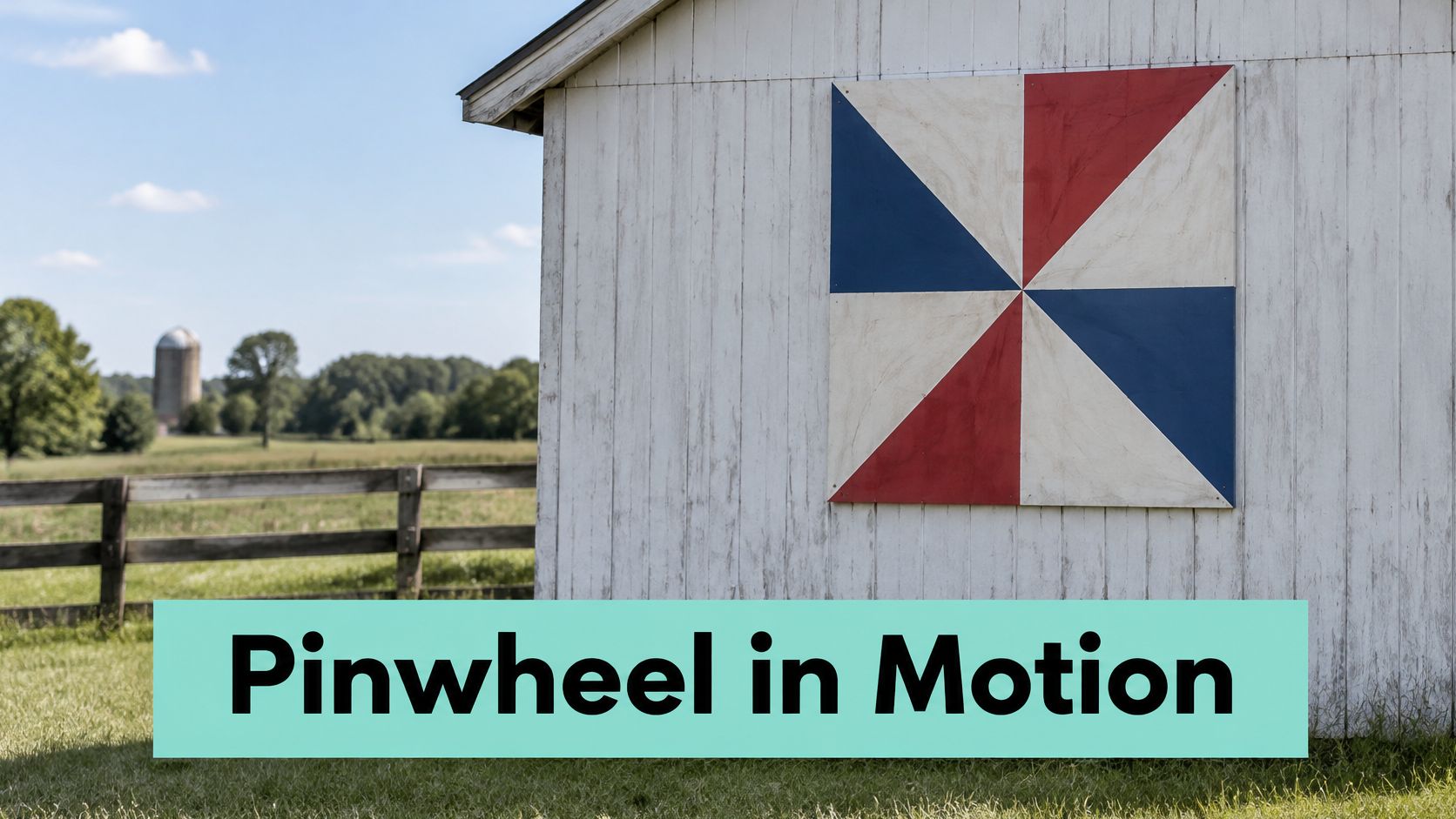
A Pinwheel works when you want movement without adding more motifs. Its rotating triangular blades suit a garden shed panel, a playroom pillow, or a cheerful lap quilt.
The design looks simple, but the center intersection needs care. A slight error there is more noticeable than a slight variation along an outside edge.
This geometric panel illustrates the value of clear color separation on a white building.
How Do You Avoid a Crooked Center?
Mark the center first, then extend your construction lines to the perimeter. Check the blade direction on paper before transferring the design to wood.
For painting, the Grit barn quilt tutorial recommends working from the lightest color, letting painted areas dry before masking adjacent sections, and removing tape immediately after the final coat. Don't leave tape in place while you move on to another project.
For fabric, make the Pinwheel in cotton and use a Snowy Owl backing for a soft lap quilt. Plush triangles can work, but stretch and pile make the central junction harder to manage.
Review OPN's guide to the 45-degree ruler before trimming diagonal units. Check the ruler's markings against the pattern rather than assuming every diagonal tool works the same way.
First-order offer: OPN offers 15% off your first order and free U.S. shipping on orders over $70. Choose your top and backing together so your colors work before you cut.
5. Why Is Log Cabin Useful for Learning Layout?
A Log Cabin block begins with a center square and builds outward with strips. For a cabin entryway or a warm-toned throw, it's an approachable way to create a strong light-and-dark division.
Its simplicity can be misleading. In fabric, inconsistent seam allowances gradually pull the block out of square, and painted strips reveal uneven spacing more clearly than a textured photograph suggests.
We recommend a broad-strip version for a first outdoor panel. Thin strips create more masking work and can disappear when the panel is viewed from the road.
How Do You Keep the Strips Consistent?
Build the layout on a measured drawing instead of estimating each strip independently. Plan which side stays light and which side stays dark before adding decorative color changes.
A useful scaling example appears in the Knox Historical Society barn quilt instructions: an 8-by-8-foot panel with a 2-inch border on every side leaves a 92-inch pattern area, which divides into 23-inch squares on a four-by-four grid. The principle is simple: subtract both borders before dividing the usable space.
- Painted version: Use that same measured-area approach to establish consistent strip boundaries.
- Fabric version: Check the block for square as you add strips, rather than waiting until the end.
- Texture pairing: Use cotton logs on the front and Snowy Owl with a deep neutral minky on the back.
Avoid narrow Luxe Cuddle strips for your first Log Cabin. Thick seam allowances and changing pile direction add work without improving the block's readability.
For longarm finishing, a relaxed curve can soften the straight geometry. Dense stitching isn't necessary just because the patchwork contains many seams.
6. How Can Flying Geese Become a Woodland Throw?
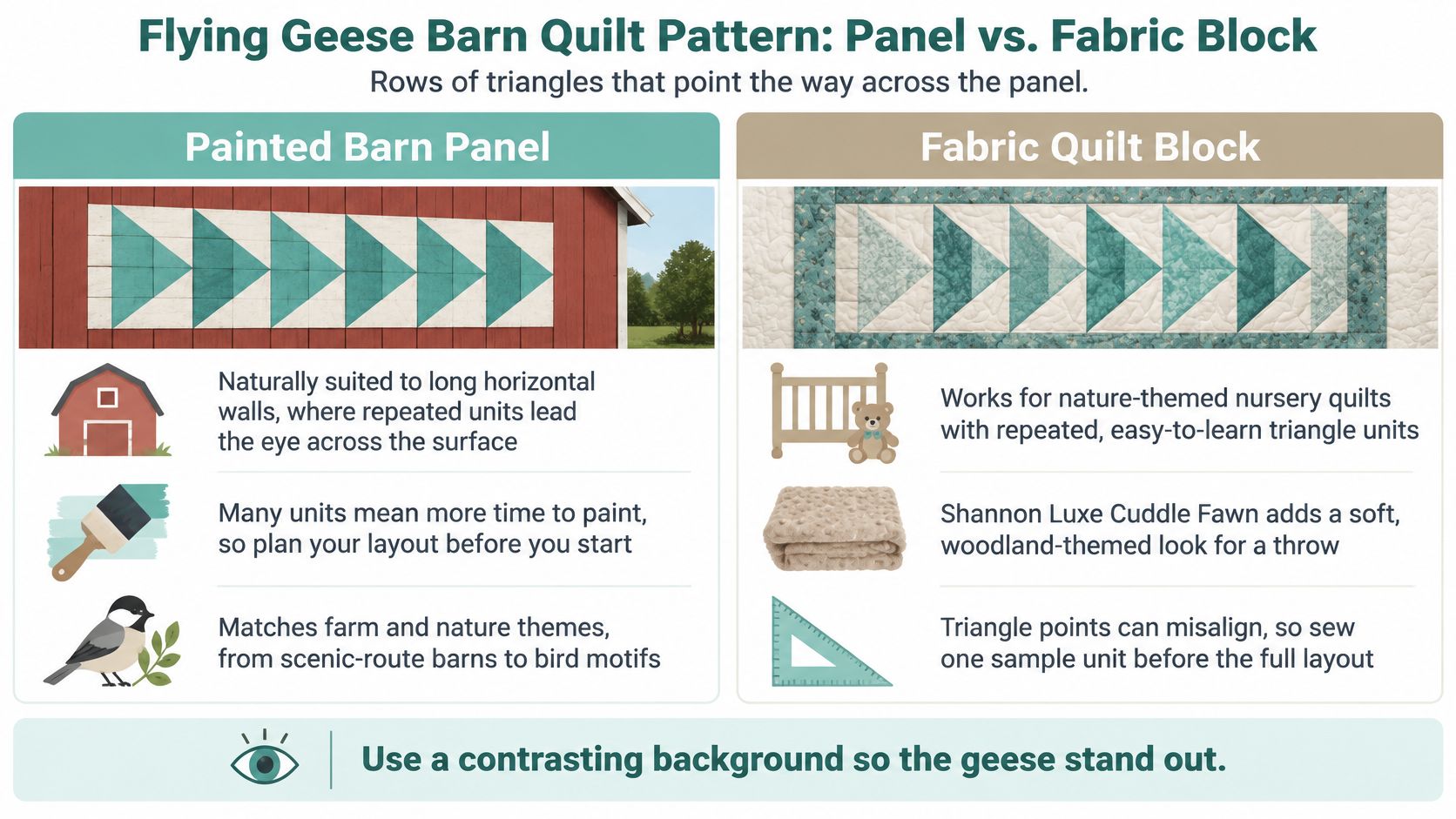
Flying Geese gives you repeated directional triangles that suit a nature-themed project. A row across a shed panel can echo a roofline, while repeated fabric units can form a calm, woodland-inspired throw.
Each traditional fabric unit has a central triangle and contrasting side triangles. The main challenge is preserving the point when you join units, not just sewing along a diagonal.
Compare the painted arrangement with the fabric interpretation before choosing your layout.
Where Should Fawn Texture Go?
For a first woodland throw, put the geese in quilting cotton and Shannon Luxe Cuddle Fawn on the back. The printed texture adds interest without making every triangle harder to handle.
If you want plush fabric on the front, choose a larger layout and test a complete joined section. A loose unit may look fine while the joined seam becomes too bulky.
- Make a sample: Check the finished unit against the pattern before cutting the remaining fabric.
- Protect the tip: Mark the seam intersection so the joining seam doesn't cut across it.
- Check direction: Keep directional prints and plush nap consistent across the layout.
Read OPN's Block Lock ruler guide when choosing a trimming method. Use a tool suited to the unit you're making rather than trying to correct every shape with the same ruler.
For quilting, flowing leaves or gentle curves complement the directional patchwork. Keep the scale open enough that the Fawn backing remains soft rather than compressed into a dense surface.
7. Is Sawtooth Star Easier Than It Looks?
A Sawtooth Star looks elaborate, but its standard construction is straightforward: a large center square, Flying Geese point units, and corner squares. It's a strong choice after you're comfortable keeping triangle points intact.
Unlike Ohio Star, its familiar point units are usually Flying Geese rather than quarter-square triangles. Choose the diagram first, then practice the units that diagram requires.
For an indoor reading-chair throw, try a cream star against a charcoal background. A large, uninterrupted center gives the design breathing room and provides space for a favorite fabric.
How Can You Add Hide Without Losing Definition?
Keep the pointed units in cotton and use Luxe Cuddle Hide as the backing or a broad feature area. Narrow plush points can lose their crisp outline when the pile crosses the seam.
Use OPN's eight-point star quilt block guide to compare the layout with your intended design. Don't choose a pattern by its name alone, since similar star names can describe different construction methods.
For a visual companion to your pattern, the video below offers another way to examine the block's geometry.
- For paint: Keep neighboring values distinct so the points don't merge into the background.
- For fabric: Confirm the center and surrounding units finish at compatible sizes.
- For quilting: Choose stitching that supports the patchwork without competing with the star.
Keep the precision in the piecing and the softness in the backing. You don't need plush fabric in every part of a cozy quilt.
8. When Should You Choose Bear's Paw?
Choose Bear's Paw for a woodland-themed pillow, a cabin throw, or a painted panel near a garden entrance. Its broad paw shapes remain recognizable without relying on tiny decorative details.
The traditional block combines a larger paw square with smaller triangular claws. It's approachable when enlarged, but it isn't the easiest design here because the claws introduce repeated diagonal seams and directional decisions.
A family painting project can work well with this motif. Have an adult establish the measured outline, then divide the larger color areas among participants instead of asking everyone to redraw matching paws.
How Do You Keep the Claws Readable?
Choose brown, forest green, and cream with a clear difference between the paws and the background. Keep the claw shapes generous, especially when the panel will hang high on a wall.
For a fabric pillow, use cotton claws and an earthy Luxe Cuddle Hide or Fawn reverse. That keeps the outline legible while making the finished pillow inviting to hold.
- Lay out before sewing: Rotated claw units can change the paw into an unrelated shape.
- Check the background: Similar-value fabrics can erase the motif even when the seams are accurate.
- Test the texture: Brush the pile into its natural direction before judging the color pairing.
Outdoor mounting deserves as much planning as the pattern. The Easy Graph Paper barn quilt guide discusses exterior-grade plywood or MDO, sealed edges, exterior paint, and aluminum composite board as an alternative.
Choose mounting hardware for the actual wall, panel weight, and exposure. For a historic building, rental property, or roadside location, confirm permission before drilling. A large square panel isn't something to hang with indoor picture hardware.
How the Eight Easy Barn Quilt Patterns Compare for Beginners
Use the core shapes and key challenge to choose a block that fits your painting or fabric project. The same designs can become painted panels, quilt tops, throws, or pillows. For fabric versions, Shannon Luxe Cuddle adds texture, while OPN's mail-in longarm service can handle the quilting finish.
| Item | Core Shapes | Best Setting | Key Challenge |
|---|---|---|---|
| Ohio Star Barn Quilt Pattern | Eight-point star, triangles, and center square | High-contrast barn panel visible from the road | Points can blur with low contrast |
| Square in a Square Barn Quilt Pattern | Nested squares and corner triangles | Modern farmhouse or storefront | Small placement errors are noticeable |
| Churn Dash Barn Quilt Pattern | Corner half-square triangles, rectangular bars, and a center square | Historic or country-style buildings | Diagonal alignment requires careful measuring |
| Pinwheel Barn Quilt Pattern | Four triangles rotating around a center | Outbuildings, entryways, or attention-grabbing panels | Center alignment must be precise |
| Log Cabin Barn Quilt Pattern | Concentric strips around a center square | Historic cabins and farmhouses | Many strips take time and need planned colors |
| Flying Geese Barn Quilt Pattern | Repeated triangles arranged in rows | Long horizontal barn walls | Triangle points can misalign |
| Sawtooth Star Barn Quilt Pattern | Central star with sawtooth points | Barns or quilt displays seeking a dimensional look | Triangle matching and detailed painting require precision |
| Bear's Paw Barn Quilt Pattern | A larger paw square with smaller triangular claws | Wooded or rural settings | The motif may be less familiar to visitors |
For a first project, compare the challenge with the finish you want. A panel rewards careful measuring and clear color contrast. A fabric block brings seam placement into the process, and plush textures can make that work less forgiving. Pairing a straightforward cotton patchwork top with a Shannon Luxe Cuddle backing keeps the block manageable while adding a soft finish. The table's shape descriptions also help you choose a pattern whose construction suits the result, whether you want a wall display or a finished throw or pillow.
How Do You Start Your First Easy Barn Quilt Project?
Choose the block whose construction you understand, not just the one you like in a photograph. Square in a Square offers a clean starting point, Churn Dash teaches contrasting units, and the star designs reward careful point matching.
Make a paper sample before buying the full material quantity. For a fabric project, sew a sample using the same fabrics and seam treatment you intend to use in the finished piece.
Our strongest recommendation for beginners is a cotton patchwork top with a Shannon Luxe Cuddle backing. You'll learn the block without adding plush stretch to every diagonal seam, and you'll still get the soft finish that makes a throw feel special.
What Should You Prepare Before Painting or Mailing?
For a painted panel, finish the substrate before drawing the design. Seal exposed edges carefully, use compatible exterior coatings, and plan the mounting method before the panel becomes awkward to handle.
The hanging tips from Colorado Art Services offer an additional starting point for thinking about placement and hardware. Outdoor barn panels still need hardware and structural support suited to their particular installation.
For a quilt top, prepare for finishing rather than trying to hide problems under quilting:
- Check the surface: Flatten seams and correct rippled borders before packing.
- Inspect the back: Remove loose threads that could show through pale fabric.
- Confirm the backing: Check the required extra backing allowance with OPN before cutting minky.
- Discuss the finish: Tell our team about plush sections, directional backing, and the feel you want.
OPN's Mail-in Longarm service provides edge-to-edge quilting with batting, thread, and free return shipping included. Check the current preparation instructions before sending your top, especially if you want Luxe Cuddle in the piecing rather than only on the back.
OPN Quilting is backed by hundreds of verified reviews, with phone and email support available when you need help matching fabric to a project. Ask about texture and backing suitability before ordering, particularly when your pattern has narrow points or bulky intersections.
Use these easy barn quilt patterns to make a manageable first project, then give it a finish you'll enjoy using. Choose your Shannon Luxe Cuddle backing and turn that favorite block into a finished throw.
On Pins & Needles Quilting Co. offers premium Shannon Cuddle and Luxe Cuddle fabrics alongside mail-in longarm finishing for your barn-quilt-inspired throw. Visit On Pins & Needles Quilting Co. to choose your texture and plan your finish. Get 15% Off Your First Order.