
A high-output conventional iron suits many home quilters working across cotton, linen, and delicate fabrics. For large backings or long pressing sessions, a steam generator's higher sustained output may justify its larger footprint. The right choice depends on how much fabric you press and how it responds to heat and moisture.
At the pressing station, a quilt top may sit beside a soft backing while the iron spits on a high pile or runs short of steam midway through a seam. In published comparisons, standard irons average about 40 g/min of steam, while steam generators average about 120 g/min. A tested high-output conventional model reaches 70 g/min, a more relevant benchmark for quilters weighing compact size against sustained output.
For minky and other delicate fabrics, controlled heat and anti-drip protection matter alongside steam volume. The practical test is whether the iron presses your usual fabrics without flattening the pile, leaving moisture marks, or forcing repeated passes.
Quick Picks for Quilting, Sewing and Minky Pressing
We focus on fabric and finishing, so these picks come from published independent tests and the quilting criteria we use every week, not from a sales sheet. Use the table to match your most-used fabric first, then your longest pressing session. Finally, decide whether your seams need one strong burst or steady continuous steam.
| Pick | Best for | Steam output | Standout feature | Trade-off |
|---|---|---|---|---|
| Rowenta SteamForce DW9280 | Heavy cotton, linen and layered quilt tops | Strong bursts, continuous rate not published | 1,800 W and dedicated burst control | Reportedly near 3x the cost of many irons, one-year warranty |
| High-output conventional iron (3,100 W tested model) | Home quilters with mixed fabrics | 70 g/min continuous, 230 g boost | Compact footprint and simpler operation | Lower throughput on large quilt tops |
| Steam generator station | Large backings, seam-heavy piecing, production pressing | About 120 g/min typical, up to 180 g/min tested | Highest continuous output | Larger footprint and higher price |
| Anti-drip compact iron (Drip Stop type) | Minky, synthetics and delicate fabrics at low heat | Lower volume, controlled delivery | Water stays contained at low temperatures | Lower steam volume for heavy linen |
The Rowenta row rests on specific testing. Independent testing identified the DW9280 as producing the most forceful steam bursts among the tested irons, with its 1,800-watt system and stainless-steel soleplate. That same testing reported a cost nearly three times many competing irons and only a one-year warranty, so it's a burst specialist, not a default buy.
How Do You Read These Picks for Your Own Fabric Mix
Test any candidate against the quilt textures you sew in practice. For us, that means Shannon Fabrics Luxe Cuddle Hide, Snowy Owl, and Fawn on the delicate side, and quilting cotton and linen on the high-heat side. If an iron can't move between those safely, it doesn't belong at a quilting station, whatever its wattage says.
A conventional high-output model covers most home piecing, mixed-fabric weeks, and minky-backed quilts when it has anti-drip protection and a readable dial. A generator earns the counter space only when you're pressing large backings often enough that continuous output, not convenience, limits you. When you're ready to stock test scraps, Shop the Luxe Cuddle Collection on our site and start with the texture you'll use most.
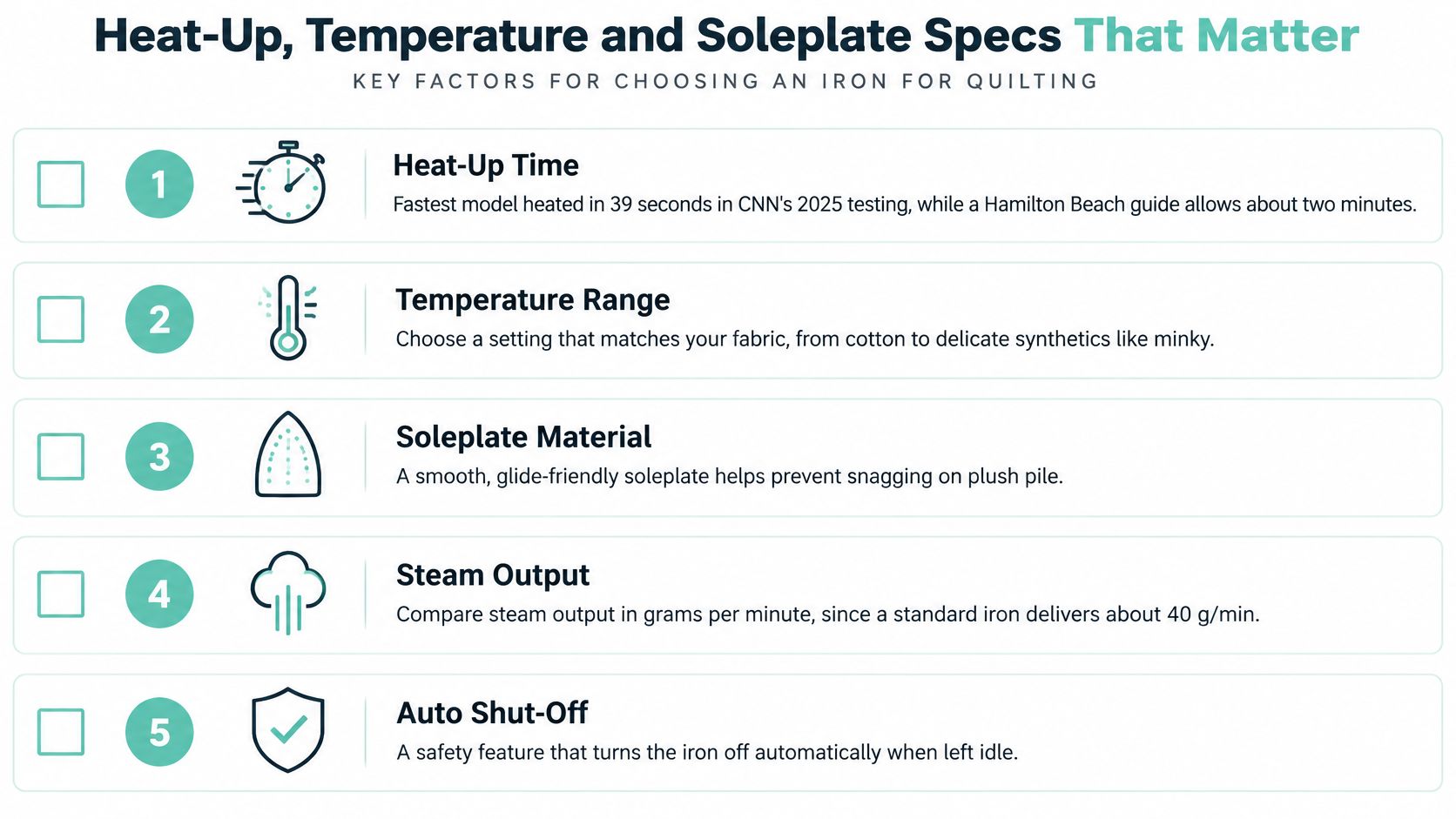
Heat-Up, Temperature and Soleplate Specs That Matter
Minky at one end of the pressing table and linen at the other call for an iron with predictable heat and a readable control. Heat-up speed, temperature range, soleplate, weight, and service life are five useful specs to compare. The guide to choosing an iron for sewing and quilting work covers similar considerations for garment sewing.
How Fast Should a Quilting Iron Heat Up
Heat-up time affects how long you wait when starting a pressing session or changing settings. CNN testing recorded a fastest heating time of 39 seconds for one model, with clear differences in wrinkle-removal effectiveness across irons. Separately, Hamilton Beach guidance says about two minutes to reach the selected temperature, with steam used only at the high-temperature setting on the referenced model. These are figures for different irons, not a direct comparison.
For short piecing sessions, quick readiness can reduce pauses. For frequent temperature changes, check how the iron signals that it has reached the selected setting. Match that setting to the fabric label rather than relying on habit.
What Temperature Range Do Quilt Fabrics Need
Temperature control matters when moving between synthetics, minky, cotton, and linen. Tefal's guide maps one dot to synthetic fabrics, two dots to wool and silk, and three dots to cotton and linen. Choose a dial or display you can read easily at the board, then test unfamiliar fabrics on scraps.
Set the iron for the most heat-sensitive fabric first if you'll press a mixed stack. Check the manual before using steam at lower settings, since steam availability can depend on the model and temperature.
Why Do Soleplate, Weight and Warranty Change the Result
- Soleplate: The Rowenta DW9280 has a stainless-steel soleplate. Compare soleplate shape and material in person or in product specifications, and consider how easily it moves across the fabrics you press.
- Weight: If you press quilt tops for long stretches, a lighter iron may be easier to handle. A heavier one may feel steadier in short sessions. Check the listed weight and consider how it feels in your hand before buying.
- Durability and warranty: Warranty terms vary by model, so check the coverage and whether replacement parts are available. That matters more if the iron sees daily use than occasional pressing.
Choose an iron that offers repeatable settings for the fabrics you work with and controls you can read mid-session. Wattage or steam output alone won't tell you whether it suits your quilting workload.
Steam Generator Versus High-Output Iron for Quilting
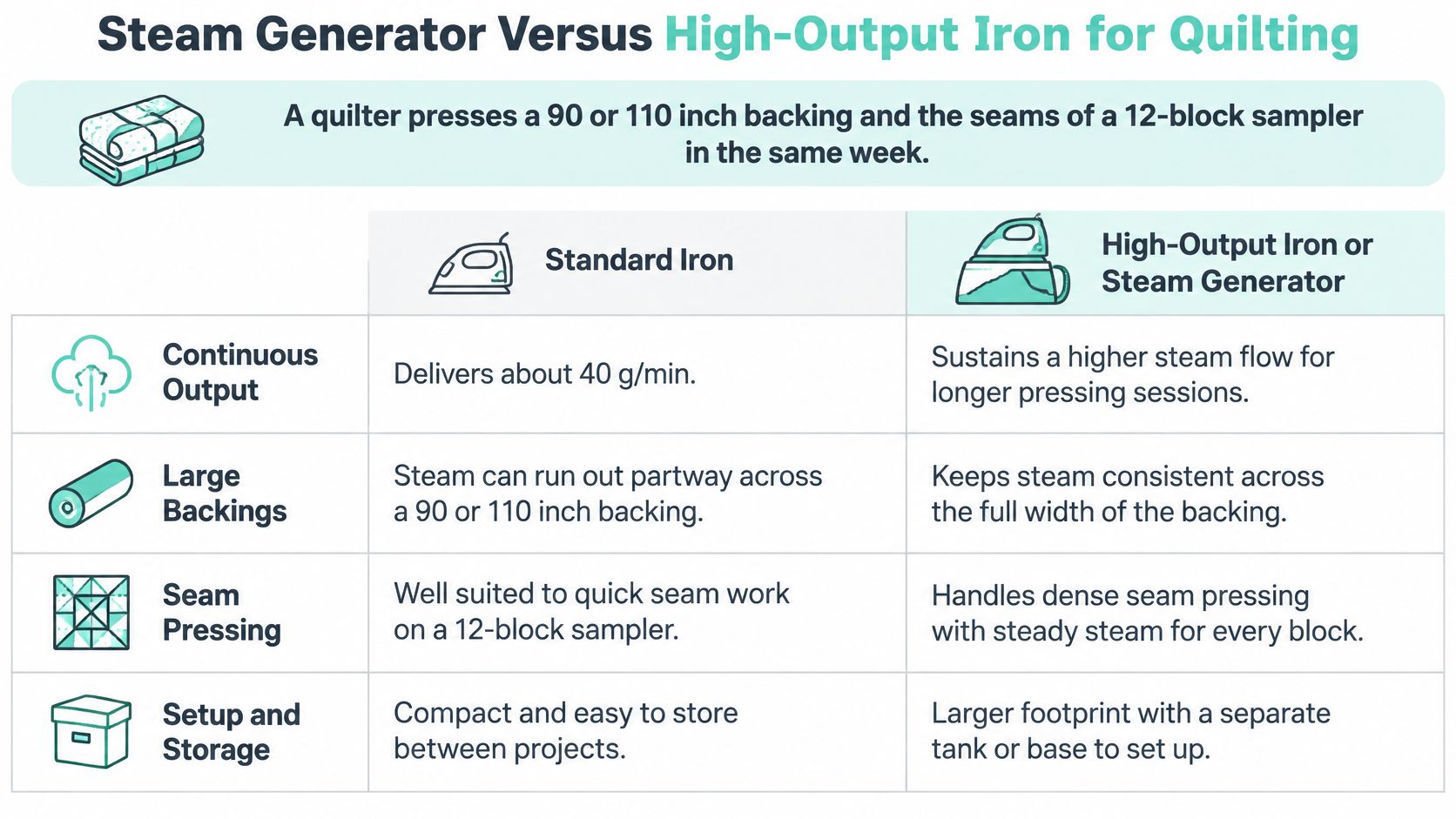
A long backing and a seam-heavy quilt top ask different things of an iron. In a typical studio week, pressing a 90- or 110-inch backing may call for sustained steam, while a 12-block sampler puts more emphasis on control over individual seams. Match the machine to the work that slows you down.
The chart compares standard and high-output irons across quilting tasks.
What Does Continuous Steam Output Actually Buy You
For a large backing, continuous steam output matters more than a high burst rating. Independent testing found approximately 120 grams per minute for steam generators versus about 40 grams per minute for standard irons. The same testing recorded a conventional 3,100-watt model delivering 70 g/min continuously, with a 230-gram boost. Some generator models reached 180 g/min.
Higher continuous output can mean fewer pauses as you work across a wide backing. For a single block, that extra capacity may make little difference. More steam is not automatically better: without dependable temperature control, fabric can stay damp and take longer to handle.
The differentiator: Continuous steam suits large backings; burst strength can help with bulky seams. Choose according to the task that costs you the most time.
Where Does a Burst Specialist Fit Between the Two
The Rowenta SteamForce DW9280 is a burst specialist rather than a steam generator. In the cited testing, it produced the most forceful steam bursts among the tested irons. It has a 1,800 W system and a stainless-steel soleplate. Those specifications describe its output and construction, but they do not establish how it will perform on every quilt fabric.
The trade-offs matter too. Its reported price is nearly three times that of many competitors, and it comes with a one-year warranty. For frequent, seam-heavy piecing, strong bursts may suit the workload. For occasional pressing, the higher cost is harder to justify.
This video shows pressing motion and steam behaviour to observe when comparing models.
Which One Should Most Home Quilters Choose
For many home quilters, a high-output conventional iron offers a practical balance. It is compact, straightforward to refill, and easier to store between projects. A generator takes up more space, requires a separate base, and costs more, so its capacity makes most sense when large backings are a regular workload.
Choose a burst-focused iron for frequent seam-heavy piecing and dense layers. Choose a generator if pressing large backings is the recurring bottleneck. If neither task dominates, the added footprint may not earn its place in your sewing room.
Protecting Minky and Cuddle From Steam Damage
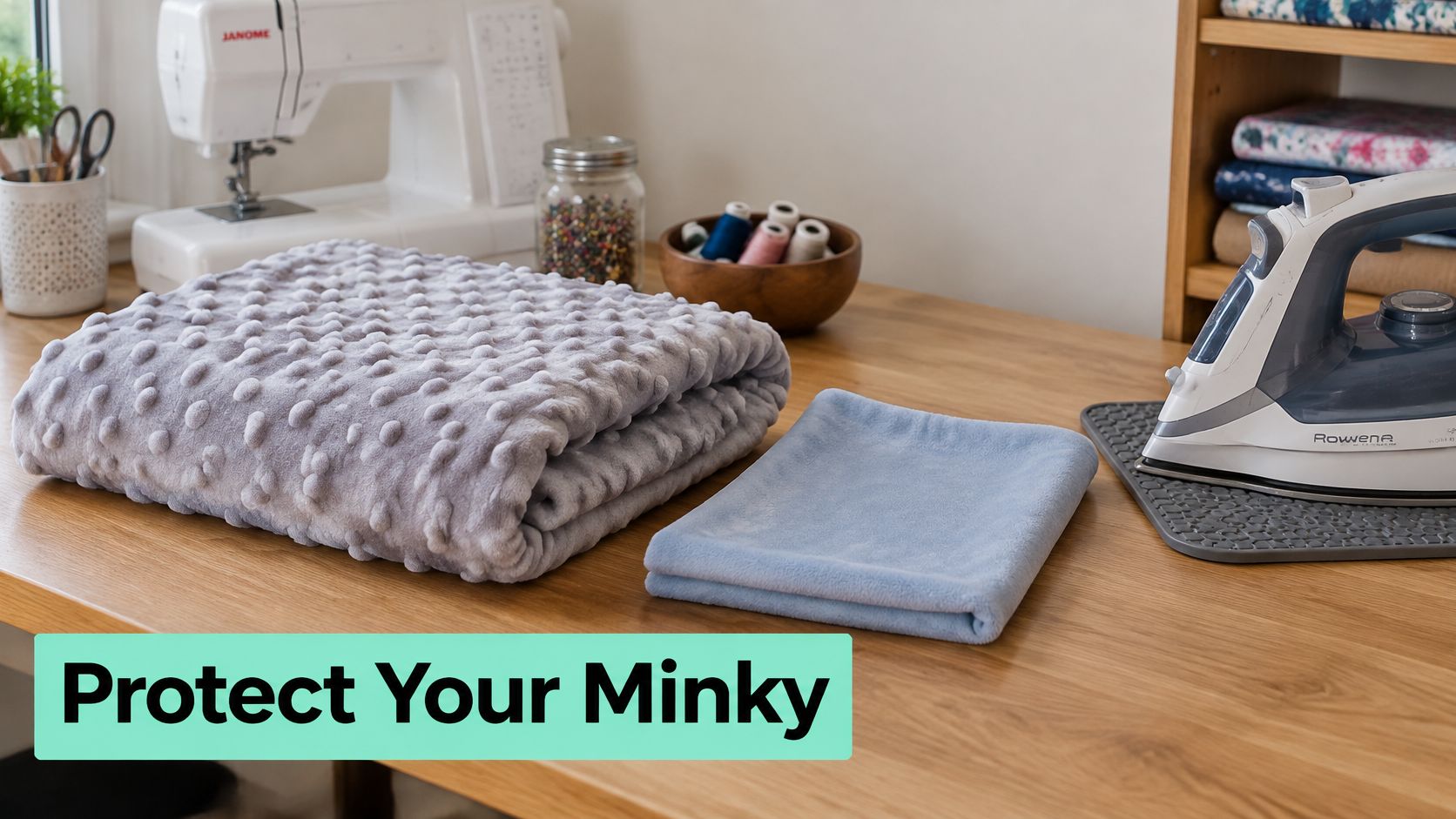
One hot, wet pass can ruin the fabric you bought for its softness. Minky is a plush polyester pile, and high heat plus wet steam can flatten it, leave shine or scorch marks, and make the backing feel stiff. Once pile crushes badly, brushing rarely brings it fully back.
Cuddle is a lower-pile minky, while Luxe Cuddle is the higher-pile version. Textures such as Hide, Snowy Owl, and Fawn sit in that luxe high-pile group, so they need the most careful handling at the board. If you're still learning how these fabrics behave under the needle, our guide to sewing minky fabric without it sliding covers the handling basics before you press anything.
The photo below shows the setup we mean, with the backing laid flat and the iron kept off the pile until settings are confirmed.
How Do You Press Minky Without Crushing the Pile
- Set the one-dot synthetic range before the iron touches minky, not after you've already pressed cotton at three dots.
- Test a scrap from the same bolt because texture and colour can react differently under the same setting.
- Press from the wrong side so the soleplate meets the backing knit, not the face pile.
- Use a pressing cloth between iron and fabric whenever you must work from the right side.
- Keep steam minimal or press dry since low temperatures don't vaporize water as consistently as high settings.
- Lift and brush the pile upright with your fingers while the fabric is still warm, then let it cool undisturbed.
Why Does Anti-Drip Protection Matter More on Delicate Pile
At low temperatures, water that doesn't fully vaporize can escape as droplets and spot the pile. Philips describes its Drip Stop system as preventing water droplets from escaping so users can iron delicate materials at low temperatures without water stains. That feature is distinct from auto-shutoff, since anti-drip addresses moisture marks during ironing rather than unattended heat hazards.
If you alternate between delicate synthetics and heavier cotton or linen in the same session, put anti-drip on your must-have list. It's the difference between a clean backing and a spotted one you notice only under quilting light. Stop struggling with bulky seams in your quilt backs by pairing careful pressing with extra-wide fabric that needs no pieced seam at all.
First-order shoppers get 15% off, and U.S. orders over $70 ship free. Stock up on test cuts of Hide, Snowy Owl, or Fawn before you commit a full backing to a new iron.
Press a scrap of each texture you own and label the setting that worked. That small library saves guesswork on gift deadlines. When you're ready, Shop the Luxe Cuddle Collection and start with the texture from your test.
Auto-Shutoff, Descaling and Warranty Over Time
During a quilt session, you may set an iron down to adjust a seam or reposition fabric. Auto-shutoff timings help you understand how quickly it powers down, but they do not replace staying nearby. One Breville manual specifies automatic shutoff after 15 minutes on its heel and after 30 seconds on its soleplate. A second Breville model is described as shutting off after 10 minutes on its heel and 30 seconds on its soleplate. For the Rowenta DW9280 and Philips Drip Stop model, look up “auto shut-off” or “safety auto-off” in the model's instruction manual, then check the listed timings for both the heel and soleplate positions. If the manual gives no separate timings, contact the manufacturer before relying on a specific interval.
| Model | Heel-rest shutoff | Soleplate shutoff |
|---|---|---|
| Breville model in the first manual | 15 min | 30 s |
| Second Breville model | 10 min | 30 s |
| Rowenta DW9280 | Check the model manual | Check the model manual |
| Philips Drip Stop model | Check the model manual | Check the model manual |
Unplug the iron after use and follow its manual's care instructions. A shutoff feature is a backup, particularly in a shared sewing room where someone may move fabric or a pressing surface while the iron is unattended.
What Ownership Costs Do Most Reviews Skip
Warranty terms matter alongside descaling and repair access. Check the length of the warranty, what parts and labor it covers, and whether the terms differ for household and frequent use. A one-year warranty for the Rowenta DW9280 is cited elsewhere in this article; confirm the current terms for the model and seller before buying.
Follow the manufacturer's water guidance and descaling schedule. Mineral buildup can contribute to spotting or leaks, especially where tap water is hard. Include descaling supplies and any required filter replacements in your running costs.
Repairability can also affect long-term value. Expert Reviews says a steam generator is repairable for 15 years, while an eco mode is claimed to use up to 30% less energy than maximum mode. Check the product's own warranty and service information to see whether parts or repairs are available for the iron you are considering.
After heavy use, inspect the tank and soleplate for mineral residue. Follow the manual if you notice flakes, spotting, or leaks, and use this guide to clean an iron soleplate and follow routine care steps. For a quilter pressing often, clear maintenance instructions and accessible repairs can matter as much as the steam output.
Which Steam Iron Fits Your Quilting Workload
The right iron depends on what you press, how long you press, and how often you maintain the appliance. A quilter piecing blocks once in a while has different needs from someone flattening wide backings every week. Match the iron to your actual sessions rather than buying for the highest steam output.
- Occasional piecer: An entry-level or mid-range conventional iron with a clear temperature dial is usually enough. Light use rarely justifies a steam generator's cost or counter space.
- Weekly quilter working with mixed fabrics: A mid-range conventional iron with anti-drip protection helps when switching between cotton and synthetics, where water spots can spoil the finish.
- Seam-heavy piecer pressing thick layers: A burst-focused iron such as the Rowenta SteamForce DW9280 can reduce repeat passes over bulky seams. Weigh that convenience against its premium price.
- Quilter preparing large backings: A steam generator suits frequent, high-volume pressing. For backings that need attention only occasionally, mailing the quilt may be more practical.
- Gift maker sewing minky scarves and pillows: A compact iron with reliable low-temperature control and anti-drip protection is a better fit than an iron chosen for maximum steam. High-pile fabric can show heat and moisture marks quickly.
When Does Mailing the Quilt Beat Buying a Bigger Iron
If you rarely press a queen-size backing, consider the mail-in option before purchasing a generator. For example, a 110-inch backing that needs pressing only now and then may not justify the price and storage space of a high-output setup. Our Mail-in Longarm service includes edge-to-edge quilting, batting and thread, plus free return shipping. Compare the mail-in quote with the cost of a generator you would use only a few times a year.
Prepare the backing carefully before shipping. It should be at least 4 inches longer and wider than the quilt top, with seams pressed and loose threads clipped. These longarm quilt prep tips for a smooth mail-in finish explain the steps that help the quilt load without delays.
At On Pins & Needles Quilting Co., hands-on longarm and fabric handling experience informs our minky and Cuddle pressing advice. We regularly see backings arrive with crushed pile, unpressed seams, or too little fabric around the top. Careful temperature and moisture control can prevent the first problem, while pressing seams and measuring accurately address the others.
What Is the Simplest Decision Path Before You Buy
- List the fabrics you press most, including minky and linen, and identify which one causes the most trouble.
- Choose the iron category for your largest pieces and longest sessions, rather than an average block-making day.
- Check the temperature range, anti-drip feature, and dial readability against the care labels for those fabrics.
- Review the warranty, descaling routine, and access to spare parts if you expect to press weekly.
- Compare a mail-in quote if your backing is 110 inches or larger and you do not press backings often.
Test a scrap cut from the actual backing before pressing the full project. Luxe Cuddle Snowy Owl and Fawn are useful test fabrics because their pile makes heat or moisture marks easy to spot. Keep the successful scrap near your ironing board, marked with the setting that worked.
For minky, control matters more than maximum output. Heat and drips can flatten or mark the pile, while extra steam does not solve either problem.
The best steam iron for quilting is the one that suits your fabrics, session length, and maintenance habits. A practical fit will serve you better than a headline steam rating that exceeds your needs. Get 15% Off Your First Order with us, with free shipping on orders over $70, and test your settings on a fabric scrap before starting a project.
Pick an iron based on your workload, then choose fabric and finishing to match. On Pins & Needles Quilting Co. offers extra-wide Shannon Cuddle backings in Hide, Snowy Owl, and Fawn, along with mail-in edge-to-edge longarm quilting that includes batting, thread, and free return shipping. Visit On Pins & Needles Quilting Co. to browse Luxe Cuddle textures, order a test cut for your pressing scraps, or book longarm quilting.