
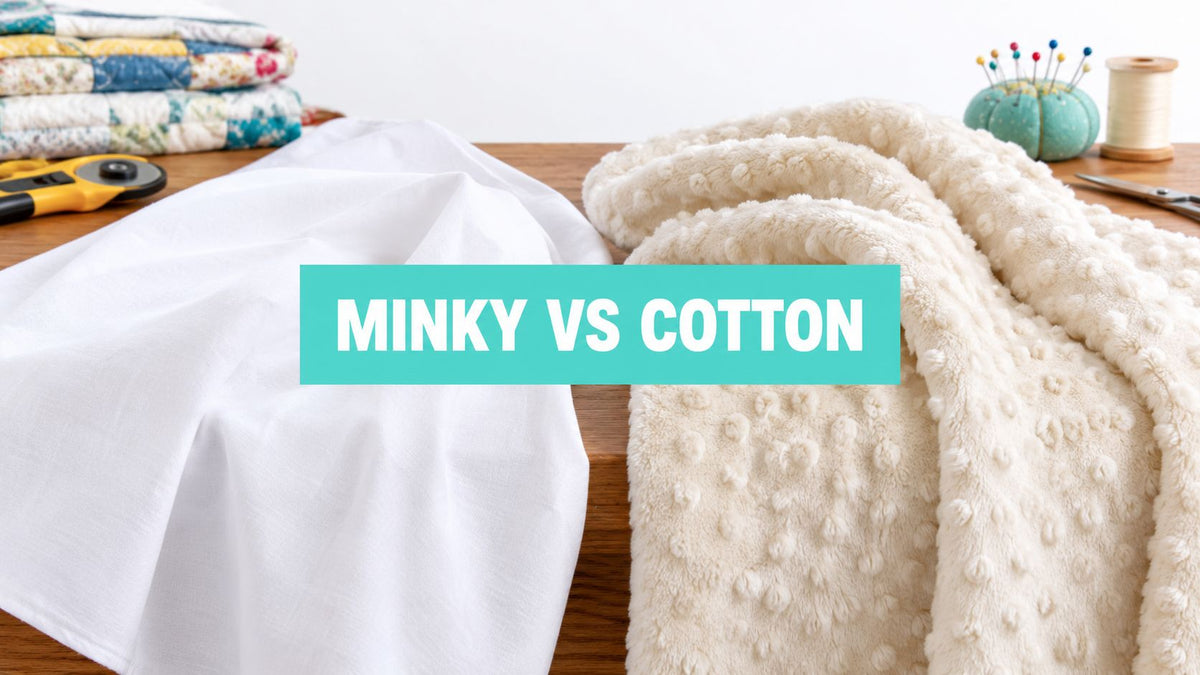
You've finished a beautiful quilt top, but the backing is still folded on the cutting table, and you're wondering whether to piece standard cotton or choose something softer and wider. For most large quilts, the best fabric for quilt backing is extra-wide minky when you want a smooth, plush finish, while wide cotton remains the practical choice for breathable, traditional quilts.
Why Your Quilt Backing Choice Matters
A backing can change the entire character of a quilt. A flat woven cotton gives a crisp, breathable feel, while plush minky creates a warmer drape that invites the recipient to use the quilt as a blanket rather than display it.
The decision also affects the quilting process. A standard cotton backing may need several joined panels, and every seam adds another ridge for the batting, quilt top, and longarm foot to travel across. Those joins can make loading less forgiving, especially when a large quilt sandwich must remain square while it moves through the machine.
What changes after the quilt leaves the frame
A quilt back determines more than appearance. It influences:
- Drape: Cotton tends to feel structured and breathable, while minky falls with a soft, fluid weight.
- Warmth: Plush textures add insulation and tactile comfort without changing the pieced top.
- Handling: A wide backing removes alignment work and bulky joins.
- Durability: The fabric must tolerate quilting, washing, and everyday use.
- Maintenance: Different fibers need different washing and drying habits.
A common frustration starts with a queen-size quilt backed by standard 44-inch cotton. The quilter cuts multiple lengths, joins them, presses the seams, and discovers that the backing is slightly off-square. Once the layers are loaded, that small error can become puckers, tension changes, or a seam that feels unusually prominent beneath the finished quilt.
Practical observation: The backing isn't an invisible utility layer. It becomes the surface against the sleeper's skin, the fabric that carries the quilting texture, and the part of the sandwich that determines how easily the longarm can do its work.
Cotton still earns its place, particularly for heirloom quilts and warm-weather bedding. But the physical realities of loading make extra-wide fabric attractive for large projects. Our guide to soft quilt backing fabric is useful when you're deciding whether your priority is breathability, plushness, or fewer seams.
The Case for Cotton and Wide Backings
Cotton became the traditional benchmark for quilt backing because it balances durability, breathability, and ease of quilting. Historical references describe early American quilts with linen or linsey-woolsey backs, but plain cotton became especially common as factory-made cotton prints made fabric more affordable and accessible during the 19th and 20th centuries. Museum and folklife references frequently identify quilts made before 1970 as cotton, making woven cotton the practical baseline for many traditional projects. (Smithsonian Associates quilting handout)
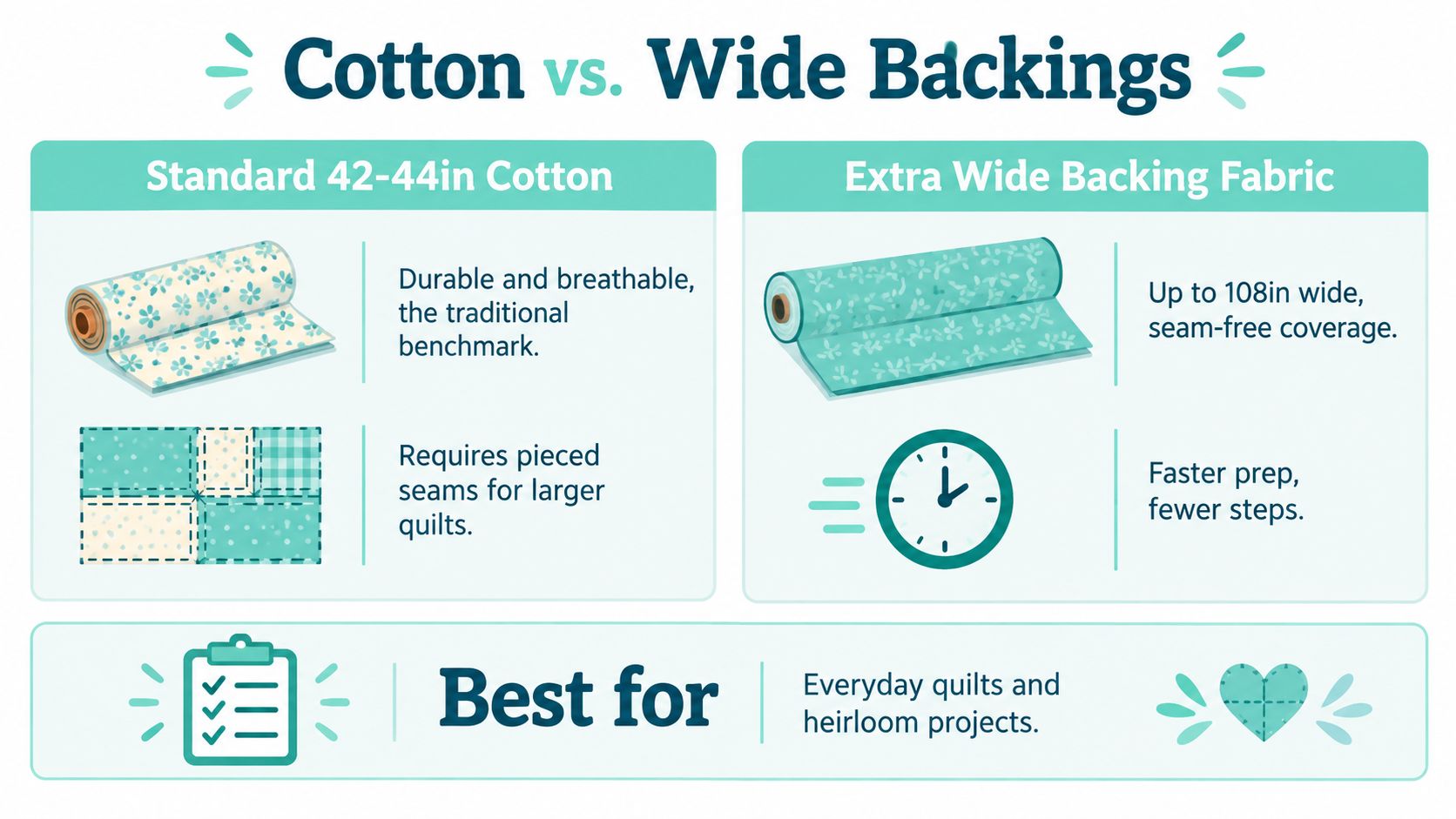
Standard quilting cotton is widely usable, but its finished width is typically only 42 to 44 inches after the selvedges are removed. A quilt wider than that needs a pieced back unless you choose a wide-back fabric, and washing can reduce the usable width further. One measured example went from 42.25 inches before washing to 41.1 inches after washing, a difference that matters when a layout is tightly calculated. (Quilt backing calculator and width guidance)
When a standard cotton back makes sense
Choose regular quilting cotton when:
- The quilt is small enough for one width: Baby quilts, table toppers, and compact throws may not need a join.
- You want maximum breathability: Cotton suits summer bedding and heirloom-style quilts.
- The back is part of the design: Pieced backs can use leftover blocks, coordinating prints, or a deliberate secondary pattern.
- You prefer familiar quilting behavior: Cotton is stable, easy to press, and predictable under a longarm.
The hidden cost appears with larger quilts. A crib quilt may require about 2.75 yards of 44-inch fabric, compared with about 1.5 yards of 108-inch backing. For a queen, the difference can be about 8.25 yards of 44-inch fabric versus 3.25 yards of 108-inch wide-back. (Quilt backing yardage chart)
Why 108-inch cotton changes the calculation
Modern wide backing solves the main weakness of standard cotton. A 108-inch width can cover many queen and king backs in one continuous panel, reducing joins, alignment work, and handling risk. A common rule is to cut the backing length at approximately the quilt length plus 8 inches, leaving room for loading and movement during quilting. (Wide quilt backing guidance)
Standard cotton commonly shrinks about 2% to 5% overall, and shrinkage can be uneven. Crosswise loss may exceed lengthwise loss, which is particularly important when working with wide backing. (Guide to quilt backs)
For large woven projects, 108-inch wide quilt backing is often the sensible middle ground. You keep cotton's breathable, traditional character without accepting the center seam and extra pressing that standard-width fabric demands.
Exploring Flannel Muslin and Fleece Options
Flannel, muslin, and fleece each solve a different comfort problem, but none behaves exactly like quilting cotton on a longarm. The best choice depends on whether warmth, breathability, softness, or easy loading matters most.
| Backing fabric | Main benefit | Longarm consideration | Best fit |
|---|---|---|---|
| Flannel | Warmer, brushed surface | Can stretch, especially when handled off-grain or on the bias | Cozy throws and winter quilts |
| Muslin | Breathable, understated, traditional feel | Can look plain and may show quilting irregularities | Heirloom and utility quilts |
| Polar fleece | Soft, warm, and accessible | Dense drape can make quilting motifs feel less defined | Casual blankets and outdoor throws |
| Wide cotton | Stable, breathable, and seam reducing | Still needs shrinkage planning | Large traditional quilts |
Is flannel suitable for quilt backing?
Flannel is appealing because it adds warmth without the plush pile of minky. It feels familiar, washes comfortably, and pairs well with flannel quilt tops or winter-themed designs.
The difficulty is control. Brushed fibers can shift against batting, and flannel may stretch when the backing is lifted, folded, or loaded. Bias handling makes that problem more noticeable, so square cutting and careful smoothing matter.
A flannel back also deserves a generous loading margin. If the fabric arrives slightly skewed, forcing it straight with pins or clamps can transfer tension into the quilt sandwich. Our practical guide to backing a quilt with flannel covers the handling concerns that make this fabric successful.
What about muslin and fleece?
Muslin is a strong choice when you want an understated, breathable surface. It supports a traditional look, but its plain appearance can make quilting lines and small tension variations more visible.
Polar fleece delivers softness and warmth at a lower-complexity level, but its heavy, dense drape can dampen the definition of intricate quilting motifs. It's comfortable for a casual throw, yet it doesn't provide the same clean, structured response as cotton or the distinctive plush texture of minky.
These alternatives aren't wrong. They require a clear understanding of the finished quilt's purpose and the way the backing will behave during loading, quilting, washing, and daily use.
Why Extra Wide Minky is the Ultimate Upgrade
Extra-wide minky addresses the most frustrating part of backing a large quilt, the need to join multiple standard-width panels. Depending on the product, 90-inch and 110-inch widths can cover much of a bed-sized quilt with little or no seaming, leaving the finished back smooth and uninterrupted.
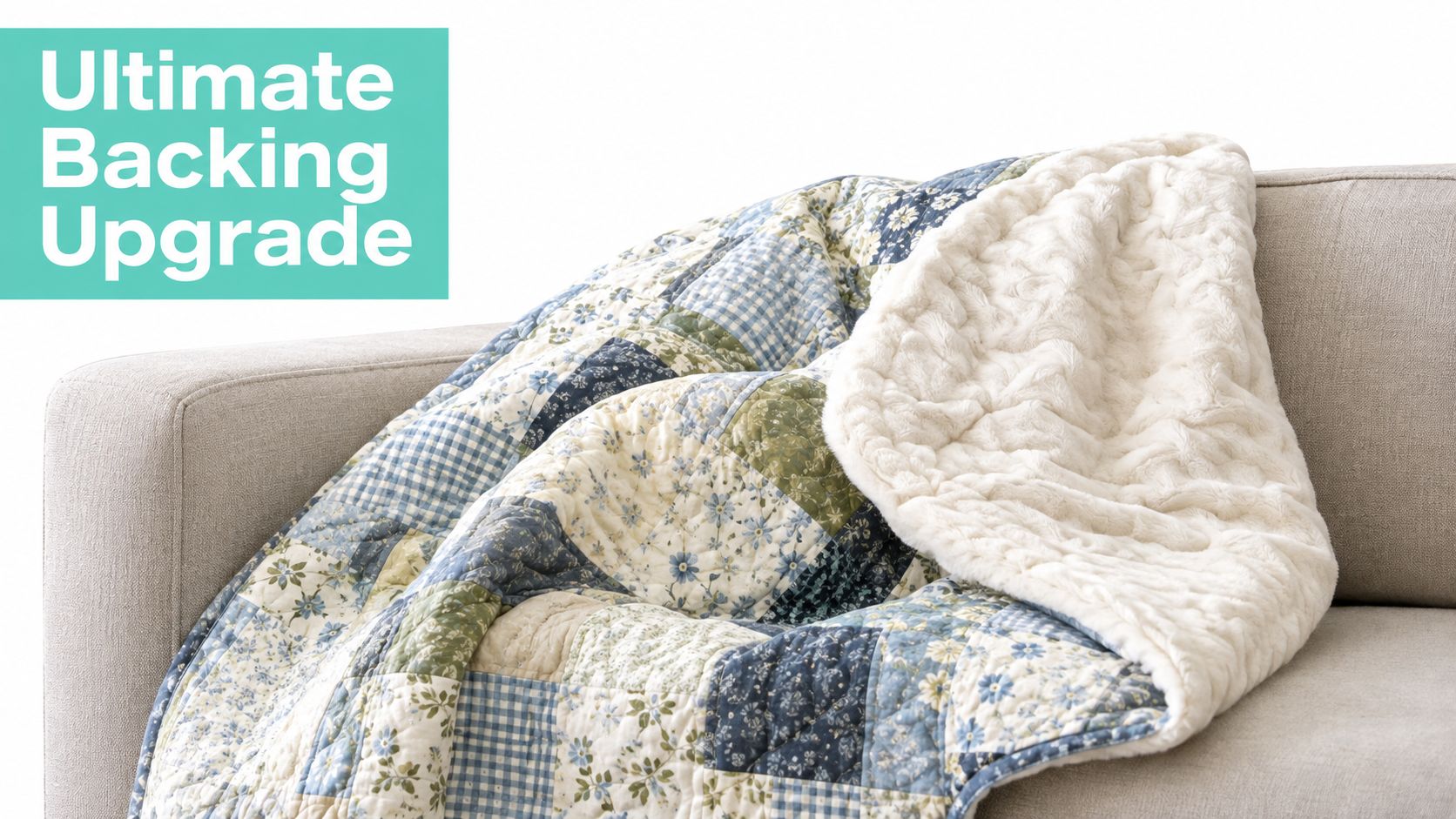
That matters under a longarm. A pieced cotton back has seam allowances that create ridges, and those ridges can affect how the foot travels across the sandwich. Extra-wide minky removes that interruption, so the machine moves over one continuous backing surface instead of crossing a center seam or multiple joins.
Which Shannon Cuddle texture should you choose?
Shannon Fabrics Cuddle and Luxe Cuddle offer different visual and tactile directions:
- Hide: A dimensional, fur-like texture that gives a dramatic luxury finish.
- Snowy Owl: A soft, winter-inspired surface with pronounced visual character.
- Fawn: A warm, inviting texture for baby quilts, gifts, and cozy sofa throws.
A smooth quilting cotton can make the pieced top feel crisp and graphic. Minky does the opposite. It softens the overall impression, adds warmth, and turns the reverse side into part of the experience rather than a supporting layer.
Loading insight: A seamless backing doesn't eliminate the need for accurate preparation, but it removes one major source of bulk and misalignment.
The practical difference becomes especially noticeable on big quilts. Standard cotton may require multiple cuts, long seams, pressing, and careful squaring before the backing ever reaches the frame. Extra-wide minky reduces those steps, although its plush surface still needs gentle handling to prevent distortion.
For a closer look at widths and project planning, see extra-wide 110-inch minky fabric. OPN's shop also carries Shannon Cuddle options including 44 to 45-inch Quilting Cuddle, 80-inch Mirage, and extra-wide 90 and 110-inch fabrics.
This short video offers a visual look at working with plush backing:
Minky isn't the automatic answer for every quilt. It can hide subtle quilting texture more than a plain woven back, and its pile demands thoughtful cutting and washing. When the priority is a luxurious reverse side, however, extra-wide minky solves the handling problem more elegantly than a heavily pieced cotton back.
How to Prepare Your Backing for Longarm Quilting
A longarm quilter needs more than the right fabric. The backing must be large enough, square enough, and stable enough to load without pulling the quilt top out of alignment.
A common rule is to add about 8 inches to the quilt-top dimensions, creating overhang for loading and shifting. Another way to express the same calculation is backing width equal to the quilt-top width plus twice the desired overhang. (Backing measurement calculator)
What should you do before cutting?
- Measure the finished top through the center. Borders and edges can stretch, so measure the actual quilt top rather than relying on the pattern size.
- Add the loading allowance. Confirm the preferred margin with your longarm quilter before cutting.
- Square the backing. A skewed edge can create tension as the backing is attached to the frame.
- Remove selvedges before piecing cotton. Selvedges can behave differently from the body of the fabric and may pucker.
- Use a strong backing seam. A pieced back needs a seam that can tolerate quilting and repeated washing.
- Press bulk away from the quilting path. Open seams can reduce the ridge beneath the needle and foot.
For minky, the preparation is gentler. A specialized longarm guide recommends 4 to 6 extra inches on all four sides, cutting the fabric square, handling it carefully, washing with cool-to-warm water, drying on low heat, and avoiding fabric softener because heat and residue can degrade the plush pile over time. (Minky quilt backing preparation)
Longarm backing preparation rules
| Fabric type | Required overhang | Prep and washing rules |
|---|---|---|
| Standard cotton | About 8 inches added to the quilt-top dimensions | Plan for shrinkage, square the fabric, and press pieced seams carefully |
| 108-inch cotton | About 8 inches added to the quilt-top dimensions | Check crosswise shrinkage and keep the single panel square |
| Minky | 4 to 6 inches on all four sides | Cut square, handle gently, use cool-to-warm water, dry on low heat, and skip fabric softener |
| Flannel | Confirm with the longarm quilter | Stabilize the grain, avoid stretching, and prepare for a softer, less rigid surface |
| Fleece | Confirm with the longarm quilter | Keep the backing flat and account for its dense drape |
Before sending a quilt through a mail-in service, review these longarm quilt preparation tips. A clean, properly sized backing gives the quilter room to load the sandwich without fighting avoidable tension problems.
Matching the Right Fabric to Your Project
The right backing becomes easier to choose when you start with the person and setting rather than the fabric rack. A baby quilt, heirloom quilt, sofa throw, and outdoor blanket all ask different things of the backing.
Which backing suits each project?
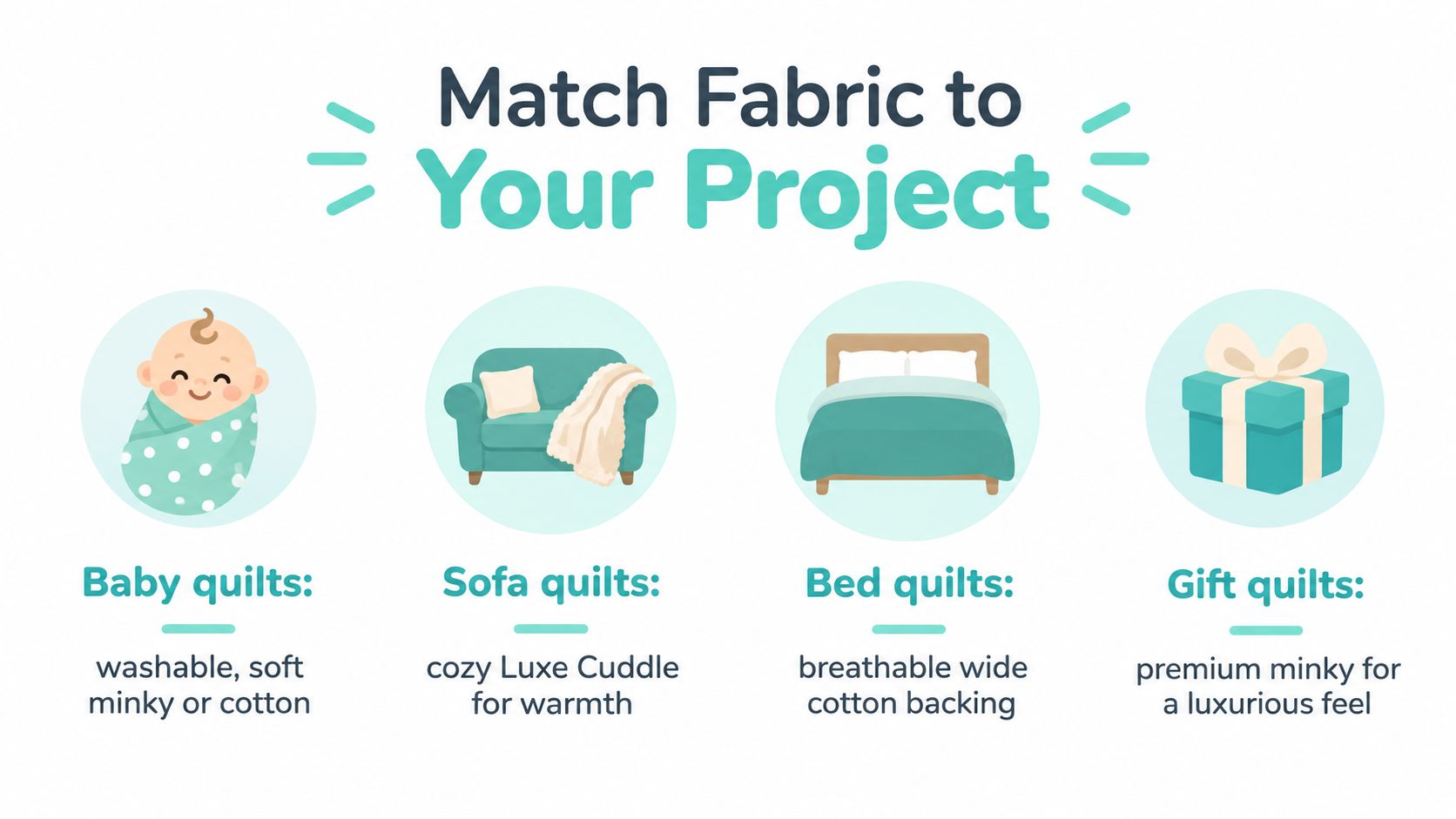
- Baby quilt: Choose soft minky or cotton when washability and comfort matter most. A gentle Cuddle texture can make the quilt feel special without requiring a complicated back.
- Cuddle blanket: Use plush minky when maximum softness is the point. A texture such as Snowy Owl or Fawn turns the reverse side into a tactile feature.
- Heirloom quilt: Select breathable cotton or a wide cotton backing when tradition, longevity, and visible quilting are central to the design.
- Sofa quilt: Luxe Cuddle creates a warm, comfortable surface that works well for curling up under a throw.
- Gift quilt: Premium minky gives a finished quilt an immediately luxurious hand, especially when the pieced top is visually restrained.
- Outdoor or picnic throw: Cotton or fleece may be more practical when the quilt needs a sturdy, easygoing surface rather than a delicate plush pile.
What should you consider before adding fabric to your cart?
Think about the finished quilt's laundering routine. A frequently washed baby quilt needs a backing whose care instructions fit the household, while a decorative gift quilt may prioritize texture and appearance.
Also consider how much quilting you want to see. A plain muslin or solid cotton can display every line clearly, while a textured minky may make the quilting feel more subtle and dimensional. Neither result is better, but they create different visual finishes.
Finally, think about the labor you're willing to spend. Standard cotton can be economical for a small project, but wide cotton or extra-wide minky becomes more attractive as the quilt grows and the seams multiply.
Finish Your Masterpiece with Confidence
The best fabric for quilt backing should make the finished quilt more useful, not make the maker wrestle with unnecessary complications. Standard cotton remains a dependable choice for breathable quilts, traditional projects, and small backs that fit within one width. Flannel, muslin, and fleece each have a place when their warmth and handling characteristics match the project.
For a large quilt, extra-wide backing earns its cost through simpler preparation. A panel reduces piecing, removes bulky joins from the quilting path, and gives the finished quilt a soft, uninterrupted reverse side. Extra-wide minky adds another benefit, the tactile appeal of Shannon Cuddle or Luxe Cuddle textures such as Hide, Snowy Owl, and Fawn.
OPN Quilting offers Mail-in Longarm quilting for quilters who have completed the top but don't want to manage the frame. The service includes batting, thread, and free return shipping, and the shop supports its work with clear preparation guidance, a pattern gallery, and hundreds of verified reviews.
Planning note: Order the backing before the top is finished if possible. That gives you time to verify width, texture, care instructions, and the loading requirements of the person quilting it.
You can browse the Luxe Cuddle collection when you want a plush, uniform back, or compare available wide backing fabrics for a woven finish. OPN also offers curated cuts, kits, ready-made minky blankets, and related sewing supplies for makers who want a straightforward path from fabric selection to finished gift.
New customers can use the 15% first-order coupon, and orders over $70 qualify for free U.S. shipping. Check the current offer details before checkout, since promotions and availability may change.
On Pins & Needles Quilting Co. offers premium Shannon Cuddle and Luxe Cuddle fabrics, extra-wide minky backing, and Mail-in Longarm finishing for quilts that deserve a smooth, professional finish. Visit On Pins & Needles Quilting Co. to choose your backing, use the 15% first-order offer, and book your quilting service today.