90-inch wide backing fabric handles throws and many twin or full quilts, while 108-inch fabric covers many queen backs and 110-inch options give king-size projects more room. The right choice depends on your finished top, usable width after selvages, and the margin your longarm quilter needs.
You've finished the quilt top, and the back is where the momentum stops. A standard 42-44 inch piece means long seams, bulky joins, and another large project before quilting can even begin. Wide backing fabric removes much of that piecing, but only when you order for the finished quilt and the machine process, not the nominal bolt width.
Why Quilters Choose Wide Backing Fabric
The finished quilt top is on the design wall, but quilting cannot start until the back is ready. Standard quilting cotton is generally 42-44 inches wide. Dedicated wide backing commonly measures 108-110 inches, roughly 2.5 times the width of standard quilting cotton (fabric width guide).
That added width can turn a queen or king backing into one continuous cut instead of several vertical strips. You avoid a center seam, spend less time pressing and matching, and keep the print or texture uninterrupted. At the longarm, you also remove a bulky join that can catch under the rollers or become more visible through quilting and laundering.
What changes when the back is one piece?
A one-piece back removes a major preparation variable. There is no long seam to align, no decision about pressing it open, and no join to monitor as the quilt advances across the frame. You still need to check the finished top, nap direction, selvages, and the loading margin your longarm quilter requires.
The practical widths vary by project:
| Width | Best for | Notes |
|---|---|---|
| 80 inches | Smaller quilts and selected throw layouts | Check the finished top and loading margin carefully |
| 90 inches | Throws, twin, full, and some queen layouts | Useful when the project does not need a broad loading panel |
| 108 inches | Many queen quilts and broad bed-size backs | A common choice for one-piece backing |
| 110 inches | Large queen and many king applications | Gives more room, but usable width still matters |
A 110-inch width is about 280 centimeters. Mill widths track bedding dimensions, which is why 108 and 110 inch goods exist at all.
Before ordering, measure the finished top rather than relying on its nominal bed size. Confirm the required overage with your longarm service, and allow for selvages, since they can reduce the usable width. A practical quilt backing guide can help you check those measurements before cutting. This finished-top-to-frame check is what helps you order once, clear room for quilting, and avoid a return.
The Common Widths and Why They Exist
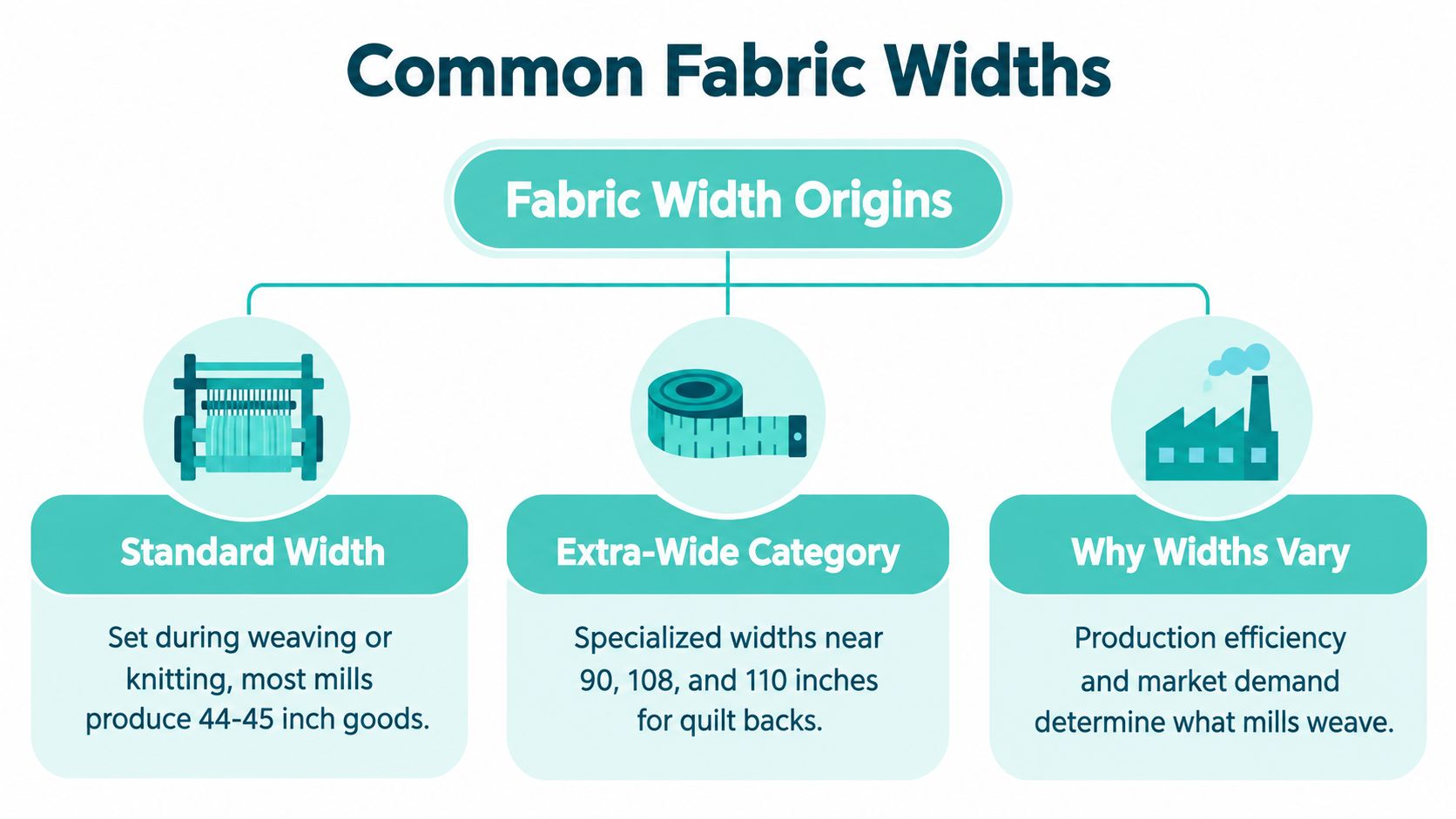
A fabric mill's width starts with its weaving or knitting equipment. Changing that standard requires retooling, so 44-45 inch goods remain common for apparel and everyday quilting. Wider goods, including 90, 108, and 110 inches, are made for bedding and quilt backing rather than general-purpose yardage. The fabric width guide outlines the production factors behind these sizes.
The choice becomes practical at the cutting table. An 80-inch Luxe Mirage can cover a smaller quilt or a top arranged in a favorable direction. 90-inch Extra Wide Cuddle 3 gives more working width for throws and smaller bed quilts. A 110-inch bolt from Shannon Fabrics is intended for large backs, particularly where a queen or king top needs one broad panel.
Why wide goods are a natural solution
Large bed coverings have long been wider than ordinary cloth. A U.S. candlewick bedspread made around 1840 measured approximately 68 by 82.5 inches. An early-19th-century South Carolina bedspread documented by the Texas Heritage Museum measured 8 by 8 feet, or 96 by 96 inches, and was woven in three sections on a 14.5-foot hand loom (Texas Heritage Museum quilt record).
A documented 1930s-1940s chenille bedspread measured 99 by 88.5 inches, another example of a large covering made before the modern wide-back category. Makers handled the width with joined sections or unusually broad looms. Wide backing fabric applies that same practical solution to current quilting equipment.
OPN Quilting carries 44-45 inch Quilting Cuddle, 80-inch Mirage, and extra-wide 90- and 110-inch options. Match the usable width to the finished top, nap direction, and the space your longarm setup needs. The 108-inch quilt backing article offers another useful comparison when weighing wide minky against standard-width fabric.
Sizing Wide Backing for Queen and King Quilts
A finished top can fit a queen mattress and still need a different backing cut than another queen quilt. Measure the completed, squared top first, then add the room required for loading, quilting movement, and trimming.
A practical rule is 4 inches on each side, adding 8 inches to both the length and width. Missouri Star Quilt Company outlines this allowance in its wide backing collection. Confirm the exact requirement with your longarm quilter, since frame setup and quilting method affect the margin. Nebraska 4-H guidance calls for backing to extend at least 3 inches beyond every side, or at least 6-8 inches more in total width and length (Nebraska 4-H Quilts of Valor guidelines).
How to make the width decision
Use this order before buying:
- Measure the finished top. Record its length and width after squaring.
- Add the loading margin. Use your quilter's requirement. Four inches per side is a common planning choice, but the service may request more.
- Remove unusable edges. Selvages may not be suitable for quilting, and plush fabric may need extra care to square.
- Compare usable width. The panel must cover the required measurement after those deductions, not match the width printed on the bolt.
- Test both orientations. Rotate the calculation when the print, nap, or grain permits it.
Here is a worked example. A 90-by-108-inch queen quilt can use approximately 3 1/3 yards of 108-inch backing when the backing width runs across the quilt. The calculation depends on that orientation and does not set the yardage for every queen top.
For a king top, a 110-inch bolt may work when the finished width plus the loading margin fits inside the usable panel. If it does not, ordering a wider bolt alone will not correct a poor orientation or an undersized cut. A seam, rotated layout, or wider product may be necessary.
Measure the panel you need after loading, not the bed you intend to cover.
Use this king-size quilt backing guide when a king project is close to the limit of a single-piece back. Making the measurement before ordering lets you check width, direction, nap, and longarm clearance together, which is how you avoid buying fabric that reaches the quilt but not the frame.
Minky Backing Versus Cotton Backing
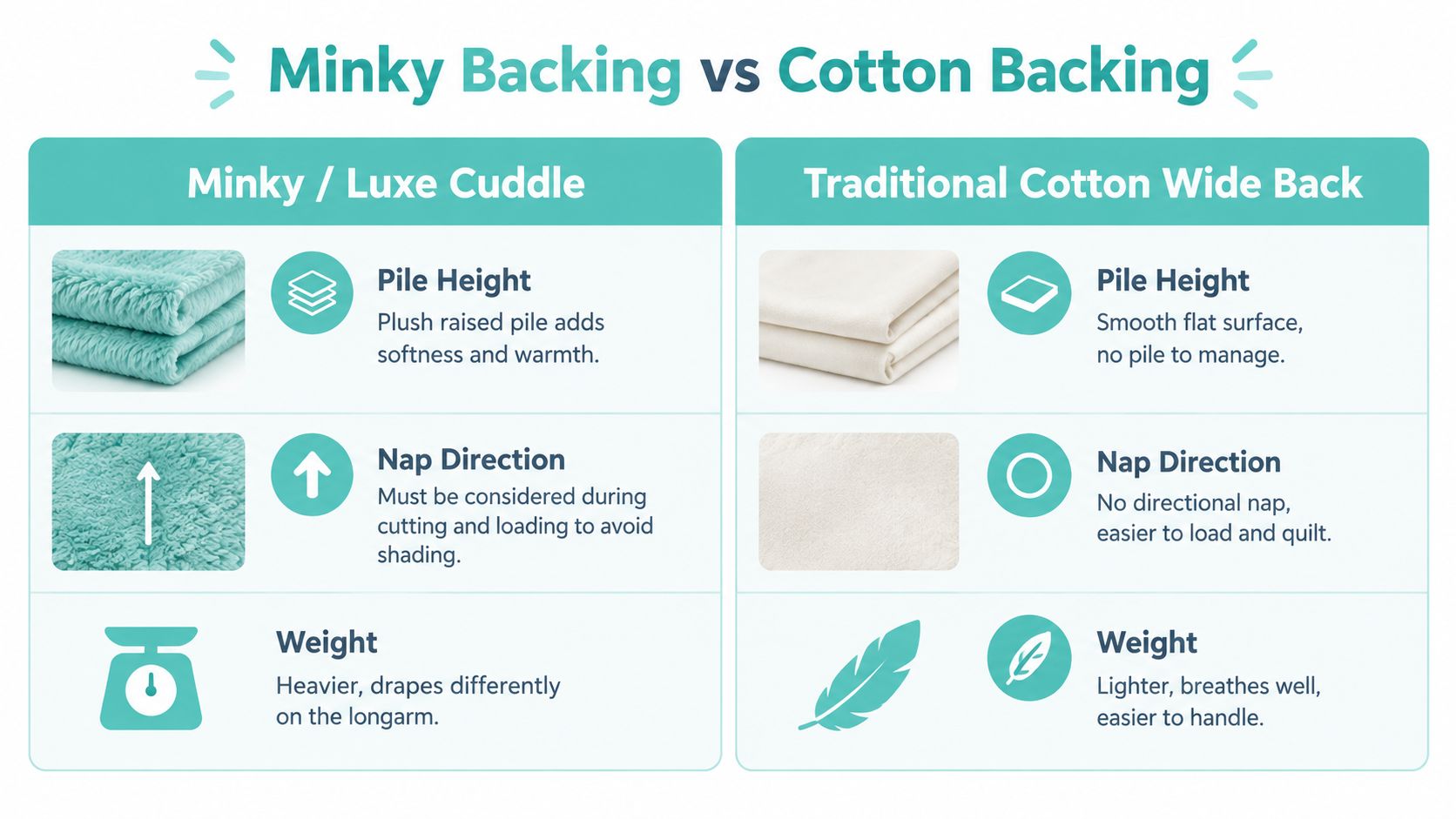
Minky and cotton solve different comfort and handling problems. Minky gives the quilt a plush, warm hand, while cotton offers a flatter, lighter surface that breathes well and usually behaves more predictably during loading.
At our longarm table, the difference is most obvious when a plush panel has a directional nap. A pattern such as Shannon Fabrics Hide, Snowy Owl, or Fawn can look different when the pile is brushed in opposite directions, so the cut and loading direction need to be decided before the fabric reaches the frame.
Which fabric suits the finished quilt?
| Consideration | Minky or Luxe Cuddle | Traditional cotton wide back |
|---|---|---|
| Feel | Plush raised pile adds softness and warmth | Smooth, flat surface |
| Direction | Nap direction affects shading and placement | No directional nap to manage |
| Handling | Heavier drape and more bulk | Lighter and easier to handle |
| Longarm preparation | Needs careful tension, squaring, and nap control | Usually simpler to load and align |
| Best use | Cozy winter blankets, baby quilts, tactile gifts | Cooler quilts, traditional drape, breathable bedding |
Minky isn't automatically difficult, but a single oversized panel can be more demanding than a pieced cotton back. The pile can hide a fold, the fabric can shift while you're smoothing it, and the finished quilt may feel heavier on the frame.
Cotton has its own trade-off. It doesn't deliver the same velvety softness, and a cotton back may feel less substantial to someone who specifically wants a plush cuddle blanket. For a cool, lighter quilt, that restraint is exactly the advantage.
The Shannon Cuddle and minky fabric guide explains the material family in practical terms. Choose plush when the quilt's purpose is warmth, sensory comfort, or a soft gift. Choose cotton when breathability, lighter handling, and a flatter quilting surface matter more.
Cutting and Prepping a Seamless Back
A flawless back still needs preparation. The cut should be square enough to load, the nap should run consistently, and the panel should arrive with its edges under control rather than rolled into a distorted bundle.
At OPN's mail-in longarm service, we need the backing to extend 4 inches past the quilt top on every side for loading and finishing. That margin works as a starting point, but always follow the exact preparation requirements of the service you use.
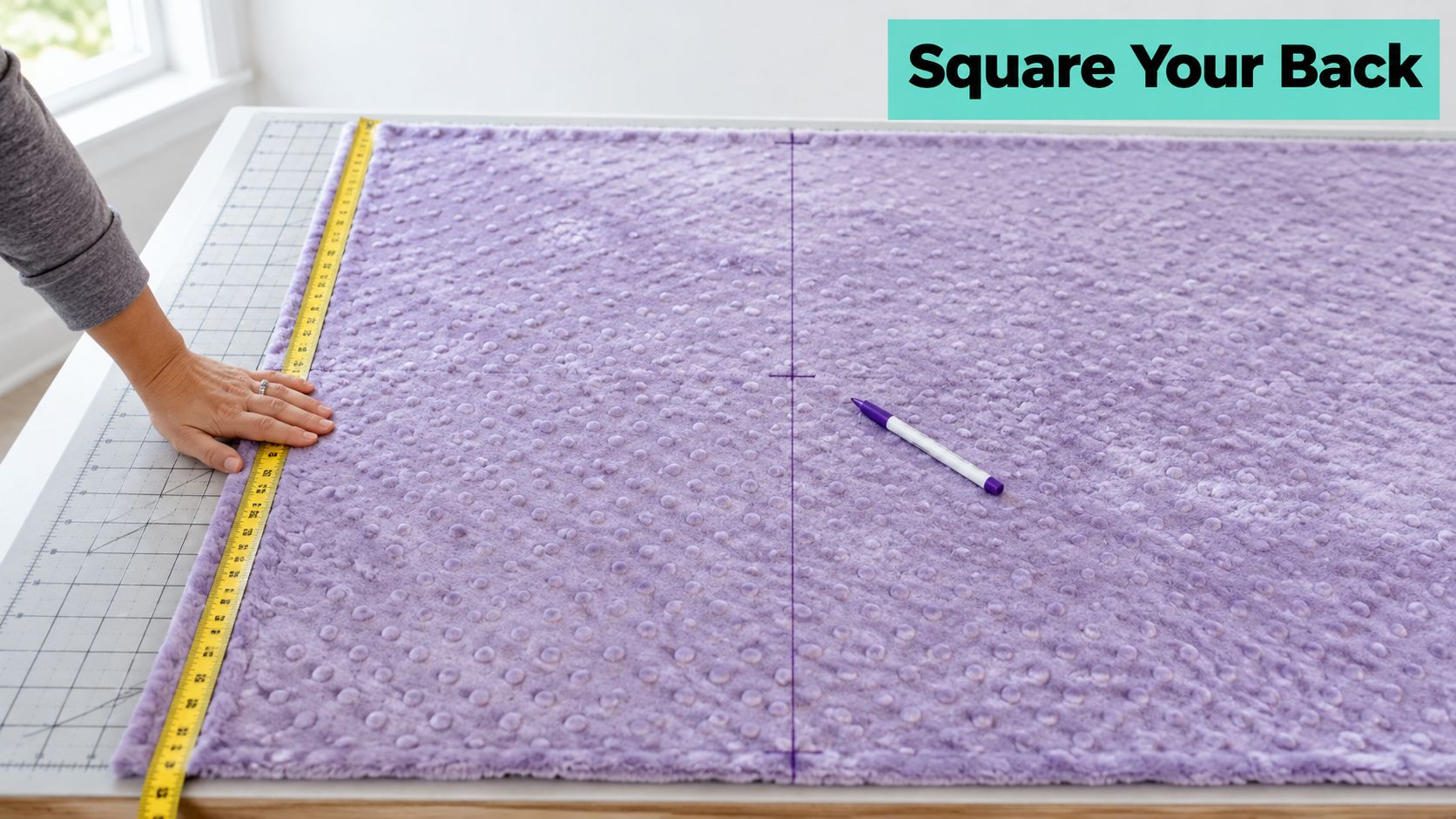
How to prepare the panel
- Lay the fabric flat. Use a clean, open surface where the entire cut can relax without hanging from the table.
- Find the grain and nap. Stroke the minky in both directions and choose which way the pile should face on the finished quilt.
- Square the cut. Trim uneven edges instead of assuming the bolt edge is a reliable right angle.
- Mark the top center. A small removable mark helps keep a directional texture oriented correctly during loading.
- Control the pile. Smooth the nap in one direction and avoid folding it in a way that creates a permanent crush line.
- Press only as appropriate. Follow the care label. Direct heat can damage plush fibers, so don't treat minky like quilting cotton.
- Secure the roll or fold. Tape or fold the panel neatly so it reaches the frame without stretching across the floor.
For cotton, press out substantial creases and keep the grain aligned. For minky, the priority is stable handling rather than a crisp pressed surface. The guide to cutting minky without the mess covers the cutting behavior that makes plush fabric different at the table.
Your pre-ship checklist should include:
- Finished top dimensions: Length and width are written down.
- Backing width: The usable width, after selvages, covers the required measurement.
- Loading margin: The longarm provider's allowance is included on every side.
- Nap direction: The chosen direction is marked for directional plush.
- Care plan: Washing and drying choices are compatible with both layers.
- Clean packaging: The backing is protected from dust, pet hair, and moisture.
The Trade-Offs Nobody Talks About
At the longarm, a wide back can save piecing time and still create work. One large panel removes a seam, but it does not prevent stretching, distortion, nap-direction mistakes, or an edge that arrives out of square.
Plush fabric may shift on the bias and catch against the rollers, especially across a large frame. A pieced cotton back adds seams, yet those seams can provide reference lines and divide the fabric into smaller, more manageable areas. The practical choice is between two handling jobs, not between a perfect back and a flawed one.
What dimensional stability tells you
Testing dimensional stability involves marking fabric specimens, washing and drying them under controlled conditions, then recording length and width changes separately. The calculation is dimensional change (%) = [(final dimension − original dimension) / original dimension] × 100, as explained in this guide to textile dimensional stability testing.
A buyer's target of approximately no more than 3% dimensional change is useful only alongside the test conditions, including wash temperature, drying method, number of cycles, conditioning, and measurement direction. As a rule of thumb, 3% across a 100-inch width equals roughly 3 inches of possible movement. That much change can create fullness or pull a quilt out of square.
A wide back reduces piecing. It does not replace a care-label check or a test wash.
The microfiber question
Synthetic plush also brings a care and environmental trade-off. A 2025 review of microfiber release from polyester textiles reports approximately 124-308 milligrams of microfiber release per wash, while manufacturing accounts for about 80% of textile environmental impact, compared with 14% during use. Those figures do not establish that every minky backing releases the same amount.
Wash less often when practical, choose cold water, reduce agitation, air-dry when suitable, and consider a laundry filter. Softness and warmth matter, but so do durability, repairability, washing frequency, and end-of-life handling. Evaluate the whole use pattern before ordering a large panel.
Laundering, Care, and Buying Your Wide Back
Care begins before the quilt is quilted. Cotton and plush can respond differently to washing, and a backing that looks perfect on the cutting table may behave differently after its first laundering.
Follow the manufacturer's label, and test a representative sample when the fabric's behavior is uncertain. If you prewash, allow the fabric to dry in the method you'll use later. If you don't prewash, keep enough margin for the quilt's layers to move without placing stress on the finished edges.
A practical buying checklist
- Choose for use: Select minky for plush warmth and cotton for a lighter, cooler hand.
- Confirm usable width: Check the bolt measurement after accounting for selvages and directional placement.
- Plan for loading: Add the margin required by your longarm service, not just the quilt-top dimensions.
- Inspect texture: For Hide, Snowy Owl, Fawn, and other raised textures, decide the nap direction before cutting.
- Review care: Match washing, drying, and shrinkage expectations to the recipient's habits.
- Order with the project in mind: On Pins & Needles Quilting Co. offers Shannon Cuddle options, extra-wide backing, and mail-in edge-to-edge longarm quilting, with batting, thread, and free return shipping included in that service.
- Use available offers: The shop provides a 15% first-order coupon and free U.S. shipping on orders over $70.
The Luxe Cuddle collection is a practical starting point for plush backing, while the Mail-in Longarm service suits quilters who want the top and backing finished professionally. OPN Quilting also has hundreds of verified reviews, which gives buyers useful customer feedback alongside the product details.
Choose the usable width before you choose the texture, then order your wide backing fabric with the correct longarm margin. Visit On Pins & Needles Quilting Co. to shop the Luxe Cuddle Collection or book your mail-in longarm service, and use the 15% first-order offer or free shipping on orders over $70 when it fits your project.