

In 2026, the global quilt market is estimated at USD 5.92 billion, with a projection of USD 9.67 billion by 2035. The best blue-and-white quilt combines a defined design mood with a coordinated palette, a suitable Shannon Cuddle or Luxe Cuddle backing, and finishing that fits the quilt's size and detail.
That growth projection places blue-and-white quilts in a home-textiles category with room for thoughtful color, material, and finish choices, not just another seasonal trend. The pairing also has deep staying power. Blue and white quilts became especially popular from roughly 1830 to 1930, with many surviving examples dating from the 1860s and a strong concentration in the final decade of the 19th century as colonial-style tastes spread, according to the Quilt Index historical overview.
Use this gallery as a decision guide. Choose the mood first, then settle the fabric scale, blue-to-white balance, backing width, texture, and quilting pattern. OPN Quilting carries Shannon Fabrics Cuddle and Luxe Cuddle, offers Mail-in Longarm finishing, and supports both DIY quilters and gift buyers with hundreds of verified reviews.
1. How can a classic blue and white toile quilt look timeless?
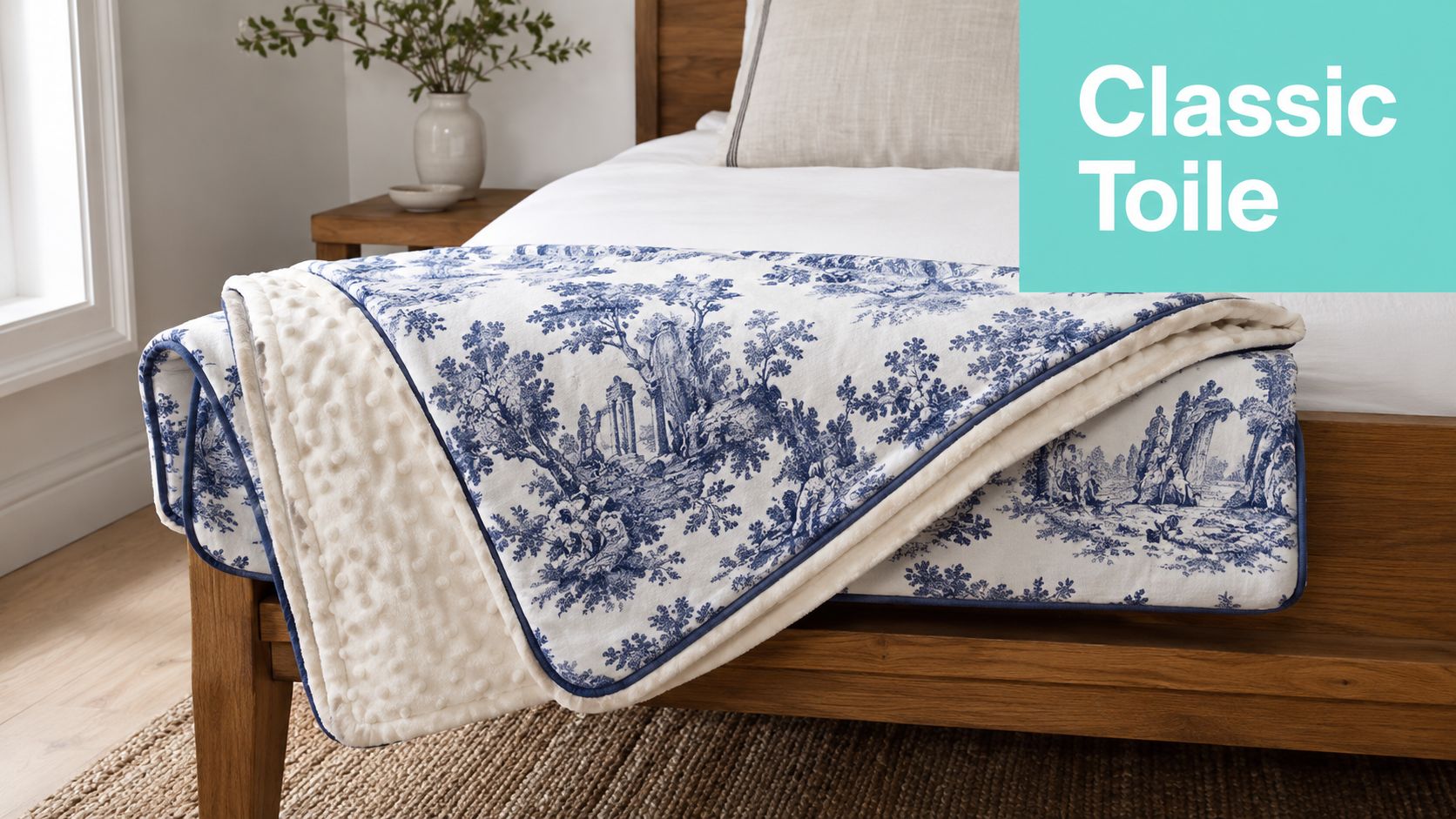
A toile quilt works when the fabric tells the story and the rest of the construction stays quiet. Scenic pastoral scenes, garden scenes, and historical vignettes printed in deep indigo or navy on white create an elegant focal point without demanding complicated piecing.
For a beginner, a pre-printed toile panel framed with solid white or pale blue borders gives the room a finished composition quickly. A more experienced quilter might use reproduction toile yardage in blocks, sashing, or appliqué-inspired arrangements. Either way, the print scale matters. Large scenes need breathing room, while small repeats can support patchwork without becoming visually crowded.
Backing choice should reinforce the front rather than compete with it. White, cream, or a soft blue Luxe Cuddle backing keeps the toile visible and adds softness without introducing another pattern.
What quilting pattern suits toile?
Floral, classic, or gently scrolling edge-to-edge quilting echoes the narrative character of toile. Dense geometric stitching can interrupt the printed scenes, especially when the top already contains borders or multiple framed panels.
Before piecing, wash indigo yardage in cool water with a color-catcher sheet. This helps identify excess dye before the fabric is placed beside a light backing, but it doesn't replace careful color testing.
Practical rule: Let a detailed toile top carry the visual interest. Use a quieter backing texture, such as Hide or Seal, when you want tactile depth without another competing image.
A queen toile quilt backed in wide Snowy Owl Luxe Cuddle can feel polished and substantial, while a small panel quilt with curated cuts makes a practical first project. For professional finishing, send the completed top to OPN's Mail-in Longarm quilting service and request a floral or traditional pattern that respects the print.
2. How do indigo and white patchwork patterns create movement?
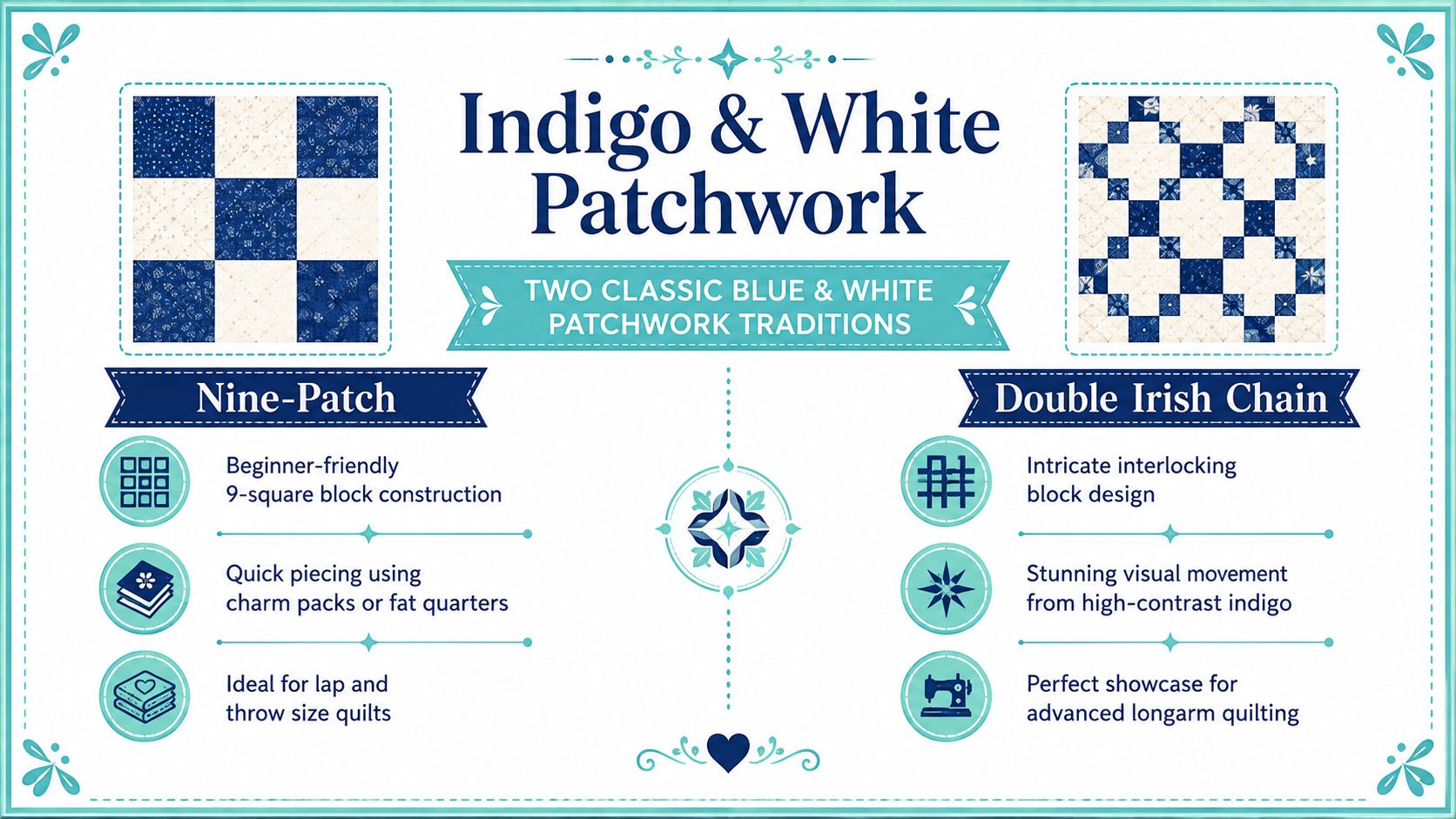
Nine-Patch and Double Irish Chain quilts prove that simple geometry can carry a room. Alternating indigo prints with white or cream creates movement through contrast, while the block structure remains approachable for a first quilt.
The critical detail is accuracy. Use a quarter-inch piecing foot and keep your seam allowance consistent, because small deviations accumulate across repeated blocks. Press seams consistently so the rows remain flat when the top is assembled.
A farmhouse throw might use a limited range of indigo prints and white background fabric. A modern version can reduce the print variety and use larger areas of negative space. For a historical feel, mix small-scale prints, faded indigo, and warm cream instead of stark white.
Which backing works for geometric quilts?
A white or cream Cuddle backing keeps the patchwork in charge. Hide texture adds a tactile contrast that can make a simple block design feel more substantial, while a smooth Luxe Cuddle surface creates a cleaner reverse side.
For a large quilt, plan the back before cutting the top. Queen-size quilts account for roughly 40–50% of quilt units sold in the United States, and queen and king quilts together represent about 55–65% of bedding quilt sales, based on U.S. quilt-size demand data. Those dimensions are common residential use cases, so extra-wide backing can prevent an unnecessary center seam.
The Double Irish Chain pattern guide is useful when you want a traditional layout with strong directional rhythm. Finish it with diagonal quilting for crisp movement, or choose feathers when you want a softer, more heirloom-like surface.
3. When should you choose blue marbled or watercolor minky backing?
Choose blue marbled or watercolor minky when the quilt top needs a calm, contemporary reverse side. Transitions from navy to medium and sky blue add movement without requiring a second pieced design. The backing becomes part of the finished quilt while remaining easy to use with a longarm pattern.
This pairing suits a solid white top, low-contrast modern patchwork, or a simple panel. Busy toile, intricate appliqué, and high-contrast borders need more restraint, because folds can bring the front and back into view at the same time. A quieter reverse keeps those detailed designs readable.
Marble emphasizes color movement. Seal creates a more subdued, softly textured surface. Choose Marble when the backing should read as a visible design feature, and Seal when the priority is a calm, comfortable layer.
How do you avoid seams on a large blue quilt?
Extra-wide backing is typically about 108 inches wide, allowing the back to cover a large quilt without an added seam, as shown in Missouri Star Quilt Company's wide backing collection. Retail listings also include widths from 104 to 120 inches, including 110-inch Shannon Cuddle-style cuts, as shown in Hancock's of Paducah backing listings.
Measure the finished top before ordering. Plan at least 4 inches of backing beyond each edge, or about 8 inches more in both width and length, so the longarm frame has enough fabric for loading and quilting. A quilt backing size chart can help confirm the required cut for the finished dimensions.
For a queen geometric quilt, 110-inch extra-wide minky fabric in Luxe Cuddle Marble can display the watercolor effect as one uninterrupted field. If standard-width fabric is the practical choice, place the seam away from major color transitions and stabilize it carefully.
Request stippling or an all-over longarm pattern through OPN's Mail-in Longarm service. Open quilting lets the marbled surface remain visible, while very dense stitching can compress the minky texture. Related blue textures can also be coordinated with OPN pillow kits or an infinity scarf kit.
4. How do indigo batik and tie-dye styles stay balanced?
Indigo batik quilts have built-in surface movement. Speckles, swirls, mottling, and resist-inspired marks give even a straightforward block pattern an artisanal character, so the design doesn't need excessive piecing to feel rich.
That visual texture creates a trade-off. If every fabric is dark, busy, and similarly scaled, the blocks can disappear. Pairing batiks with white or cream restores structure and gives the eye a place to rest.
For an improvisational art quilt, mix several indigo batiks and allow the shapes to develop organically. For a Bargello or strip design, arrange the fabrics from deep navy through medium and pale blue so the direction remains legible. A beginner can use the same idea in a simple Nine-Patch layout.
What backing makes batik feel finished?
White or cream Luxe Cuddle is usually the safest partner because it keeps the front visually dominant. A subtle Mirage or smooth Cuddle backing can work when you want the reverse side to feel contemporary, but a strongly patterned back may make the finished piece feel overworked.
Wash indigo batiks in cool water with a color-catcher before assembly. Test a scrap against the chosen cream backing, especially when the quilt is intended as a gift and the finished layers won't be easy to separate later.
Use organic, meandering, or all-over quilting to support the hand-dyed impression. Dense custom stitching around every irregular mark can flatten the relaxed character that makes batik appealing in the first place.
5. How can blue and white appliqué quilts look both traditional and modern?
Appliqué brings a different kind of focus to a blue-and-white quilt. Traditional motifs such as flowers, birds, wreaths, and geometric forms can recall Baltimore Album or Hawaiian-inspired work, while large abstract shapes and generous negative space create a distinctly modern interpretation.
The sewing method changes the visual language. Needle-turn appliqué produces a softer handmade edge, while machine blanket stitch gives consistent definition around bold motifs. Fusible web can simplify template placement, but stabilize the fabric and choose thread carefully so the appliqué remains clean after quilting.
A traditional block-by-block appliqué quilt benefits from warm white or cream rather than a hard white background when you want an aged, livable appearance. A modern wall quilt may need true white to make navy shapes look sharper.
How should you quilt around appliqué?
The quilting pattern should frame the motifs without drawing attention away from them. Stippling in the negative space can make the appliqué shapes stand forward, while a custom or restrained floral pattern can reinforce a botanical design.
Place one design element at a time during planning. If the appliqué already has flowers, birds, and multiple border details, a heavily ornate quilting pattern can obscure the silhouette from across the room.
A blue-and-white appliqué tutorial can help beginners decide between machine and hand techniques before cutting expensive fabric. Once the top is complete, a cream Luxe Cuddle backing provides a neutral reverse side and a comfortable hand.
For a finished heirloom, use OPN's Mail-in Longarm service and specify whether the quilting should frame each motif or remain edge-to-edge. That conversation matters more with appliqué than with a basic rail quilt because the stitching can either clarify or bury the shapes.
A good appliqué backing should support the work, not compete with it. Texture is welcome, visual noise isn't.
15% first-order offer: Use OPN's first-order coupon when you're buying backing or a project kit, and remember that U.S. orders over $70 qualify for free shipping.
6. Why are blue and white strip-pieced quilts practical for beginners?
Strip piecing gives beginners a reliable route to geometric quilts. Pre-cut 2.5-inch jelly-roll strips reduce repeated measuring and cutting, while rail fences, log cabins, courthouse steps, and similar layouts create structure without requiring advanced block construction.
Match the strips in pairs, chain-piece them, and press each set in a consistent direction. Subcut only after the sewn units lie flat. This sequence helps keep intersections aligned, particularly where white fabric meets saturated indigo and every slight shift becomes visible.
A small rail quilt makes a manageable first project with soft white Quilting Cuddle on the reverse. For makers preparing several pieces for an online shop, coordinated bundles help maintain a recognizable palette. Inspect every cut for shade consistency before sewing, then shop this blue natural fabric for a dependable neutral-and-blue pairing.
How do you finish a strip quilt efficiently?
Let the quilting respond to the strip direction. Diagonal lines sharpen rails and steps, while a flowing meander softens a layout that might otherwise feel overly rigid. Dense stitching can flatten the texture of the piecing, so choose spacing that supports the scale of the strips.
Use a quieter backing than the strip set. White, cream, or a low-contrast blue texture keeps the front legible when the quilt is folded across a sofa or bed, while a strongly patterned reverse can compete with the linear design.
The jelly roll guide explains why pre-cut strips suit fast, coordinated projects. Pair them with curated fabric cuts when you need controlled yardage without purchasing an entire bolt.
For a finished top, OPN's edge-to-edge longarm service provides a practical final step. Batting and thread are included, and free return shipping simplifies the process after the quilt leaves your sewing room.
7. Which ready-made blue and white minky quilt makes the best gift?
A ready-made minky quilt suits buyers who want the softness and visual impact of a blue-and-white quilt without piecing, basting, quilting, or binding it.
OPN's finished designs pair blue-and-white quilt tops or printed panels with Shannon Fabrics textures such as Hide, Snowy Owl, Fawn, and Seal. That combination works for wedding gifts, nurseries, reading nooks, bedrooms, and home theaters, including recipients unfamiliar with quilt construction.
Match the backing to the recipient's habits and décor. Snowy Owl and Fawn create a soft neutral effect. Hide has a more pronounced velvety surface, while Seal adds texture without dominating the reverse side.
What should gift buyers check before ordering?
Start with the room and intended use. A small throw can serve as a couch accent. A bed-sized quilt needs enough coverage to look deliberate rather than undersized.
- Quiet interiors: Choose cream, Snowy Owl, or Fawn for softened neutrals.
- Tactile luxury: Choose Hide when the backing's feel matters as much as its color.
- Modern rooms: Choose blue Marble or Seal when restrained movement suits the décor.
- Coordinated gifting: Add an OPN infinity scarf kit or pillow kit in a related texture.
A busy backing can weaken a complex top when the quilt is folded or displayed from both sides. Review the reverse as part of the whole gift, not as an isolated fabric choice.
The ready-made luxury minky blanket collection gives non-sewers and last-minute buyers a practical starting point. Include a care card explaining how to preserve the softness. For recipients who enjoy wearable comfort, your cozy companion guide explains how textile gifts can fit into daily use.
Blue & White Quilts: 7-Style Comparison
| Item | Complexity 🔄 | Resources & Time ⚡ | Expected Outcome 📊⭐ | Ideal Use Cases | Key Advantages 💡 |
|---|---|---|---|---|---|
| Classic Blue & White Toile Quilt Pattern | Medium, panel-friendly or intricate for full reproduction | Moderate, cotton toile yardage + extra-wide minky for backing; moderate sewing time | High ⭐⭐⭐⭐, elegant, photogenic, timeless finish | Bed quilts, wall hangings, heirlooms, portfolio pieces | Instantly recognizable classic aesthetic; pairs well with Luxe Cuddle; strong visual interest |
| Indigo & White Patchwork (Nine-Patch & Double Irish Chain) | Low–Medium, straightforward blocks but requires precise piecing | Low–Moderate, fat quarters/charm packs; efficient chain-piecing | High ⭐⭐⭐⭐, bold contrast, showcases quilting detail | Throws, bed quilts, farmhouse/modern interiors | Beginner-friendly, scalable, excellent for longarm quilting and gifts |
| Blue Marbled & Watercolor Minky Backing | Low, primarily a backing decision or ready-made option | Low time, higher material cost, extra-wide options eliminate seams | Medium–High ⭐⭐⭐, polished, modern, less bespoke | Modern quilts, ready-made gifts, non-sewists, coordinated home décor | Seamless, professional look; saves piecing time; great for minimal fronts |
| Indigo Batik & Tie-Dye Inspired Quilts | Low–Medium, standard piecing; fabrics mask small flaws | Moderate, batik yardage (often pricier); must pre-wash to prevent bleed | High ⭐⭐⭐⭐, artisan, gallery-quality appearance | Art quilts, bohemian/eco-conscious décor, heirloom pieces | Authentic hand-dyed aesthetic; unique fabric personality; hides imperfections |
| Blue & White Appliqué Quilts (Traditional & Modern) | High, hand or machine appliqué requires skill and time | High, precise templates, stabilizers, time-intensive stitching | Very High ⭐⭐⭐⭐⭐, striking focal pieces, highly valued | Wall art, heirloom quilts, collector and exhibition work | Strong visual impact; museum-quality potential; versatile design language |
| Blue & White Strip Pieced & Jelly Roll Quilts | Low, designed for speed with pre-cut strips | Very efficient ⚡, pre-cut jelly rolls reduce cutting and layout time | High ⭐⭐⭐⭐, consistent, saleable, quick production | Quick gifts, beginner projects, small-business production | Time-efficient, color-coordinated bundles; ideal for fast, repeatable results |
| Luxury Ready-Made Blue & White Minky Quilts & Blankets | Minimal, no sewing required | Minimal time, higher price, finished products ready to use | Very High ⭐⭐⭐⭐⭐, immediate luxury, gift-ready quality | Premium gifts, non-sewists, hospitality/retail displays | Heirloom-quality convenience; premium textures and presentation; ready to gift |
Turn Inspiration Into a Finished Quilt
Choose toile when the print carries a story, patchwork when geometry is the main attraction, and batik when you want fabric movement without complicated construction. Appliqué rewards patience and benefits from restrained quilting, while strip piecing gives beginners and gift makers a practical route to a coordinated top.
Blue marbled backing works especially well for modern quilts with quiet fronts. Ready-made minky blankets make more sense when the goal is an immediate gift rather than a sewing project. For a large residential quilt, queen or king dimensions deserve early backing planning, particularly if a smooth reverse matters.
The palette decision is just as important as the pattern. Saturated indigo needs white or cream to remain legible, but true white can look sharper and more graphic than a warm off-white. Recent quilting coverage describes a movement toward creamy whites, eggshells, and textured off-whites, while Pantone's 2026 Color of the Year, Cloud Dancer, reinforces white as a calming design choice, as discussed in this quilting color analysis.
Backing should match the quilt's value. A dark back can shadow a light front, while a high-contrast back may show through lighter areas, so consider the thread color before ordering. A purely blue backing emphasizes white quilting, a pale backing emphasizes blue quilting, and a medium-toned, tonal, or mottled fabric can create a more balanced two-sided result, following guidance from the American Quilter backing guide.
OPN's Mail-in Longarm service includes batting, thread, and free return shipping. Shannon Fabrics textures including Hide, Snowy Owl, and Fawn give you practical choices for softness and visual restraint, while extra-wide 90-inch and 110-inch options can reduce seam planning on larger backs.
If you choose Shannon Cuddle, follow care guidance that recommends cool-water washing, low-heat drying, and avoiding high heat and fabric softeners. For Shannon Cuddle fabric, a 90/14 stretch needle and stitch length around 3.0–3.5 mm are recommended because the fabric is knitted, according to the Shannon Cuddle fabric guide.
A considered blue-and-white quilt doesn't need an elaborate pattern. It needs a clear mood, a backing that respects the front, and finishing that suits the scale. OPN offers a 15% first-order coupon and free U.S. shipping on orders over $70, so you can build the project around the texture and size that fit your plan.
On Pins & Needles Quilting Co. offers premium Shannon Cuddle and Luxe Cuddle fabrics, curated cuts, project kits, ready-made blankets, and Mail-in Longarm finishing for blue-and-white quilt projects. Visit On Pins & Needles Quilting Co. to choose your backing, arrange professional quilting, or order a finished gift today.