
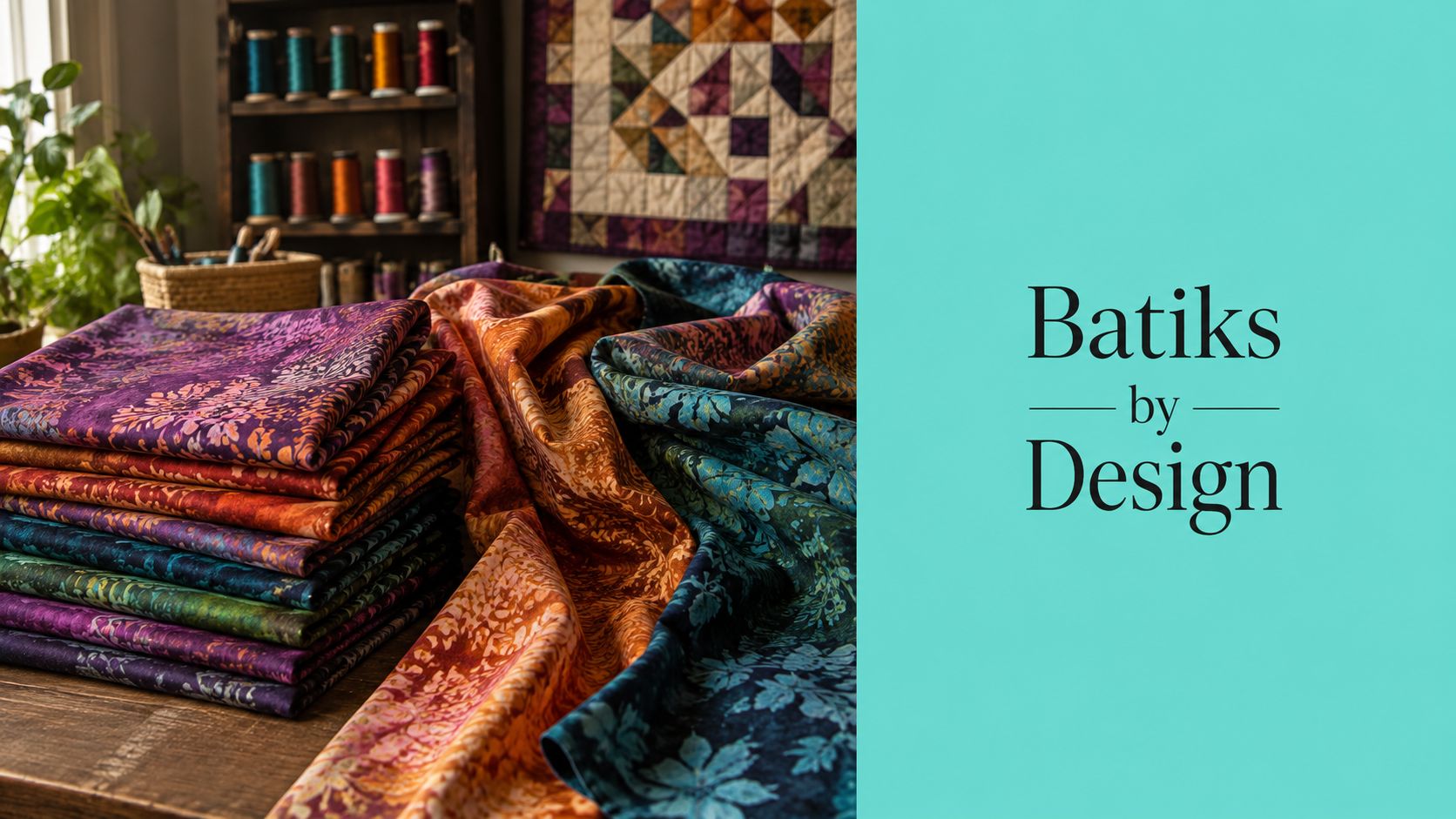
Batiks by Design are wax-resist-dyed cotton fabrics with rich color gradients and artistic patterns that quilters value for their distinctive texture and visual depth. They feel different because the wax-resist process leaves subtle surface variation and layered color, which gives quilt tops more movement than ordinary printed cotton.
Why do so many quilt tops look flat on the machine, while a batik top keeps my attention from the first stitch to the last? The answer sits in the way batik is made, in the way it behaves under a needle, and in the way it finishes when you pair it with the right backing and quilting plan.
What Are Batiks by Design and Why Quilters Love Them
Why do batiks feel richer than a standard cotton print? Because they're built from layers of wax-resist dyeing, which gives the cloth more depth, more variation, and more visual interest in a quilt top. Historical sources trace batik-like resist dyeing back to ancient Egypt in the 4th century BC, while Javanese batik developed into a highly organized textile tradition by at least the 12th century and is documented in Indonesian history over roughly 700 years, including the Majapahit era from 1294 to 1309. Those roots explain why batiks by design don't read as trendy novelty fabric, they read as a mature textile tradition with a long technical lineage. Batik history overview
Why quilters reach for batiks
A batik top behaves like a fabric with personality. The motifs tend to hold together visually across a quilt, even when you mix cuts, because the color movement is already built into the cloth.
That matters on a longarm frame. If a quilt top already has depth, the quilting can reinforce that richness instead of carrying the whole design load. You get more from each pass of the machine, especially when the top needs texture without heavy quilting density.
Practical rule: Choose batiks when you want the fabric to do more than sit there as background.
For me, batiks work especially well when the piecing is simple but the finish needs to feel refined. A clean nine-patch, a panel quilt, or a large-format modern layout can all look more intentional when the top has that wax-resist variation running through it. I also like pairing them with low-loft or plush backings, especially a Luxe Cuddle Collection backing, because the contrast between crisp batik surface and soft backing changes how the whole quilt handles and hangs.
What sets them apart from standard prints
Standard prints often rely on repeat motifs laid over a consistent base. Batiks by design usually feel more organic, because the color sits in layers and the surface doesn't look perfectly uniform.
That difference matters in quilts that need to age well. The fabric keeps giving your eye something to find, even after the pattern is familiar. In practical terms, batiks also work well for makers who care about dye quality and fiber behavior, which is why I pay attention to sourcing and finishing details, including non-toxic fabric dyes when I'm comparing fabric lines for clients.
A quick maker's test
If you're deciding whether batik belongs in a project, ask three things.
- Does the quilt need visual depth? Batik gives you that without extra applique or dense piecing.
- Does the top need to stay crisp in a busy room? The layered color helps it hold attention.
- Do you want the fabric to feel special without becoming fussy? Batik usually lands in that sweet spot.
The best place to see that balance is in a project sample or yardage cut before you sew. Batik also earns its keep when you're matching it to backing and quilting plans, because a cloth with built-in movement can carry a cleaner stitch path and still finish with polish.
The Wax-Resist Technique That Makes Batiks Unique
Where does a batik get its character? It starts with plain cloth, then hot wax is placed where dye should stay out. After the dye bath, the wax is removed, and each wax-and-dye cycle leaves behind the layered color shifts that make batik easy to identify under daylight or machine light. How batik fabric is made
What the process does to the cloth
Wax-resist dyeing decorates fabric and physically blocks dye penetration during each bath. That is how batik holds sharply preserved motifs while still showing blended color around them.
The quilting result is a cloth with slight surface irregularity and a distinctive crinkled feel. That texture is part of the appeal, but it also changes how the fabric feeds, folds, and presses compared with a flat screen-printed cotton. I pay attention to that difference on the longarm because a batik top that looks crisp in the shop can behave very differently once thread tension and batting enter the equation.
A traditional hand method called Batik Tulis uses a canting, a copper, pen-like tool filled with hot wax, to draw intricate designs by hand before dyeing. Traditional Batik Tulis and the canting tool
Why the history matters at the sewing table
The wax-resist method moved through larger-scale production as batik stamps and factory dye systems developed, and that shift helped the cloth travel far beyond its first regional roots. Vlisco, founded in 1846 in Helmond, the Netherlands, built on that trade history by producing imitation batiks inspired by Indonesian textiles and exporting wax prints to the Dutch East Indies and later to West Africa. Vlisco and batik's transcontinental trade history
That history matters because modern quilters often file batik away as either handmade or decorative. It is both, and that mix explains why the fabric still fits into serious sewing work. The category has always adapted to scale, export, and changing dye systems, which is one reason the cloth can feel familiar from one bolt to the next while still showing small variations that give each cut some life.
Batik has survived shifts in tools, dyes, and markets because the resist method still produces something machine printing can't fully fake.
By the early 20th century, traditional dyes were increasingly replaced by chemical dyes from Britain and Germany, which shows how batik adapted to global industrial supply chains while keeping its wax-resist identity. For quilters, that matters because it helps explain why batik fabrics can read as consistent in motif language yet still carry subtle variation in the cloth. If you want a practical look at dye choice and cloth safety, I also point clients to this guide on non-toxic fabric dyes when they are comparing fabric lines.
If you want that same visual depth in a quilt finish, pair the top with a professional edge-to-edge plan from Mail-in Longarm, and for a closer look at how minky behaves in quilt projects, see More Sewing's minky guide.
How to Pair Batiks with Minky Backings for Professional Results
Why do some batik quilts feel finished the moment they come off the frame, while others look busy on the front and awkward on the back? The difference usually comes from how the top and backing handle together. Batik gives you movement and color depth, while minky adds warmth, a softer hand, and a cleaner feel on the reverse side.
Matching texture to color family
I have seen quilt tops age poorly because the backing pulled attention away from the front. That usually happens when both sides compete for the same visual space, or when a backing has too much stiffness under a densely patterned batik top.
The better choice is a backing that supports the top instead of copying it. Shannon Cuddle textures like Hide, Snowy Owl, and Fawn each change the final look in a different way. If you want one texture that adds depth without crowding the design, Luxe Cuddle Hide is a strong option. For a wider view of the available backing styles, the Cuddle collection gives you several choices in one place.
| Batik Color Families and Minky Pairing Guide | Recommended Minky Texture | Why It Works |
|---|---|---|
| Deep jewel tones | Hide | Keeps the back plush without competing with saturated fronts |
| Soft neutrals | Snowy Owl | Adds a clean, airy contrast that won't overpower subtle batiks |
| Earth tones | Fawn | Echoes the grounded feel of the top and keeps the finish cohesive |
That table is a starting point, not a rulebook. The right match depends on whether the quilt should feel cozy, sleek, or more display-oriented.
What helps and what doesn't
Cotton batik and pile-backed minky behave differently at the machine, and good results depend on respecting that difference. You do not get the same response from both fabrics, so the setup has to account for stretch, loft, and how much surface texture you want to preserve.
For a practical outside reference on handling plush fabric, More Sewing's minky guide is useful because it focuses on the sewing side of the material, not just the appearance.
- Works well: Batik tops with smooth, intentional piecing and a minky backing that has enough body to finish cleanly.
- Works less well: Batik blocks with tiny seam allowances, because the visual texture gets lost once the back is too heavy.
- Works well: Quilts that will be used often, because the minky side makes the quilt feel finished without needing extra decorative layers.
If you are choosing a backing for a specific quilt, how to choose quilt backing is worth reading before you cut.
Where to Source Quality Batiks and Practical Alternatives
Where you buy batiks by design matters as much as the print itself. Look for shops that state fabric width, fiber content, and repeatability clearly, because those details tell you how the cloth will handle in the cutting room and at the longarm. Industrial and inspection-oriented batik specs commonly list width, weight, composition, and pattern repeat, including examples such as 140 cm width, 260 gsm, 100% spun cotton, and a 46.6 cm vertical pattern repeat. Example of technical batik fabric specifications
What to look for before you buy
The best batik yardage is the one that fits the job. A quilt back for a large bed quilt needs different handling than a patchwork block, and the shop description should help you make that call.
Buying rule: If the listing won't tell you what the cloth is made from or how wide it is, assume you'll have to verify more before cutting.
A reliable source should also tell you whether the fabric is meant for quilting, garment sewing, or home décor. That matters because a stiff decorative cloth and a true quilting cotton do not behave the same way once the presser foot comes down.
For broader fabric selection logic, compare quilt fabric fibers keeps the focus on how fiber choice changes the sewing experience, which is the part that affects your finished quilt.
Practical alternatives when batik isn't available
If you cannot find the exact batik line you want, choose a solid or near-solid minky that lets the quilt top carry the story. That is often the cleanest path for makers who want batik energy without visual clutter, especially when the top already has strong movement.
On Pins & Needles Quilting Co. carries options that work well in this role, including Shannon Cuddle Fawn and other low-noise textures that support a patterned top. If you want to compare textures in one place, start with a product guide like where to buy material for quilts and then match the backing to the quilt top instead of forcing the top to adapt to the backing.
Get 15% Off Your First Order and free U.S. shipping on orders over $70 when you're ready to stock up.
For a batik front with a soft back, Shannon Cuddle Hide is an easy product to compare against the top. It gives you a practical reference point when you are choosing between a textured backing and a smoother one, and that choice affects how the quilt finishes under the needle.
Real Batik and Minky Project Ideas from Beginners to Pros
A first batik and minky project does not need a complicated layout to look deliberate. A small baby blanket, a throw pillow, or a panel-backed quilt lets the fabric do the work, and that matters because batiks can look busy fast once the seams start stacking up.
Start small and let the fabric carry the work
For a first project, batik cotton paired with minky behaves best when the construction stays simple. A pillow front gives you the texture contrast without a full quilt load, and a small blanket lets you see how the fabrics respond after trimming, turning, and pressing.
A project outside the quilt room can still teach the same fabric lessons. The structure in how to sew a crossbody tote bag translates well to batik panels, because the same basics apply, clean cuts, stable seams, and a finish that respects the fabric instead of fighting it.
Mid-level projects that hold up well
A patchwork quilt with minky backing is a strong intermediate choice. The top can stay traditional, while the back adds a softer feel that gift recipients notice right away.
The most reliable setup is a batik quilt top with a soft, coordinated backing and a professional edge-to-edge finish. A planned quilt top with clear shapes also helps if you want a faster visual payoff, and the fabric panel projects guide offers layout ideas that fit that approach.
Advanced combinations for experienced makers
Mixed-texture quilts are where batik shows its range. You can combine batik piecing with minky borders, minky backs, or dimensional surface contrast if you already know how your machine handles loft and drag.
The cleanest finishes come from deciding the quilt's job first, then choosing the texture that supports that job.
If the quilt is a gift, keep the front balanced and let the back add softness. If it is a display piece, you can push more contrast between the batik front and plush backing without worrying as much about daily wear.
For faster piecing before the longarm stage, the strip bundles collection gives you a practical starting point.
Care and Finishing Tips for Your Batik and Minky Quilt
What keeps a batik and minky quilt looking good after real use? The answer is usually simple care, careful finishing, and a willingness to respect how the two fabrics behave differently. Batik cotton and polyester minky do not react the same way to heat, water, or pressure, so the safest approach is to start with a gentle routine and keep it consistent.
Basic care that protects both fabrics
Wash cold and use a gentle cycle when the quilt needs cleaning. Tumble dry low, and do not treat the quilt like a towel load that can handle high heat.
- Wash Cold, Gentle Cycle: Helps protect the batik's surface variation and keeps the minky from looking overworked.
- Tumble Dry Low: Reduces stress on mixed fibers and helps the quilt keep its drape.
- Avoid Bleach: Harsh chemicals can damage both the color and the finish.
- Store Flat or Rolled: This helps prevent long-term creasing in a quilt you want to keep looking crisp.
- Use a Quilt Label: A label gives the quilt a record of materials and care, which matters more as the piece gets used.
For a material-specific care reference, the article on how to wash mink blankets is useful because the handling advice overlaps with minky-backed quilts.
Machine finish or home finish
A professional longarm edge-to-edge finish usually gives the cleanest result on batik and minky combinations. That matters when the top is richly patterned and the backing adds pile, because the quilting needs to stabilize both sides evenly.
| Batik and Minky Quilt Care Quick Reference | Machine-Washed | Longarm-Quilted Finish |
|---|---|---|
| Finish stability | Depends on the maker's seam handling | More even across the full quilt |
| Visual consistency | Can vary with home-machine tension | Usually more uniform in the quilt field |
| Best use case | Everyday wash-and-wear pieces | Gift quilts, heirloom-style finishes, and larger tops |
If you want the finishing handled for you, the mail-in longarm option includes batting, thread, and return shipping, which removes a lot of guesswork from the last stage. The pattern gallery also helps you compare how different motifs read on a finished quilt, and it is easier to choose a design before the top leaves your hands.
Your Next Batik Project Starts Here
What should your next batik project solve first, the top, the backing, or the finish? Batiks by Design work because they bring history, depth, and practical sewing value into the same quilt. Pair that with the right minky backing, and the result feels deliberate instead of crowded.
Start with the part that removes the biggest headache from the table. That may be a carefully chosen batik top, a plush backing, or a finishing path that saves you from wrestling the quilt through a home machine. A good project choice is the one that matches your skill level, your timeline, and the way you want the quilt to wear.
On Pins & Needles Quilting Co. has hundreds of verified reviews, which matters when you are buying fabric or sending out a quilt top you care about. That kind of feedback tells you whether the product selection holds up in real use, and whether the finishing work matches the look you want. For batik makers, that means fewer surprises once the quilt is cut, layered, and stitched.
On Pins & Needles Quilting Co. carries premium batik-friendly minky, quilt backings, and mail-in longarm finishing for quilts that need a polished result. Visit On Pins & Needles Quilting Co. to choose your fabric, compare textures, and get your next batik project moving with confidence.