
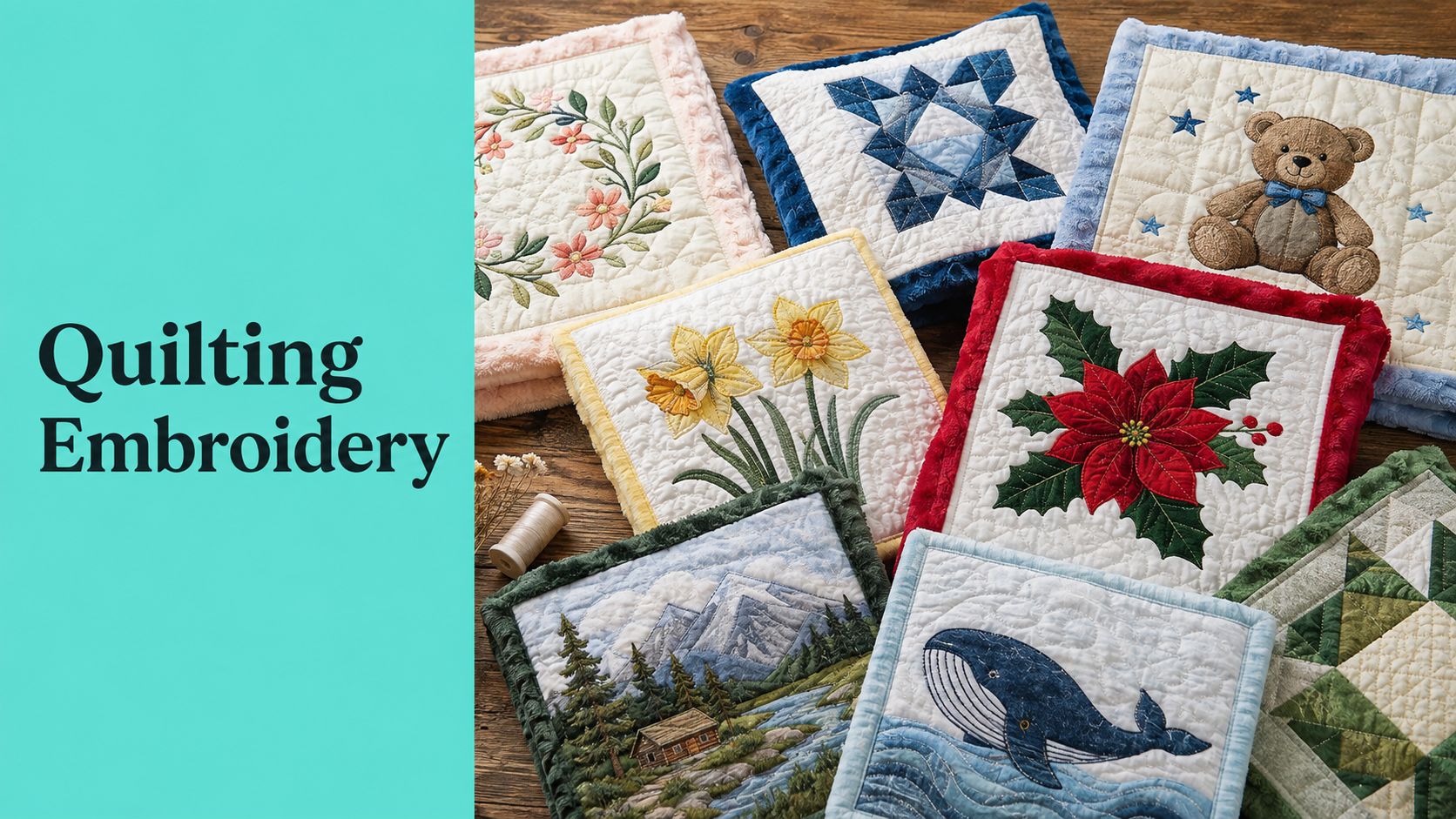
Quilting embroidery designs work best on minky when they stay light, continuous, and scale-true. The right motif keeps plush backing from looking flat or overworked, and it helps a quilt finish with the kind of smooth, professional drape minky naturally wants. On Pins & Needles Quilting Co. supports that finish with Mail-in Longarm service, Shannon Fabrics textures, and hundreds of verified reviews that make the process easier to trust.
The reason this matters is simple. Quilting has been around for thousands of years, with layered stitching estimated as far back as 3400 BCE History of quilting, and today the category is still commercially strong, with industry reporting that points to billions in market volume and steady participant demand quilt market analysis. That long history explains why modern quilters care so much about design, texture, and finish quality. Minky just raises the stakes because its pile, width, and softness can either enhance a quilt or expose every bad decision.

1. Edge-to-Edge Quilting Designs
Edge-to-edge is the safest place to start when you want quilting embroidery designs that look polished on minky without creating bulky intersections. The pattern runs continuously across the quilt surface, so the eye reads texture instead of stop-and-start segments. That's a strong fit for large blankets, especially when you're sending the quilt top through OPN's edge-to-edge quilting patterns for minky.
For minky-backed quilts, the practical upside is coverage. Continuous stitching spreads density more evenly, which helps avoid the flat spots you get when a design is too concentrated in one area. It also pairs well with seam-free wide backings, including the extra-wide options OPN carries for clean finishing.
What works in real projects
A flowing meander on a baby blanket feels softer than a rigid grid. A snowflake or vine design on holiday fabric gives you movement without fighting the pile. For modern quilts, a simple all-over motif keeps the surface cohesive and lets the fabric do the talking.
Practical rule: On Luxe Cuddle, choose a design that reads from a distance, not one that depends on tiny detail.
A few trade-offs matter here:
- Use gentler density: Dense stitching can over-compress plush backing.
- Match thread thoughtfully: Neutral gray works especially well with Snowy Owl, and earthy tones suit Fawn.
- Keep prep tight: Proper alignment matters more on minky because the fabric can shift during handling.
- Plan batting carefully: Heavier batting can support the surface better under continuous stitching.
If you want a design path that feels low-risk but still refined, edge-to-edge is the workhorse. It's the easiest way to make minky look finished instead of just covered.
2. Feather Wreath Embroidery Designs
Feather wreaths bring a softer, heirloom feel without turning a quilt into a wall of detail. The curved stitching frames space beautifully, which matters on plush backing because minky already has visual richness. A wreath motif adds sophistication while letting the fabric stay tactile.
Luxe Cuddle Hide, Snowy Owl, and Fawn do a lot of work for you. Feather wreaths sit comfortably on those textures because the stitching nestles into the pile rather than flattening it completely. That makes them a smart choice for baby quilts, throw blankets, and elegant home décor pieces.

Where feather wreaths shine
I'd reach for feather wreaths when the quilt top is simple. Solids, tone-on-tone piecing, and calm prints all give the motif room to breathe. On a busy top, the feathers can disappear into the noise, which wastes the stitch-out.
The best results usually come from restraint. Keep the wreath away from binding edges, and don't pair it with overly dense batting if you want the motif to stay visible. If the thread matches or lightly contrasts the backing, the effect reads expensive rather than loud.
Browse feather and swirl pattern ideas if you're choosing something for a gift quilt or a keepsake piece. Feather wreaths aren't the fastest option, but they're one of the easiest ways to make a plush quilt feel intentional.
3. Stippling and Meandering Designs
Stippling and meandering give minky a cleaner finish because they keep the surface from looking pinched in one spot and untouched in another. Tight or scattered quilting can flatten one area while the rest stays lofty. Continuous looping stitches spread that texture more evenly, so the quilt still feels soft.
They also work well on wide, seam-free backs. With 90-inch or 110-inch backing, a simple all-over pattern helps the quilt read as one piece instead of a set of joined sections. That matters most on larger quilts, where block-by-block quilting can start to feel broken up.
How to choose between the two
Stippling is tighter and more controlled. Meandering is looser and more organic. On delicate Luxe Cuddle, the looser option usually keeps more of the plush look.
For mail-in finishing, I'd be clear about the look you want before the quilt leaves your hands:
- Ask for looser movement on soft, textured minky.
- Request a thread color close to the backing for a quieter finish.
- Use scraps for a test stitch if the quilt is especially important.
- Keep piecing simple so the quilting pattern does not fight the top.
If you want to compare how that plays out on actual finishes, OPN's computerized longarm quilting gallery is a useful reference. A clean meander often suits minky better than a dense pattern that crowds the pile.
On minky, the design should support the texture, not compete with it.
4. Floral and Botanical Embroidery Designs
Floral and botanical motifs work when you want the quilt to feel luxurious but still familiar. Vines, blossoms, leaves, and garden shapes soften the look of a blanket without making it fussy. On minky, that balance matters because the fabric already delivers a lot of surface interest.
These designs pair especially well with Shannon Cuddle textures and with neutrals that need a little visual lift. A floral pattern on Fawn reads warm and polished. A botanical line on Snowy Owl reads airy and refined. On Hide, the contrast can look especially modern if the quilt top stays simple.

The trade-off with detail
Floral designs can look beautiful, but they ask more from the quilt. If the motif is too dense, the surface can lose softness. If the thread colors are too busy, the embroidery starts to dominate the minky instead of enhancing it.
That's why simpler piecing usually wins. Tone-on-tone tops, solids, and understated prints let the embroidery take center stage. If you want more dimension, use a few thread colors rather than trying to pack in every possible shade.
Explore floral and paisley quilting motifs before you commit to a mail-in finish. The right botanical design can make a gift quilt feel custom without turning it stiff.
5. Geometric and Modern Quilting Designs
Geometric designs are the cleanest choice when the quilt top already has a strong shape language. Straight lines, crosshatch, honeycomb, and angular motifs give structure without softening the quilt into sameness. On minky, that structure is valuable because the plush backing can make a quilt look visually relaxed unless the quilting gives it direction.
This style is especially good on solid or tonal Cuddle fabrics. It also works well on 110-inch backs where crisp linework can create an architectural feel. If the quilt top has modern piecing, geometric quilting reinforces that intention instead of distracting from it.
Precision matters more here
Modern quilting shows every error. If the top is off-square, the quilting will make it obvious. That's not a flaw in the design, it's just how these motifs behave on large, soft surfaces.
A few things usually separate a good result from a frustrating one:
- Square the top before mailing it in.
- Choose a spacing plan and stick to it.
- Use contrast carefully so the pattern stays readable.
- Keep the fabric palette simple if you want the quilting to carry the look.
See OPN's modern quilting design ideas if your project leans contemporary. I'd pick geometric quilting for a quilt that needs sharpness more than romance.
6. Pantograph Quilting Designs
Pantographs give you repeatable coverage without making the quilt feel mechanical. The motif moves across the surface in a controlled sequence, so each pass gets the same treatment. On minky, that consistency helps because the backing already feels soft, and the quilting adds the structure.
Pantographs also work well because they offer flexibility. A simple heart or star motif fits a toddler blanket, while a decorative scroll suits a throw. On extra-wide backings, the repeat helps the quilt read as one finished whole.
Good pantograph choices for minky
The best pantographs on plush backing are flowing, readable, and not overly crowded. Dense motifs can fight the nap of the fabric, while cleaner repeats keep the finish smooth. If you're sending a quilt to OPN, use the pattern gallery to match the motif to the project instead of guessing.
Practical selection beats trend-chasing. A pretty design that looks strong on paper can feel too busy on a quilt with bold fabric or thick batting. A simpler repeat usually holds up better over time.
Read OPN's edge-to-edge and quilting guidance before choosing a pantograph for your mail-in project. For minky, I'd rather have a confident repeat than a fussy one.
7. Custom and Digitized Embroidery Designs
Custom designs make sense when the quilt has a specific story to tell. A family name, a memorial motif, a baby announcement, or a logo can all be turned into stitching that feels personal instead of generic. On minky, custom work can look especially rich because the fabric softens the design without erasing it.
This is also where scale becomes critical. Quilting design libraries commonly ship in 13 hoop sizes, including square and rectangular formats, with reverse files for large-project continuity APQS hoop sizes. That matters because a quilt motif that looks balanced in a small hoop can fall apart when it's repeated across a king-size surface. Good digitizing keeps the repeat coherent from one section to the next.
What makes custom work succeed
Custom quilting is only as good as the source material. Clear artwork, clean lines, and realistic expectations about density all matter. If the design is too detailed, it can blur in minky pile. If it's too sparse, it can disappear.
For a custom project, I'd focus on these basics:
- Send clean artwork or a sharp sketch.
- Ask how the motif scales across the full quilt.
- Keep thread colors aligned with the backing tone.
- Request a sample stitch on similar fabric if the quilt is high-stakes.
If you're exploring more personalized finishing, OPN's Mail-in Longarm service is the natural place to start. Custom work feels best when the design supports the quilt instead of trying to overpower it.
Mid-post note: New shoppers can usually take advantage of 15% off their first order, and OPN also offers free shipping on orders over $70. That matters when you're ordering backing, batting, and finishing supplies together.
8. Appliqué and Dimensional Embroidery Designs
Dimensional work turns a quilt into an object with depth, not just surface decoration. Appliqué, raised fabric layers, and stitched relief all give the eye something to follow beyond the flat quilt plane. On minky, that can be stunning because the softness underneath makes the raised elements feel richer.
This is the most specialized option on the list. It's not for every quilt, and it's not always practical for everyday use. For display pieces, keepsakes, or special gifts, though, it can be unforgettable. That's especially true when the background quilting stays quieter and the dimensional elements get room to stand out.

Why this style needs more care
Not every longarm setup is right for dimensional work. The stitching has to support the layers without crushing them, and the materials have to stay stable through the process. If the quilt is meant to be used hard, this isn't the first finish I'd choose.
A few common-sense guardrails help:
- Use dimensional work on special pieces, not daily baby blankets.
- Keep the background quilting simple.
- Check portfolio examples before committing.
- Plan for careful care after completion.
If you want to see the stitching process in motion, this video gives a useful look at how decorative textile work develops on fabric.
For inspiration and materials, OPN's minky selection includes textures like Hide, Snowy Owl, and Fawn, which give dimensional motifs a soft but still defined base. That combination is hard to beat when the goal is visual richness.
8-Design Comparison: Quilting & Embroidery
| Design | 🔄 Complexity | ⚡ Speed / Efficiency | 💡 Resources & Tips | ⭐ Expected Outcome | 📊 Ideal Use Cases |
|---|---|---|---|---|---|
| Edge-to-Edge Quilting Designs | Moderate, continuous pattern; needs tension control and guidance | High, efficient for large or high-volume quilts | Use 110" minky, heavier batting (CTT/wool), neutral thread; pre-wash and follow prep guides | Professional, seamless coverage with even stitch distribution ⭐⭐⭐⭐ | Seamless minky quilts, production runs, modern/holiday themes |
| Feather Wreath Embroidery Designs | High, skilled operator required for crisp feathering | Moderate, more time per motif vs all-over patterns | Works on 44–110" minky; match thread color, place motifs ≥6" from binding, test stitch | Elegant, heirloom-quality detail that preserves pile texture ⭐⭐⭐⭐ | Baby blankets, throws, heirloom/ decorative quilts |
| Stippling and Meandering Designs | Moderate–High, consistent stitch length demands experience | Moderate–High, continuous freehand is efficient if density low | Prefer looser meander on Luxe Cuddle, neutral thread, test on scraps, specify batting weight | Subtle texture that hides imperfections and stabilizes batting ⭐⭐⭐⭐ | Large seamless quilts, minimalist tops, stabilization on minky |
| Floral and Botanical Embroidery Designs | Very high, multi-layered, detailed stitching and shading | Low, time-consuming, especially with multi-color threads | Multiple thread colors, heavier batting, skilled digitizer/operator, request samples | Gallery-worthy, detailed focal quilting that can dominate the top ⭐⭐⭐⭐⭐ | Heirloom quilts, art quilts, premium gift projects |
| Geometric and Modern Quilting Designs | Moderate, requires precise piecing; aided by computer guidance | High, straight-line and repeat patterns are quick | Ensure square piecing, use straight-edge guides, test tension, single-thread color works well | Clean, architectural aesthetic with strong visual impact ⭐⭐⭐⭐ | Modern/architectural quilts, solids and tonal Cuddle, gallery-style pieces |
| Pantograph Quilting Designs | Low–Moderate, stencil-guided, repeatable patterns | High, consistent all-over coverage quickly | Browse pattern library, medium-weight batting, single-thread color to reduce cost | Consistent professional all-over finish with predictable repeat ⭐⭐⭐⭐ | Affordable professional finishing, baby and production quilts |
| Custom and Digitized Embroidery Designs | Very high, bespoke design, digitization and programming required | Low, longer timeline for consultation, revisions and testing | Provide high-res art, plan timeline, test stitch on matching Cuddle, premium batting | Truly one-of-a-kind, museum-quality heirloom results ⭐⭐⭐⭐⭐ | Commemorative quilts, personalized heirlooms, commissioned art |
| Appliqué and Dimensional Embroidery Designs | Very high, specialized fiber-art skills and precision placement | Low, labor- and material-intensive | Use stabilizers/fusible web, portfolio review, hand-wash care, avoid for infant use | Sculptural, high-art textile pieces with raised dimensional effects ⭐⭐⭐⭐⭐ | Art quilts, gallery/display pieces, luxury home décor |
Choose Your Next Quilting Embroidery Design
The best quilting embroidery designs for minky are the ones that respect the fabric's softness, keep density under control, and match the scale of the quilt top. If you want the safest finish, choose edge-to-edge or a clean pantograph. If you want a more refined look, feather wreaths and botanicals give you heirloom style without losing the plush feel.
OPN makes the process more practical because the shop is built around both the fabric and the finish. You can shop Shannon Cuddle, Luxe Cuddle, extra-wide backings, and Mail-in Longarm service in one place, then use the pattern galleries to narrow the design before you mail anything in. That's a real advantage when you're balancing backing width, thread color, batting choice, and design density.
If you're still deciding, start with the quilt's purpose. Everyday blankets usually do best with simple, continuous stitching. Keepsakes can carry more detail, while display pieces can handle dimensional work if you're willing to treat them carefully. For more fabric ideas, browse the Luxe Cuddle Collection, check the Shannon Cuddle basics, and read more browse web design posts for layout inspiration.
Ready to finish the quilt you've already pieced, or start with fabric that makes the stitching look better from day one? Choose a design, prep your top, and send it in with confidence. Shop the Luxe Cuddle Collection, book your Longarm service today, and get 15% off your first order with free shipping on $70+.
On Pins & Needles Quilting Co. carries premium minky fabrics, wide backings, and mail-in finishing that fit this topic exactly. If you want a quilt that feels soft, looks intentional, and finishes cleanly, visit On Pins & Needles Quilting Co. to shop the fabrics and services that make these quilting embroidery designs work.